
Leetcode 中Linked List Cycle 一类问题
141. Linked List Cycle
Given a linked list, determine if it has a cycle in it.
Follow up:
Can you solve it without using extra space?
/**

 * Definition for singly-linked list.

 * struct ListNode {

 *     int val;

 *     ListNode *next;

 *     ListNode(int x) : val(x), next(NULL) {}

 * };

 */

class Solution {

public:

    bool hasCycle(ListNode *head) {

        if (head == NULL){

            return false;

        }

        ListNode* slow = head;

        ListNode* fast = head;

        while (fast -> next != NULL && fast -> next -> next != NULL){    // 注意判断条件,第一次写的时候没有注意到要判断fast -> next是否为空

            slow = slow -> next;

            fast = fast -> next -> next;

            if (fast == slow){

                return true;

            }

        }

        return false;

    }

};
160. Intersection of Two Linked Lists
Write a program to find the node at which the intersection of two singly linked lists begins.
For example, the following two linked lists:
A:          a1 → a2

                   ↘

                     c1 → c2 → c3

                   ↗

B:     b1 → b2 → b3
begin to intersect at node c1.
Notes:
- If the two linked lists have no intersection at all, return
null. - The linked lists must retain their original structure after the function returns.
- You may assume there are no cycles anywhere in the entire linked structure.
- Your code should preferably run in O(n) time and use only O(1) memory.
两种方法:
1. 利用两个栈去做,但是这不符合题目O(1)空间复杂度的要求
2. 很tricky的一种方法。双指针解决:
Two pointer solution (O(n+m) running time, O(1) memory):
- Maintain two pointers pA and pB initialized at the head of A and B, respectively. Then let them both traverse through the lists, one node at a time.
- When pA reaches the end of a list, then redirect it to the head of B (yes, B, that's right.); similarly when pB reaches the end of a list, redirect it the head of A.
- If at any point pA meets pB, then pA/pB is the intersection node.
- To see why the above trick would work, consider the following two lists: A = {1,3,5,7,9,11} and B = {2,4,9,11}, which are intersected at node '9'. Since B.length (=4) < A.length (=6), pB would reach the end of the merged list first, because pB traverses exactly 2 nodes less than pA does. By redirecting pB to head A, and pA to head B, we now ask pB to travel exactly 2 more nodes than pA would. So in the second iteration, they are guaranteed to reach the intersection node at the same time.
- If two lists have intersection, then their last nodes must be the same one. So when pA/pB reaches the end of a list, record the last element of A/B respectively. If the two last elements are not the same one, then the two lists have no intersections.
/**

 * Definition for singly-linked list.

 * struct ListNode {

 *     int val;

 *     ListNode *next;

 *     ListNode(int x) : val(x), next(NULL) {}

 * };

 */

class Solution {

public:

    ListNode *getIntersectionNode(ListNode *headA, ListNode *headB) {

        if (headA == NULL || headB == NULL){

            return NULL;

        }

        ListNode* p1 = headA;

        ListNode* p2 = headB;

        while(p1 != p2){

            p1 = p1 == NULL ? headB: p1 -> next;   // 注意的一点是,这种条件判断也包含了当两个链表没有交点的情况,此时p1和p2都是NULL,会跳出循环,

            p2 = p2 == NULL ? headA: p2 -> next;

        }

        return p1;

    }

};
二次刷:思路是a和b都开始一步一步的走,然后如果a走到了链表的尾部就从b的头部从新开始走,同理,如果b走到了链表的尾部就从a的头部开始走,不过要注意的是要对到达过链表的尾部做标记,这样才能判断链表有没有交点。代码写的有点啰嗦,其实就是上边的代码的 简洁版。。。没有对比就没有提高
/**

 * Definition for singly-linked list.

 * struct ListNode {

 *     int val;

 *     ListNode *next;

 *     ListNode(int x) : val(x), next(NULL) {}

 * };

 */

class Solution {

public:

    ListNode *getIntersectionNode(ListNode *headA, ListNode *headB) {

        if (headA == NULL || headB == NULL){

            return NULL;

        }

        ListNode* pA = headA;

        ListNode* pB = headB;

        bool a = true;

        bool b = true;

        while (pA -> val != pB -> val){

            pA = pA -> next;

            pB = pB -> next;

            if (pA == NULL) {

                if (a == false){

                    return NULL;

                }

                pA = headB;

                a = false;

            }

            if (pB == NULL){

                if (b == false){

                    return NULL;

                }

                pB = headA;

                b = false;

            }

        }

        return pA;

    }

};
或者很正常的一种思路:先求出两个链表的长度,求出长度的差值,然后用两个指针,一个指针先走长度的差值的那些步数,然后两个指针开始一块走,碰到的话就是交点,到了末尾就是没有交点。
19. Remove Nth Node From End of List
Given a linked list, remove the nth node from the end of list and return its head.
For example, Given linked list: 1->2->3->4->5, and n = 2. After removing the second node from the end, the linked list becomes 1->2->3->5.
Note:
Given n will always be valid.
Try to do this in one pass.
/**

 * Definition for singly-linked list.

 * struct ListNode {

 *     int val;

 *     ListNode *next;

 *     ListNode(int x) : val(x), next(NULL) {}

 * };

 */

class Solution {

public:

    ListNode* removeNthFromEnd(ListNode* head, int n) {

        if (head == NULL){

            return NULL;

        }

        ListNode* newp = new ListNode();   // 要新建一个结点,来防止只有一个结点的情况出现

        newp -> next = head;

        ListNode* slow = newp;

        ListNode* fast = newp;

        for (int i = ; i <= n; i++){

            fast = fast -> next;

        }

        while (fast != NULL){

            slow = slow -> next;

            fast = fast -> next;

        }

        slow -> next = slow -> next -> next;

        return newp -> next;

    }

};
==========
142. Linked List Cycle II
Given a linked list, return the node where the cycle begins. If there is no cycle, return null.
To represent a cycle in the given linked list, we use an integer pos which represents the position (0-indexed) in the linked list where tail connects to. If pos is -1, then there is no cycle in the linked list.
Note: Do not modify the linked list.
Example 1:
Input: head = [3,2,0,-4], pos = 1

Output: tail connects to node index 1

Explanation: There is a cycle in the linked list, where tail connects to the second node.
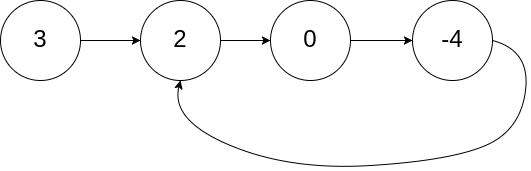
Example 2:
Input: head = [1,2], pos = 0

Output: tail connects to node index 0

Explanation: There is a cycle in the linked list, where tail connects to the first node.
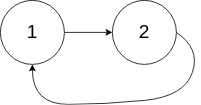
Example 3:
Input: head = [1], pos = -1

Output: no cycle

Explanation: There is no cycle in the linked list.
class Solution {

public:

    ListNode *detectCycle(ListNode *head) {

        if (!head) return NULL;

        ListNode *slow = head;

        ListNode *fast = head;

        bool HasCycle = false;

        while (fast->next != NULL && fast->next->next != NULL){

            slow = slow -> next;

            fast = fast -> next -> next;

            if (fast == slow){

                HasCycle = true;

                break;

            }

        }

        // 需要判断是否是有环的,若是有环,那么就

        if (HasCycle){

            // 若是有环,那么让fast 从头开始走,每次走一个结点。

            fast = head;

            while (slow != fast){

                fast = fast ->next;

                slow = slow ->next;

            }

            return fast;

        }

        return NULL;

    }

};
Leetcode 中Linked List Cycle 一类问题的更多相关文章
- [LeetCode] 141. Linked List Cycle 链表中的环
Given a linked list, determine if it has a cycle in it. Follow up:Can you solve it without using ext ...
- [LeetCode] 142. Linked List Cycle II 链表中的环 II
Given a linked list, return the node where the cycle begins. If there is no cycle, return null. Foll ...
- 【Leetcode】Linked List Cycle II
Given a linked list, return the node where the cycle begins. If there is no cycle, return null. Foll ...
- 【算法分析】如何理解快慢指针?判断linked list中是否有环、找到环的起始节点位置。以Leetcode 141. Linked List Cycle, 142. Linked List Cycle II 为例Python实现
引入 快慢指针经常用于链表(linked list)中环(Cycle)相关的问题.LeetCode中对应题目分别是: 141. Linked List Cycle 判断linked list中是否有环 ...
- [LeetCode] 142. Linked List Cycle II 单链表中的环之二
Given a linked list, return the node where the cycle begins. If there is no cycle, return null. To r ...
- [LeetCode] 141. Linked List Cycle 单链表中的环
Given a linked list, determine if it has a cycle in it. To represent a cycle in the given linked lis ...
- Java for LeetCode 142 Linked List Cycle II
Given a linked list, return the node where the cycle begins. If there is no cycle, return null. Foll ...
- (链表 双指针) leetcode 142. Linked List Cycle II
Given a linked list, return the node where the cycle begins. If there is no cycle, return null. To r ...
- [Leetcode Week6]Linked List Cycle II
Linked List Cycle II 题解 题目来源:https://leetcode.com/problems/linked-list-cycle-ii/description/ Descrip ...
随机推荐
- 【转】JSF中的三大核心组件 UI标签的详细介绍和使用举例
JSF提供了大量的UI标签来简化创建视图.这些UI标签类似于ASP.NET中的服务器组件.使用这些标签,可以通过其value,binding,action,actionListener等属性直接绑定到 ...
- BurpSuit添加CA证书拦截HTTPS通信
问题 BurpSuit 安装成功后可以直接使用代理对使用 HTTP 协议通信的会话进行拦截,但是对于使用 HTTPS 协议通信的会话进行代理使用时就会出现如下画面 例如访问百度主页: 原因 HTTPS ...
- mssql sql server上如何建一个只读视图–视图锁定的另类解决方案
转自:http://www.maomao365.com/?p=4508 <span style="color:red;font-weight:bold;">我们熟知一个 ...
- SQL Server "允许远程连接到此服务器" 配置
在SQL Server的属性-->连接中我们可以看到这样一个选项:'允许远程连接到此服务器'(英文是remote access),其默认值是1,表示此选项开启. 但是这个参数并非是字面上所显示的 ...
- Android内嵌PDF预览
一.在对应模块的build.gradle文件中加入依赖 dependencies { implementation 'com.github.barteksc:android-pdf-viewer:3. ...
- centOS7docker安装oracle
1.拉取oracle 11g 的镜像: 用root登陆服务器,输入下面的命令,拉取oracle 11g的镜像,有点大,6.8G多: docker pull registry.cn-hangzhou.a ...
- Microsoft .NET Framework 3.5 离线安装方法 (仅适用于Win8以上的系统)
所需工具:本系统对应原版镜像或Win8以上操作系统原版ISO镜像 操作: 1.利用Windows资源管理器挂载 ISO 镜像,或其他虚拟光驱工具挂载镜像,记住挂载的盘符 2.打开Windows命令提示 ...
- 【2018.04.27 C与C++基础】关于switch-case及if-else的效率问题
对于这个问题自己是比较清楚的,在分支比较多时,switch-case的效率肯定比if-else的要高许多,其原理类似于我们在优化某些程序时使用查表来代替算法计算一样. 如果想进一步深究的话,可以查看G ...
- 1. 路过面了个试就拿到2个offer。是运气吗?
路过随便面个试就拿到2个offer.是运气吗? #复习很重要#看看面试问的问题,再瞧瞧师兄的学习态度,你就明白 机会为何总与你擦肩而过了.[玫瑰] 以下是我和师兄的聊天记录,你会几个?
- js格式化输入框内金额、银行卡号[转]
这篇文章主要介绍了js格式化输入框内金额.银行卡号,采用“keyup”事件处理格式化,每4位数一组中间空格隔开,如何格式化输入框内金额.银行卡号,需要了解的朋友可以参考一下 我们在项目中经常遇到需要格 ...