
前端CSS3布局display:flex用法
前端CSS3布局display:flex用法
先附上代码
点击查看代码
<!DOCTYPE html>

<html>

  <head>

    <meta charset="utf-8">

    <title>display:flex</title>

    <style>

      .flex-box {

        background-color: aquamarine;

      }

      .flex-box>div {

        background-color: lightgray;

        width: 100px;

        height: 100px;

        text-align: center;

        border: 1px solid red;

      }

    </style>

  </head>

  <body>

    <div class="flex-box">

      <div>1</div>

      <div>2</div>

      <div>3</div>

      <div>4</div>

      <div>5</div>

      <div>6</div>

      <div>7</div>

      <div>8</div>

    </div>

  </body>

</html>
运行效果
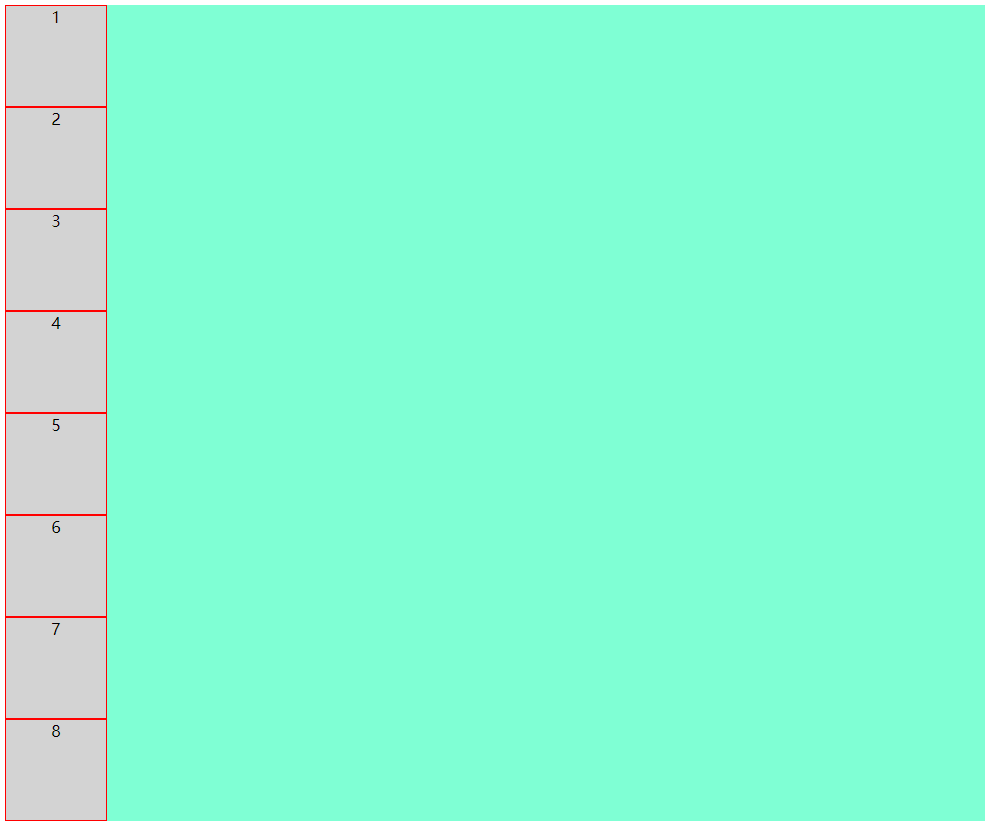
8个小方块呈纵向排列
好,接下来我们看看display:flex到底有哪些好处
先在flex-box中设置display:flex,看看效果
上代码
点击查看代码
.flex-box {

    background-color: aquamarine;

    display: flex;

}
效果图

仅仅设置了display: flex,8个小方块呈横向排列了
接下来详解flex布局的几个常用属性
flex-direction
flex-wrap
flex-flow
justify-content
align-items
1. flex-direction
该属性决定小方块按横向或纵向排列
(1):row(决定小方块横向排列,起点在左端)
上代码
点击查看代码
.flex-box {

    background-color: aquamarine;

    display: flex;

    flex-direction: row;

}
效果图

可以看到,样式并没有什么变化,这是因为row是flex-direction的默认排列方式
(2):row-reverse(决定小方块横向排列,起点在右端)
上代码
点击查看代码
.flex-box {

    background-color: aquamarine;

    display: flex;

    flex-direction: row-reverse;

}
效果图

(3):column(决定小方块纵向排列,起点在上端)
上代码
点击查看代码
.flex-box {

    background-color: aquamarine;

    display: flex;

    flex-direction: column;

}
效果图
(4):column-reverse(决定小方块纵向排列,起点在下端)
上代码
点击查看代码
.flex-box {

    background-color: aquamarine;

    display: flex;

    flex-direction: column-reverse;

}
效果图
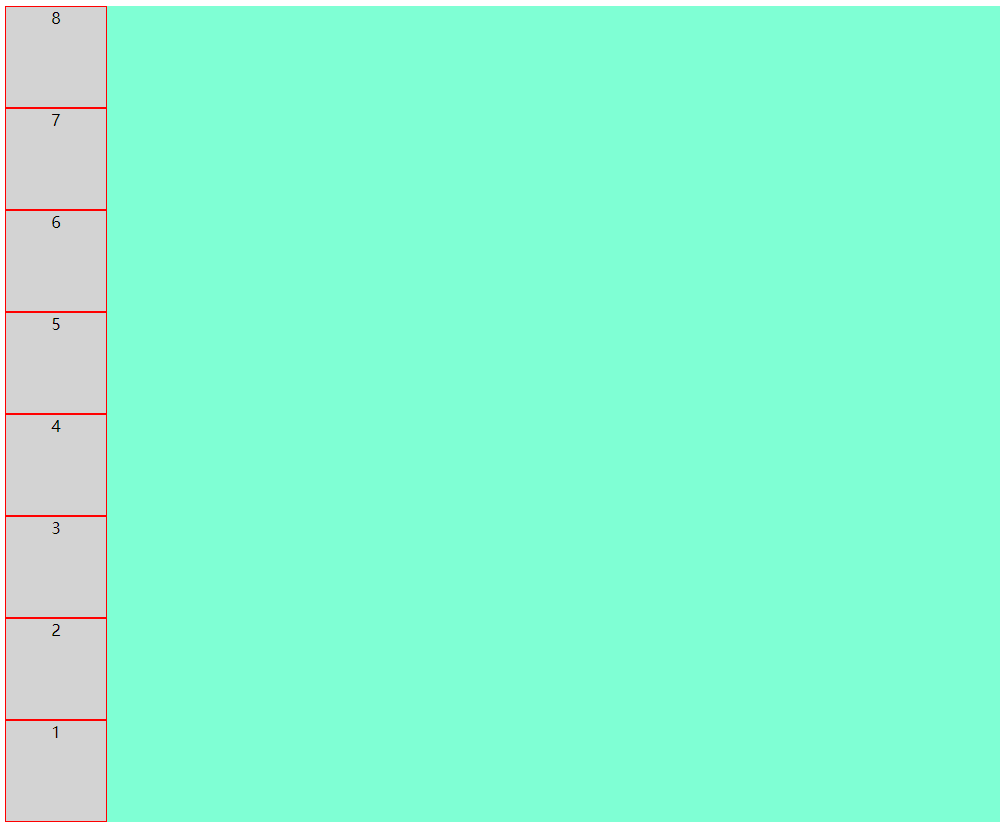
到此,flex-direction属性就讲完了
接下来讲解flex-wrap
2. flex-wrap
该属性决定小方块是否换行,默认不换行,内容会被挤压
(1):nowrap(决定小方块不换行,起点在上端,内容会被挤压)
上代码
点击查看代码
.flex-box {

    background-color: aquamarine;

    display: flex;

    flex-wrap: nowrap;

}
效果图

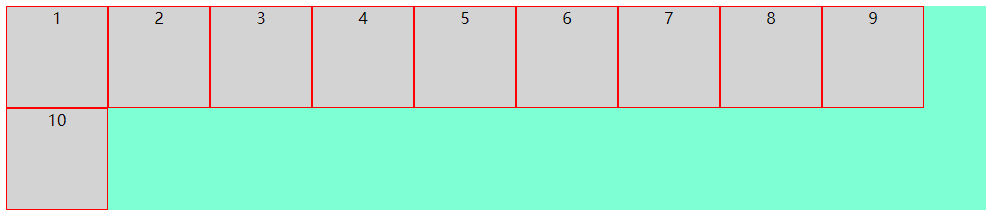
(2):wrap(决定小方块换行,起点在上端,内容不会被挤压,)
上代码
点击查看代码
.flex-box {

    background-color: aquamarine;

    display: flex;

    flex-wrap: wrap;

}
效果图
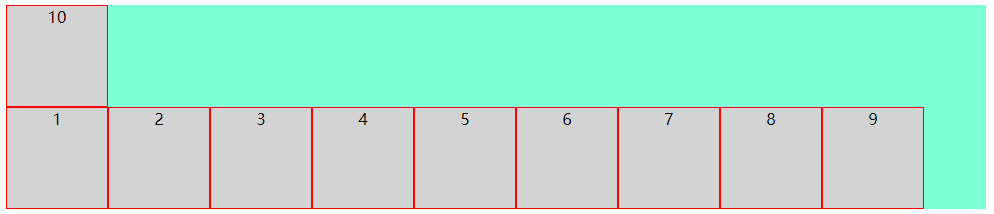
(3):wrap-reverse(决定小方块换行,起点在下端,内容不会被挤压,)
上代码
点击查看代码
.flex-box {

    background-color: aquamarine;

    display: flex;

    flex-wrap: wrap-reverse;

}
效果图
3. flex-flow
该属性是用于同时设置 flex-direction 和 flex-wrap 属性的简写属性
包含如下几种可能
row nowrap|wrap|wrap-reverse
row-reverse nowrap|wrap|wrap-reverse
column nowrap|wrap|wrap-reverse
column-reverse nowrap|wrap|wrap-reverse
由于可能太多了,下面只列举了一种,但小编试过了,所有的可能都是对的
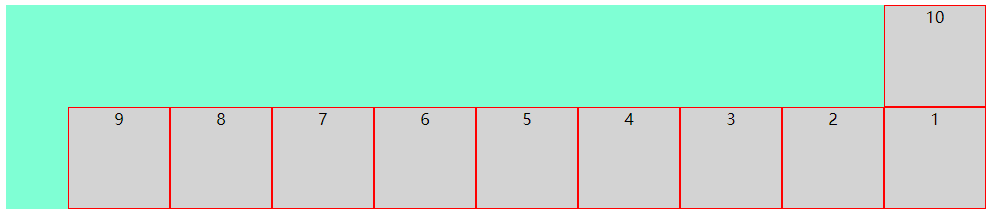
(1):row-reverse wrap-reverse(决定小方块呈横向排列且起点在右端,换行且起点在下端,内容不会被挤压)
上代码
点击查看代码
.flex-box {

    background-color: aquamarine;

    display: flex;

    flex-flow: row-reverse wrap-reverse;

}
效果图
4. justify-content
该属性决定小方块在纵轴上的对齐方式
(1):flex-start(决定小方块左对齐)
上代码
点击查看代码
.flex-box {

    background-color: aquamarine;

    display: flex;

    justify-content: flex-start;

}
效果图

(2):center(决定小方块中心对齐)
上代码
点击查看代码
.flex-box {

    background-color: aquamarine;

    display: flex;

    justify-content: center;

}
效果图

(3):flex-end(决定小方块右对齐)
上代码
点击查看代码
.flex-box {

    background-color: aquamarine;

    display: flex;

    justify-content: flex-end;

}
效果图

(4):space-around(决定小方块之间的间隔比小方块与边框的间隔大一倍)
上代码
点击查看代码
.flex-box {

    background-color: aquamarine;

    display: flex;

    justify-content: space-around;

}
效果图

(5):space-between(决定小方块两端对齐,小方块之间间隔相等)
上代码
点击查看代码
.flex-box {

    background-color: aquamarine;

    display: flex;

    justify-content: space-between;

}
效果图

(6):space-evenly(决定小方块之间的间隔相等)
上代码
点击查看代码
.flex-box {

    background-color: aquamarine;

    display: flex;

    justify-content: space-evenly;

}
效果图

5. align-items
该属性决定小方块在横轴上的对齐方式
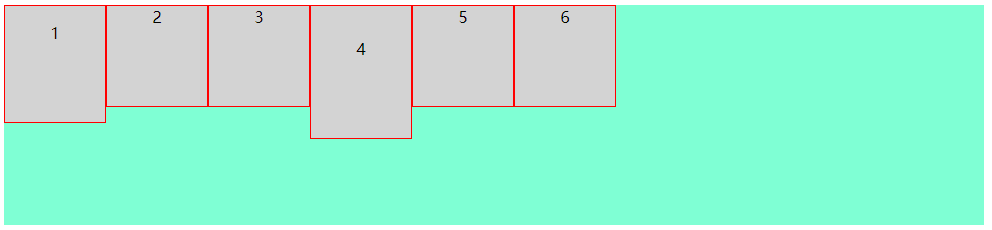
(1):flex-start(决定小方块上对齐)
上代码
点击查看代码
.flex-box {

    background-color: aquamarine;

    display: flex;

    align-items: flex-start;

}
效果图
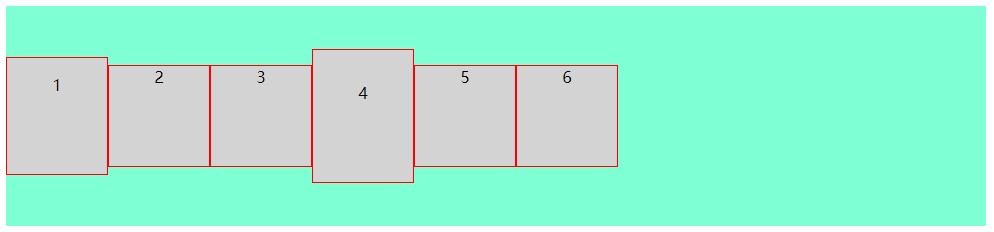
(2):center(决定小方块中心对齐)
上代码
点击查看代码
.flex-box {

    background-color: aquamarine;

    display: flex;

    align-items: center;

}
效果图
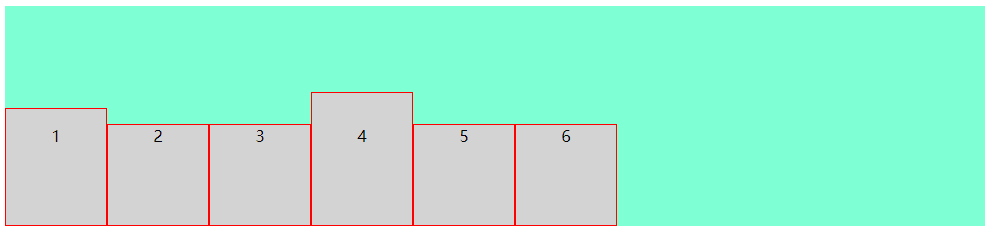
(3):flex-end(决定小方块下对齐)
上代码
点击查看代码
.flex-box {

    background-color: aquamarine;

    display: flex;

    align-items: flex-end;

}
效果图
(4):baseline(决定小方块第一行文字的基线对齐)
上代码
点击查看代码
.flex-box {

    background-color: aquamarine;

    display: flex;

    align-items: baseline;

}
效果图
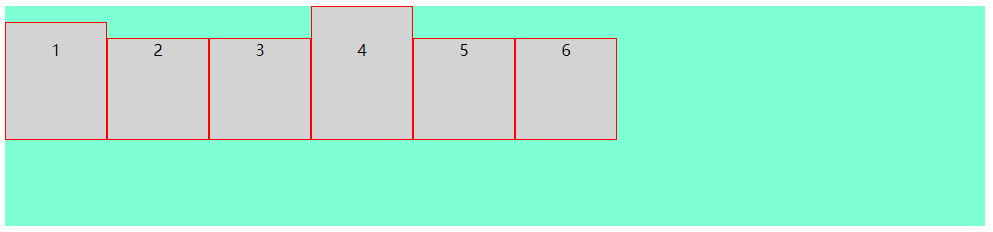
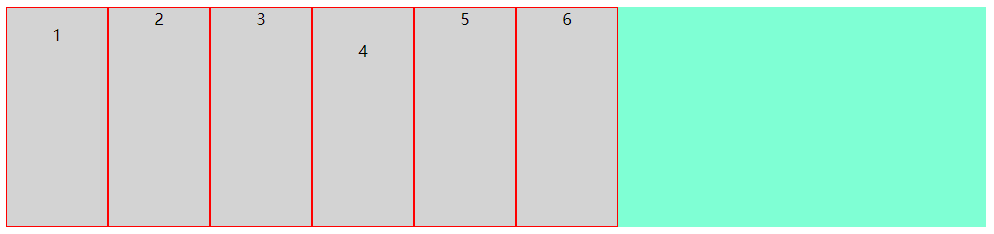
(5):stretch(决定小方块占满整个容器的高度)
注意:小方块的高度应不设置或设置为auto
上代码
点击查看代码
.flex-box {

    background-color: aquamarine;

    display: flex;

    align-items: stretch;

}
效果图
以上是容器的属性,接下来我们讲解小方块的属性
order
flex-grow
flex-shrink
flex-basis
flex
align-self
(1):order(决定小方块显示的顺序,默认为0)
注意:小方块order不设置或设置为0的优先级比设置为1的优先级高
注意:该值必须为数字
上代码
点击查看代码
<div class="flex-box">

  <div style="order: 1">1</div>

  <div style="order: 2">2</div>

  <div style="order: 0">3</div>

  <div>4</div>

  <div>5</div>

  <div>6</div>

</div>
效果图

(2):flex-grow(决定某个小方块相对于其它小方块将增长多少)
注意:该值必须为数字,数值越大,增长越多
上代码
点击查看代码
<div class="flex-box">

  <div style="flex-grow: 1">1</div>

  <div style="flex-grow: 2">2</div>

  <div style="flex-grow: 3">3</div>

  <div>4</div>

  <div>5</div>

  <div>6</div>

</div>
效果图

将窗口变长

(3):flex-shrink(决定某个小方块相对于其它小方块将收缩多少)
注意:该值必须为数字,数值越大,收缩越多
上代码
点击查看代码
<div class="flex-box">

  <div style="flex-shrink: 1">1</div>

  <div style="flex-shrink: 2">2</div>

  <div style="flex-shrink: 3">3</div>

  <div>4</div>

  <div>5</div>

  <div>6</div>

</div>
效果图

将窗口缩小
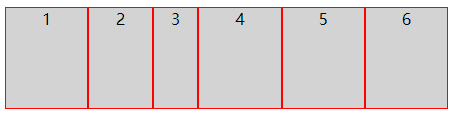
(4):flex-basis(决定某个小方块的初始长度)
上代码
点击查看代码
<div class="flex-box">

  <div style="flex-basis: 60px">1</div>

  <div style="flex-basis: 80px">2</div>

  <div style="flex-basis: 120px">3</div>

  <div>4</div>

  <div>5</div>

  <div>6</div>

</div>
效果图

(5):flex(flex-grow、flex-shrink 和 flex-basis 属性的简写属性)
上代码
点击查看代码
<div class="flex-box">

  <div>1</div>

  <div>2</div>

  <div style="flex: 0 0 200px">3</div>

  <div>4</div>

  <div>5</div>

  <div>6</div>

</div>
效果图

(6):align-self(决定某个小方块的对齐方式,将覆盖容器的 align-items 属性所设置的默认对齐方式)
上代码
点击查看代码
<div class="flex-box">

  <div style="align-self: flex-start; height: 60px;">1</div>

  <div style="align-self: center;  height: 80px;">2</div>

  <div style="align-self: flex-end;  height: 160px;">3</div>

  <div>4</div>

  <div>5</div>

  <div>6</div>

</div>
效果图

至此,display:flex的常用用法就讲完了
前端CSS3布局display:flex用法的更多相关文章
- 前端CSS3布局display:grid用法
前端CSS3布局display:flex用法 1. 先附上代码 点击查看代码 <!DOCTYPE html> <html> <head> <meta char ...
- CSS弹性盒布局(display:flex)
CSS弹性布局(display:flex) 参考: http://www.runoob.com/w3cnote/flex-grammar.html https://www.jianshu.com/p/ ...
- css3 伸缩布局 display:flex等
<!DOCTYPE html> <html lang="en"> <head> <meta charset="UTF-8&quo ...
- 弹性盒布局display:flex详解
一:弹性盒子 随着响应式设计的流行,网站开发者在设计网页布局时往往要考虑到页面在适配不同分辨率的浏览器时其内部组件位置大小都会产生变化,因此需要设计者根据窗口尺寸来调整布局,从而改变组件的尺寸和位置, ...
- css3布局属性flex
html代码如下: <ul class="ul_box"> <li><a href="#">html</a>&l ...
- css display:flex 属性
一:display:flex 布局 display:flex 是一种布局方式.它即可以应用于容器中,也可以应用于行内元素.是W3C提出的一种新的方案,可以简便.完整.响应式地实现各种页面布局.目前,它 ...
- CSS3:布局display属性的flex(弹性布局)
CSS3:布局display属性的flex(弹性布局) 一.简介 Flex是Flexible Box的缩写,意为"弹性布局",用来为盒状模型提供最大的灵活性.设为Flex布局以后, ...
- 浅谈CSS3中display属性的Flex布局
浅谈CSS3中display属性的Flex布局 最近在学习微信小程序,在设计首页布局的时候,新认识了一种布局方式display:flex 1 .container { 2 display: fle ...
- 【分享】谈CSS3中display属性的flex布局
最近在学习微信小程序(重新学习微信小程序),在设计首页布局的时候,新认识了一种布局方式display:flex .guide-top{ height: 36%; display: flex; /*fl ...
随机推荐
- TensorFlow使用GPU训练时CPU占用率100%而GPU占用率很低
在训练keras时,发现不使用GPU进行计算,而是采用CPU进行计算,导致计算速度很慢. 用如下代码可检测tensorflow的能使用设备情况: from tensorflow.python.clie ...
- xml中的<![CDATA[]]>和转义字符
被<![CDATA[]]>这个标记所包含的内容将表示为纯文本,比如<![CDATA[<]]>表示文本内容"<". 此标记用于xml文档中,我们先 ...
- DDD(Domain-Driven Design) 领域驱动设计
DDD(Domain-Driven Design) 领域驱动设计 1. DDD(Domain-Driven Design)是什么? DDD是Eric Evans在2003年出版的<领域驱动设计: ...
- 『忘了再学』Shell基础 — 9、Bash中的特殊符号(一)
目录 1.双单引号 2.双引号 3.$符号 4.反引号 5.$()符号 6.#符号 7.\符号 1.双单引号 '':单引号.在单引号中所有的特殊符号,如$和"`"(反引号)都没有特 ...
- gin框架使用【2.RESTFUL API使用】
package mainimport ( "github.com/gin-gonic/gin")func main() { router := gin.Default() rout ...
- SVG 和 CSS3 实现一个超酷爱心 Like 按钮
在现代网页中,我们经常可以在一些文章.视频和图片页面上找到"Like"按钮,并且通过点击该按钮来表示自己对该内容的喜欢或者不喜欢.大部分"Like"按钮是纯文本 ...
- 2021.08.05 P7095 不离【扶咕咕出题】(贪心)
2021.08.05 P7095 不离[扶咕咕出题](贪心) [P7095 yLOI2020] 不离 - 洛谷 | 计算机科学教育新生态 (luogu.com.cn) 题意: 游戏中人物有两个属性,我 ...
- docker入门_docker安装
docker入门_docker安装 ubuntu 安装 curl -sSL https://get.daocloud.io/docker | sh # 官方安装脚本自动安装 systemctl ena ...
- 邮件html页编写指南
前言 写过邮件的html一般都用table来布局,为什么呢?原因是大多数的邮件客户端(比如Outlook和Gmail),会过滤经过多次的邮件编写实践及度娘的指导,我发现,编写自制兼容outlook与f ...
- python基础练习题(题目 猴子吃桃问题:猴子第一天摘下若干个桃子,当即吃了一半,还不瘾,又多吃了一个第二天早上又将剩下的桃子吃掉一半,又多吃了一个。以后每天早上都吃了前一天剩下的一半零一个。到第10天早上想再吃时,见只剩下一个桃子了。求第一天共摘了多少)
day13 --------------------------------------------------------------- 实例021:猴子偷桃 题目 猴子吃桃问题:猴子第一天摘下若干 ...