
FreeRTOS --(6)内存管理 heap5
转载自https://blog.csdn.net/zhoutaopower/article/details/106748308
FreeRTOS 中的 heap 5 内存管理,相对于 heap 4《FreeRTOS --(5)内存管理 heap4》 只增加了对非连续内存区域的管理,什么叫非连续区域内存呢?比如一款芯片,它即支持了内部的 RAM,也支持了外挂 RAM,那么这两个内存就可能在地址上不是连续的,比如 RAM1、RAM2、RAM3,如下所示:
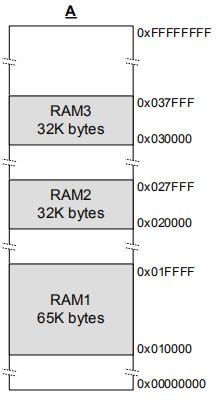
针对这种情况,就可以使用 heap 5 来管理;
不同于之前的 heap 管理,heap 5 引入了一个结构体来管理这些非连续的区域:
typedef struct HeapRegion

{

 /* The start address of a block of memory that will be part of the heap.*/

 uint8_t *pucStartAddress;

 /* The size of the block of memory in bytes. */

 size_t xSizeInBytes;

} HeapRegion_t;
一个块连续的内存用一个 HeapRegion_t 表示,多个连续内存通过 HeapRegion_t 数组的形式组织成为了所有的内存;
heap 5 要求,在调用正式的内存分配函数之前,需要定义 HeapRegion,并调用 vPortDefineHeapRegions 来初始化它;
官方给了一个 demo:
/* Define the start address and size of the three RAM regions. */

#define RAM1_START_ADDRESS ( ( uint8_t * ) 0x00010000 )

#define RAM1_SIZE ( 65 * 1024 )

#define RAM2_START_ADDRESS ( ( uint8_t * ) 0x00020000 )

#define RAM2_SIZE ( 32 * 1024 )

#define RAM3_START_ADDRESS ( ( uint8_t * ) 0x00030000 )

#define RAM3_SIZE ( 32 * 1024 )

/* Create an array of HeapRegion_t definitions, with an index for each of the three

RAM regions, and terminating the array with a NULL address. The HeapRegion_t

structures must appear in start address order, with the structure that contains the

lowest start address appearing first. */

const HeapRegion_t xHeapRegions[] =

{

    { RAM1_START_ADDRESS, RAM1_SIZE },

    { RAM2_START_ADDRESS, RAM2_SIZE },

    { RAM3_START_ADDRESS, RAM3_SIZE },

    { NULL, 0 } /* Marks the end of the array. */

};

int main( void ) {

    /* Initialize heap_5. */

    vPortDefineHeapRegions( xHeapRegions );

    /* Add application code here. */

}
如果有 3 个 RAM 区域的话,那么这样去定义他们;
需要注意的几点是:
1、定义 HeapRegion_t 数组的时候,最后一定要定义成为 NULL 和 0,这样接口才知道这是终点;
2、被定义的 RAM 区域,都会去参与内存管理;
那么问题就来了,在真实使用的时候,有可能你很难去定义部分 RAM 的 Start Address!
比如,一款芯片,它告诉你,它的第一块 RAM 有 64KB,第二块 RAM 有 32KB,第三块 RAM 有 32KB,那么你显然不能够直接将这些内存信息,按照上面 demo 代码的形式,定义到这个表格中,因为在编译阶段,有可能你相关的代码和数据等等(.text,.data,.bss,等)都会占用一部分的 RAM,但凡是定义到这个 HeapRegion_t 数组表格的,都会参与内存管理的行为,这显然是我们不愿意的;
也就是说,比如你芯片的 RAM 起始地址 0x2000_0000,你编译你的 Source Code 后,相关的代码和数据要占用 20KB,也就是 0x5000;那么你定义的 RAM1_START_ADDRESS 起始地址,就必须要大于 0x2000_0000+0x5000,这样才不会踩到你的其他数据;但是呢?你总不可能每次编译完都去改你的这个表吧?这是很痛苦的事情;
所有考虑到实际的使用,官方给出参考 demo 的方法是:
/* Define the start address and size of the two RAM regions not used by the

linker. */

#define RAM2_START_ADDRESS ( ( uint8_t * ) 0x00020000 )

#define RAM2_SIZE ( 32 * 1024 )

#define RAM3_START_ADDRESS ( ( uint8_t * ) 0x00030000 )

#define RAM3_SIZE ( 32 * 1024 )

/* Declare an array that will be part of the heap used by heap_5. The array will be

placed in RAM1 by the linker. */

#define RAM1_HEAP_SIZE ( 30 * 1024 )

static uint8_t ucHeap[ RAM1_HEAP_SIZE ];

/* Create an array of HeapRegion_t definitions. Whereas in Listing 6 the first entry

described all of RAM1, so heap_5 will have used all of RAM1, this time the first

entry only describes the ucHeap array, so heap_5 will only use the part of RAM1 that

contains the ucHeap array. The HeapRegion_t structures must still appear in start

address order, with the structure that contains the lowest start address appearing

first. */

const HeapRegion_t xHeapRegions[] =

{

    { ucHeap, RAM1_HEAP_SIZE },

    { RAM2_START_ADDRESS, RAM2_SIZE },

    { RAM3_START_ADDRESS, RAM3_SIZE },

    { NULL, 0 } /* Marks the end of the array. */

};
即,将链接的代码数据,根据链接器(Linker)配置后,这些都放置在第一段的区域,ucHeap 也放在一样的地方,这样就避免去根据 map 文件去硬编码这个表格;
通过 beyond compare 可以知道,heap 5 和 heap 4 的代码在分配内存的 pvPortMalloc,和释放内存的 vPortFree,以及插入节点合并空闲内存 prvInsertBlockIntoFreeList 的部分,几乎完全一样,唯一不一样的地方在于:
heap 4 的内存初始化用的是 prvHeapInit
heap 5 的内存初始化用的是 vPortDefineHeapRegions
那我们就来看看这个 vPortDefineHeapRegions 的实现:
void vPortDefineHeapRegions( const HeapRegion_t * const pxHeapRegions )

{

BlockLink_t *pxFirstFreeBlockInRegion = NULL, *pxPreviousFreeBlock;

size_t xAlignedHeap;

size_t xTotalRegionSize, xTotalHeapSize = 0;

BaseType_t xDefinedRegions = 0;

size_t xAddress;

const HeapRegion_t *pxHeapRegion;

    /* Can only call once! */

    configASSERT( pxEnd == NULL );

    pxHeapRegion = &( pxHeapRegions[ xDefinedRegions ] );

    while( pxHeapRegion->xSizeInBytes > 0 )

    {

        xTotalRegionSize = pxHeapRegion->xSizeInBytes;

        /* Ensure the heap region starts on a correctly aligned boundary. */

        xAddress = ( size_t ) pxHeapRegion->pucStartAddress;

        if( ( xAddress & portBYTE_ALIGNMENT_MASK ) != 0 )

        {

            xAddress += ( portBYTE_ALIGNMENT - 1 );

            xAddress &= ~portBYTE_ALIGNMENT_MASK;

            /* Adjust the size for the bytes lost to alignment. */

            xTotalRegionSize -= xAddress - ( size_t ) pxHeapRegion->pucStartAddress;

        }

        xAlignedHeap = xAddress;

        /* Set xStart if it has not already been set. */

        if( xDefinedRegions == 0 )

        {

            /* xStart is used to hold a pointer to the first item in the list of

            free blocks.  The void cast is used to prevent compiler warnings. */

            xStart.pxNextFreeBlock = ( BlockLink_t * ) xAlignedHeap;

            xStart.xBlockSize = ( size_t ) 0;

        }

        else

        {

            /* Should only get here if one region has already been added to the

            heap. */

            configASSERT( pxEnd != NULL );

            /* Check blocks are passed in with increasing start addresses. */

            configASSERT( xAddress > ( size_t ) pxEnd );

        }

        /* Remember the location of the end marker in the previous region, if

        any. */

        pxPreviousFreeBlock = pxEnd;

        /* pxEnd is used to mark the end of the list of free blocks and is

        inserted at the end of the region space. */

        xAddress = xAlignedHeap + xTotalRegionSize;

        xAddress -= xHeapStructSize;

        xAddress &= ~portBYTE_ALIGNMENT_MASK;

        pxEnd = ( BlockLink_t * ) xAddress;

        pxEnd->xBlockSize = 0;

        pxEnd->pxNextFreeBlock = NULL;

        /* To start with there is a single free block in this region that is

        sized to take up the entire heap region minus the space taken by the

        free block structure. */

        pxFirstFreeBlockInRegion = ( BlockLink_t * ) xAlignedHeap;

        pxFirstFreeBlockInRegion->xBlockSize = xAddress - ( size_t ) pxFirstFreeBlockInRegion;

        pxFirstFreeBlockInRegion->pxNextFreeBlock = pxEnd;

        /* If this is not the first region that makes up the entire heap space

        then link the previous region to this region. */

        if( pxPreviousFreeBlock != NULL )

        {

            pxPreviousFreeBlock->pxNextFreeBlock = pxFirstFreeBlockInRegion;

        }

        xTotalHeapSize += pxFirstFreeBlockInRegion->xBlockSize;

        /* Move onto the next HeapRegion_t structure. */

        xDefinedRegions++;

        pxHeapRegion = &( pxHeapRegions[ xDefinedRegions ] );

    }

    xMinimumEverFreeBytesRemaining = xTotalHeapSize;

    xFreeBytesRemaining = xTotalHeapSize;

    /* Check something was actually defined before it is accessed. */

    configASSERT( xTotalHeapSize );

    /* Work out the position of the top bit in a size_t variable. */

    xBlockAllocatedBit = ( ( size_t ) 1 ) << ( ( sizeof( size_t ) * heapBITS_PER_BYTE ) - 1 );

}
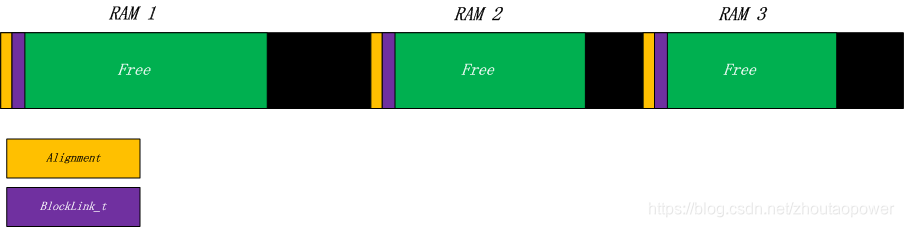
经过一些对齐操作,将 demo 中的 3 块内存通过链表的方式挂接起来了,只不过内存地址不连续而已,但是对于连续的内存地址中,照样在释放的时候,可以进行合并操作;
FreeRTOS --(6)内存管理 heap5的更多相关文章
- 轻量级操作系统FreeRTOS的内存管理机制(一)
本文由嵌入式企鹅圈原创团队成员朱衡德(Hunter_Zhu)供稿. 近几年来,FreeRTOS在嵌入式操作系统排行榜中一直位居前列,作为开源的嵌入式操作系统之一,它支持许多不同架构的处理器以及多种编译 ...
- FreeRTOS 动态内存管理
以下转载自安富莱电子: http://forum.armfly.com/forum.php 本章节为大家讲解 FreeRTOS 动态内存管理,动态内存管理是 FreeRTOS 非常重要的一项功能,前面 ...
- FreeRTOS的内存管理
FreeRTOS提供了几个内存堆管理方案,有复杂的也有简单的.其中最简单的管理策略也能满足很多应用的要求,比如对安全要求高的应用,这些应用根本不允许动态内存分配的. FreeRTOS也允许你自己实现内 ...
- freertos之内存管理
任务.信号量.邮箱才调度器开始调度之前就应该创建,所以它不可能像裸奔程序那样的函数调用能确定需要多少内存资源,RTOS提供了3种内存管理的方法: 1 方法一:确定性好适合于任务.信号量.队列都不被删除 ...
- FreeRTOS内存管理
简介 Freertos的内存管理分别在heap_1.c,heap_2.c,heap_3.c,heap_4.c,heap_5.c个文件中,选择合适的一种应用于嵌入式项目中即可. 本文的图片中 红色部分B ...
- FreeRTOS --(3)内存管理 heap2
在<FreeRTOS --(2)内存管理 heap1>知道 heap 1 的内存管理其实只是简单的实现了内存对齐的分配策略,heap 2 的实现策略相比 heap 1 稍微复杂一点,不仅仅 ...
- FreeRTOS --(2)内存管理 heap1
转载自https://blog.csdn.net/zhoutaopower/article/details/106631237 FreeRTOS 提供了5种内存堆管理方案,分别对应heap1/heap ...
- FreeRTOS --(5)内存管理 heap4
FreeRTOS 中的 heap 4 内存管理,可以算是 heap 2 的增强版本,在 <FreeRTOS --(3)内存管理 heap2>中,我们可以看到,每次内存分配后都会产生一个内存 ...
- FreeRTOS--堆内存管理
因为项目需要,最近开始学习FreeRTOS,一开始有些紧张,因为两个星期之前对于FreeRTOS的熟悉度几乎为零,经过对FreeRTOS官网的例子程序的摸索,和项目中问题的解决,遇到了很多熟悉的身影, ...
随机推荐
- SpringBoot:自定义注解实现后台接收Json参数
0.需求 在实际的开发过程中,服务间调用一般使用Json传参的模式,SpringBoot项目无法使用@RequestParam接收Json传参 只有@RequestBody支持Json,但是每次为了一 ...
- JavaScript中call如何使用?
一句话概括:call是函数才能调用的方法.作用是改变属性环境.有点绕,举个例子. 此处代码是在window环境下声明的变量和函数. var name='王延朋'; var age=18; var ex ...
- docker-compose配置django web项目容器和EMQX容器
1.Dockerfile FROM gatewayserver_null:v1.1 ADD ./GatewayServer /code ADD ./entrypoint.sh /code# 给entr ...
- 怎样在方法里面得到Request,或者Session?
直接在方法的形参中声明request,SpringMvc就自动把request对象传入.
- String 和 StringBuilder、StringBuffer 的区别?
Java 平台提供了两种类型的字符串:String 和 StringBuffer/StringBuilder,它 们可以储存和操作字符串.其中 String 是只读字符串,也就意味着 String 引 ...
- idea推送项目到github
参考: https://blog.csdn.net/SoWhatWorld/article/details/103817786?depth_1-utm_source=distribute.pc_rel ...
- weevely使用小结
Weevely 写在前面 由于比赛不确定会不会提供菜刀或者蚁剑,这里我稍微对weevely进行简单介绍一下,具体还是请看官方文档,官方文档讲的很详细(前提你英语嘚不错) 官方文档:https://gi ...
- ASP.NET WebAPI解决跨域问题
跨域是个很蛋疼的问题...随笔记录一下... 一.安装nuget包:Microsoft.AspNet.WebApi.Core 二.在Application_Start方法中启用跨域 1 protect ...
- Supervisor学习笔记
请点击我 > supervisor笔记
- [强网杯2019]upload buuoj
提示:重点在这,可节省大部分时间 扫描后台 发现www.tar.gz备份文件. 这平台有429[太多请求限制]防护.dirsearch扫描一堆429.于是用了最笨的方法. 文件上传 先注册个账号 注册 ...