
POJ:2632-Crashing Robots
Crashing Robots
Time Limit: 1000MS Memory Limit: 65536K
Description
In a modernized warehouse, robots are used to fetch the goods. Careful planning is needed to ensure that the robots reach their destinations without crashing into each other. Of course, all warehouses are rectangular, and all robots occupy a circular floor space with a diameter of 1 meter. Assume there are N robots, numbered from 1 through N. You will get to know the position and orientation of each robot, and all the instructions, which are carefully (and mindlessly) followed by the robots. Instructions are processed in the order they come. No two robots move simultaneously; a robot always completes its move before the next one starts moving.
A robot crashes with a wall if it attempts to move outside the area of the warehouse, and two robots crash with each other if they ever try to occupy the same spot.
Input
The first line of input is K, the number of test cases. Each test case starts with one line consisting of two integers, 1 <= A, B <= 100, giving the size of the warehouse in meters. A is the length in the EW-direction, and B in the NS-direction.
The second line contains two integers, 1 <= N, M <= 100, denoting the numbers of robots and instructions respectively.
Then follow N lines with two integers, 1 <= Xi <= A, 1 <= Yi <= B and one letter (N, S, E or W), giving the starting position and direction of each robot, in order from 1 through N. No two robots start at the same position.
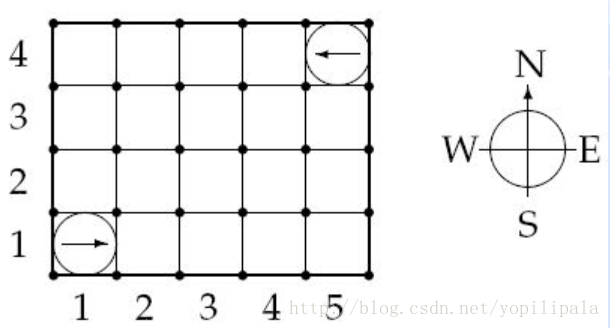
Figure 1: The starting positions of the robots in the sample warehouse
Finally there are M lines, giving the instructions in sequential order.
An instruction has the following format:
< robot #> < action> < repeat>
Where is one of
L: turn left 90 degrees,
R: turn right 90 degrees, or
F: move forward one meter,
and 1 <= < repeat> <= 100 is the number of times the robot should perform this single move.
Output
Output one line for each test case:
Robot i crashes into the wall, if robot i crashes into a wall. (A robot crashes into a wall if Xi = 0, Xi = A + 1, Yi = 0 or Yi = B + 1.)
Robot i crashes into robot j, if robots i and j crash, and i is the moving robot.
OK, if no crashing occurs.
Only the first crash is to be reported.
Sample Input
4
5 4
2 2
1 1 E
5 4 W
1 F 7
2 F 7
5 4
2 4
1 1 E
5 4 W
1 F 3
2 F 1
1 L 1
1 F 3
5 4
2 2
1 1 E
5 4 W
1 L 96
1 F 2
5 4
2 3
1 1 E
5 4 W
1 F 4
1 L 1
1 F 20
Sample Output
Robot 1 crashes into the wall
Robot 1 crashes into robot 2
OK
Robot 1 crashes into robot 2
题意就是给你一个图里面有很多机器人,每个机器人可以自身向左转或者右转(90度)或者向前走每个动作重复k次。输出机器人第一次撞到墙或者第一次撞到其他的机器人(机器人按照指令依次执行)。只输出第一次撞击,之后的不管。
真的是反向建图日神仙,本来就是东西南北傻傻分不清,xy还反着输入,图的行列也是反着的。对于方向感不强的人来说简直是折磨啊。其实只要弄清楚方向,这个题很简单就可以过了。
#include<stdio.h>
#include<cstring>
using namespace std;
struct roob
{
int x,y;
char dir[10];
} r[110];
bool r_pos[310][310];//标记图中机器人的位置
char Dir[10]= "0NESW";//用来计算机器人的转向
int n,m,x,y;
void init()
{
memset(r_pos,0,sizeof(r_pos));
scanf("%d%d",&y,&x);//xy反着输入的
scanf("%d%d",&n,&m);
for(int i=1; i<=n; i++)
{
scanf("%d%d%s",&r[i].y,&r[i].x,&r[i].dir);
r_pos[r[i].x][r[i].y] = true;
}
}
bool check(int w,int times)//机器人w向前走times步
{
roob now = r[w];
int x1 = now.x;
int y1 = now.y;
r_pos[x1][y1] = false;//走了之后记得取消标记
if(now.dir[0] == 'N')
{
for(int i=1; i<=times; i++)
{
int x2 = x1+i;
if(r_pos[x2][y1])
{
for(int i=1; i<=n; i++)
if(r[i].x == x2 && r[i].y == y1)
{
printf("Robot %d crashes into robot %d\n",w,i);
return true;
}
}
}
x1 += times;
}
else if(now.dir[0] == 'S')
{
for(int i=1; i<=times; i++)
{
int x2 = x1-i;
if(r_pos[x2][y1])
{
for(int i=1; i<=n; i++)
if(r[i].x == x2 && r[i].y == y1)
{
printf("Robot %d crashes into robot %d\n",w,i);
return true;
}
}
}
x1 -= times;
}
else if(now.dir[0] == 'E')
{
for(int i=1; i<=times; i++)
{
int y2 = y1+i;
if(r_pos[x1][y2])
{
for(int i=1; i<=n; i++)
if(r[i].x == x1 && r[i].y == y2)
{
printf("Robot %d crashes into robot %d\n",w,i);
return true;
}
}
}
y1 += times;
}
else if(now.dir[0] == 'W')
{
for(int i=1; i<=times; i++)
{
int y2 = y1-i;
if(y2 < 1)
continue;
if(r_pos[x1][y2])
{
for(int i=1; i<=n; i++)
if(r[i].x == x1 && r[i].y == y2)
{
printf("Robot %d crashes into robot %d\n",w,i);
return true;
}
}
}
y1 -= times;
}
if(x1<1 || y1<1 || x1>x || y1>y)//走到地图外面去了
{
printf("Robot %d crashes into the wall\n",w);
return true;
}
r_pos[x1][y1] = true;//到达新的地点被标记
r[w].x = x1;
r[w].y = y1;
return false;
}
void solve()
{
bool flag = false;//标记是否发生第一次撞击
while(m--)
{
int w,times;
char d[10];
scanf("%d%s%d",&w,d,×);
if(flag)//发生第一次撞击之后都不用管了
continue;
int temp2;
if(r[w].dir[0] == 'N')
temp2 = 1;
else if(r[w].dir[0] == 'E')
temp2 = 2;
else if(r[w].dir[0] == 'S')
temp2 = 3;
else if(r[w].dir[0] == 'W')
temp2 = 4;
if(d[0] == 'F')
flag = check(w,times);
else if(d[0] == 'L')//向左转的计算
{
times %= 4;
temp2 -= times;
if(temp2 < 1)
temp2 += 4;
r[w].dir[0] = Dir[temp2];
}
else if(d[0] == 'R')//向右转的计算
{
times %= 4;
temp2 += times;
if(temp2 > 4)
temp2 %= 4;
r[w].dir[0] = Dir[temp2];
}
}
if(!flag)
printf("OK\n");
}
int main()
{
int t;
scanf("%d",&t);
while(t--)
{
init();
solve();
}
return 0;
}POJ:2632-Crashing Robots的更多相关文章
- 模拟 POJ 2632 Crashing Robots
题目地址:http://poj.org/problem?id=2632 /* 题意:几个机器人按照指示,逐个朝某个(指定)方向的直走,如果走过的路上有机器人则输出谁撞到:如果走出界了,输出谁出界 如果 ...
- Poj OpenJudge 百练 2632 Crashing Robots
1.Link: http://poj.org/problem?id=2632 http://bailian.openjudge.cn/practice/2632/ 2.Content: Crashin ...
- POJ 2632 Crashing Robots (坑爹的模拟题)
Crashing Robots Time Limit: 1000MS Memory Limit: 65536K Total Submissions: 6599 Accepted: 2854 D ...
- poj 2632 Crashing Robots
点击打开链接 Crashing Robots Time Limit: 1000MS Memory Limit: 65536K Total Submissions: 6655 Accepted: ...
- POJ 2632 Crashing Robots(较为繁琐的模拟)
题目链接:http://poj.org/problem?id=2632 题目大意:题意简单,N个机器人在一个A*B的网格上运动,告诉你机器人的起始位置和对它的具体操作,输出结果: 1.Robot i ...
- poj 2632 Crashing Robots(模拟)
链接:poj 2632 题意:在n*m的房间有num个机器,它们的坐标和方向已知,现给定一些指令及机器k运行的次数, L代表机器方向向左旋转90°,R代表机器方向向右旋转90°,F表示前进,每次前进一 ...
- poj 2632 Crashing Robots 模拟
题目链接: http://poj.org/problem?id=2632 题目描述: 有一个B*A的厂库,分布了n个机器人,机器人编号1~n.我们知道刚开始时全部机器人的位置和朝向,我们可以按顺序操控 ...
- POJ 2632 Crashing Robots (模拟 坐标调整)(fflush导致RE)
题目链接:http://poj.org/problem?id=2632 先话说昨天顺利1Y之后,直到今天下午才再出题 TAT,真是刷题计划深似海,从此AC是路人- - 本来2632是道略微恶心点的模拟 ...
- POJ 2632 Crashing Robots 模拟 难度:0
http://poj.org/problem?id=2632 #include<cstdio> #include <cstring> #include <algorith ...
- POJ 2632:Crashing Robots
Crashing Robots Time Limit: 1000MS Memory Limit: 65536K Total Submissions: 8424 Accepted: 3648 D ...
随机推荐
- HttpListener Start 拒绝访问
HttpListener Start 拒绝访问 以管理员权限运行cmd 输入: netsh http add urlacl url=http://127.0.0.1:8080/ user=HuQing
- 构造方法,this,super,final,static
1构造方法 一个Person类,属性都被private了,外界无法直接访问属性,必须对外提供相应的set和get方法.但如果需要在创建对象的同时明确对象的属性值,就需要构造方法了. 1.1定义 构建创 ...
- ios 12 xcode10 新升级的编译报错libstdc++.6.0.9 Multiple commands produce
问题一 编译报错 Showing Recent Messages :-1: Multiple commands produce '/Users/duning/Library/Developer/Xco ...
- iOS优化
load妙用 aop面向切面编程 NSNumber Or Int @()适配64位 经过漫长时间的学习 你终于掌握了iOS大法 你找到了份iOS开发的工作 信誓旦旦的要开始你的coding生涯 老板对 ...
- 【虚拟机-磁盘管理】理解及快速测定 Azure 虚拟机的磁盘性能
随着越来越多的用户将生产系统迁移到 Azure 平台的虚拟机服务中,Azure 虚拟机的性能愈发被关注.传统的数据中心中,我们通常使用 CPU,内存,存储和网络的性能来衡量生产压力.特别是对于 IO ...
- JDBC + SAP云平台 = 运行在云端的数据库应用
在前一篇文章JPA + EclipseLink + SAP云平台 = 运行在云端的数据库应用我介绍了如何通过JPA和EclipseLink操作部署在SAP云平台上的HANA数据库实例. 在这篇文章里, ...
- ASUS主板 Type C 接口无效问题
修改UEFI设置,把 USB TYPE C POWER SWITCH 改成启用
- HDU 5095 Linearization of the kernel functions in SVM (坑水)
比较坑的水题,首项前面的符号,-1,+1,只有数字项的时候要输出0. 感受一下这些数据 160 0 0 0 0 0 0 0 0 -10 0 0 0 0 0 0 0 0 10 0 0 0 0 0 0 0 ...
- [web开发] 利用微信小程序开发上海大学失物招领平台
我从开始学微信小程序到最后完全写完这个小程序耗时四天,可以说开发难度非常之低,门槛也非常低,之前从来没接触过微信小程序,重新写下开发记录. 先放图: 1.前端开发 前端我用到了iview的ui框架,因 ...
- ACM博弈论基础
博弈论的题目有如下特点: 有两名选手 两名选手交替操作,每次一步,每步都在有限的合法集合中选取一种进行 在任何情况下,合法操作只取决于情况本身,与选手无关 游戏败北的条件为:当某位选手需要进行操作时, ...