
typeof, offsetof 和container_of
要理解Linux中实现的双向循环链表("侵入式"链表),首先得弄明白宏container_of。 本文尝试从gcc的关键字typeof和宏offsetof入手,循序渐进地剖析宏container_of之实现原理。
1. typeof (from: https://en.wikipedia.org/wiki/Typeof)
typeof is an operator provided by several programming languages to

determine the data type of a variable. This is useful when

constructing programs that must accept multiple types of data

without explicitly specifying the type.

The GNU compiler (GCC) extensions for the C programming language provide

typeof:

#define max(a, b) \

       ({ typeof (a) _a = (a); \

          typeof (b) _b = (b); \

         _a > _b ? _a : _b; })
typeof和sizeof一样,都是关键字。只不过typeof不是标准的c语言关键字,而是gcc支持的(扩展)关键字。 typeof的作用是取得某个变量的数据类型。例如:
unsigned int a = ; // typeof (a) is unsigned int

short b = ;        // typeof (b) is short
2. offsetof (from: include/linux/stddef.h)
#define offsetof(TYPE, MEMBER) ((size_t)&((TYPE *)0)->MEMBER)
宏offsetof的作用是获取某个成员变量(MEMBER)在其所在的结构体(TYPE)里的偏移。 上面的宏实现得非常巧妙(如果你正好也熟悉汇编,一定会英雄所见略同),剖析如下:
() P = (TYPE *)  // 将地址0x0强制转化为类型为TYPE的结构体X的首地址

() M = P->MEMBER  // 访问X的成员变量MEMBER

() A = &M         // 取得X的成员变量MEMBER的内存地址

() O = (size_t)A  // 将成员变量MEMBER的内存地址强制转换成偏移量(Offset),

      = (size_t)&M // 由于内存地址也是无符号整数,所以MEMBER相对于结构体X首地址的偏移Offset等于&M

      = (size_t)&(P->MEMBER) = (size_t)&P->MEMBER  // 注意: -> 比 & 优先级高

      = (size_t)&(P)->MEMBER = (size_t)&((TYPE *))->MEMBER
为了理解更容易一些,不妨(多加几重括号)将宏offsetof定义为:
#define offsetof(TYPE, MEMBER) ((size_t)(&(((TYPE *)0)->MEMBER)))
进而,用图解析如下: (此图为本人原创,如需转载请注明出处)

3. container_of (from: include/linux/kernel.h)
 /**

  * container_of - cast a member of a structure out to the containing structure

  * @ptr:        the pointer to the member.

  * @type:       the type of the container struct this is embedded in.

  * @member:     the name of the member within the struct.

  *

  */

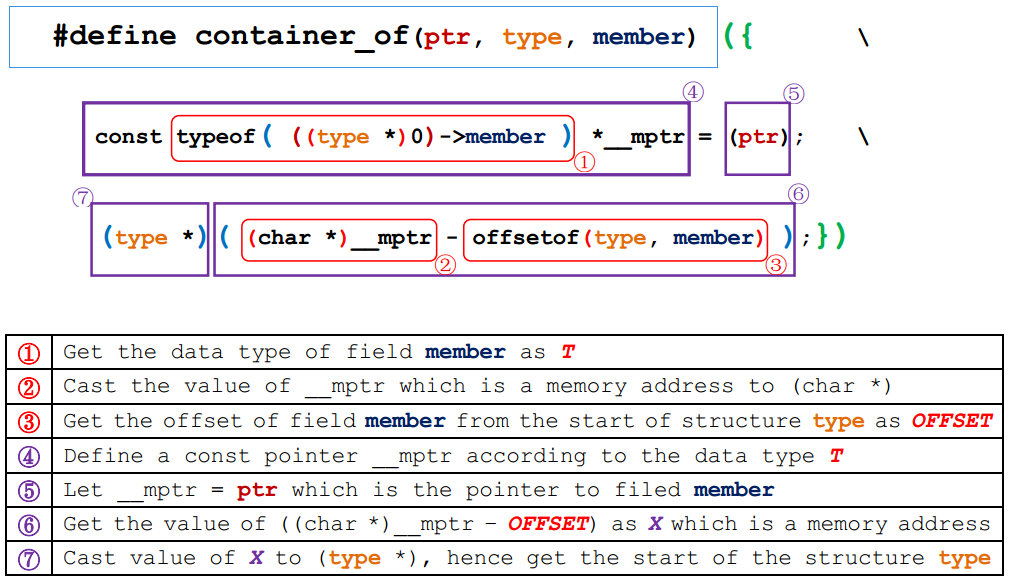
 #define container_of(ptr, type, member) ({                      \

         const typeof( ((type *))->member ) *__mptr = (ptr);    \

         (type *)( (char *)__mptr - offsetof(type,member) );})
- L9: 用一个临时变量__mptr保存成员变量的指针ptr
- L10: offsetof(type, member): 计算出成员变量相对于其所在的结构体的偏移,不妨记为OFFSET
- L10: (char *)__mptr - OFFSET, 就是成员变量所在的结构体的首地址 (注意: 对(char *)巧妙的应用)
因此, 宏container_of的作用就是根据某个成员变量的内存地址,反推出其所在的结构体变量的首地址。用图解析如下: (此图为本人原创,如需转载请注明出处)
示例代码: foo.c
 #include <stdio.h>

 #define offsetof(TYPE, MEMBER)  ((size_t)&((TYPE *)0)->MEMBER)

 #define container_of(ptr, type, member) ({                              \

                 const typeof( ((type *))->member ) *__mptr = (ptr);    \

                 (type *)( (char *)__mptr - offsetof(type,member) );})

 typedef struct foo_s {

         int             m_int;

         short           m_short;

         char            m_char;

         long long       m_longlong;

 } foo_t;

 int

 main(int argc, char *argv[])

 {

         foo_t ox = {0x12345678, 0x1234, 'A', 0xfedcba9876543210};

         char *p3 = &ox.m_char;

         foo_t *p = container_of(p3, foo_t, m_char);

         printf("foo_t ox (%p) sizeof(foo_t) = %d\n", &ox, sizeof (foo_t));

         printf("foo_t *p (%p) p3(%p)\n", p, p3);

         printf("foo_t->m_int      = %#x\t\t(%d)(%p)\n",

             p->m_int, offsetof(foo_t, m_int), &ox.m_int);

         printf("foo_t->m_short    = %#x\t\t(%d)(%p)\n",

             p->m_short, offsetof(foo_t, m_short), &ox.m_short);

         printf("foo_t->m_char     = %c\t\t\t(%d)(%p)\n",

             p->m_char, offsetof(foo_t, m_char), &ox.m_char);

         printf("foo_t->m_longlong = %#llx\t(%d)(%p)\n",

             p->m_longlong, offsetof(foo_t, m_longlong), &ox.m_longlong);

         return ;

 }
编译并运行
$ gcc -g -Wall -m32 -o foo foo.c

$ ./foo

foo_t ox (0xbfdfe990) sizeof(foo_t) =

foo_t *p (0xbfdfe990) p3(0xbfdfe996)

foo_t->m_int      = 0x12345678          ()(0xbfdfe990)

foo_t->m_short    = 0x1234              ()(0xbfdfe994)

foo_t->m_char     = A                   ()(0xbfdfe996)

foo_t->m_longlong = 0xfedcba9876543210  ()(0xbfdfe998)
反汇编并结合gcc -E foo.c
(gdb) set disassembly-flavor intel

(gdb) disas /m main

Dump of assembler code for function main:

      {

   0x0804841d <+>:     push   ebp

   0x0804841e <+>:     mov    ebp,esp

   0x08048420 <+>:     and    esp,0xfffffff0

   0x08048423 <+>:     sub    esp,0x40

              foo_t ox = {0x12345678, 0x1234, 'A', 0xfedcba9876543210};

   0x08048426 <+>:     mov    DWORD PTR [esp+0x30],0x12345678

   0x0804842e <+>:    mov    WORD PTR [esp+0x34],0x1234

   0x08048435 <+>:    mov    BYTE PTR [esp+0x36],0x41

   0x0804843a <+>:    mov    DWORD PTR [esp+0x38],0x76543210

   0x08048442 <+>:    mov    DWORD PTR [esp+0x3c],0xfedcba98

              char *p3 = &ox.m_char;

   0x0804844a <+>:    lea    eax,[esp+0x30]

   0x0804844e <+>:    add    eax,0x6

   0x08048451 <+>:    mov    DWORD PTR [esp+0x24],eax

              foo_t *p = container_of(p3, foo_t, m_char);

   0x08048455 <+>:    mov    eax,DWORD PTR [esp+0x24]

   0x08048459 <+>:    mov    DWORD PTR [esp+0x28],eax

   0x0804845d <+>:    mov    eax,DWORD PTR [esp+0x28]

   0x08048461 <+>:    sub    eax,0x6

   0x08048464 <+>:    mov    DWORD PTR [esp+0x2c],eax

#

# --- L21's output from "gcc -E foo.c" ---

# 001               foo_t *p = ({

# 002    const typeof( ((foo_t *))->m_char ) *__mptr = (p3);

# 003    (foo_t *)( (char *)__mptr - ((size_t)&((foo_t *))->m_char) );

# 004               });

#
结合汇编代码阅读下面两行,会更好懂:-)
 const typeof( ((foo_t *))->m_char ) *__mptr = (p3);

 (foo_t *)( (char *)__mptr - ((size_t)&((foo_t *))->m_char) );
小结
- typeof (VAR): 获取变量VAR的数据类型, (注意typeof是gcc支持的扩展关键字)
- offsetof(TYPE, MEMBER): 获取成员变量MEMBER在其所在的结构体(类型为TYPE)里的偏移
- container_of(PTR, TYPE, MEMBER): 根据成员变量MEMBER的内存首地址PTR, 反推出其所在的结构体(类型为TYPE)变量的内存首地址
参考资料
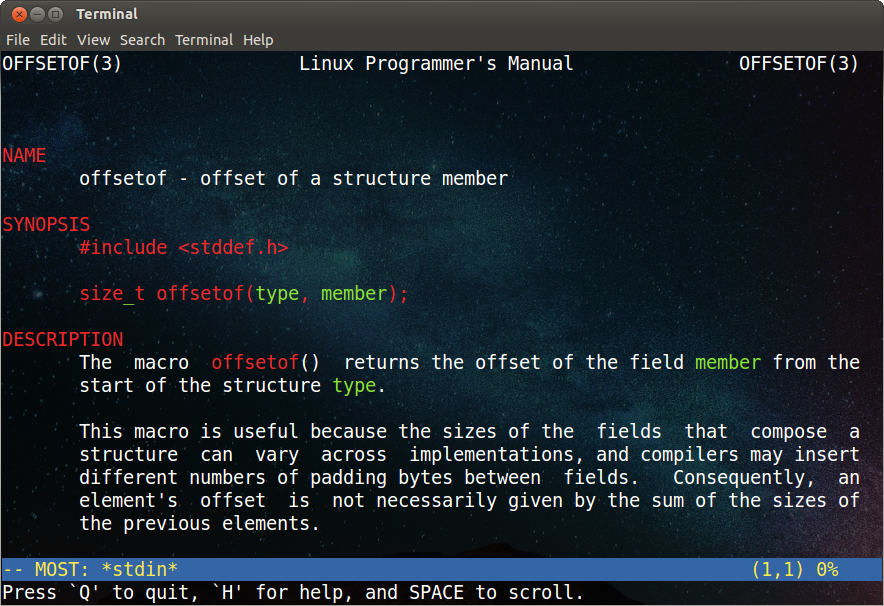
1. $ man -s3 offsetof
2. C Operators (which are copied from book C Programming: A Modern Approach, Second Edition) (快速查询C操作符的脚本戳这里)
APPENDIX  A

C Operators

--------------------------------------------------------------------------------

Precedence              Name                    Symbol(s)       Associativity

--------------------------------------------------------------------------------

    1           Array subscripting              []              Left

    1           Function call                   ()              Left

    1           Structure and union member      .  ->           Left

    1           Increment (postfix)             ++              Left

    1           Decrement (postfix)             --              Left

--------------------------------------------------------------------------------

    2           Increment (prefix)              ++              Right

    2           Decrement (prefix)              --              Right

    2           Address                         &               Right

    2           Indirection                     *               Right

    2           Unary plus                      +               Right

    2           Unary minus                     -               Right

    2           Bitwise complement              ~               Right

    2           Logical negation                !               Right

    2           Size                            sizeof          Right

--------------------------------------------------------------------------------

    3           Cast                            ()              Right

--------------------------------------------------------------------------------

    4           Multiplicative                  *  /  %         Left

--------------------------------------------------------------------------------

    5           Additive                        +  -            Left

--------------------------------------------------------------------------------

    6           Bitwise shift                   <<  >>          Left

--------------------------------------------------------------------------------

    7           Relational                      <  >  <=  >=    Left

--------------------------------------------------------------------------------

    8           Equality                        ==  !=          Left

--------------------------------------------------------------------------------

    9           Bitwise and                     &               Left

--------------------------------------------------------------------------------

   10           Bitwise exclusive or            ^               Left

--------------------------------------------------------------------------------

   11           Bitwise inclusive or            |               Left

--------------------------------------------------------------------------------

   12           Logical and                     &&              Left

--------------------------------------------------------------------------------

   13           Logical or                      ||              Left

--------------------------------------------------------------------------------

   14           Conditional                     ?:              Right

--------------------------------------------------------------------------------

   15           Assignment                      =  *=  /=  %=   Right

                                                += -=  <<= >>=

                                                &= ^=  |=

--------------------------------------------------------------------------------

   16           Comma                           ,               Left

--------------------------------------------------------------------------------

                                                                             735
typeof, offsetof 和container_of的更多相关文章
- [dev]typeof, offsetof 和container_of
转一篇文章.写的比较好,浅显易懂,还画了图. https://www.cnblogs.com/idorax/p/6796897.html 概况一下: container_of用到了typeof和off ...
- linux中offsetof与container_of宏定义
linux内核中offsetof与container_of的宏定义 #define offsetof(TYPE, MEMBER) ((size_t) &((TYPE *)0)->M ...
- (转)offsetof与container_of宏[总结]
1.前言 今天在看代码时,遇到offsetof和container_of两个宏,觉得很有意思,功能很强大.offsetof是用来判断结构体中成员的偏移位置,container_of宏用来根据成员的地址 ...
- offsetof与container_of宏[总结]
1.前言 今天在看代码时,遇到offsetof和container_of两个宏,觉得很有意思,功能很强大.offsetof是用来判断结构体中成员的偏移位置,container_of宏用来根据成员的地址 ...
- typeof、offsetof、container_of的解释
链表是内核最经典的数据结构之一,说到链表就不得不提及内核最经典(没有之一)的宏container_of. container_of似乎就是为链表而生的,它的主要作用是根据一个结构体变量中的一个域成员变 ...
- typeof, offsetof, container_of宏
container_of宏实现如下: #define container_of(ptr, type, member) ({ \ )->member ) *__mptr = (ptr); \ (t ...
- C语言笔记(结构体与offsetof、container_of之前的关系)
关于结构体学习,需要了解:结构体的定义和使用.内存对齐.结构体指针.得到结构体元素的偏移量(offsetof宏实现) 一.复习结构体的基本定义和使用 typedef struct mystruct { ...
- offsetof与container_of宏分析
offsetof宏:结构体成员相对结构体的偏移位置 container_of:根据结构体成员的地址来获取结构体的地址 offsetof 宏 原型: #define offsetof(TYPE, MEM ...
- 对offsetof、 container_of宏和结构体的理解
offsetof 宏 #include<stdio.h> #define offsetoff(type, member) ((int)&((type*)0)->me ...
随机推荐
- 个人项目-词频统计(语言:C++)
词频统计 (个人项目) 要求 (1). 实现一个控制台程序,给定一段英文字符串,统计其中各个英文单词(4字符以上含4字符)的出现频率. 附加要求:读入一段文本文件,统计该文本文件中单词的频率. (2) ...
- 使用C语言实现线性表
线性表是最常用且最简单的一种数据结构.一个线性表是n个数据元素的有限序列,序列中的每个数据元素,可以是一个数字,可以是一个字符,也可以是复杂的结构体或对象.例如:1,2,3,4,5是一个线性表,A,B ...
- asp.net——Base64加密解密
/// <summary> /// 实现Base64加密解密 /// </summary> public sealed class Base64 { /// <summa ...
- SQL多行字符串按条件合并
USE [ARTEA.MES]GO /****** Object: UserDefinedFunction [dbo].[UnionPart] Script Date: 11/18/2015 15:3 ...
- JAVA的学习内容
http://www.weixueyuan.net/java/rumen/ 安卓学习文档 http://www.runoob.com/w3cnote/android-tutorial-linearla ...
- jquery带参数选项卡4
带参数选项卡: <!DOCTYPE html> <html lang="en"> <head> <meta charset="U ...
- Hibernate 干货
一 .hibernate概念: hibernate应用在javaee 三层框架中的dao层(web 层 --service层--dao层),在dao层实现对数据库的CRUD操作.hibernate是对 ...
- 《Spark MLlib 机器学习实战》1——读后总结
1 概念 2 安装 3 RDD RDD包含两种基本的类型:Transformation和Action.RDD的执行是延迟执行,只有Action算子才会触发任务的执行. 宽依赖和窄依赖用于切分任务,如果 ...
- centos和ubuntu配置路由的三种方式
本篇总结三种修改路由的方式:route, ip route, 以及通过修改文件来配置路由,前2种命令行形式适用于ubuntu和centos,重启失效,最后一种永久有效. 一. route命令 ...
- Spring Boot 中使用 jpa
本文原文版权归 CSDN Hgihness 所有,此处为转载+技术收藏,如有再转请自觉于篇头处标明原文作者及出处,这是大家对作者劳动成果的自觉尊重!! 作者:Hgihness 原文:http://bl ...