
Quick guide for converting from JAGS or BUGS to NIMBLE
Converting to NIMBLE from JAGS, OpenBUGS or WinBUGS
NIMBLE is a hierarchical modeling package that uses nearly the same modeling language as the popular MCMC packages WinBUGS, OpenBUGS and JAGS. NIMBLE makes the modeling language extensible — you can add distributions and functions — and also allows customization of MCMC or other algorithms that use models. Here is a quick summary of steps to convert existing code from WinBUGS, OpenBUGS or JAGS to NIMBLE. For more information, see examples on r-nimble.org or the NIMBLE User Manual.
Main steps for converting existing code
These steps assume you are familiar with running WinBUGS, OpenBUGS or JAGS through an R package such as R2WinBUGS, R2jags, rjags, or jagsUI.
- Wrap your model code in nimbleCode({}), directly in R.
- This replaces the step of writing or generating a separate file containing the model code.
- Alternatively, you can read standard JAGS- and BUGS-formatted code and data files using
readBUGSmodel. - Provide information about missing or empty indices
- Example: If x is a matrix, you must write at least x[,] to show it has two dimensions.
- If other declarations make the size of x clear, x[,] will work in some circumstances.
- If not, either provide index ranges (e.g. x[1:n, 1:m]) or use the dimensions argument to nimbleModel to provide the sizes in each dimension.
- Choose how you want to run MCMC.
- Use nimbleMCMC() as the just-do-it way to run an MCMC. This will take all steps to
set up and run an MCMC using NIMBLE’s default configuration. - To use NIMBLE’s full flexibility: build the model, configure and build the MCMC, and compile both the model and MCMC. Then run the MCMC via runMCMC or by calling the run function of the compiled MCMC. See the NIMBLE User Manual to learn more about what you can do.
See below for a list of some more nitty-gritty additional steps you may need to consider for some models.
Example: An animal abundance model
This example is adapted from Chapter 6, Section 6.4 of Applied Hierarchical Modeling in Ecology: Analysis of distribution, abundance and species richness in R and BUGS. Volume I: Prelude and Static Models by Marc Kéry and J. Andrew Royle (2015, Academic Press). The book’s web site provides code for its examples.
Original code
The original model code looks like this:
cat(file = "model2.txt","

model {

# Priors

for(k in 1:3){                # Loop over 3 levels of hab or time factors

   alpha0[k] ~ dunif(-10, 10) # Detection intercepts

   alpha1[k] ~ dunif(-10, 10) # Detection slopes

   beta0[k] ~ dunif(-10, 10)  # Abundance intercepts

   beta1[k] ~ dunif(-10, 10)  # Abundance slopes

}

# Likelihood

# Ecological model for true abundance

for (i in 1:M){

   N[i] ~ dpois(lambda[i])

   log(lambda[i]) <- beta0[hab[i]] + beta1[hab[i]] * vegHt[i]

   # Some intermediate derived quantities

   critical[i] <- step(2-N[i])# yields 1 whenever N is 2 or less

   z[i] <- step(N[i]-0.5)     # Indicator for occupied site

   # Observation model for replicated counts

   for (j in 1:J){

      C[i,j] ~ dbin(p[i,j], N[i])

      logit(p[i,j]) <- alpha0[j] + alpha1[j] * wind[i,j]

   }

}

# Derived quantities

Nocc <- sum(z[])         # Number of occupied sites among sample of M

Ntotal <- sum(N[])       # Total population size at M sites combined

Nhab[1] <- sum(N[1:33])  # Total abundance for sites in hab A

Nhab[2] <- sum(N[34:66]) # Total abundance for sites in hab B

Nhab[3] <- sum(N[67:100])# Total abundance for sites in hab C

for(k in 1:100){         # Predictions of lambda and p ...

   for(level in 1:3){    #    ... for each level of hab and time factors

      lam.pred[k, level] <- exp(beta0[level] + beta1[level] * XvegHt[k])

      logit(p.pred[k, level]) <- alpha0[level] + alpha1[level] * Xwind[k]

   }

}

N.critical <- sum(critical[]) # Number of populations with critical size

}")
Brief summary of the model
This is known as an "N-mixture" model in ecology. The details aren't really important for illustrating the mechanics of converting this model to NIMBLE, but here is a brief summary anyway. The latent abundances N[i] at sites i = 1...M are assumed to follow a Poisson. The j-th count at the i-th site, C[i, j], is assumed to follow a binomial with detection probability p[i, j]. The abundance at each site depends on a habitat-specific intercept and coefficient for vegetation height, with a log link. The detection probability for each sampling occasion depends on a date-specific intercept and coefficient for wind speed. Kéry and Royle concocted this as a simulated example to illustrate the hierarchical modeling approaches for estimating abundance from count data on repeated visits to multiple sites.
NIMBLE version of the model code
Here is the model converted for use in NIMBLE. In this case, the only changes to the code are to insert some missing index ranges (see comments).
library(nimble)

Section6p4_code <- nimbleCode( {

    # Priors

    for(k in 1:3) {                # Loop over 3 levels of hab or time factors

      alpha0[k] ~ dunif(-10, 10) # Detection intercepts

      alpha1[k] ~ dunif(-10, 10) # Detection slopes

      beta0[k] ~ dunif(-10, 10)  # Abundance intercepts

      beta1[k] ~ dunif(-10, 10)  # Abundance slopes

    }

    # Likelihood

    # Ecological model for true abundance

    for (i in 1:M){

      N[i] ~ dpois(lambda[i])

      log(lambda[i]) <- beta0[hab[i]] + beta1[hab[i]] * vegHt[i]

      # Some intermediate derived quantities

      critical[i] <- step(2-N[i])# yields 1 whenever N is 2 or less

      z[i] <- step(N[i]-0.5)     # Indicator for occupied site

      # Observation model for replicated counts

      for (j in 1:J){

        C[i,j] ~ dbin(p[i,j], N[i])

        logit(p[i,j]) <- alpha0[j] + alpha1[j] * wind[i,j]

        }

    }

    # Derived quantities; unnececssary when running for inference purpose

    # NIMBLE: We have filled in indices in the next two lines.

    Nocc <- sum(z[1:100])         # Number of occupied sites among sample of M

    Ntotal <- sum(N[1:100])       # Total population size at M sites combined

    Nhab[1] <- sum(N[1:33])  # Total abundance for sites in hab A

    Nhab[2] <- sum(N[34:66]) # Total abundance for sites in hab B

    Nhab[3] <- sum(N[67:100])# Total abundance for sites in hab C

    for(k in 1:100){         # Predictions of lambda and p ...

      for(level in 1:3){    #    ... for each level of hab and time factors

        lam.pred[k, level] <- exp(beta0[level] + beta1[level] * XvegHt[k])

        logit(p.pred[k, level]) <- alpha0[level] + alpha1[level] * Xwind[k]

        }

      }

    # NIMBLE: We have filled in indices in the next line.

    N.critical <- sum(critical[1:100]) # Number of populations with critical size

  })
Simulated data
To carry this example further, we need some simulated data. Kéry and Royle provide separate code to do this. With NIMBLE we could use the model itself to simulate data rather than writing separate simulation code. But for our goals here, we simply copy Kéry and Royle's simulation code, and we compact it somewhat:
# Code from Kery and Royle (2015)

# Choose sample sizes and prepare obs. data array y

set.seed(1)                   # So we all get same data set

M <- 100                      # Number of sites

J <- 3                        # Number of repeated abundance measurements

C <- matrix(NA, nrow = M, ncol = J) # to contain the observed data

# Create a covariate called vegHt

vegHt <- sort(runif(M, -1, 1)) # sort for graphical convenience

# Choose parameter values for abundance model and compute lambda

beta0 <- 0                    # Log-scale intercept

beta1 <- 2                    # Log-scale slope for vegHt

lambda <- exp(beta0 + beta1 * vegHt) # Expected abundance

# Draw local abundance

N <- rpois(M, lambda)

# Create a covariate called wind

wind <- array(runif(M * J, -1, 1), dim = c(M, J))

# Choose parameter values for measurement error model and compute detectability

alpha0 <- -2                        # Logit-scale intercept

alpha1 <- -3                        # Logit-scale slope for wind

p <- plogis(alpha0 + alpha1 * wind) # Detection probability

# Take J = 3 abundance measurements at each site

for(j in 1:J) {

  C[,j] <- rbinom(M, N, p[,j])

}

# Create factors

time <- matrix(rep(as.character(1:J), M), ncol = J, byrow = TRUE)

hab <- c(rep("A", 33), rep("B", 33), rep("C", 34))  # assumes M = 100

# Bundle data

# NIMBLE: For full flexibility, we could separate this list

#         into constants and data lists.  For simplicity we will keep

#         it as one list to be provided as the "constants" argument.

#         See comments about how we would split it if desired.

win.data <- list(

    ## NIMBLE: C is the actual data

    C = C,

    ## NIMBLE: Covariates can be data or constants

    ##         If they are data, you could modify them after the model is built

    wind = wind,

    vegHt = vegHt,

    XvegHt = seq(-1, 1,, 100), # Used only for derived quantities

    Xwind = seq(-1, 1,,100),   # Used only for derived quantities

    ## NIMBLE: The rest of these are constants, needed for model definition

    ## We can provide them in the same list and NIMBLE will figure it out.

    M = nrow(C),

    J = ncol(C),

    hab = as.numeric(factor(hab))

)
Initial values
Next we need to set up initial values and choose parameters to monitor in the MCMC output. To do so we will again directly use Kéry and Royle's code.
Nst <- apply(C, 1, max)+1   # Important to give good inits for latent N

inits <- function() list(N = Nst,

                         alpha0 = rnorm(3),

                         alpha1 = rnorm(3),

                         beta0 = rnorm(3),

                         beta1 = rnorm(3))

# Parameters monitored

# could also estimate N, bayesian counterpart to BUPs before: simply add "N" to the list

params <- c("alpha0", "alpha1", "beta0", "beta1", "Nocc", "Ntotal", "Nhab", "N.critical", "lam.pred", "p.pred")
Run MCMC with nimbleMCMC
Now we are ready to run an MCMC in nimble. We will run only one chain, using the same settings as Kéry and Royle.
samples <- nimbleMCMC(

    code = Section6p4_code,

    constants = win.data, ## provide the combined data & constants as constants

    inits = inits,

    monitors = params,

    niter = 22000,

    nburnin = 2000,

    thin = 10)
## defining model...
## Detected C as data within 'constants'.
## Adding C as data for building model.
## building model...
## setting data and initial values...
## running calculate on model (any error reports that follow may simply reflect missing values in model variables) ...

## checking model sizes and dimensions...

## checking model calculations...

## model building finished.

## compiling... this may take a minute. Use 'showCompilerOutput = TRUE' to see C++ compiler details.

## compilation finished.

## runMCMC's handling of nburnin changed in nimble version 0.6-11. Previously, nburnin samples were discarded *post-thinning*.  Now nburnin samples are discarded *pre-thinning*.  The number of samples returned will be floor((niter-nburnin)/thin).

## running chain 1...
## |-------------|-------------|-------------|-------------|

## |-------------------------------------------------------|
Work with the samples
Finally we want to look at our samples. NIMBLE returns samples as a simple matrix with named columns. There are numerous packages for processing MCMC output. If you want to use the coda package, you can convert a matrix to a coda mcmc object like this:
library(coda)

coda.samples <- as.mcmc(samples)
Alternatively, if you call nimbleMCMC with the argument samplesAsCodaMCMC = TRUE, the samples will be returned as a coda object.
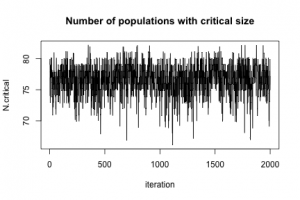
To show that MCMC really happened, here is a plot of N.critical:
plot(jitter(samples[, "N.critical"]), xlab = "iteration", ylab = "N.critical",

     main = "Number of populations with critical size",

     type = "l")
Next steps
NIMBLE allows users to customize MCMC and other algorithms in many ways. See the NIMBLE User Manual and web site for more ideas.
Smaller steps you may need for converting existing code
If the main steps above aren't sufficient, consider these additional steps when converting from JAGS, WinBUGS or OpenBUGS to NIMBLE.
- Convert any use of truncation syntax
- e.g. x ~ dnorm(0, tau) T(a, b) should be re-written as x ~ T(dnorm(0, tau), a, b).
- If reading model code from a file using readBUGSmodel, the x ~ dnorm(0, tau) T(a, b) syntax will work.
- Possibly split the data into data and constants for NIMBLE.
- NIMBLE has a more general concept of data, so NIMBLE makes a distinction between data and constants.
- Constants are necessary to define the model, such as nsite in for(i in 1:nsite) {...} and constant vectors of factor indices (e.g. block in mu[block[i]]).
- Data are observed values of some variables.
- Alternatively, one can provide a list of both constants and data for the constants argument to nimbleModel, and NIMBLE will try to determine which is which. Usually this will work, but when in doubt, try separating them.
- Possibly update initial values (inits).
- In some cases, NIMBLE likes to have more complete inits than the other packages.
- In a model with stochastic indices, those indices should have inits values.
- When using nimbleMCMC or runMCMC, inits can be a function, as in R packages for calling WinBUGS, OpenBUGS or JAGS. Alternatively, it can be a list.
- When you build a model with nimbleModel for more control than nimbleMCMC, you can provide inits as a list. This sets defaults that can be over-ridden with the inits argument to runMCMC.
转自:https://r-nimble.org/quick-guide-for-converting-from-jags-or-bugs-to-nimble
Quick guide for converting from JAGS or BUGS to NIMBLE的更多相关文章
- Nemerle Quick Guide
This is a quick guide covering nearly all of Nemerle's features. It should be especially useful to a ...
- 29 A Quick Guide to Go's Assembler 快速指南汇编程序:使用go语言的汇编器简介
A Quick Guide to Go's Assembler 快速指南汇编程序:使用go语言的汇编器简介 A Quick Guide to Go's Assembler Constants Symb ...
- (转) Quick Guide to Build a Recommendation Engine in Python
本文转自:http://www.analyticsvidhya.com/blog/2016/06/quick-guide-build-recommendation-engine-python/ Int ...
- Quick Guide to Microservices with Spring Boot 2.0, Eureka and Spring Cloud
https://piotrminkowski.wordpress.com/2018/04/26/quick-guide-to-microservices-with-spring-boot-2-0-eu ...
- Use swig + lua quick guide
软件swigwin3 用于生成c的lua包装lua5.2源代码 步骤进入目录G:\sw\swigwin-3.0.12\Examples\lua\arrays执行 SWIG -lua ex ...
- (转) [it-ebooks]电子书列表
[it-ebooks]电子书列表 [2014]: Learning Objective-C by Developing iPhone Games || Leverage Xcode and Obj ...
- windows ntp安装及调试
Setting up NTP on Windows It's very helpful that Meinberg have provided an installer for the highly- ...
- ROM后缀含义
ROM files, unless altered by the uploader, always have special suffixes to quickly denote what the s ...
- spring-boot(三) HowTo
Spring Boot How To 1. 简介 本章节将回答一些常见的"我该怎么做"类型的问题,这些问题在我们使用spring Boot时经常遇到.这绝不是一个详尽的列表,但它覆 ...
随机推荐
- 模块的封装之C语言类的封装
[微知识]模块的封装(一):C语言类的封装 是的,你没有看错,我们要讨论的是C语言而不是C++语言中类的封装.在展开知识点之前,我首先要 重申两点: 1.面向对象是一种思想,基本与所用的语言是无关的. ...
- [BZOJ4069][Apio2015]巴厘岛的雕塑
题目大意 分成 \(x\) 堆,是的每堆的和的异或值最小 分析 这是一道非常简单的数位 \(DP\) 题 基于贪心思想,我们要尽量让最高位的 \(1\) 最小, 因此我们考虑从高位向低位进行枚举,看是 ...
- python 将类属性转为字典
class dictObj(object): def __init__(self): self.x = 'red' self.y = 'Yellow' self.z = 'Green' def do_ ...
- Visitor(访问者)
意图: 定义一个操作中的算法的骨架,而将一些步骤延迟到子类中.TemplateMethod 使得子类可以不改变一个算法的结构即可重定义该算法的某些特定步骤. 适用性: 一次性实现一个算法的不变的部分, ...
- 小图标变为字体@font-face
https://www.zhihu.com/question/29054543 https://icomoon.io/app/#/select http://iconfont.cn/
- Cool Auto-Suggest 插件使用方法
刚入职的时候公司主管曾经让我用Cool Auto-Suggest 插件写过后台管理页面内的自动填充及搜索功能. 其实这个插件的使用很简单,网上也有相应的翻译文档,但是明显的机翻看着无法忍受.我写一下使 ...
- c# lambda表达式学习
1. 普通绑定: public void button1_Click(object sender, EventArgs e) { MessageBox.Show("ok"); } ...
- C#MVC中@HTML中的方法
//生成表单 @{ Html.BeginForm("Index", "Simple", FormMethod.Post, new { id = "my ...
- python自动化运维之路03
set集合 集合是一个无序的.不可重复的集合.主要作用有: 1.去重,把一个列表变成集合,就等于去重了. 2.关系测试,测试两组数据之前的交集.差集.并集等关系 常用操作 创建.交集.并集.差集.对称 ...
- 返回值为 Record类型的函数 初始化 Result
function TMiTeC_Storage.GetPhysInfo(Index: integer): TDeviceInfo; begin Finalize(Result); FillChar(R ...