
【DMCP】2020-CVPR-DMCP Differentiable Markov Channel Pruning for Neural Networks-论文阅读
DMCP
2020-CVPR-DMCP Differentiable Markov Channel Pruning for Neural Networks
- Shaopeng Guo(sensetime 商汤)
- GitHub: 64 stars
- https://github.com/zx55/dmcp
Introduction
propose a novel differentiable channel pruning method named Differentiable Markov Channel Pruning (DMCP) to perform efficient optimal sub-structure searching.
本文提出DMCP(可微分的通道剪枝)来高效地搜索子空间。
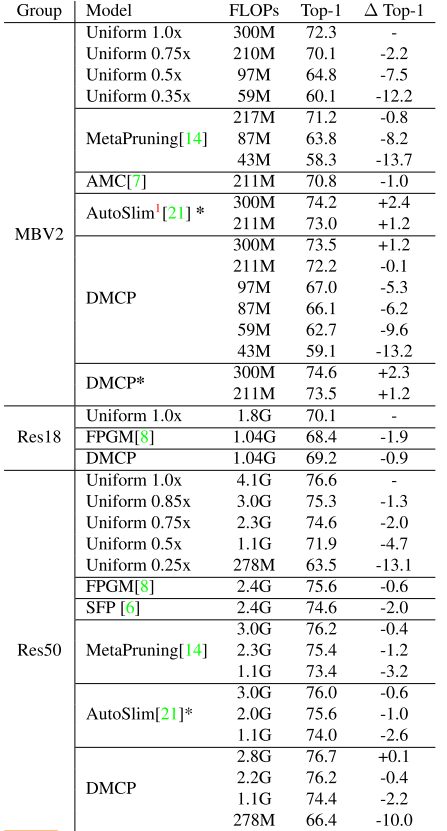
At the same FLOPs, our method outperforms all the other pruning methods both on MobileNetV2 and ResNet, as shown in Figure 1.
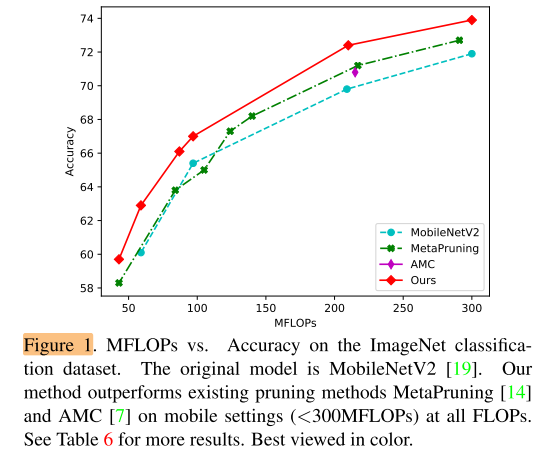
With our method, MobileNetV2 has 0.1% accuracy drop with 30% FLOPs reduction and the FLOPs of ResNet-50 is reduced by 44% with only 0.4% drop.
Motivation
Recent works imply that the channel pruning can be regarded as searching optimal sub-structure from unpruned networks.
通道的修剪可以视为从未修剪的网络中搜索最佳的子结构(网络剪枝得到的子结构比继承的权重更重要)
However, existing works based on this observation require training and evaluating a large number of structures, which limits their application.
之前的工作需要训练和评估很多子结构,开销大
Conventional channel pruning methods mainly rely on the human-designed paradigm.
卷积网络的剪枝主要依靠手工设计的范式(重要性指标)
the structure of the pruned model is the key of determining the performance of a pruned model, rather than the inherited “important” weights.
剪枝后网络的结构对性能的影响更大,而不是所继承的”重要“权重
the optimization of these pruning process need to train and evaluate a large number of structures sampled from the unpruned network, thus the scalability of these methods is limited.
之前的(搜索子结构)的剪枝方法需要训练和评估大量的网络,因此可扩展性(修剪不同大小的网络)受到限制
A similar problem in neural architecture search (NAS) has been tackled by differentiable method DARTS
在NAS中也有类似的问题,已经被可微分方法DARTS解决了
ps 与DATRS的区别
First, the definition of search space is different. The search space of DARTS is a category of pre-defined operations (convolution, max-pooing, etc), while in the channel pruning, the search space is the number of channels in each layer.
第一,搜索空间的不同。DARTS的搜索空间是一些预定义的操作,而我们的搜索空间是不同层通道的数量
Second, the operations in DARTS are independent with each other. But in the channel pruning, if a layer has k + 1 channels, it must have at least k channels first, which has a logical implication relationship.
第二,DARTS中的操作时互相独立的(比如两个node的连接之间的不同操作,卷积,池化,互不影响),但通道剪枝中,如果一层有k+1个通道,那么它首先要有k个通道。
Contribution
Our method makes the channel pruning differentiable by modeling it as a Markov process.
我们通过将模型剪枝建模为马尔科夫过程,从而使之可以微分
Method
Our method is differentiable and can be directly optimized by gradient descent with respect to standard task loss and budget regularization (e.g. FLOPs constraint).
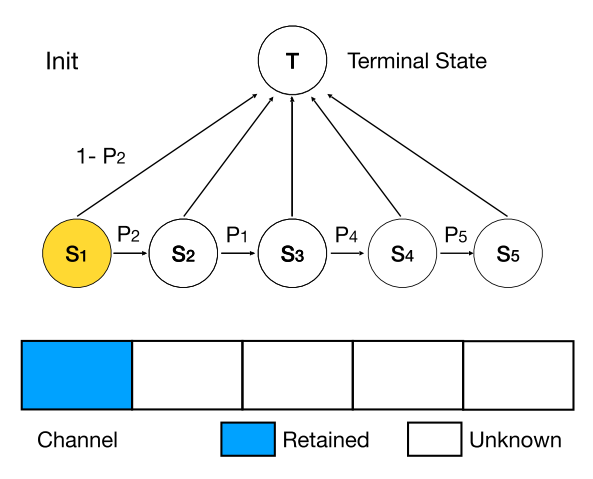
DMCP中,我们将通道剪枝视为markov(马尔科夫)过程,剪枝中的markov状态(state)代表是否保留相应的通道,状态之间的转移视为剪枝的过程
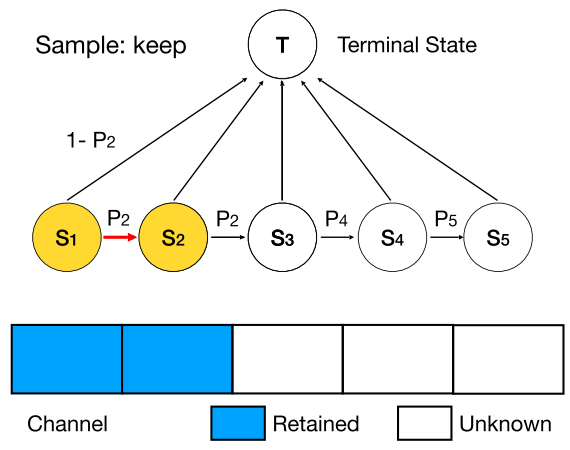
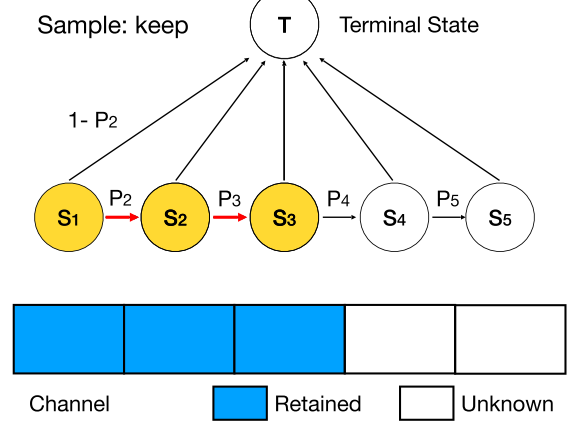
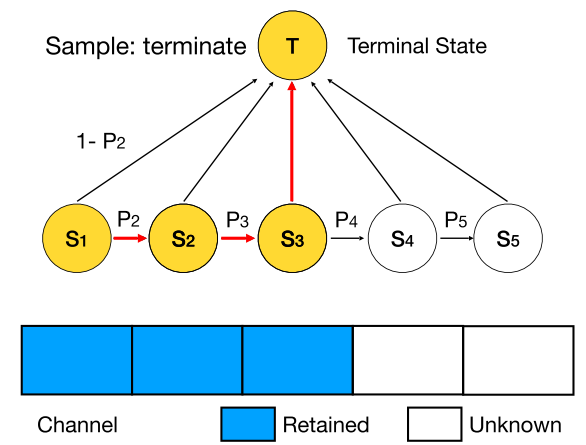
In the Markov process for each layer, the state \(S_k\) represents the \(k^{th}\) channel is retained, the transition from \(S_k\) to \(S_{k+1}\) represents the probability of retaining the (k+1)th channel given that the kth channel is retained.
每一层为一个马尔科夫过程,状态 \(S_k\) 表示保留第k个通道。状态 \(S_k\) 到 \(S_{k+1}\) 的转移代表保留第k+1个通道的概率
Note that the start state is always \(S_1\) in our method.
\(S_1\) 是起始状态,即每层都至少有1个通道
Then the marginal probability for state \(S_k\), i.e. the probability of retaining \(k^{th}\) channel, can be computed by the product of transition probabilities and can also be viewed as a scaling coefficient.
因此,第k个状态(保留第k个通道)的边缘概率=之前所有转移概率的乘积,可以视为第k个通道的放大系数
Each scaling coefficient is multiplied to its corresponding channel’s feature map during the network forwarding.
前向过程中,每个通道的feature map 乘以 该通道对应的 边缘概率(放大系数)
So the transition probabilities parameterized by learnable parameters can be optimized in an end-to-end manner by gradient descent with respect to task loss together with budget regularization (e.g. FLOPs constraint).
因此可以通过对目标loss 和 代价loss(FLOPs loss)的梯度下降,来end to end地优化 不同层,不同通道的转移概率
After the optimization, the model within desired budgets can be sampled by the Markov process with learned transition probabilities and will be trained from scratch to achieve high performance.
优化完成后(即网络中每一层的转移概率/边缘概率 可以抽样出符合FLOPs限制的网络了),进行采样子网络并从头开始训练
因此,DMCP选择将剪枝的过程建模为一个马尔科夫模型。图二展示了一层通道数为5的卷积层的剪枝过程。其中S1表示保留第一个通道,S2表示保留第二个通道,以此类推。T表示剪枝完毕。概率p则为转移概率,通过可学习的参数计算得到,后文中会详细介绍。
(1)优化剪枝空间
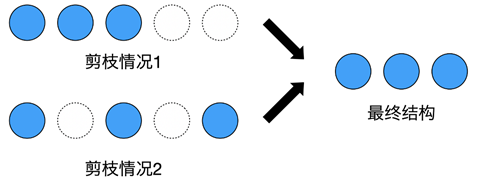
在传统的剪枝方法中,会为每个通道计算“重要性”来决定是否保留它。而当我们把模型剪枝看作模型结构搜索问题后,不同模型的区别则在于每一层的通道数量。如果仍然每个通道单独判断,就会产生同样的结构,造成优化困难。如图三所示:情况1中,最后两个通道被剪掉,情况2中,第2个和第4个通道被剪掉,而这两种情况都会产生3个通道的卷积层,使剪枝空间远大于实际网络个数。
因此,DMCP采用保留前k个通道的方式,大大缩小了剪枝空间。
(2)建模剪枝过程
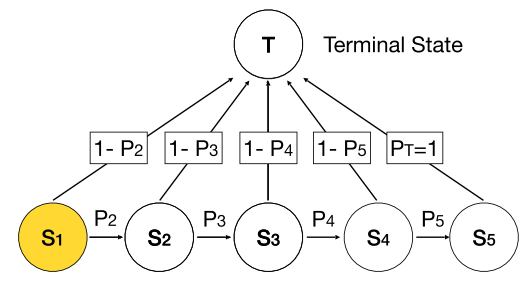
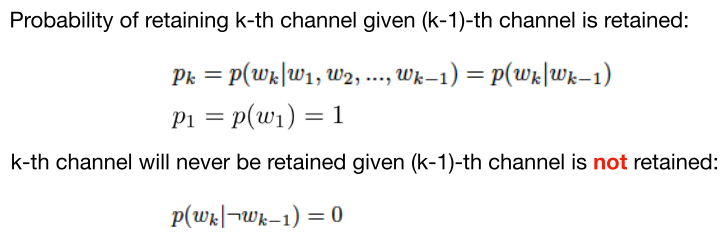
其中pk为马尔科夫模型中的转移概率。这样,通过在优化完毕后的马尔可夫模型上采样就可以得到相应的剪枝后的模型。
(3)学习转移概率
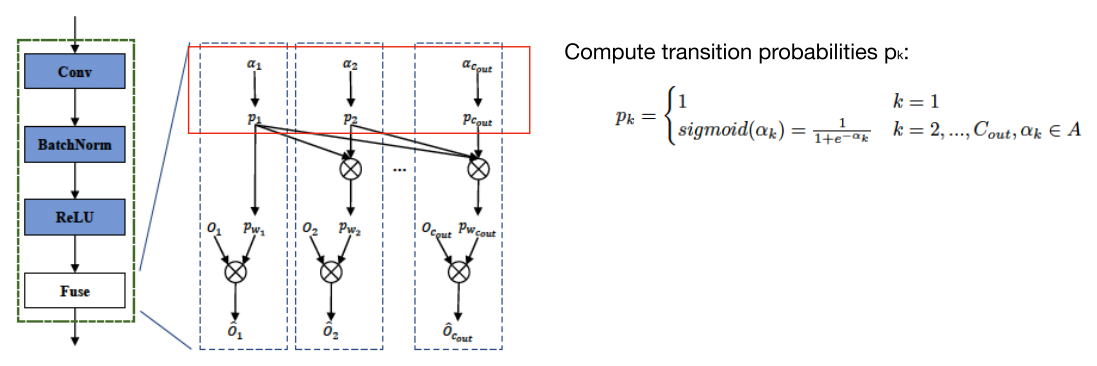
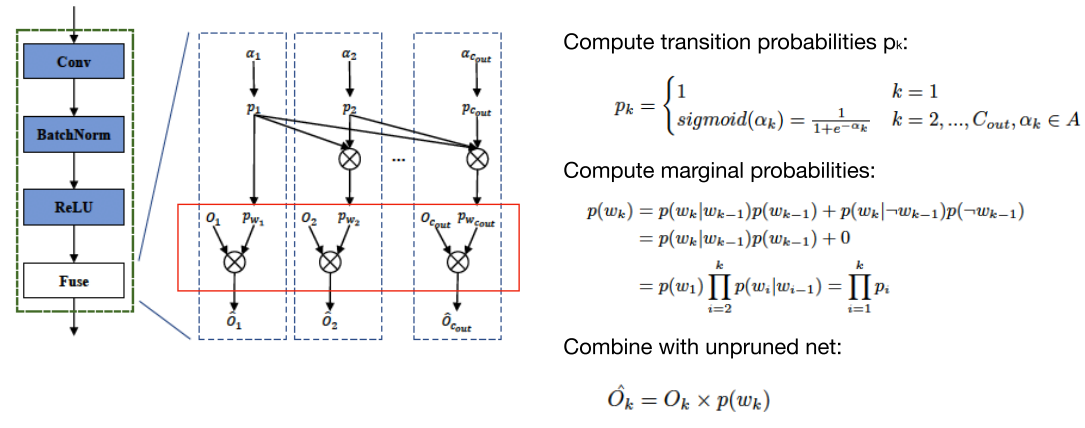
(\(p_k\) 是转移概率,\(p_{w1}\) 是边缘概率)
(4)训练流程
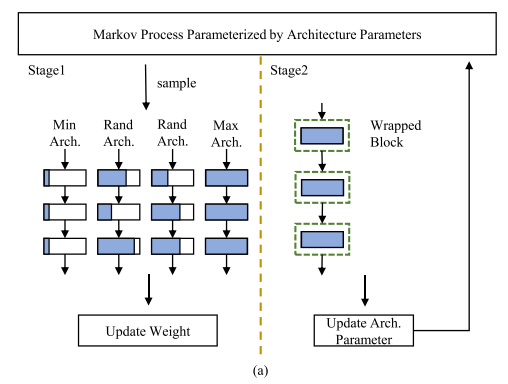
DMCP的训练可以分为两个阶段:训练原模型和更新马尔科夫模型。这两个阶段是交替进行来优化的。
阶段一,训练原模型。
在每一轮迭代过程中,利用马尔科夫过程采样两个随机结构,同时也采样了最大与最小的结构来保证原模型的所有参数可以充分训练。所有采样的结构都与原模型共享训练参数,因此所有子模型在任务数据集上的精度损失函数得到的梯度都会更新至原模型的参数上。
阶段二,更新马尔科夫模型
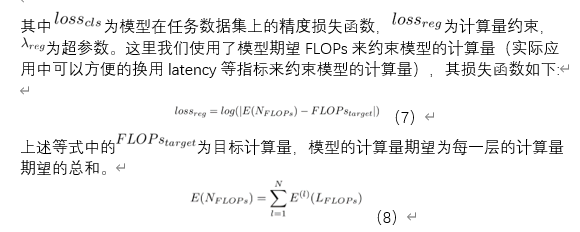
在训练原模型后,通过前文中所描述的方法将马尔科夫模型中的转移概率和原模型结合,从而可以利用梯度下降的方式更新马尔科夫模型的参数,其损失函数如下:

Experiments
Conclusion
The proposed method is differentiable by modeling the channel pruning as the Markov process, thus can be optimized with respect to task loss by gradient descent.
Summary
Reference
【CVPR 2020 Oral丨DMCP: 可微分的深度模型剪枝算法解读】https://zhuanlan.zhihu.com/p/146721840
【Soft Filter Pruning(SFP)算法笔记】https://blog.csdn.net/u014380165/article/details/81107032
【DMCP】2020-CVPR-DMCP Differentiable Markov Channel Pruning for Neural Networks-论文阅读的更多相关文章
- 论文笔记——Channel Pruning for Accelerating Very Deep Neural Networks
论文地址:https://arxiv.org/abs/1707.06168 代码地址:https://github.com/yihui-he/channel-pruning 采用方法 这篇文章主要讲诉 ...
- MetaPruning: Meta Learning for Automatic Neural Network Channel Pruning
MetaPruning: Meta Learning for Automatic Neural Network Channel Pruning 2019-08-11 19:48:17 Paper: h ...
- 模型压缩之Channel Pruning
论文地址 channel pruning是指给定一个CNN模型,去掉卷积层的某几个输入channel以及相应的卷积核, 并最小化裁剪channel后与原始输出的误差. 可以分两步来解决: channe ...
- [论文分享]Channel Pruning via Automatic Structure Search
authors: Mingbao Lin, Rongrong Ji, etc. comments: IJCAL2020 cite: [2001.08565v3] Channel Pruning via ...
- Research Guide: Pruning Techniques for Neural Networks
Research Guide: Pruning Techniques for Neural Networks 2019-11-15 20:16:54 Original: https://heartbe ...
- 论文阅读笔记三十三:Feature Pyramid Networks for Object Detection(FPN CVPR 2017)
论文源址:https://arxiv.org/abs/1612.03144 代码:https://github.com/jwyang/fpn.pytorch 摘要 特征金字塔是用于不同尺寸目标检测中的 ...
- 目标检测--Scalable Object Detection using Deep Neural Networks(CVPR 2014)
Scalable Object Detection using Deep Neural Networks 作者: Dumitru Erhan, Christian Szegedy, Alexander ...
- 深度学习(六十九)darknet 实现实验 Compressing Deep Neural Networks with Pruning, Trained Quantization and Huffma
本文主要实验文献文献<Deep Compression: Compressing Deep Neural Networks with Pruning, Trained Quantization ...
- CVPR 2018paper: DeepDefense: Training Deep Neural Networks with Improved Robustness第一讲
前言:好久不见了,最近一直瞎忙活,博客好久都没有更新了,表示道歉.希望大家在新的一年中工作顺利,学业进步,共勉! 今天我们介绍深度神经网络的缺点:无论模型有多深,无论是卷积还是RNN,都有的问题:以图 ...
随机推荐
- C#线程 基本同步
第二部分: 基本同步 同步要点 到目前为止,我们已经描述了如何在线程上启动任务,配置线程以及双向传递数据.我们还描述了局部变量如何专用于线程,以及如何在线程之间共享引用,从而允许它们通过公共字段进行 ...
- Android简单应用程序破解——runtime.apk
对于<Debugging Android Application>一文中最后附上的练习,我采用了另一种静态方法绕开原有的逻辑去破解.主要的过程如下: 利用apktool将练习的runtim ...
- cisco-GNS3-pix防火墙基本配置实操(持续更新)
一.ASA和PIX基础配置 1.ASA防火墙配置 1.GNS配置 因为使用的GNS3的版本可能不同,gns配置asa防火墙的步骤可能不同 在低版本的gns中直接在qemu选项里可以直接配置,参考:ht ...
- Chisel3 - model - 子模块,顶层模块
https://mp.weixin.qq.com/s/3uUIHW8DmisYARYmNzUZeg 介绍如何构建由模块组成的硬件模型. 1. 子模块 一个模块可以有一个或多个子模块,创建子 ...
- Chisel3 - 运算符和位宽推断
https://mp.weixin.qq.com/s/rI-CJM6GyI6EUHPZ3uYiFg 如同Verilog中的众多运算符,Chisel也针对自身的数据类型,提供了很多运算符. Ch ...
- Java实现 LeetCode 826 安排工作以达到最大收益(暴力DP)
826. 安排工作以达到最大收益 有一些工作:difficulty[i] 表示第i个工作的难度,profit[i]表示第i个工作的收益. 现在我们有一些工人.worker[i]是第i个工人的能力,即该 ...
- Java实现 LeetCode 692 前K个高频单词(map的应用)
692. 前K个高频单词 给一非空的单词列表,返回前 k 个出现次数最多的单词. 返回的答案应该按单词出现频率由高到低排序.如果不同的单词有相同出现频率,按字母顺序排序. 示例 1: 输入: [&qu ...
- Java实现 LeetCode 551 学生出勤记录 I(暴力大法好)
551. 学生出勤记录 I 给定一个字符串来代表一个学生的出勤记录,这个记录仅包含以下三个字符: 'A' : Absent,缺勤 'L' : Late,迟到 'P' : Present,到场 如果一个 ...
- Java实现 蓝桥杯 算法提高 计算行列式
试题 算法提高 计算行列式 资源限制 时间限制:1.0s 内存限制:256.0MB 问题描述 //据说很多人的题目会有一大堆废话,本傻×就不在这里废话了. 给定一个N×N的矩阵A,求|A|. 输入格式 ...
- Java实现 蓝桥杯 历届试题 约数倍数选卡片
问题描述 闲暇时,福尔摩斯和华生玩一个游戏: 在N张卡片上写有N个整数.两人轮流拿走一张卡片.要求下一个人拿的数字一定是前一个人拿的数字的约数或倍数.例如,某次福尔摩斯拿走的卡片上写着数字" ...