
【LeetCode题解】225_用队列实现栈(Implement-Stack-using-Queues)
更多 LeetCode 题解笔记可以访问我的 github。
@
描述
使用队列实现栈的下列操作:
- push(x) -- 元素 x 入栈
- pop() -- 移除栈顶元素
- top() -- 获取栈顶元素
- empty() -- 返回栈是否为空
注意:
- 你只能使用队列的基本操作-- 也就是
push to back,peek/pop from front,size, 和is empty这些操作是合法的。 - 你所使用的语言也许不支持队列。 你可以使用 list 或者 deque(双端队列)来模拟一个队列 , 只要是标准的队列操作即可。
- 你可以假设所有操作都是有效的(例如, 对一个空的栈不会调用 pop 或者 top 操作)。
解法一:双队列,入快出慢
思路
为了实现栈这种数据结构后入先出(last in first out, LIFO)的效果,解法一借助于两个队列。其中,一个队列保存栈的所有元素(设为队列1 q1),另一个队列用于辅助实现入栈、出栈的效果(设为队列2 q2)。相关操作的底层实现细节见下面对应的小节。
入栈(push)
入栈时,直接将新的元素 x 压入队列1 q1 的队尾(rear),并且用变量 top 保存栈顶元素,方便后面的查看栈顶元素(peek)操作,具体的实现步骤见图1。
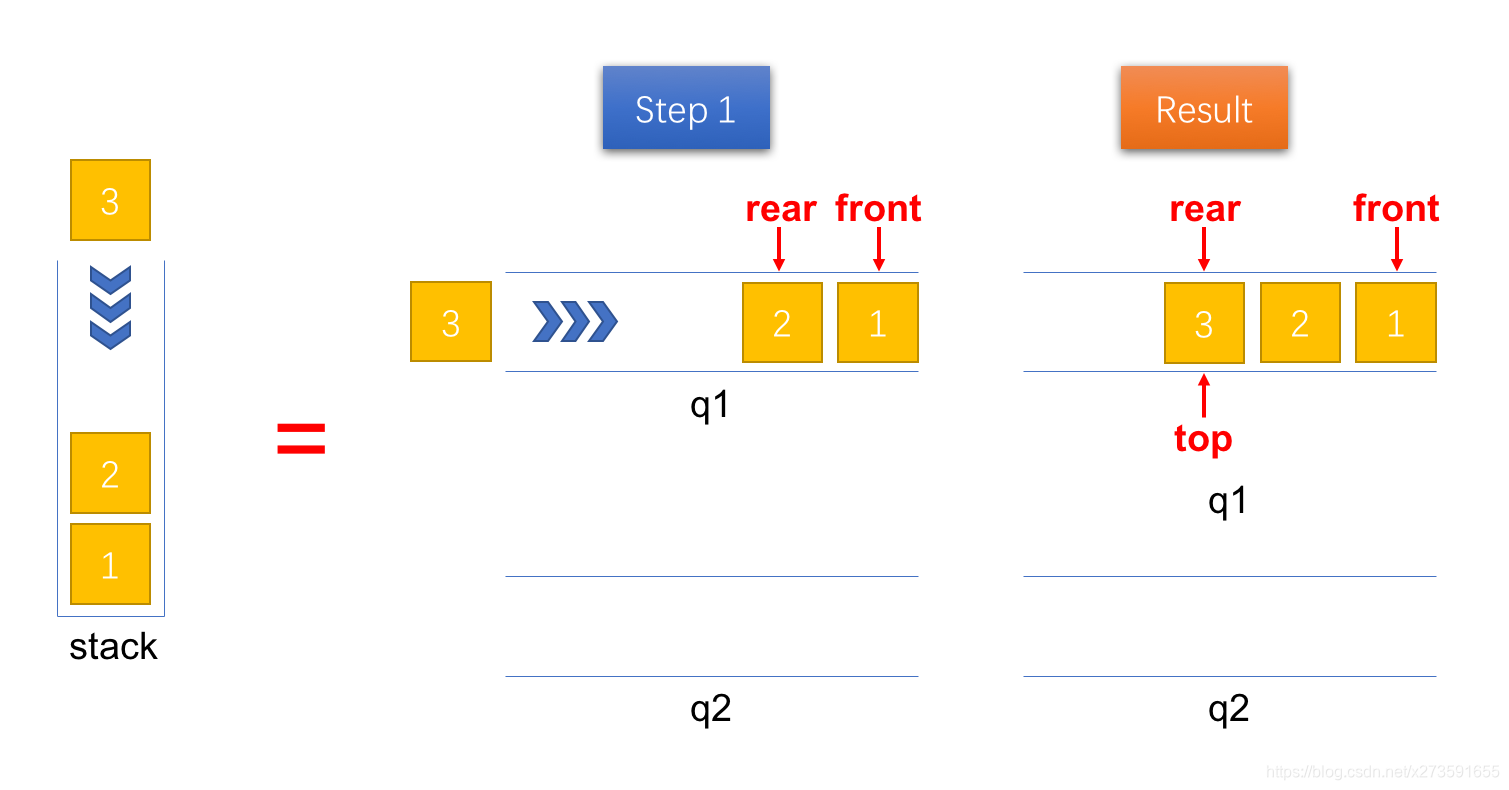
图1:将一个元素压入栈
代码(Java)实现如下:
/** Push element x onto stack. */

public void push(int x) {

    top = x;

    q1.add(x);

}
复杂度分析如下:
- 时间复杂度:$ O(1) $
- 空间复杂度:$ O(1) $
出栈(pop)
由于入栈时直接将元素入队到队列1 q1 中,因此,栈顶的元素位于队列1 q1 的尾部。为了能将栈顶元素(队列1 q1 尾部的元素)弹出,必须先将队列1 q1 队尾之前的元素出队。这里,我们借助另一个队列(辅助队列 q2)实现这一过程——将队列1 q1 队尾之前的元素出队并入队到队列2 q2 中。 之后,将队列1 q1 中唯一个元素(栈顶元素)出队。最后,再将两个队列的引用进行交换即可完成出栈操作。具体的实现步骤如图2所示。
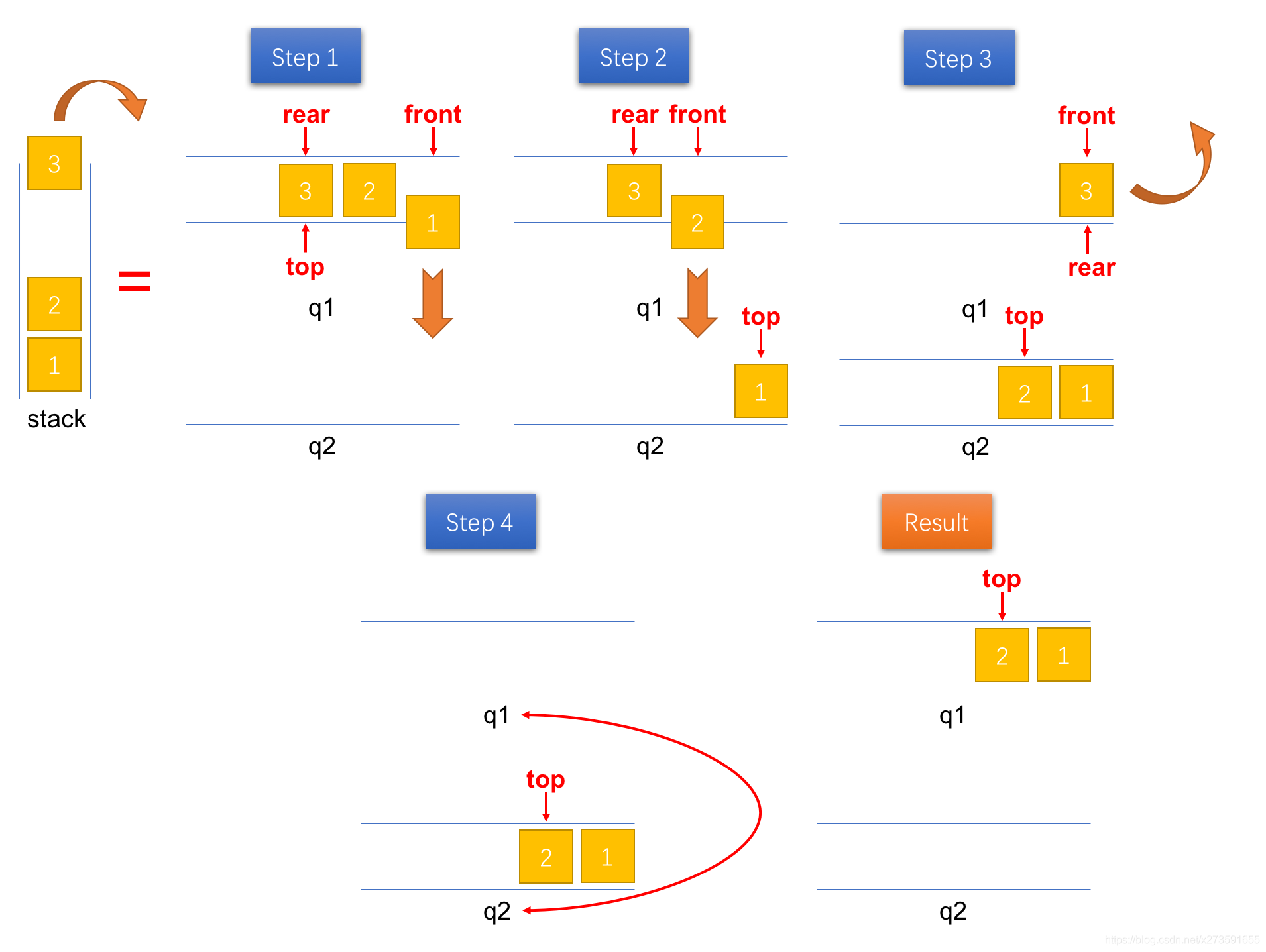
图2:将一个元素出栈
代码(Java)实现如下:
/** Removes the element on top of the stack and returns that element. */

public int pop() {

    if (q1.size() == 0) {

        throw new NoSuchElementException("[ERROR] The queue is empty!");

    }

    while (q1.size() > 1) {

        top = q1.remove();

        q2.add(top);

    }

    int res = q1.remove();

    Queue<Integer> temp = q1;

    q1 = q2;

    q2 = temp;

    return res;

}
复杂度分析如下:
- 时间复杂度:$ O(n) $,其中 \(n\) 表示未出栈前元素的数目。出栈操作需要从队列1
q1出队 \(n\) 个元素,同时入队 \(n-1\) 个元素到队列2q2,因此需要 \(2n - 1\) 次操作。因此LinkedList的添加和删除操作的时间复杂度是 \(O(1)\) 的,因此,总的时间复杂度为 \(O(n)\) - 空间复杂度:$ O(1) $
查看栈顶元素(peek)
因为我们用变量 top 保存了栈顶的元素,因此只需要返回该变量即可,代码(Java)实现如下:
/** Get the top element. */

public int top() {

    return top;

}
复杂度分析如下:
- 时间复杂度:$ O(1) $
- 空间复杂度:$ O(1) $
是否为空(empty)
队列1 q1 中保存了栈中的所有元素,因此,如果想要知道栈是否为空,只需要判断队列1 q1 中是否还有元素,代码(Java)实现如下:
/** Returns whether the stack is empty. */

public boolean empty() {

	return q1.isEmpty();

}
复杂度分析如下:
- 时间复杂度:$ O(1) $
- 空间复杂度:$ O(1) $
Java 实现
import java.util.NoSuchElementException;

import java.util.LinkedList;

import java.util.Queue;

class MyStack {

    /**

     * The main queue using to store all the elements in the stack

     */

    private Queue<Integer> q1;

    /**

     * The auxiliary queue using to implement `pop` operation

     */

    private Queue<Integer> q2;

    /**

     * The top element in the stack

     */

    private int top;

    /** Initialize your data structure here. */

    public MyStack() {

        q1 = new LinkedList<>();

        q2 = new LinkedList<>();

    }

    /** Push element x onto stack. */

    public void push(int x) {

        top = x;

        q1.add(x);

    }

    /** Removes the element on top of the stack and returns that element. */

    public int pop() {

        if (q1.size() == 0) {

            throw new NoSuchElementException("[ERROR] The stack is empty!");

        }

        while (q1.size() > 1) {

            top = q1.remove();

            q2.add(top);

        }

        int res = q1.remove();

        Queue<Integer> temp = q1;

        q1 = q2;

        q2 = temp;

        return res;

    }

    /** Get the top element. */

    public int top() {

        return top;

    }

    /** Returns whether the stack is empty. */

    public boolean empty() {

        return q1.isEmpty();

    }

}
Python 实现
from collections import deque

class MyStack:

    def __init__(self):

        """

        Initialize your data structure here.

        """

        self._q1, self._q2, self._top = deque(), deque(), None

    def push(self, x):

        """

        Push element x onto stack.

        :type x: int

        :rtype: void

        """

        self._top = x

        self._q1.append(x)

    def pop(self):

        """

        Removes the element on top of the stack and returns that element.

        :rtype: int

        """

        if not self._q1:

            raise Exception("[ERROR] The stack is empty!")

        while len(self._q1) > 1:

            self._top = self._q1.popleft()

            self._q2.append(self._top)

        res = self._q1.popleft()

        self._q1, self._q2 = self._q2, self._q1

        return res

    def top(self):

        """

        Get the top element.

        :rtype: int

        """

        return self._top

    def empty(self):

        """

        Returns whether the stack is empty.

        :rtype: bool

        """

        return not self._q1
解法二:双队列,入慢出快
思路
与解法一相同的是,解法二也借助于两个队列。不同之处在于解法二在入栈时,已经在队列中将元素排列成出栈的顺序。因此,解法二实现的栈的入栈操作是 \(O(n)\) 的时间复杂度,而出栈操作则只需要 \(O(1)\) 的时间复杂度。相关操作的底层实现细节见下面对应的小节。
入栈(push)
为了使得队列1 q1 中的出队顺序和出栈顺序是一致的,需要借助另一个队列(辅助队列 q2)。每次有新的元素压入栈时,将该元素入队到队列2 q2 中。接着,将队列1 q1 中的所有元素出队并入队到队列2 q2 中。最后,再将两个队列的引用进行交换,则队列1 q1 中出队的顺序即为实际的出栈顺序。具体的操作步骤如图3所示。
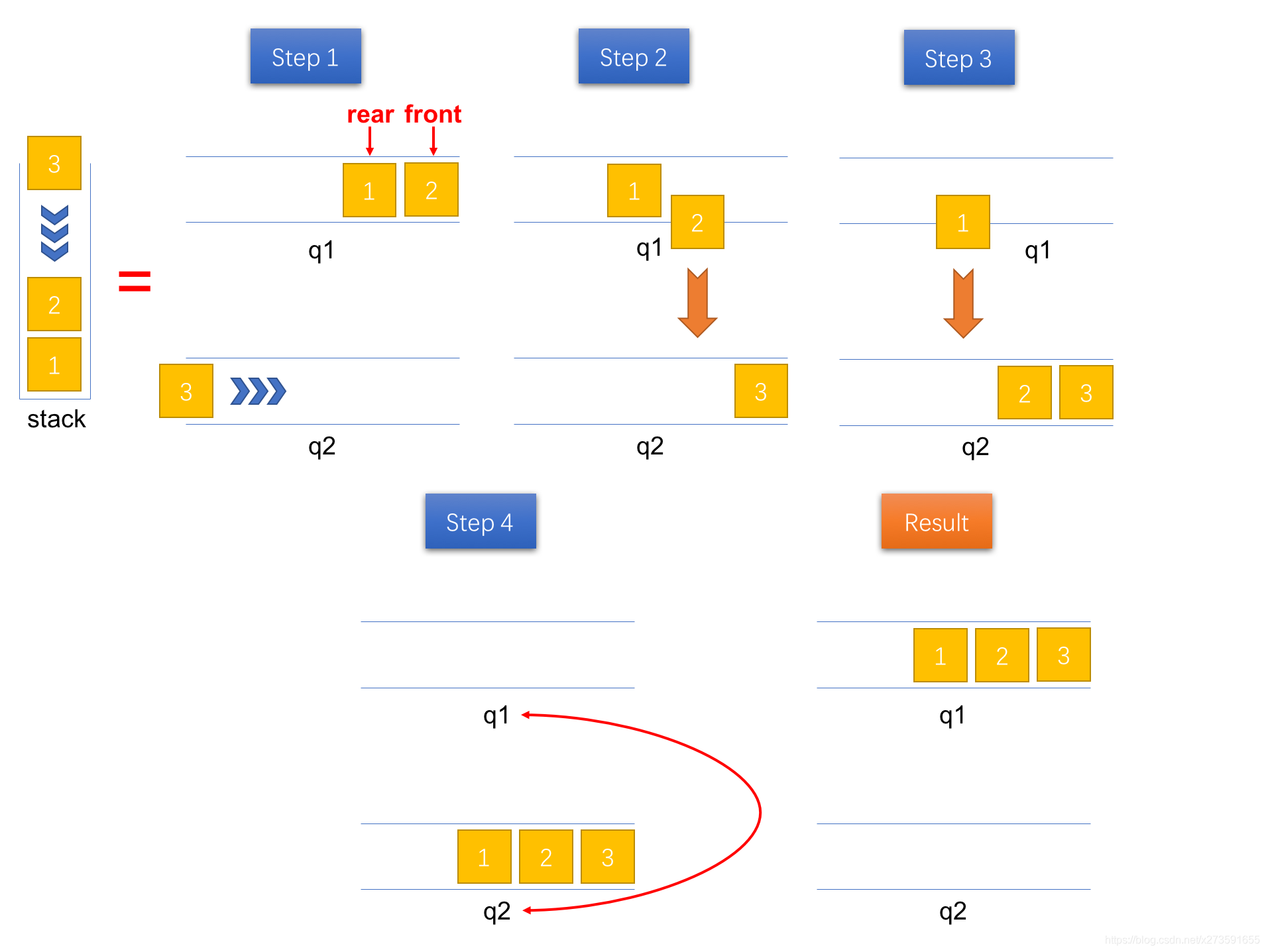
图3:将一个元素压入栈
代码(Java)实现如下:
/** Push element x onto stack. */

public void push(int x) {

    q2.add(x);

    while (!q1.isEmpty()) {

        q2.add(q1.remove());

    }

    Queue<Integer> temp = q1;

    q1 = q2;

    q2 = temp;

}
复杂度分析如下:
- 时间复杂度:\(O(n)\),其中 \(n\) 表示入栈前元素的数目。入栈操作需要 \(n+1\) 个入队操作,同时还需要 \(n\) 个出队操作,因此,总共需要 \(2n + 1\) 个操作。由于
LinkedList的添加和删除操作的时间复杂度是 \(O(1)\) 的,因此,总的时间复杂度是 \(O(n)\) 的 - 空间复杂度:\(O(1)\)
出栈(pop)
由于在入栈时已经将队列中的元素排列成出栈的顺序,因此,只需要出队队列1 q1 中队首的元素即可。
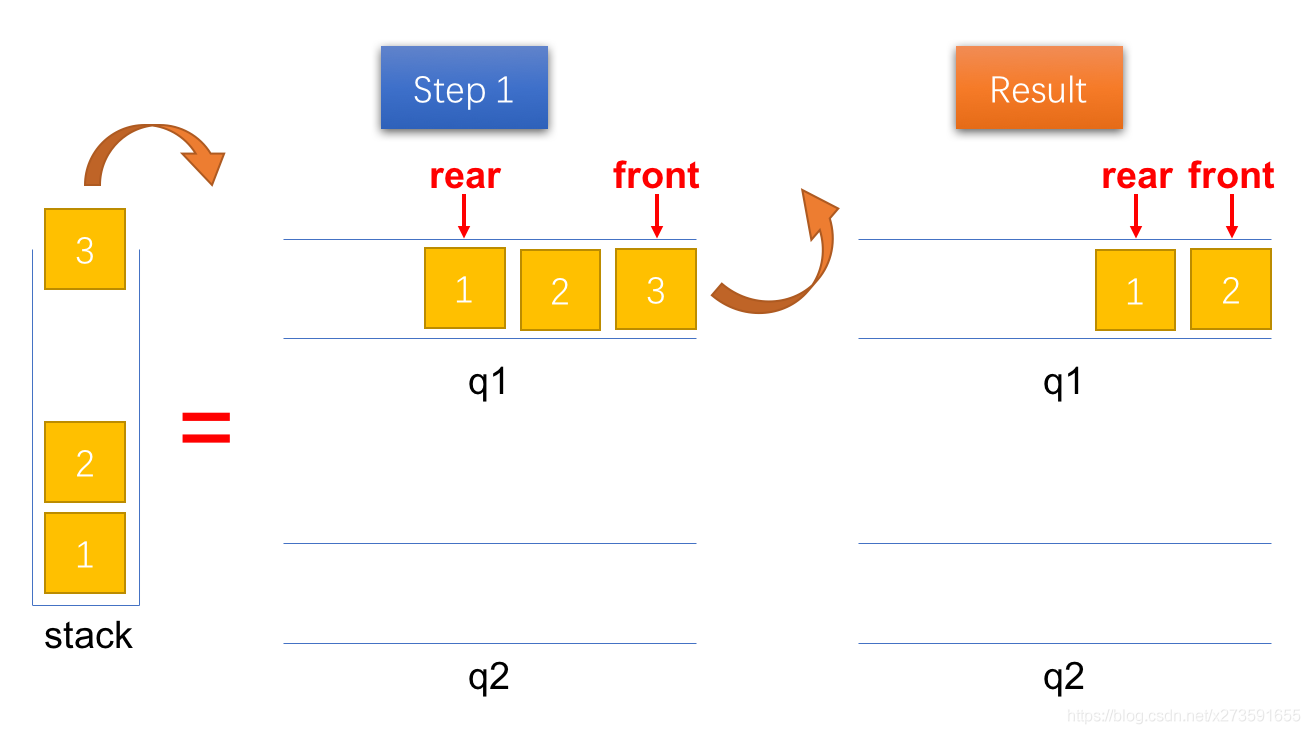
图4:将一个元素出栈
代码(Java)实现如下:
/** Removes the element on top of the stack and returns that element. */

public int pop() {

    if (q1.isEmpty()) {

        throw new NoSuchElementException("[ERROR] The stack is empty!");

    }

    return q1.remove();

}
复杂度分析如下:
- 时间复杂度:$ O(1) $
- 空间复杂度:$ O(1) $
查看栈顶元素(peek)
同理,只需要返回队列1 q1 队首元素即可。
/** Get the top element. */

public int top() {

    if (q1.isEmpty()) {

        throw new NoSuchElementException("[ERROR] The stack is empty!");

    }

    return q1.peek();

}
复杂度分析如下:
- 时间复杂度:$ O(1) $
- 空间复杂度:$ O(1) $
是否为空(empty)
这个操作和解法一的没什么不同,故不再赘言。
Java 实现
import java.util.LinkedList;

import java.util.NoSuchElementException;

import java.util.Queue;

class MyStack {

    private Queue<Integer> q1;

    private Queue<Integer> q2;

    /** Initialize your data structure here. */

    public MyStack() {

        q1 = new LinkedList<>();

        q2 = new LinkedList<>();

    }

    /** Push element x onto stack. */

    public void push(int x) {

        q2.add(x);

        while (!q1.isEmpty()) {

            q2.add(q1.remove());

        }

        Queue<Integer> temp = q1;

        q1 = q2;

        q2 = temp;

    }

    /** Removes the element on top of the stack and returns that element. */

    public int pop() {

        if (q1.isEmpty()) {

            throw new NoSuchElementException("[ERROR] The stack is empty!");

        }

        return q1.remove();

    }

    /** Get the top element. */

    public int top() {

        if (q1.isEmpty()) {

            throw new NoSuchElementException("[ERROR] The stack is empty!");

        }

        return q1.peek();

    }

    /** Returns whether the stack is empty. */

    public boolean empty() {

        return q1.isEmpty();

    }

}
Python 实现
from collections import deque

class MyStack:

    def __init__(self):

        """

        Initialize your data structure here.

        """

        self._q1, self._q2 = deque(), deque()

    def push(self, x):

        """

        Push element x onto stack.

        :type x: int

        :rtype: void

        """

        self._q2.append(x)

        while self._q1:

            self._q2.append(self._q1.popleft())

        self._q1, self._q2 = self._q2, self._q1

    def pop(self):

        """

        Removes the element on top of the stack and returns that element.

        :rtype: int

        """

        if not self._q1:

            raise Exception("[ERROR] The stack is empty!")

        return self._q1.popleft()

    def top(self):

        """

        Get the top element.

        :rtype: int

        """

        if not self._q1:

            raise Exception("[ERROR] The stack is empty!")

        return self._q1[0]

    def empty(self):

        """

        Returns whether the stack is empty.

        :rtype: bool

        """

        return not self._q1
解法三:单队列
思路
上面两种解法都借助于两个队列,实际上,只借助于一个队列也可以实现栈的先入先出效果。
入栈(push)
入栈时,新添加的元素位于队列的队尾,但是对于栈而言,它其实是栈顶元素。为了使得新添加的元素位于队首,可以将其之前的所有元素出队并重新入队。最终,队列中元素的顺序和出栈的顺序是一致的。具体的操作步骤如下图所示。
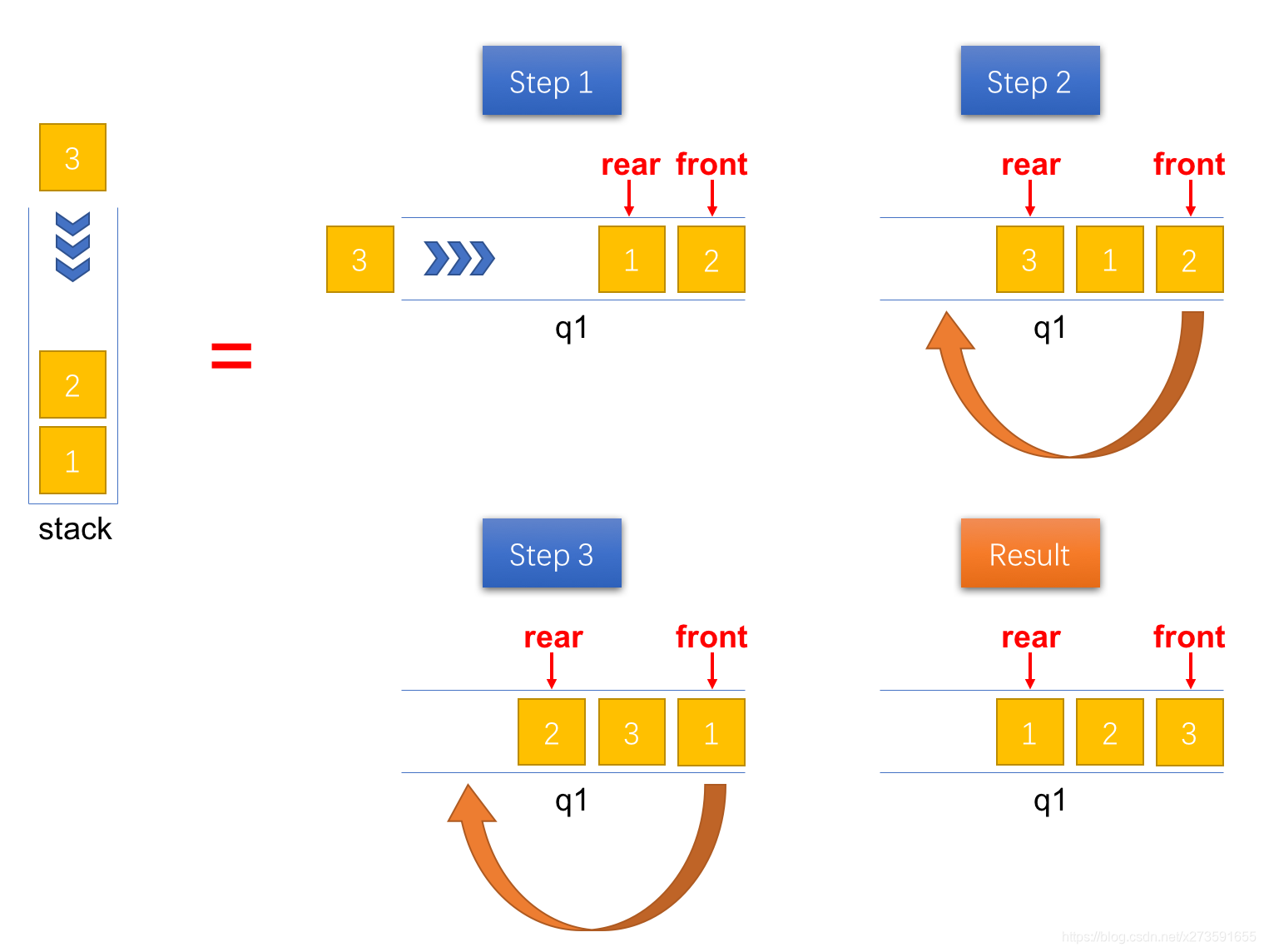
图5:将一个元素压入栈
代码(Java)实现如下:
/** Push element x onto stack. */

public void push(int x) {

    queue.add(x);

    for (int i = 0; i < queue.size() - 1; ++i) {

        queue.add(queue.remove());

    }

}
复杂度分析:
- 时间复杂度:\(O(n)\),其中 \(n\) 表示入栈前栈内元素的数目。入栈操作需要 \(n\) 次的出队操作,同时也需要 \(n + 1\)次的入队操作,因此,需要总的操作次数为 \(2n + 1\) 次。由于
LinkedList的添加和删除操作的时间复杂度是 \(O(1)\) 的,因此,总的时间复杂度为 \(O(n)\) - 空间复杂度:\(O(1)\)
出栈(pop)
由于在入栈时已经将队列中的元素排列成出栈的顺序,因此,只需要出队队列 q1 中队首的元素即可。
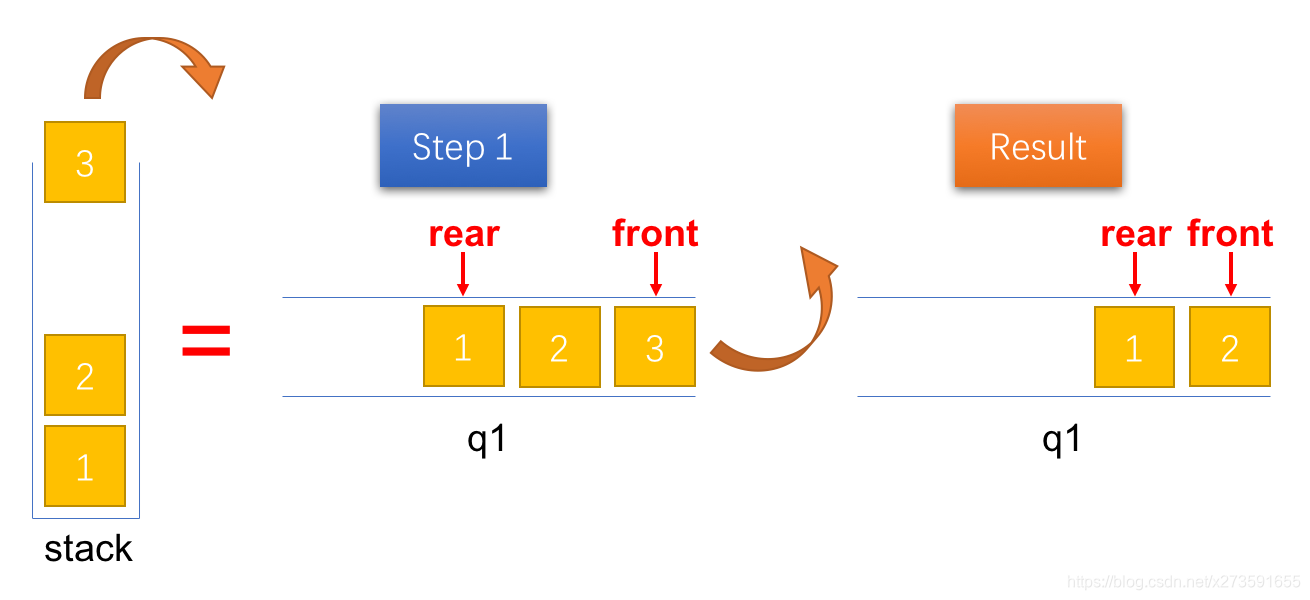
图6:将一个元素出栈
代码(Java)实现如下:
/** Removes the element on top of the stack and returns that element. */

public int pop() {

    if (queue.isEmpty()) {

        throw new NoSuchElementException("[ERROR] The stack is empty!");

    }

    return queue.remove();

}
复杂度分析如下:
- 时间复杂度:$ O(1) $
- 空间复杂度:$ O(1) $
查看栈顶元素(peek)
同理,只需要返回队列 q1 的队首元素即可。
/** Get the top element. */

public int top() {

    if (queue.isEmpty()) {

        throw new NoSuchElementException("[ERROR] The stack is empty!");

    }

    return queue.peek();

}
复杂度分析如下:
- 时间复杂度:$ O(1) $
- 空间复杂度:$ O(1) $
是否为空(empty)
队列 q1 中保存了栈中的所有元素,因此,如果想要知道栈是否为空,只需要判断队列 q1 中是否还有元素,代码(Java)实现如下:
/** Returns whether the stack is empty. */

public boolean empty() {

    return queue.isEmpty();

}
复杂度分析如下:
- 时间复杂度:$ O(1) $
- 空间复杂度:$ O(1) $
Java 实现
import java.util.LinkedList;

import java.util.NoSuchElementException;

import java.util.Queue;

class MyStack {

    private Queue<Integer> queue;

    /** Initialize your data structure here. */

    public MyStack() {

        queue = new LinkedList<>();

    }

    /** Push element x onto stack. */

    public void push(int x) {

        queue.add(x);

        for (int i = 0; i < queue.size() - 1; ++i) {

            queue.add(queue.remove());

        }

    }

    /** Removes the element on top of the stack and returns that element. */

    public int pop() {

        if (queue.isEmpty()) {

            throw new NoSuchElementException("[ERROR] The stack is empty!");

        }

        return queue.remove();

    }

    /** Get the top element. */

    public int top() {

        if (queue.isEmpty()) {

            throw new NoSuchElementException("[ERROR] The stack is empty!");

        }

        return queue.peek();

    }

    /** Returns whether the stack is empty. */

    public boolean empty() {

        return queue.isEmpty();

    }

}

/**

 * Your MyStack object will be instantiated and called as such:

 * MyStack obj = new MyStack();

 * obj.push(x);

 * int param_2 = obj.pop();

 * int param_3 = obj.top();

 * boolean param_4 = obj.empty();

 */
Python 实现
from collections import deque

class MyStack:

    def __init__(self):

        """

        Initialize your data structure here.

        """

        self._q = deque()

    def push(self, x):

        """

        Push element x onto stack.

        :type x: int

        :rtype: void

        """

        self._q.append(x)

        for _ in range(len(self._q) - 1):

            self._q.append(self._q.popleft())

    def pop(self):

        """

        Removes the element on top of the stack and returns that element.

        :rtype: int

        """

        if not self._q:

            raise Exception("[ERROR] The stack is empty!")

        return self._q.popleft()

    def top(self):

        """

        Get the top element.

        :rtype: int

        """

        if not self._q:

            raise Exception("[ERROR] The stack is empty!")

        return self._q[0]

    def empty(self):

        """

        Returns whether the stack is empty.

        :rtype: bool

        """

        return not self._q
【LeetCode题解】225_用队列实现栈(Implement-Stack-using-Queues)的更多相关文章
- LeetCode 225:用队列实现栈 Implement Stack using Queues
题目: 使用队列实现栈的下列操作: push(x) -- 元素 x 入栈 pop() -- 移除栈顶元素 top() -- 获取栈顶元素 empty() -- 返回栈是否为空 Implement th ...
- [Swift]LeetCode225. 用队列实现栈 | Implement Stack using Queues
Implement the following operations of a stack using queues. push(x) -- Push element x onto stack. po ...
- leetcode:Implement Stack using Queues 与 Implement Queue using Stacks
一.Implement Stack using Queues Implement the following operations of a stack using queues. push(x) - ...
- leetcode 155. Min Stack 、232. Implement Queue using Stacks 、225. Implement Stack using Queues
155. Min Stack class MinStack { public: /** initialize your data structure here. */ MinStack() { } v ...
- 【LeetCode】232 & 225 - Implement Queue using Stacks & Implement Stack using Queues
232 - Implement Queue using Stacks Implement the following operations of a queue using stacks. push( ...
- 232. Implement Queue using Stacks,225. Implement Stack using Queues
232. Implement Queue using Stacks Total Accepted: 27024 Total Submissions: 79793 Difficulty: Easy Im ...
- Implement Queue by Two Stacks & Implement Stack using Queues
Implement Queue by Two Stacks Implement the following operations of a queue using stacks. push(x) -- ...
- [LeetCode] Implement Stack using Queues 用队列来实现栈
Implement the following operations of a stack using queues. push(x) -- Push element x onto stack. po ...
- LeetCode 225 Implement Stack using Queues(用队列来实现栈)(*)
翻译 用队列来实现栈的例如以下操作. push(x) -- 将元素x加入进栈 pop() -- 从栈顶移除元素 top() -- 返回栈顶元素 empty() -- 返回栈是否为空 注意: 你必须使用 ...
随机推荐
- HBase最佳实践(好文推荐)
HBase最佳实践-写性能优化策略 HBase最佳实践-管好你的操作系统 HBase最佳实践之列族设计优化 [大数据]HBase最佳实践 – 集群规划
- hdu 4941 map的使用
http://acm.hdu.edu.cn/showproblem.php?pid=4941 给定N,M和K,表示在一个N*M的棋盘上有K个棋子,给出K个棋子的位置和值,然后是Q次操作,对应的是: 1 ...
- AngularJS 模块及provide
一.模块 模块是一些功能的集合,如控制器.服务.过滤器.指令等子元素组成的整体. 1.注册和使用 模块相当于是一个注册表,保存着名字和编程元素的对照表,可存入也可取出. angular.module( ...
- ASP.NET Web API 框架研究 Web Host模式下的消息处理管道
寄宿的作用是开启一个进程为Web API提供一个运行环境以解决持续监听.请求监听和响应回复,即将接收到的请求转换成HttpRequestMessage对象传入管道,并将管道生成并经过处理后的HttpR ...
- 前端开发 - jQuery
本节内容 一.jQuery概述 二.选择器 三.操作DOM 四.修改DOM结构 五.事件 六.动画 七.AJAX(待续) 八.扩展(待续) 一.jQuery概述 jQuery 是一个 JavaScri ...
- 12.Scrapy与mongodb交互和设置中间键
反反爬虫相关机制 Some websites implement certain measures to prevent bots from crawling them, with varying d ...
- [leetcode 50]remove element
1 题目 Given an array and a value, remove all instances of that value in place and return the new leng ...
- RNN以及LSTM的介绍和公式梳理
前言 好久没用正儿八经地写博客了,csdn居然也有了markdown的编辑器了,最近花了不少时间看RNN以及LSTM的论文,在组内『夜校』分享过了,再在这里总结一下发出来吧,按照我讲解的思路,理解RN ...
- ASP.NET Core开源地址
https://github.com/dotnet/corefx 这个是.net core的 开源项目地址 https://github.com/aspnet 这个下面是asp.net core 框架 ...
- C# 一些代码小结--UI操作
C# 一些代码小结--UI操作 使用控件名调用控件 object obj = this.GetType().GetField("控件名", System.Reflection.Bi ...