
【C++ Primer | 07】泛型算法
定制操作
 #include <iostream>
 #include <string>
 #include <vector>
 #include <algorithm>
 #include <numeric>
 #include <list>
 using namespace std;

 template <typename Sequence>
 inline ostream& println(Sequence const& seq)
 {
     for (auto const& elem : seq)
         cout << elem << " ";
     cout << endl;
     return cout;
 }

 inline bool is_shorter(std::string const& lhs, std::string const& rhs)
 {
     return  lhs.size() < rhs.size();
 }

 void elimdups(vector<string> &vs)
 {
     sort(vs.begin(), vs.end());
     auto new_end = unique(vs.begin(), vs.end());
     vs.erase(new_end, vs.end());
 }

 int main()
 {
     vector<", "Hi", "alan", "wang" };
     elimdups(v);
     stable_sort(v.begin(), v.end(), is_shorter);
     cout << "ex10.11 :\n";
     println(v);
     system("pause");
     ;
 }
输出结果:

Exercise 10.14:
 int main()
 {
     auto sum = [](int a, int b) {return a + b; };
     cout << sum(, ) << endl;
     ;
 }
Exercise 10.16
 #include <iostream>
 #include <string>
 #include <vector>
 #include <algorithm>
 using namespace std;

 void elimdups(vector<string> &vs)
 {
     sort(vs.begin(), vs.end());
     for (auto c : vs)
         cout << c << " ";
     cout << endl;

     auto new_end = unique(vs.begin(), vs.end());
     vs.erase(new_end, vs.end());
     for (auto c : vs)
         cout << c << " ";
     cout << endl;

 }

 void biggies(vector<string> &vs, size_t sz)
 {
     elimdups(vs);
     stable_sort(vs.begin(), vs.end(), [](string const& lhs, string const& rhs) {
         return lhs.size() < rhs.size(); });

     auto wc = find_if(vs.begin(), vs.end(), [sz](string const& s) {
         return s.size() >= sz; });

     for_each(wc, vs.end(), [](const string &s) {
         cout << s << " ";
     });
 }

 int main()
 {
     vector<string> v{
         ","hi~", "alan", "alan", "cp"
     };
     cout << "ex10.16: " << endl;
     biggies(v, );
     cout << endl;
     system("pause");
     ;
 }
输出结果:
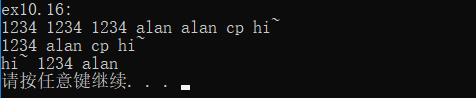
Exercise 10.18、10.19
 #include <iostream>
 #include <string>
 #include <vector>
 #include <algorithm>
 using namespace std;

 // from ex 10.9
 void elimdups(vector<string> &vs)
 {
     sort(vs.begin(), vs.end());
     auto new_end = unique(vs.begin(), vs.end());
     vs.erase(new_end, vs.end());
     for (auto it = vs.cbegin(); it != vs.end(); ++it)
         cout << *it << " ";
     cout << endl;
 }

 // ex10.18
 void biggies_partition(vector<string> &vs, size_t sz)
 {
     elimdups(vs);
     auto pivot = partition(vs.begin(), vs.end(), [sz](const string &s) {
         return s.size() >= sz; }
     );

     for (auto it = vs.cbegin(); it != pivot; ++it)
         cout << *it << " ";

 }

 // ex10.19
 void biggies_stable_partition(vector<string> &vs, std::size_t sz)
 {
     elimdups(vs);

     auto pivot = stable_partition(vs.begin(), vs.end(), [sz](const string& s) {
         return s.size() >= sz; });

     for (auto it = vs.cbegin(); it != pivot; ++it)
         cout << *it << " ";
 }

 int main()
 {
     // ex10.18
     vector<string> v{
         "the", "quick", "red", "fox", "jumps", "over", "the", "slow", "red", "turtle"
     };

     cout << "ex10.18: ";
     vector<string> v1(v);
     biggies_partition(v1, );
     cout << endl;

     // ex10.19
     cout << "ex10.19: ";
     vector<std::string> v2(v);
     biggies_stable_partition(v2, );
     cout << endl;
     system("pause");
     ;
 }
输出结果:

参数绑定
Exercise 10.22:
 #include <iostream>
 #include <vector>
 #include <string>
 #include <algorithm>
 #include <functional>

 using namespace std;
 using namespace std::placeholders;

 bool isLesserThanOrEqualTo6(const string &s, string::size_type sz)
 {
     return s.size() <= sz;
 }

 int main()
 {
     vector<string> authors{ "Mooophy", "pezy", "Queequeg90", "shbling", "evan617" };
     cout << count_if(authors.cbegin(), authors.cend(), bind(isLesserThanOrEqualTo6, _1, )) << endl;
     system("pause");
     ;
 }
Exercise 10.24:
#include <iostream>
#include <vector>
#include <algorithm>
#include <functional>

using namespace std;
using namespace std::placeholders;

auto check_size(string const& str, size_t sz)
{
    return str.size() < sz;
}

int main()
{
    vector<, , , , , , ,  };
    ");
    auto result = find_if(vec.begin(), vec.end(), bind(check_size, str, _1));
    if (result != vec.end())
        cout << *result << endl;
    else
        cout << "Not found" << endl;
    system("pause");
    ;
}
#include <iostream>
#include <vector>
#include <algorithm>
#include <functional>

using namespace std;
using namespace std::placeholders;

auto check_size(string const& str, size_t sz)
{
    return str.size() < sz;
}

int main()
{
    vector<int> vec{ 0, 1, 2, 3, 4, 5, 6, 7 };
    string str("123456");
    auto result = find_if(vec.begin(), vec.end(), bind(check_size, str, _1));
    if (result != vec.end())
        cout << *result << endl;
    else
        cout << "Not found" << endl;
    system("pause");
    return 0;
}
#include <iostream>
#include <vector>
#include <algorithm>
#include <functional>

using namespace std;
using namespace std::placeholders;

auto check_size(string const& str, size_t sz)
{
    return str.size() < sz;
}

int main()
{
    vector<int> vec{ 0, 1, 2, 3, 4, 5, 6, 7 };
    string str("123456");
    auto result = find_if(vec.begin(), vec.end(), bind(check_size, str, _1));
    if (result != vec.end())
        cout << *result << endl;
    else
        cout << "Not found" << endl;
    system("pause");
    return 0;
}
【C++ Primer | 07】泛型算法的更多相关文章
- c++ primer 11 泛型算法
使用泛型算法必须包含头文件#inlucde <algorithm> 标准库还定义一组泛化的算术算法,其命名习惯与泛型算法相同,包含头文件#include <numeric> f ...
- C++ Primer : 第十章 : 泛型算法 之 只读、写和排序算法
大多数算法都定义在<algorithm>头文件里,而标准库还在头文件<numeric>里定义了一组数值泛型算法,比如accumulate. ● find算法,算法接受一对迭代 ...
- C++ Primer 5th 第10章 泛型算法
练习10.1:头文件algorithm中定义了一个名为count的函数,它类似find,接受一对迭代器和一个值作为参数.count返回给定值在序列中出现的次数.编写程序,读取int序列存入vector ...
- C++ Primer 读书笔记:第11章 泛型算法
第11章 泛型算法 1.概述 泛型算法依赖于迭代器,而不是依赖容器,需要指定作用的区间,即[开始,结束),表示的区间,如上所示 此外还需要元素是可比的,如果元素本身是不可比的,那么可以自己定义比较函数 ...
- 【足迹C++primer】30、概要(泛型算法)
概要(泛型算法) 大多数算法的头文件中定义algorithm在. 标准库也是第一个文件numeric它定义了一套通用算法. #include<iostream> #include<n ...
- 【C++ Primer | 07】常用算法
第一部分 常用泛型算法: find(beg, end, val); equal(beg1, end1, beg2); fill(beg, end, val); fill_n(beg, cnt, val ...
- [C++ Primer] : 第10章: 泛型算法
概述 泛型算法: 称它们为"算法", 是因为它们实现了一些经典算法的公共接口, 如搜索和排序; 称它们是"泛型的", 是因为它们可以用于不同类型的元素和多种容器 ...
- C++ Primer 学习笔记_45_STL实践与分析(19)--泛型算法的结构
STL实践与分析 --泛型算法的结构 引言: 正如全部的容器都建立在一致的设计模式上一样,算法也具有共同的设计基础. 算法最主要的性质是须要使用的迭代器种类.全部算法都指定了它的每一个迭代器形參可使用 ...
- C++ Primer笔记6_STL之泛型算法
1.泛型算法: 大多数算法定义在头文件algorithm中.标准库还在头文件numeric中定义了一组数值泛型算法 仅仅读算法: 举例: find函数用于找出容器中一个特定的值,有三个參数 int v ...
- C++ 泛型算法
<C++ Primer 4th>读书笔记 标准容器(the standard container)定义了很少的操作.标准库并没有为每种容器类型都定义实现这些操作的成员函数,而是定义了一组泛 ...
随机推荐
- k64 datasheet学习笔记52---Universal Asynchronous Receiver/Transmitter (UART)
1.前言 UART实现与外设或CPU的通信 2. UART概述 2.1基本特性 (1)Full-duplex operation (2)Standard mark/space non-return-t ...
- 利用Linux系统生成随机密码的10种方法【转】
Linux操作系统的一大优点是对于同样一件事情,你可以使用高达数百种方法来实现它.例如,你可以通过数十种方法来生成随机密码.本文将介绍生成随机密码的十种方法. 1. 使用SHA算法来加密日期,并输出结 ...
- DeprecationWarning: Calling an asynchronous function without callback is deprecated. - how to find where the “function:” is?
I recently updated my node to 7.2.1 and noticed that there is a warning coming: (node:4346) Deprecat ...
- VB获取CAD属性值
Dim myAcadApp As AutoCAD.AcadApplication, activeDoc As AutoCAD.AcadDocument, acMS As AutoCAD.AcadMod ...
- The superclass "javax.servlet.http.HttpServlet" was not found on the Java Build Path 解决办法
♦ 未在 Java构建路径中 找到父类 "javax.servlet.http.HttpServlet" ♦ 解决办法: 项目右击 → Build Path → 右侧 Add L ...
- CF55D: Beautiful Number
传送门 一句话题意 求 l~r 之间有多少个数能整除自己各位上的数(排除 0 ) 分析 然后我们一看就知道数位 dp ,但是状态很难设计啊 QWQ 我们可以发现所有数位的 lcm 最大为 2520 ( ...
- HBase基础架构及原理
1. HBase框架简单介绍 HBase是一个分布式的.面向列的开源数据库,它不同于一般的关系数据库,是一个适合于非结构化数据存储的数据库.另一个不同的是HBase基于列的而不是基于行的模式.HBas ...
- Appium新版本不再支持ByName定位了怎么办
appium版本在1.5以后就不再支持ByName的定位,本文章仅介绍在appium1.6.3/1.6.4/1.6.5版本下如何支持ByName定位,适用于安卓.在使用appium1.5之后的版本时, ...
- python之hashlib
简介: 用于加密相关的操作,代替了md5模块和sha模块,主要提供SHA1,SHA224,SHA256,SHA384,SHA512,MD5算法.在python3中已经废弃了md5和sha模块,简单说明 ...
- 给Linux增加swap内存
有时内存不足时, 编译xxx报错cc: 编译器内部错误:已杀死(程序 cc1) Please submit a full bug report, with preprocessed source if ...