
vmware vSphere 5.5的14个新功能
1.Flash Read Cache

This completely new feature in vSphere 5.5 provides a mechanism for utilizing fast SSD as a Linux host swap cache or to provide improved read speed for a host virtual disk. To make use of this feature, you first have to create a new resource, as shown in the screenshot. Then you must connect to that resource from each VM needing access. For a Linux guest, this would consist of configuring a swap disk to use part of the read cache. Another option would be to enable caching for a VM.
2.Application HA

Also new in vSphere 5.5 is policy-based application monitoring and automatic remediation. Based on vFabric Hyperic, Application HA supports a short list of off-the-shelf applications, including Microsoft SQL Server, SharePoint, IIS, and the Apache Web Server, and makes it possible to attempt a restart when a failure is detected. If the application restart is unsuccessful, the feature will leverage vSphere HA to restart the VM on the same host after a predetermined amount of time. If that process fails, the VM will be restarted on another host.
3.Low latency improvements

VMware has added a number of improvements at both the VM and hypervisor level to help improve overall latency. At the VM level, this consists of a single setting to indicate to vSphere the sensitivity to latency. For high sensitivity applications, the underlying hypervisor can do things like bypass the CPU scheduling algorithms and dedicate one or more CPU sockets exclusively to a single VM. Additional actions include reserving memory for a latency sensitive VMs and disabling networking features, such as coalescing and LRO vNIC support for predictable network response.
4.62TB virtual machine disks

The 2TB limit on VM disks is starting to pinch. With vSphere 5.5, the maximum size for VMDK files increases all the way up to 62TB. Why that particular number you might ask? VMware settled on something smaller than 64TB to allow room for snapshots and any other required services while staying under a 64TB volume size. Existing VMDK files will have to be offline in order to be expanded. The new huge VMDK file size will not be supported in the initial release of the VSAN product, however -- expect that to come at a later date.
5.Storage tagging
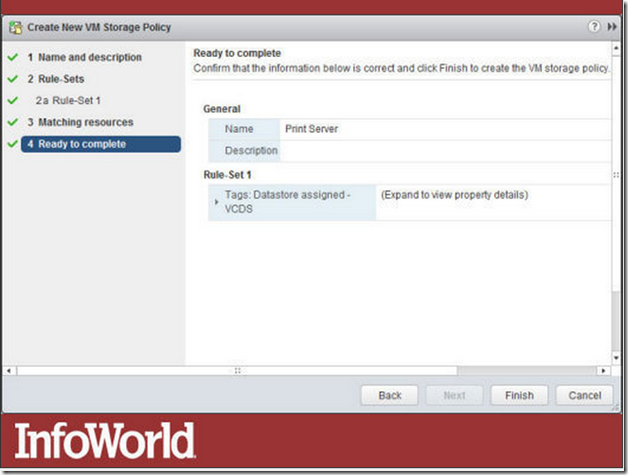
In really large data centers, it can be a challenge to identify the appropriate class of storage for a specific purpose. In this screenshot, you can see the name Print Server being assigned to a new VM Storage Policy. This creates a new policy that can be applied to all new virtual machines needing storage for a print server, making storage provisioning much simpler.
6.Improved LACP support

LACP (Link Aggregation Control Protocol) allows you to aggregate the bandwidth of multiple physical NICs. Whereas vSphere 5.1 supported only one LACP group per distributed switch, severely limiting your aggregation options, vSphere 5.5 supports up to 64. Plus, you can now save LACP configurations as templates to use on other hosts, and you can draw on 22 different hashing algorithms (versus just IP hash in 5.5) to distribute load across links.
7.Port mirroring

Sometimes it becomes necessary to capture the packets going across the network to track down a problem. The latest version of vSphere includes a an enhanced version of the open source packet analyzer tcpdump and a number of options for mirroring ports to capture traffic in a variety of places. You can capture packets from virtual NICs, virtual switches, and uplinks at the host level as well.
8.Traffic filtering

Moving network traffic from host A to host B in a virtual network now resembles what you would expect to see on a physical network with sophisticated switches. The vSphere 5.5 distributed switch now includes the ability to shape and direct Layer 3 network traffic using the Differentiated Services Code Point field in the IP packet header. It's also known as DiffServ and acts like the access control list feature found on many high-end physical switches. Individual rules can be configured on a distributed switch to handle specific types of traffic in order to provide a higher quality of service when necessary.
9.vCenter Server improvements

The vSphere Web Client has seen a number of enhancements in this release. Many reflect user feedback, such as the “10 most recent objects” list shown in the screenshot. Other improvements to the user experience include the new drag and drop support and the ability to filter search results for large installations.
The vCenter Server Appliance, meanwhile, gets a scalability boost. Previous versions supported a limited number of hosts and VMs, but these limits have been increased to 500 hosts and up to 5,000 VMs.
VMware has also poured a good deal of effort into making vCenter Single Sign-On simpler to install and easier to scale across multiple vCenter Server instances. Version 5.5 will even include a suite of diagnostic tools.
10.Multiple point-in-time replicas

Previous versions of vSphere Replication kept only the most recent copy of a virtual machine. Version 5.5 can keep up to 24 historical snapshots. You could retain one replica per day for 24 days, or one per hour for 24 hours -- however you want to slice it. Recovery always draws on the most recent copy, but from there, you can use the snapshot manager to revert to any other point in time.
11.ACPI support

One of the limitations of previous versions of VMware virtual machines was the small number of virtual devices supported. The vSphere 5.5 release introduces Virtual Hardware 10, which adds SATA-based virtual device nodes via AHCI (Advanced Host Controller Interface) support. AHCI support is required for OS X guests going forward due to Apple’s elimination of support for IDE devices. It also makes it possible to connect up to 120 devices per VM.
12.Support for new graphics devices

Virtual Hardware 10 also adds support for a number of new graphic capabilities. First up is support for both AMD and Intel GPUs. Included in this update is the ability to vMotion a VM between disparate hardware platforms including disparate GPU support. This previously required similar hardware for the vMotion to work. Also included in this release is support for OpenGL version 2.1, which is the default graphics API used in popular Linux distributions including Fedora 17 and Ubuntu 12.
vmware vSphere 5.5的14个新功能的更多相关文章
- VMware vsphere Hypervisor、VMware vsphere和VMware Workstation小记
VMware Workstation软件需要依赖于宿主操作系统之上. VMware vSphere是VMware公司推出一套服务器虚拟化解决方案,它是可以直接独立安装和运行在祼机上的系统. VMwar ...
- 超详细 Java 15 新功能介绍
点赞再看,动力无限.微信搜「程序猿阿朗 」,认认真真写文章. 本文 Github.com/niumoo/JavaNotes 和 未读代码博客 已经收录,有很多知识点和系列文章. Java 15 在 2 ...
- Java 17 新功能介绍(LTS)
点赞再看,动力无限.Hello world : ) 微信搜「程序猿阿朗 」. 本文 Github.com/niumoo/JavaNotes 和 未读代码博客 已经收录,有很多知识点和系列文章. Jav ...
- VMware vSphere 5.1 简介与安装
虚拟化系列-VMware vSphere 5.1 简介与安装 标签: 虚拟化 esxi5.1 VMware vSphere 5.1 原创作品,允许转载,转载时请务必以超链接形式标明文章 原始出处 . ...
- [转载]【虚拟化系列】VMware vSphere 5.1 网络管理
转载自:http://mabofeng.blog.51cto.com/2661587/1020375 网络是VMware vSphere 5.1的基础,所有虚拟机都需要网络来进行通信.如果将所有的虚拟 ...
- [转载]【虚拟化系列】VMware vSphere 5.1 虚拟机管理
转载自:http://mabofeng.blog.51cto.com/2661587/1019497 在上一博文中我们安装了强大的VMware vCenter管理中心,通过VMware vSphere ...
- [转载]【虚拟化系列】VMware vSphere 5.1 简介与安装
转载自:http://mabofeng.blog.51cto.com/2661587/1017680 一. VMware vSphere 5.1简介 vSphere是VMware推 ...
- VMware vSphere学习整理
知识点整理 内存选择 一般来说,每个虚拟机需要的内存在1~4GB甚至更多,还要为VMware ESXi预留一部分内存 2个6核的2U服务器配置64GB内存,4个6核或8核心的4U服务器配置128GB或 ...
- 【虚拟化系列】VMware vSphere 5.1 网络管理
网络是VMware vSphere 5.1的基础,所有虚拟机都需要网络来进行通信.如果将所有的虚拟机都看成是物理机,则在网络拓扑上,需要网卡和交换机等不同的网络连接设备和方式.而在虚拟化中,这些 ...
随机推荐
- 性能测试三十八:Java性能分析神器-JProfiler安装和简单介绍
Jprofiler是一个重量级的工具,需要分别在服务器和windows都装客户端,会损耗性能,用于发现问题后排查问题,而不是常规的监控 JPROFILER工具下载地址:http://www.ej-te ...
- 获取修改value
val() 方法,获取和修改有value属性的元素,有value属性的元素有input.botton.select等.相当于JavaScript中的value. <!DOCTYPE html&g ...
- Visual Studio强大的帮助工具--Resharper安装与使用
ReSharper是一个JetBrains公司出品的代码生成工具,其能帮助Microsoft Visual Studio成为一个更佳的IDE.使用ReSharper,你可以进行深度代码分析,智能代码协 ...
- .NetCore下使用Prometheus实现系统监控和警报 (六)进阶Grafana集成自定义收集指标
Prometheus中包含了很多收集指标,那么我们怎来在Grafana中来使用呢? 接下来我们还是以之前自定义的来演示如图:我们在Prometheus中已经可以看到这个之前我们自定义的类型了 关于Gr ...
- #9 //[SDOI2017]新生舞会
题解: 分数规划+费用流 常数巨大开o2加inline加register还是不行 我也不知道为什么 代码: #include <bits/stdc++.h> using namespace ...
- Codeforces 891C Envy
Envy 感觉这种最小生成树上的啥题都差不多的解法.. #include<bits/stdc++.h> #define LL long long #define fi first #def ...
- Nordic Collegiate Programming Contest NCPC 2017-Problem G Galactic Collegiate Programming Contest
题目大意:有n( n<1e5 )只队伍参加程序竞赛,然后给m个信息,每个信息告诉你第p 个队伍过了一题,并且告诉你罚时是多少,让你输入每个信息之后,第一个队伍的 排名. 思路:一眼看过去就像数据 ...
- 【Java】 剑指offer(20) 表示数值的字符串
本文参考自<剑指offer>一书,代码采用Java语言. 更多:<剑指Offer>Java实现合集 题目 请实现一个函数用来判断字符串是否表示数值(包括整数和小数).例如, ...
- python selenium-webdriver 元素定位(三)
上两篇的博文中介绍了python selenium的环境搭建和编写的第一个自动化测试脚本,从第二篇的例子中看出来再做UI级别的自动化测试的时候,有一个至关重要的因素,那就是元素的定位,只有从页面上找到 ...
- POI搜索简介
用户输入——用户输出-----------------------------------------------------------而POI搜索引擎,需要做的就是拿到输入条件,给出用户比较满意的 ...