
FITTING A MODEL VIA CLOSED-FORM EQUATIONS VS. GRADIENT DESCENT VS STOCHASTIC GRADIENT DESCENT VS MINI-BATCH LEARNING. WHAT IS THE DIFFERENCE?
FITTING A MODEL VIA CLOSED-FORM EQUATIONS VS. GRADIENT DESCENT VS STOCHASTIC GRADIENT DESCENT VS MINI-BATCH LEARNING. WHAT IS THE DIFFERENCE?
In order to explain the differences between alternative approaches to estimating the parameters of a model, let's take a look at a concrete example: Ordinary Least Squares (OLS) Linear Regression. The illustration below shall serve as a quick reminder to recall the different components of a simple linear regression model:
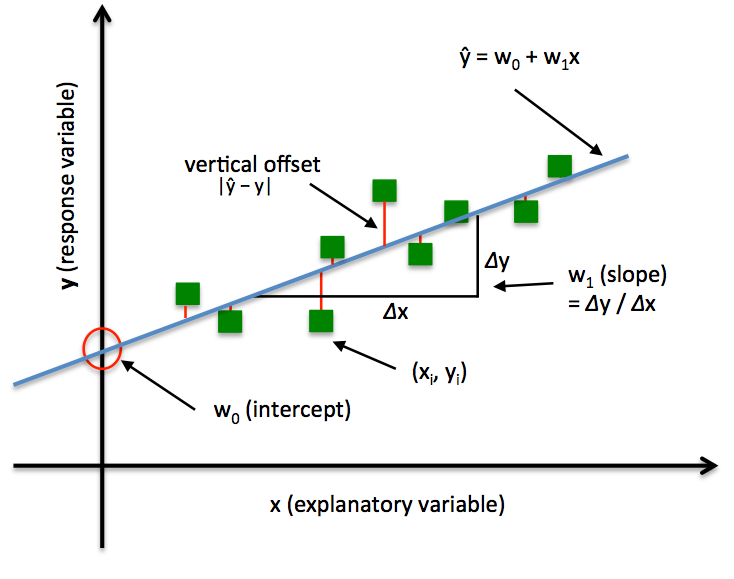
In Ordinary Least Squares (OLS) Linear Regression, our goal is to find the line (or hyperplane) that minimizes the vertical offsets. Or, in other words, we define the best-fitting line as the line that minimizes the sum of squared errors (SSE) or mean squared error (MSE) between our target variable (y) and our predicted output over all samples i in our dataset of size n.
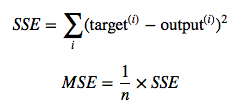
Now, we can implement a linear regression model for performing ordinary least squares regression using one of the following approaches:
- Solving the model parameters analytically (closed-form equations)
- Using an optimization algorithm (Gradient Descent, Stochastic Gradient Descent, Newton's Method, Simplex Method, etc.)
1) NORMAL EQUATIONS (CLOSED-FORM SOLUTION)
The closed-form solution may (should) be preferred for "smaller" datasets -- if computing (a "costly") matrix inverse is not a concern. For very large datasets, or datasets where the inverse of XTX may not exist (the matrix is non-invertible or singular, e.g., in case of perfect multicollinearity), the GD or SGD approaches are to be preferred. The linear function (linear regression model) is defined as:

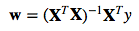
where y is the response variable, x is an m-dimensional sample vector, and w is the weight vector (vector of coefficients). Note that w0 represents the y-axis intercept of the model and therefore x0=1. Using the closed-form solution (normal equation), we compute the weights of the model as follows:
2) GRADIENT DESCENT (GD)
Using the Gradient Decent (GD) optimization algorithm, the weights are updated incrementally after each epoch (= pass over the training dataset).
The cost function J(⋅), the sum of squared errors (SSE), can be written as:
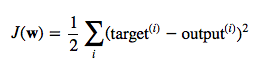
The magnitude and direction of the weight update is computed by taking a step in the opposite direction of the cost gradient
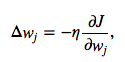
where η is the learning rate. The weights are then updated after each epoch via the following update rule:
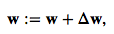
where Δw is a vector that contains the weight updates of each weight coefficient w, which are computed as follows:
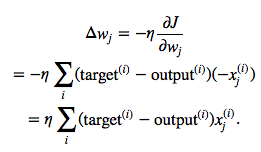
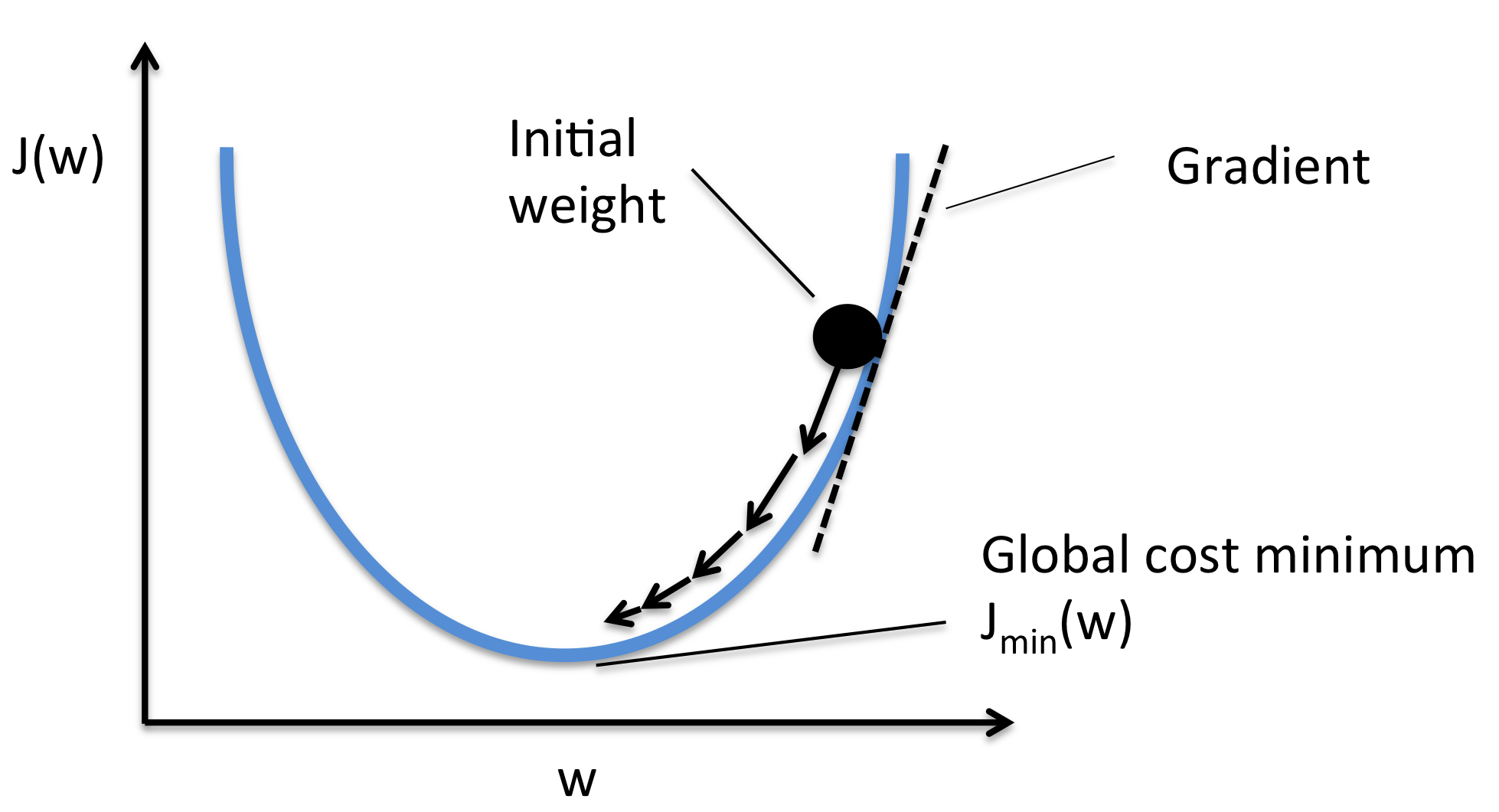
Essentially, we can picture GD optimization as a hiker (the weight coefficient) who wants to climb down a mountain (cost function) into a valley (cost minimum), and each step is determined by the steepness of the slope (gradient) and the leg length of the hiker (learning rate). Considering a cost function with only a single weight coefficient, we can illustrate this concept as follows:
3) STOCHASTIC GRADIENT DESCENT (SGD)
In GD optimization, we compute the cost gradient based on the complete training set; hence, we sometimes also call itbatch GD. In case of very large datasets, using GD can be quite costly since we are only taking a single step for one pass over the training set -- thus, the larger the training set, the slower our algorithm updates the weights and the longer it may take until it converges to the global cost minimum (note that the SSE cost function is convex).
In Stochastic Gradient Descent (SGD; sometimes also referred to as iterative or on-line GD), we don't accumulate the weight updates as we've seen above for GD:

Instead, we update the weights after each training sample:
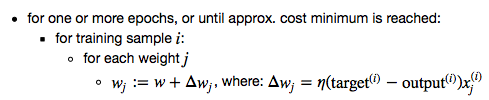
Here, the term "stochastic" comes from the fact that the gradient based on a single training sample is a "stochastic approximation" of the "true" cost gradient. Due to its stochastic nature, the path towards the global cost minimum is not "direct" as in GD, but may go "zig-zag" if we are visualizing the cost surface in a 2D space. However, it has been shown that SGD almost surely converges to the global cost minimum if the cost function is convex (or pseudo-convex)[1]. Furthermore, there are different tricks to improve the GD-based learning, for example:
An adaptive learning rate η Choosing a decrease constant d that shrinks the learning rate over time:

Momentum learning by adding a factor of the previous gradient to the weight update for faster updates:

A NOTE ABOUT SHUFFLING
There are several different flavors of SGD, which can be all seen throughout the literature. Let's take a look at the three most common variants:
A)
- randomly shuffle samples in the training set
- for one or more epochs, or until approx. cost minimum is reached
- for training sample i
- compute gradients and perform weight updates
- for training sample i
- for one or more epochs, or until approx. cost minimum is reached
B)
- for one or more epochs, or until approx. cost minimum is reached
- randomly shuffle samples in the training set
- for training sample i
- compute gradients and perform weight updates
- for training sample i
- randomly shuffle samples in the training set
C)
- for iterations t, or until approx. cost minimum is reached:
- draw random sample from the training set
- compute gradients and perform weight updates
- draw random sample from the training set
In scenario A [3], we shuffle the training set only one time in the beginning; whereas in scenario B, we shuffle the training set after each epoch to prevent repeating update cycles. In both scenario A and scenario B, each training sample is only used once per epoch to update the model weights.
In scenario C, we draw the training samples randomly with replacement from the training set [2]. If the number of iterationst is equal to the number of training samples, we learn the model based on a bootstrap sample of the training set.
4) MINI-BATCH GRADIENT DESCENT (MB-GD)
Mini-Batch Gradient Descent (MB-GD) a compromise between batch GD and SGD. In MB-GD, we update the model based on smaller groups of training samples; instead of computing the gradient from 1 sample (SGD) or all n training samples (GD), we compute the gradient from 1 < k < n training samples (a common mini-batch size is k=50).
MB-GD converges in fewer iterations than GD because we update the weights more frequently; however, MB-GD let's us utilize vectorized operation, which typically results in a computational performance gain over SGD.
REFERENCES
- [1] Bottou, Léon (1998). "Online Algorithms and Stochastic Approximations". Online Learning and Neural Networks. Cambridge University Press. ISBN 978-0-521-65263-6
- [2] Bottou, Léon. "Large-scale machine learning with SGD." Proceedings of COMPSTAT'2010. Physica-Verlag HD, 2010. 177-186.
- [3] Bottou, Léon. "SGD tricks." Neural Networks: Tricks of the Trade. Springer Berlin Heidelberg, 2012. 421-436.
FITTING A MODEL VIA CLOSED-FORM EQUATIONS VS. GRADIENT DESCENT VS STOCHASTIC GRADIENT DESCENT VS MINI-BATCH LEARNING. WHAT IS THE DIFFERENCE?的更多相关文章
- Python之路-(Django(csrf,中间件,缓存,信号,Model操作,Form操作))
csrf 中间件 缓存 信号 Model操作 Form操作 csrf: 用 django 有多久,我跟 csrf 这个概念打交道就有久了. 每次初始化一个项目时都能看到 django.middlewa ...
- 最大似然估计实例 | Fitting a Model by Maximum Likelihood (MLE)
参考:Fitting a Model by Maximum Likelihood 最大似然估计是用于估计模型参数的,首先我们必须选定一个模型,然后比对有给定的数据集,然后构建一个联合概率函数,因为给定 ...
- django 用model来简化form
django里面的model和form其实有很多地方有相同之处,django本身也支持用model来简化form 一般情况下,我们的form是这样的 from django import forms ...
- Django(八)下:Model操作和Form操作、序列化操作
二.Form操作 一般会创建forms.py文件,单独存放form模块. Form 专门做数据验证,而且非常强大.有以下两个插件: fields :验证(肯定会用的) widgets:生成HTML(有 ...
- Django(八)上:Model操作和Form操作
↑↑↑点上面的”+”号展开目录 Model和Form以及ModelForm简介 Model操作: 创建数据库表结构 操作数据库表 做一部分的验证 Form操作: 数据验证(强大) ModelForm ...
- day23 Model 操作,Form 验证以及序列化操作
Model 操作 1创建数据库表 定制表名: 普通索引: 创建两个普通索引,这样就会生成两个索引文件 联合索引: 为了只生成一个索引文件,才 ...
- [Angular2 Form] Reactive form: valueChanges, update data model only when form is valid
For each formBuild, formControl, formGroup they all have 'valueChanges' prop, which is an Observable ...
- 提高神经网络的学习方式Improving the way neural networks learn
When a golf player is first learning to play golf, they usually spend most of their time developing ...
- [C2P3] Andrew Ng - Machine Learning
##Advice for Applying Machine Learning Applying machine learning in practice is not always straightf ...
随机推荐
- C#中成员初始化顺序
http://blog.csdn.net/huangcailian/article/details/25958967 一.成员初始化整体顺序 1.成员赋值初始化先于构造函数: 2.成员赋值初始先从子类 ...
- m3u8字段意义解析
m3u8字段意义解析 HLS,Http Live Streaming是由Apple公司定义的用于实时流传输的协议,HLS基于HTTP协议实现,传输内容包括两部分,一是M3U8描述文件,二是TS媒体文件 ...
- 收集的User-Agent
headers = [ {"User-Agent": "Mozilla/4.0 (compatible; MSIE 6.0; Windows NT 5.1; SV1; A ...
- [CareerCup] 1.6 Rotate Image 翻转图像
1.6 Given an image represented by an NxN matrix, where each pixel in the image is 4 bytes, write a m ...
- 实践:VIM深入研究(20135301 && 20135337)
目录 一.基本知识 1.vim模式介绍 2.三种常用模式的切换 二.Vim文档编辑 1.vim重复命令 2.游标的快速跳转 3.复制粘贴和剪切 4.删除文本 5.字符的替换及撤销(Undo操作) 6. ...
- 安装mysql(zip格式安装包)
mysql下载地址:http://www.mysql.com/ 一. zip格式,解压缩之后要进行配置.解压之后可以将该文件夹改名,放到合适的位置,比如把文件夹改名为MySQL Server 5.6( ...
- 20145215《Java程序设计》第2周学习总结
20145215<Java程序设计>第二周学习总结 教材学习内容总结 Java语言中的很多基本语法都和C语言类似,在这里我总结一下Java中的基本语法: 标识符: 标识符是程序中自定义的一 ...
- Ajax基础详解1
Ajax也是前端必备技能了,学习任何语言,都需要以理论为基础的大量实践才能真正学会,之前学了Ajax很多遍,因为缺乏大量实践,总是会忘.所以不实践是失败之母...当然理论基础也很重要啦,今天谈谈我对A ...
- C#Json序列化和反序列化
1.动态决定数据是否要序列化 我的需求是这样的,我用了一款数据库的组件叫Dos.ORM,确实方便了不少,但是在用的时候,我发现一个问题,比如我定义的表中有一个字段添加时间,修改时间,这些都是默认的,在 ...
- css边框阴影
<style type="text/css">.mydiv{width:250px;height:auto;border:#909090 1px solid;backg ...