
Using SQLite database in your Windows 10 apps
MVP可以在channel 9上传视频了,所以准备做个英文视频传上去分享给大家,本文做稿子。
Hello everyone,
As we all know, SQLite is a great and popular local database running on mobile devices. Consider of its powerful and useful features, lots of apps use SQLite database as the main way of application data storage, including Android and iOS apps. What's more, SQLite is a cross-platform database and also have windows version so that windows apps are easy to integrate with it. Today I will give a lesson about using SQLite in UWP project.
Install
Firstly, it's necessary for us to install SQLite for windows. you can download the binary install file here. Actually, you can alse download the source and build it by youself, if you like source more. After you finnished installation, you can find the sqlite extension in the refrence window. It will look like this:

And we need to add the VC++ 2015 Runtime refrence too.
Project Configuration
Secondly, we need to add a framework named SQLite.Net for using SQLite effectively. In other words, SQLite.Net libary will help us access sqlite database more esaily. It have some relese versions which you can find in NuGet, and two of them are most useful, including SQLite.Net-PCL and SQLite.Net.Async-PCL.
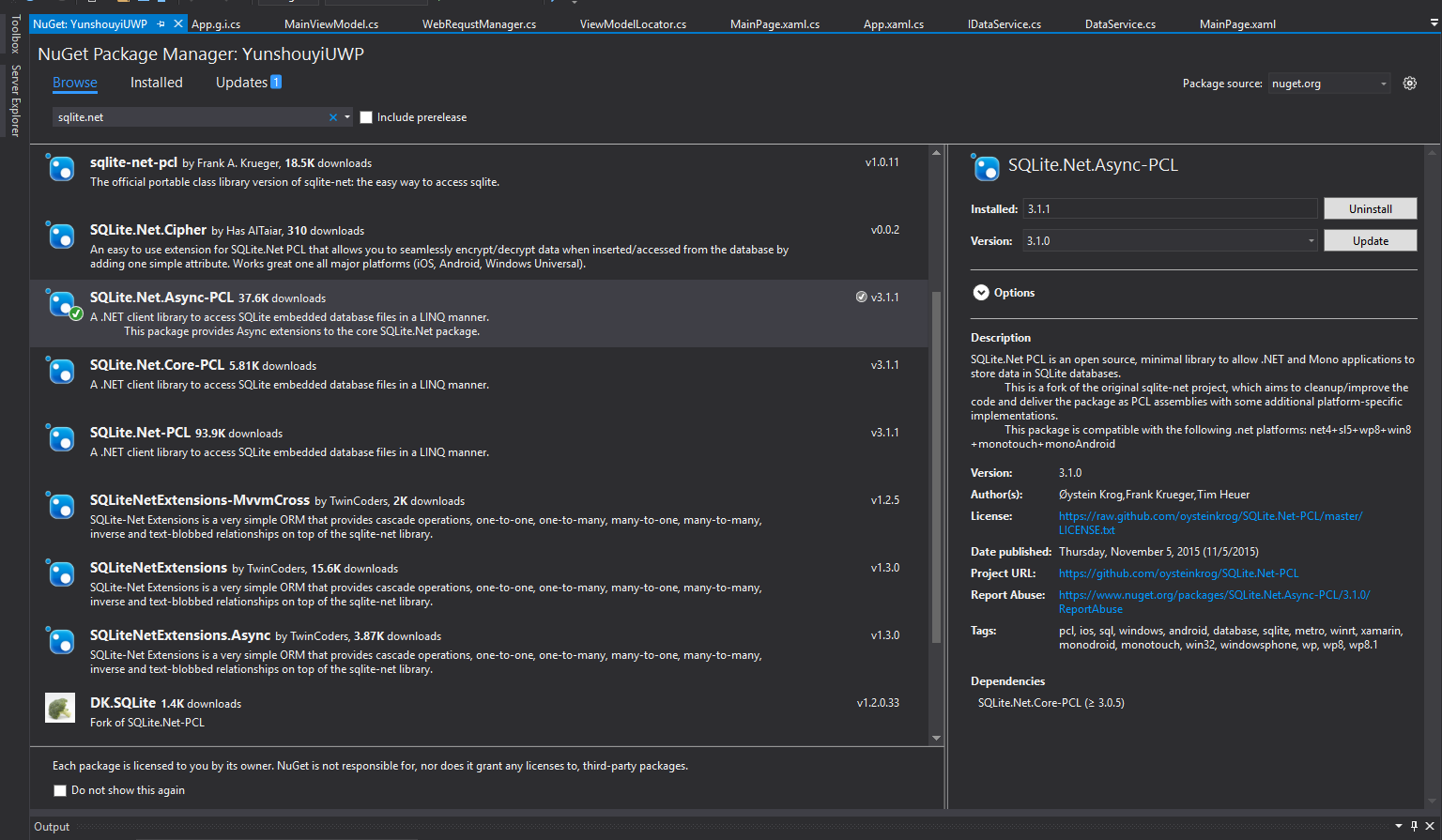
What's the defference between SQLite.Net-PCL and SQLite.Net.Async-PCL framework is that SQLite.Net.Async-PCL support asynchronous operations. Actually I like async-await more, so I will install SQLite.Net.Async-PCL framework. Once we finish configurations, we can write some code to use SQLite now.
SQLiteDBManager
Let's we have some interesting codes to begin using this amazing tool now. What's more, I will provide some example codes written by myself for you. The mainly code is used to manager local SQLite database file and access it more easily, so I named it SQLiteDBMnager.
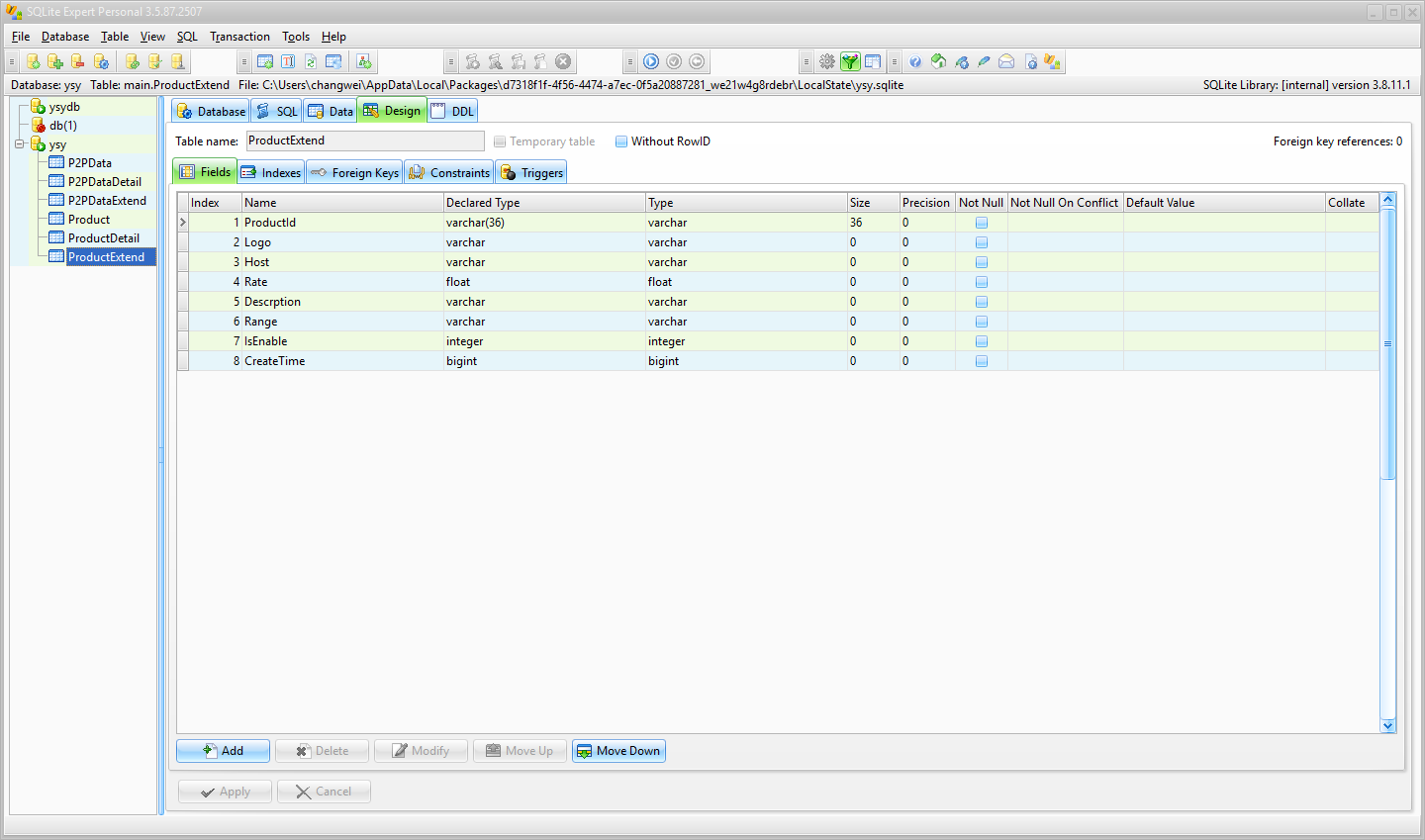
Before we access the data of database, we need import and manage the database file. In windows runtime framework we need to move or create database file in ApplicationData folder. And you can create a database file using SQLite Expert which is famous manage tool for SQLite database.
/// <summary>

        /// init db

        /// </summary>

        private static async void InitDBAsync()

        {

            try

            {

                var file = await ApplicationData.Current.LocalFolder.TryGetItemAsync("ysy.sqlite");

                if (file == null)

                {

                    var dbFile = await StorageFile.GetFileFromApplicationUriAsync(new Uri("ms-appx:///Data/ysy.sqlite"));

                    file = await dbFile.CopyAsync(ApplicationData.Current.LocalFolder);

                    var dbConnect = new SQLiteAsyncConnection(() => new SQLiteConnectionWithLock(new SQLite.Net.Platform.WinRT.SQLitePlatformWinRT(), new SQLiteConnectionString(file.Path, true)));

                    //create db tables

                    var result = await dbConnect.CreateTablesAsync(new Type[] { typeof(Product), typeof(P2PData), typeof(ProductDetail), typeof(P2PDataDetail), typeof(ProductExtend), typeof(P2PDataExtend) });

                    Debug.WriteLine(result);

                }

            }

            catch (Exception ex)

            {

                Debug.WriteLine(ex.Message);

            }

        }
After we initialize database, we need to access the data of database. Fortunately, SQLite.NET provides some method for us, but we still do some works to simplify codes.
/// <summary>

        /// get current DBConnection

        /// </summary>

        /// <returns></returns>

        public async Task<SQLiteAsyncConnection> GetDbConnectionAsync()

        {

            if (dbConnection == null)

            {

                var path = await GetDBPathAsync();

                dbConnection = new SQLiteAsyncConnection(() => new SQLiteConnectionWithLock(new SQLite.Net.Platform.WinRT.SQLitePlatformWinRT(), new SQLiteConnectionString(path, true)));

            }

            return dbConnection;

        }
Add/Delete/Modify/Find
/// <summary>

        /// insert a item

        /// </summary>

        /// <param name="item">item</param>

        /// <returns></returns>

        public async Task<int> InsertAsync(object item)

        {

            try

            {

                var dbConnect = await GetDbConnectionAsync();

                return await dbConnect.InsertOrReplaceAsync(item);

            }

            catch (Exception ex)

            {

                Debug.WriteLine(ex.Message);

                return -;

            }

        }

        /// <summary>

        /// insert lots of items

        /// </summary>

        /// <param name="items">items</param>

        /// <returns></returns>

        public async Task<int> InsertAsync(IEnumerable items)

        {

            try

            {

                var dbConnect = await GetDbConnectionAsync();

                return await dbConnect.InsertOrReplaceAllAsync(items);

            }

            catch (Exception ex)

            {

                Debug.WriteLine(ex.Message);

                return -;

            }

        }

        /// <summary>

        /// find a item in database

        /// </summary>

        /// <typeparam name="T">type of item</typeparam>

        /// <param name="pk">item</param>

        /// <returns></returns>

        public async Task<T> FindAsync<T>(T pk) where T : class

        {

            try

            {

                var dbConnect = await GetDbConnectionAsync();

                return await dbConnect.FindAsync<T>(pk);

            }

            catch (Exception ex)

            {

                Debug.WriteLine(ex.Message);

                return null;

            }

        }

        /// <summary>

        /// find a collection of items

        /// </summary>

        /// <typeparam name="T">type of item</typeparam>

        /// <param name="sql">sql command</param>

        /// <param name="parameters">sql command parameters</param>

        /// <returns></returns>

        public async Task<List<T>> FindAsync<T>(string sql, object[] parameters) where T : class

        {

            try

            {

                var dbConnect = await GetDbConnectionAsync();

                return await dbConnect.QueryAsync<T>(sql, parameters);

            }

            catch (Exception ex)

            {

                Debug.WriteLine(ex.Message);

                return null;

            }

        }

        /// <summary>

        /// update item in table

        /// </summary>

        /// <typeparam name="T">type of item</typeparam>

        /// <param name="item">item</param>

        /// <returns></returns>

        public async Task<int> UpdateAsync<T>(T item) where T : class

        {

            try

            {

                var dbConnect = await GetDbConnectionAsync();

                return await dbConnect.UpdateAsync(item);

            }

            catch (Exception ex)

            {

                Debug.WriteLine(ex.Message);

                return -;

            }

        }

        /// <summary>

        /// update lots of items in table

        /// </summary>

        /// <typeparam name="T">type of item</typeparam>

        /// <param name="items">items</param>

        /// <returns></returns>

        public async Task<int> UpdateAsync<T>(IEnumerable items) where T : class

        {

            try

            {

                var dbConnect = await GetDbConnectionAsync();

                return await dbConnect.UpdateAllAsync(items);

            }

            catch (Exception ex)

            {

                Debug.WriteLine(ex.Message);

                return -;

            }

        }

        /// <summary>

        /// delete data from table

        /// </summary>

        /// <typeparam name="T">type of item</typeparam>

        /// <param name="item">item</param>

        /// <returns></returns>

        public async Task<int> DeleteAsync<T>(T item) where T : class

        {

            try

            {

                var dbConnect = await GetDbConnectionAsync();

                return await dbConnect.DeleteAsync<T>(item);

            }

            catch (Exception ex)

            {

                Debug.WriteLine(ex.Message);

                return -;

            }

        }

        /// <summary>

        /// delete all items in table

        /// </summary>

        /// <param name="t">type of item</param>

        /// <returns></returns>

        public async Task<int> DeleteAsync(Type t)

        {

            try

            {

                var dbConnect = await GetDbConnectionAsync();

                return await dbConnect.DeleteAllAsync(t);

            }

            catch (Exception ex)

            {

                Debug.WriteLine(ex.Message);

                return -;

            }

        }
Last but not least, we can access the database easily. For example,
 /// <summary>

        /// get product tabele data

        /// </summary>

        /// <returns></returns>

        private async Task<List<Fund>> GetFundDataFromDataBaseAsync()

        {

            var manager = SQLiteDBManager.Instance();

            var funds =new List<Fund>();

            var products = await manager.FindAsync<Product>("select * from Product", null);

            products.ForEach(p => {

                funds.Add(new Fund { Id=p.ProductId.ToString(), Host=p.Company, Image=p.Icon, Name=p.Name, Platform=p.FoundationName, QRNH=p.QRNH, WFSY=p.WFSY });

            });

            if (funds != null && funds.Count > )

            {

                return funds;

            }

            return null;

        }
You can get entire file here.
Conclusion
SQLite database is a good choice as application data storage container, and more excellent that ApplicationSettings and Xml/Json data files in many ways, I think.
Using SQLite database in your Windows 10 apps的更多相关文章
- Always run a program in administrator mode in Windows 10
From: https://www.cnet.com/how-to/always-run-a-program-in-administrator-mode-in-windows-10/ If you'r ...
- SQLite.Net-PCLUSING SQLITE IN WINDOWS 10 UNIVERSAL APPS
USING SQLITE IN WINDOWS 10 UNIVERSAL APPS 1.下载SQLite VSIX package并安装 http://sqlite.org/download.html ...
- SQLite in Windows Store Apps
Using SQLite in Windows Store Apps : https://channel9.msdn.com/Shows/Visual-Studio-Toolbox/Using-SQL ...
- Build better apps: Windows 10 by 10 development series
http://blogs.windows.com/buildingapps/2015/08/05/build-better-apps-windows-10-by-10-development-seri ...
- UWP深入学习六:Build better apps: Windows 10 by 10 development series
Promotion in the Windows Store In this article, I walk through how to Give your Store listing a mak ...
- New Windows 10 SDK - Multi-instance UWP apps
概述 前面一篇 About Windows 10 SDK Preview Build 17110 中,我们简单介绍了 Multi-instance UWP Apps,今天结合开发过程详细讲解一下. 在 ...
- Building Apps for Windows 10 on LattePanda–Jump Start
1.引言 目前来看,LattePanda应该是最小的运行Full Windows 10系统的开发板了(注意,不是Windows 10 for Mobile,也不是Windows 10 IoT系列,而是 ...
- DB 查询分析器 6.04 在 Windows 10 上的安装与运行展示
DB查询分析器 6.04 在 Windows 10 上的安装与运行展示 中国本土程序员马根峰(CSDN专访马根峰:海量数据处理与分析大师的中国本土程序员 http://www.csdn.net/art ...
- 【本人译作推荐】Windows 8应用开发:C#和XAML卷(原名:Building Windows 8 Apps with C# and XAML)
[图书推荐] 译名:Windows 8应用开发:C#和XAML卷 原名:Building Windows 8 Apps with C# and XAML 编辑推荐 国内第一本使用XAML与C#语言 ...
随机推荐
- EF连接Mysql 表'TableDetails'中的列'IsPrimaryKey'的值为DBNull
无法生成模型,因为存在以下异常:'System.Data.StrongTypingException:表'TableDetails'中的列'IsPrimaryKey'的值为DBNull.---> ...
- DJango 基础 (4)
Django模板标签 知识点: 基本概念 常用标签 模板标签例子 模板继承与应用 注释标签 模板标签 标签在渲染的过程中提供任意的逻辑. 这个定义是刻意模糊的. 例如,一个标签可以输出内容,作为控制结 ...
- pythone函数基础(9)操作数据库连接
#操作数据库连接import pymysqlconn = pymysql.connect(host='118.24.3.40',user='jxz', password='123456',port=3 ...
- Spring事务管理的配置
spring-datasource-config.xml配置事务 <bean id="txManager" class="org.springframework.j ...
- windows下Anaconda的安装与配置正解
一.下载anaconda 第一步当然是下载anaconda了,官方网站的下载需要用迅雷才能快点,或者直接到清华大学镜像站下载. 清华大学提供了镜像,从这个镜像下载速度很快,地址: https://mi ...
- 201621123002《Java程序设计》第七周学习总结
1. 本周学习总结 1.1 思维导图:Java图形界面总结 2.书面作业 1. GUI中的事件处理 1.1 写出事件处理模型中最重要的几个关键词. 事件源,事件处理方法,事件监听器 事件源(Event ...
- CentOS7:ifconfig command not found解决
https://blog.csdn.net/dandelion_drq/article/details/53503487
- C++ MFC棋牌类小游戏day5
先整理一下之前的内容: 1.画了棋盘,把棋盘的每个点的状态都保存起来. 2.画棋子,分别用tiger类和people类画了棋子,并且保存了棋子的初始状态. 下面开始设计棋子的移动: 1.单机棋子,选中 ...
- s4 Docker 网络1
网络基础 Docker Network 单机网络 Bridge Network Host Network None Network 多机网络:overlay Network 网络的分层 公有IP和私有 ...
- Release file is expired, Updates for this repository will not be applied.(资源索引文件过期问题)
将Debian下载源同步到本地之后,通过本地资源地址进行apt update操作时提示过期问题: E: Release file for http://localhost/security/dists ...