
struts2访问servlet API
搭建环境:
引入jar包,src下建立struts.xml文件
项目配置文件web.xml.
web.xml:
 <?xml version="1.0" encoding="UTF-8"?>

 <web-app xmlns:xsi="http://www.w3.org/2001/XMLSchema-instance" xmlns="http://java.sun.com/xml/ns/javaee" xsi:schemaLocation="http://java.sun.com/xml/ns/javaee http://java.sun.com/xml/ns/javaee/web-app_3_0.xsd" id="WebApp_ID" version="3.0">

   <display-name>struts2Test</display-name>

   <welcome-file-list>

     <welcome-file>index.html</welcome-file>

     <welcome-file>index.htm</welcome-file>

     <welcome-file>index.jsp</welcome-file>

     <welcome-file>default.html</welcome-file>

     <welcome-file>default.htm</welcome-file>

     <welcome-file>default.jsp</welcome-file>

   </welcome-file-list>

   <filter>

         <filter-name>struts2</filter-name>

         <filter-class>org.apache.struts2.dispatcher.ng.filter.StrutsPrepareAndExecuteFilter</filter-class>

     </filter>

     <filter-mapping>

         <filter-name>struts2</filter-name>

         <url-pattern>*.action</url-pattern>

     </filter-mapping>

 </web-app>
struts.xml:
 <?xml version="1.0" encoding="UTF-8" ?>

 <!DOCTYPE struts PUBLIC

     "-//Apache Software Foundation//DTD Struts Configuration 2.3//EN"

     "http://struts.apache.org/dtds/struts-2.3.dtd">

 <struts>

     <constant name="struts.enable.DynamicMethodInvocation" value="false" />

     <constant name="struts.devMode" value="true" />

     <package name="default" namespace="/gys" extends="struts-default">

         <action name="test" class="action.GetServletAPIAction">

             <result name="api">/servletApi.jsp</result>

         </action>

     </package>

 </struts>
Struts2的Action类并不直接与任何Servlet API耦合,这是Struts2的一个改良之处,因为Action类不在于Servlet API耦合,从而能更轻松地测试该Action.
Web中通常访问Servlet API就是HttpServletRequest,HttpSession和ServletContext,这3个类分别代表JSP内置对象中的request,session,application.
Struts2提供了一个ActionContext类来访问API,
该类提供了几个常用的方法:
Object get(Object key):该方法类似于调用HttpServletRequest的getAttribute(String name)方法.
Map getApplication():返回一个Map对象,该对象模拟了ServletContext实例.
static ActionContext getContext():静态方法,获取系统的ActionContext实例.
Map getParameters():获取所有的请求参数.类似于调用HttpServletRequest对象的getParameterMap方法.
Map getSession()返回一个Map对象,模拟了HttpSession实例.
void setApplication(Map application)直接传入一个Map实例,将该Map实例里的key-value转换成application的属性名,属性值.
void setSession(Map session)直接传入一个Map实例,将该Map实例里的key-value转换成session的属性名,属性值.
建立action类:
 package action;

 import com.opensymphony.xwork2.ActionContext;

 public class GetServletAPIAction {

     private String name;

     private String pass;

     public String getName() {

         return name;

     }

     public void setName(String name) {

         this.name = name;

     }

     public String getPass() {

         return pass;

     }

     public void setPass(String pass) {

         this.pass = pass;

     }

     public void getServletAPI1(){

         //获取ActionContext实例,通过该实例访问Servlet API

         ActionContext ctx=ActionContext.getContext();

         //获取ServletContext里的count属性

         Integer count=(Integer)ctx.getApplication().get("count");

         if(count==null){

             count=1;

         }

         else {

             count++;

         }

         //将访问人数设置成application的一个属性

         ctx.getApplication().put("count", count);

         ctx.getSession().put("username", "思思博士");

     }

     public String execute(){

         getServletAPI1();

         return "api";

     }

 }
建立页面servletApi.jsp:
 <%@ page language="java" import="java.util.*" contentType="text/html; charset=utf-8"%>

 <%

 String path = request.getContextPath();

 String basePath = request.getScheme()+"://"+request.getServerName()+":"+request.getServerPort()+path+"/";

 %>

 <!DOCTYPE HTML PUBLIC "-//W3C//DTD HTML 4.01 Transitional//EN">

 <html>

   <head>

     <base href="<%=basePath%>">

     <title>My JSP 'index.jsp' starting page</title>

     <meta http-equiv="pragma" content="no-cache">

     <meta http-equiv="cache-control" content="no-cache">

     <meta http-equiv="expires" content="0">

     <meta http-equiv="keywords" content="keyword1,keyword2,keyword3">

     <meta http-equiv="description" content="This is my page">

     <!--

     <link rel="stylesheet" type="text/css" href="styles.css">

     -->

   </head>

   <body>

     <h1>访问次数:${applicationScope.count }</h1>

     <h1>登陆人:${sessionScope.username }</h1>

   </body>

 </html>
测试一下: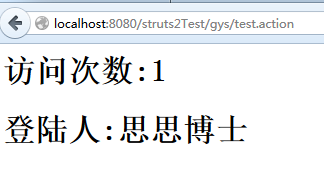
虽然Struts2提供了ActionCotext来访问Servlet API,但这种访问毕竟不能直接获得Servlet API实例,为了在Action中直接访问Servlet API,struts2还提供了如下系统接口.
ServletContextAware:实现该接口的Action可以直接访问web应用的ServletContext实例.
ServletRequestAwart:实现该接口的Action可以直接访问用户请求的HttpServletRequest实例
ServletResponseAware:实现该接口的Action可以直接访问服务器响应的HttpServletResponse实例.
下面以ServletRequestAware为例,介绍如何在Action中访问HttpServletRequest对象.
修改上面的代码:
ServletApi.jsp
 <%@ page language="java" import="java.util.*" contentType="text/html; charset=utf-8"%>

 <%

 String path = request.getContextPath();

 String basePath = request.getScheme()+"://"+request.getServerName()+":"+request.getServerPort()+path+"/";

 %>

 <!DOCTYPE HTML PUBLIC "-//W3C//DTD HTML 4.01 Transitional//EN">

 <html>

   <head>

     <base href="<%=basePath%>">

     <title>My JSP 'index.jsp' starting page</title>

     <meta http-equiv="pragma" content="no-cache">

     <meta http-equiv="cache-control" content="no-cache">

     <meta http-equiv="expires" content="0">

     <meta http-equiv="keywords" content="keyword1,keyword2,keyword3">

     <meta http-equiv="description" content="This is my page">

     <!--

     <link rel="stylesheet" type="text/css" href="styles.css">

     -->

   </head>

   <body>

    <%--  <h1>访问次数:${applicationScope.count }</h1>

     <h1>登陆人:${sessionScope.username }</h1> --%>

     <h3>${requestScope.API }</h3>

   </body>

 </html>
GetServletAPIAction.java
package action;

import javax.servlet.http.HttpServletRequest;

import javax.servlet.http.HttpServletResponse;

import org.apache.struts2.interceptor.ServletRequestAware;

import org.apache.struts2.interceptor.ServletResponseAware;

import com.opensymphony.xwork2.ActionContext;

public class GetServletAPIAction implements ServletRequestAware{

    private HttpServletRequest request;

    private String name;

    private String pass;

    public String getName() {

        return name;

    }

    public void setName(String name) {

        this.name = name;

    }

    public String getPass() {

        return pass;

    }

    public void setPass(String pass) {

        this.pass = pass;

    }

    public void getServletAPI1(){

        //获取ActionContext实例,通过该实例访问Servlet API

        ActionContext ctx=ActionContext.getContext();

        //获取ServletContext里的count属性

        Integer count=(Integer)ctx.getApplication().get("count");

        if(count==null){

            count=1;

        }

        else {

            count++;

        }

        //将访问人数设置成application的一个属性

        ctx.getApplication().put("count", count);

        ctx.getSession().put("username", "思思博士");

    }

    public void getServletAPI2(){

        request.setAttribute("API","我来自于struts2中直接访问servletAPI的request");

    }

    @Override

    public void setServletRequest(HttpServletRequest request) {

        this.request=request;

    }

    public String execute(){

        //getServletAPI1();

        getServletAPI2();

        return "api";

    }

}
测试结果:

struts2访问servlet API的更多相关文章
- 配置Struts2及Struts2访问servlet api的方式
Struts2的起源与背景 在很长的一段时间内,在所有的MVC框架中,Struts1处于绝对的统治地位,无论是从市场的普及范围,还是具体的使用者数量. 其他MVC框架都无 法与其相比,作为一一款优秀的 ...
- Struts2访问Servlet API的三种方式
有时我们需要用到Request, Response, Session,Page, ServletContext这些我们以前常用的对象,那么在Struts2中怎么样使用到这些对象呢,通常有三种方式. * ...
- Struts2访问Servlet API的几种方式
struts2提供了三种方式访问servlet API:大致分为两类 1. ActionContext: public static ActionContext getContext() :获得当前 ...
- 3.struts2访问Servlet API,并和mybaits实现全套增删改查
1.创建数据库脚本userinfo.sql prompt PL/SQL Developer import file prompt Created on 2016年5月19日 by pc set fee ...
- struts2 笔记01 登录、常用配置参数、Action访问Servlet API 和设置Action中对象的值、命名空间和乱码处理、Action中包含多个方法如何调用
Struts2登录 1. 需要注意:Struts2需要运行在JRE1.5及以上版本 2. 在web.xml配置文件中,配置StrutsPrepareAndExecuteFilter或FilterDis ...
- struts2中访问servlet API
Struts2中的Action没有与任何Servlet API耦合,,但对于WEB应用的控制器而言,不访问Servlet API几乎是不可能的,例如需要跟踪HTTP Session状态等.Struts ...
- struts2的action访问servlet API的三种方法
学IT技术,就是要学习... 今天无聊看看struts2,发现struts2的action访问servlet API的三种方法: 1.Struts2提供的ActionContext类 Object g ...
- Struts2(七) Struts2访问Servlet的API
当接受表单参数,向页面保持数据时.要用到Struts访问Servlet 的API .下面只做参考,有错误或不同意见可以发送邮箱2440867831@qq.com .建议大家看struts文档,源代码 ...
- 关于Struts2自动装配和访问Servlet API
自动装配 1.根据属性的getter和setter获取值 index.jsp <s:form action="hello" method="POST"& ...
随机推荐
- js 触摸类库
A javascript library for multi-touch gestures :// You can touch this http://hammerjs.github.io ...
- 【转】object标签和embed标签
我们现在大部分人做网页,都是直接用DW插入flash,而且DW也是所见即所得,直接生成了相应的flash显示代码.可是我们又有多少人了解这些直接由DW生成的代码呢?其实我接触flash player标 ...
- python分割数组里面重复的元素
c=[1,1,1,1,2,2,2,3,3,4,4,4,4,4,5,5,5,] a = [] x = [] for i in range(0,len(c)): if i + 1 < len(c): ...
- html之head,base,meta,title
一个简单的HTML最基本的必须的元素 用于定义文档的头部,是所有头部元素的容器.头部描述了文档的各种属性和信息,绝大多数头部的数据都不会直接显示给读者. 下面这些标签可用在head部分:base,li ...
- oracle定时任务JOB
在jobs上点新建 what值:statisticsToDay; 这个是存储过程的名字间隔:sysdate+1/24 表示每个小时运行一次 1:每分钟执行 Interval ...
- Maven最佳实践:版本管理
什么是版本管理 首先,这里说的版本管理(version management)不是指版本控制(version control),但是本文假设你拥有基本的版本控制的知识,了解subversion的基本用 ...
- Visual Studio个人常用快捷键
Ctrl+F5:运行程序 F9:设置/取消断点 F5:启动调试 F10:逐过程单步调试 F11:逐语句单步调试 按住Ctrl先按K再按D:格式化全部代码 按住Ctrl先按K再按F:将选中代码块格式化 ...
- 虚拟机IP设置
实验软件环境:虚拟机Vmware Workstation10.0 .CentOS 6.5 32位 1.自动获取IP地址 虚拟机使用桥接模式,相当于连接到物理机的网络里,物理机网络有DHCP服务器自动分 ...
- css禁用鼠标点击事件
css禁用鼠标点击事件 .disabled { pointer-events: none; } <div class="main-container disabled"> ...
- HackerRank "Self Balancing Tree"
Something to learn: Rotation ops in AVL tree does not require recursion. https://github.com/andreima ...