
Markov Decision Process in Detail
From the last post about MDP, we know the environment consists of 5 basic elements:
S:State Space of environment;
A:Actions Space that the environment allows;
{Ps,s'}:Transition Matrix, the probabilities of how environment state transit from one to another when actions are taken. The number of matrices equals to the number of actions.
R: Reward, when the system transitions from state s to s' due to action a, how much reward can an agent receive from the environment. Sometimes, reward have different definition.
γ: How reward discounts by time.
How Different between MDP and MRP:
Keyword: Action
The five elements of MDP can be illustrated by the chart below, in which the green circles are states, orange circles are actions, and there are two rewards. In MRP and Markov Process, we directly know the transition matrix. However, in the transition path from one state to another is interupted by actions. And it's worth noting that when the environment is at a certain state, there is no probabilities for actions. The reason is quite understandable: we live in the some world(environment), but different people have different behaviors.

Agent and Policy
Agent is the person or robot who interacts with the environment in Reinforcement Learning. Like human being, everyone may have different behavior under the same condition. The probability distribution of behaviors under different states is Policy. There are so many probabilities in an environment, but for a specific agent (person), he or she may take only one or several possible actions under a certain state. Given states, the policy is defined by:
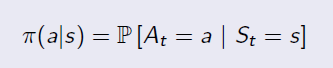
An example of policy is shown below:

From MRP to MDP: MRP+Policy
Transition Matrix: Without policies we do not exactly know the the probability from state s transitioning to s', because different agents may have different probabilitie to take actions. As long as we get π, we can calculate the state transition matrix. 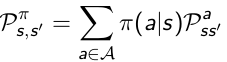
In the chart above, for example, if an agent has probabilitie 0.4 and 0.6 for action a0 and a1, the transition probability from s0 to s1 is: 0.4*0.5+0.6*1=0.8
Reward:
In MDP the reward function is related to actions, which average the uncertainties of the result from an action.

Once we've got the Policy π, we know the action distribution of a specific agent, so we can average the uncertaintie of actions, then measure how much immediate reward can receive from state s under policy π.

So now we go back from MDP to MRP, and the Markov Reward Process is defined by the tuple

Two Value Functions:
State Value Function:
State Value Function is the same as the value function in MRP. It is used to evaluate the goodness of being in a state s(by immedate and future reward), and the only difference is to average the uncertainty of actions under policy π. It is in the form of:

Action Value Function:
To average uncertainties of actions, it's neccesary to know the expected reward from possible actions. So we have Action Value Functionin MDP, which reveals whether an action is good or bad when an agent takes an particular action in state s.

If we calculate expectation of Action Value Functions under the same state s, we will end up with the State Value Function v:
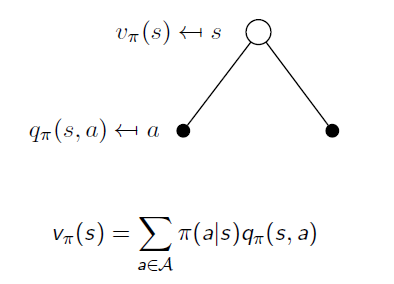
Similarly, when an action is taken, the system may end up with different states. When we remove the uncertainty of state transition, we go back from State Value Function to Action Value Function:
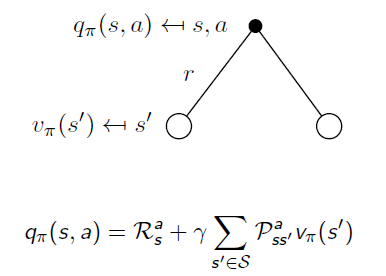
If we put them together:
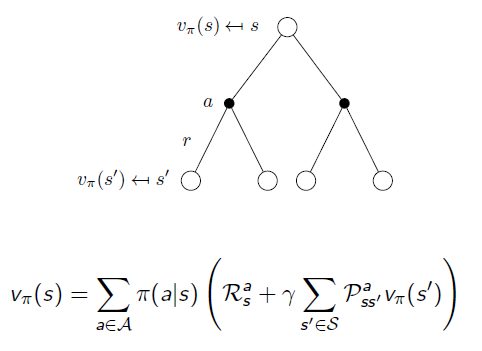
Another way:

Markov Decision Process in Detail的更多相关文章
- Step-by-step from Markov Process to Markov Decision Process
In this post, I will illustrate Markov Property, Markov Reward Process and finally Markov Decision P ...
- Ⅱ Finite Markov Decision Processes
Dictum: Is the true wisdom fortitude ambition. -- Napoleon 马尔可夫决策过程(Markov Decision Processes, MDPs ...
- Markov Decision Processes
为了实现某篇论文中的算法,得先学习下马尔可夫决策过程~ 1. https://leonardoaraujosantos.gitbooks.io/artificial-inteligence/conte ...
- Reinforcement Learning Index Page
Reinforcement Learning Posts Step-by-step from Markov Property to Markov Decision Process Markov Dec ...
- 论文笔记之:Learning to Track: Online Multi-Object Tracking by Decision Making
Learning to Track: Online Multi-Object Tracking by Decision Making ICCV 2015 本文主要是研究多目标跟踪,而 online ...
- 强化学习二:Markov Processes
一.前言 在第一章强化学习简介中,我们提到强化学习过程可以看做一系列的state.reward.action的组合.本章我们将要介绍马尔科夫决策过程(Markov Decision Processes ...
- (转) Deep Reinforcement Learning: Pong from Pixels
Andrej Karpathy blog About Hacker's guide to Neural Networks Deep Reinforcement Learning: Pong from ...
- 机器学习算法基础(Python和R语言实现)
https://www.analyticsvidhya.com/blog/2015/08/common-machine-learning-algorithms/?spm=5176.100239.blo ...
- How do I learn machine learning?
https://www.quora.com/How-do-I-learn-machine-learning-1?redirected_qid=6578644 How Can I Learn X? ...
随机推荐
- POJ3321[苹果树] 树状数组/线段树 + dfs序
Apple Tree Time Limit: 2000MS Memory Limit: 65536K Total Submissions:39452 Accepted: 11694 Descr ...
- 将地址转成blob格式(服务器下运行)
<div id="forAppend" class="demo"></div> <script> var eleAppend ...
- vue路由定义
router 根据URL分配到对应的处理程序 单应用页面,vue开发中只有一个一面 例如我们在开发移动端的时候,正常情况下底部的tab有四个选项: 首页 home 发现 find 订 ...
- 利用vsftpd在Linux构建安全的FTP服务
最近在机房搭建Linux环境,需要用到了FTP服务,查看了许多的资料,在这里做一下笔记 一.安装 方法一,使用yum命令安装,需要能够连接外网 # yum install vsftpd 方法二,使用安 ...
- 2018-8-10-使用-Resharper-特性
title author date CreateTime categories 使用 Resharper 特性 lindexi 2018-08-10 19:16:51 +0800 2018-4-25 ...
- 零点.Net Core 接触
一.Program.cs类与Startup类 1.一切从Main开始,Main方法包含了是整个应用程序的入口 ASP.NET Core应用程序可以配置和启动主机(Host). 主机负责应用程序启动和生 ...
- Firewalld--01 防火墙安全、基本指令、区域配置
目录 Firewalld防火墙安全.基本指令.区域配置 1. 防火墙安全基本概述 2. 防火墙使用区域管理 3. 防火墙基本指令参数 4.防火墙区域配置策略 Firewalld防火墙安全.基本指令.区 ...
- Windows 进入上帝模式窗口
Win10上帝模式如何启用? 默认情况下,Win10的上帝模式是隐藏的,如果要开启的话,操作步骤也非常简单,下面就介绍两种方法. 方法一.直接运行命令行 1.使用[Win + R ]快捷键打开“运行” ...
- python基础——对时间进行加减
在datetime模块中有一个timedelta这个方法,它代表两个datetime之间的时间差.. In [42]: datetime.datetime.now().strftime('%Y-%m- ...
- [Luogu2014]选课(树形dp)
[Luogu2014]选课 题目描述 在大学里每个学生,为了达到一定的学分,必须从很多课程里选择一些课程来学习,在课程里有些课程必须在某些课程之前学习,如高等数学总是在其它课程之前学习.现在有N门功课 ...