
第二十五篇 玩转数据结构——链表(Linked List)
- 我们之前实现的动态数组、栈、队列,底层都是依托静态数组,靠resize来解决固定容量的问题,而"链表"则是一种真正的动态数据结构,不需要处理固定容量的问题;
- 链表是最简单的动态数据结构;
- 学习链表有助于更深入的理解"引用"(或指针);
- 学习链表有助于更深入的理解"递归";
- 链表可以用来辅助组成其他数据结构;
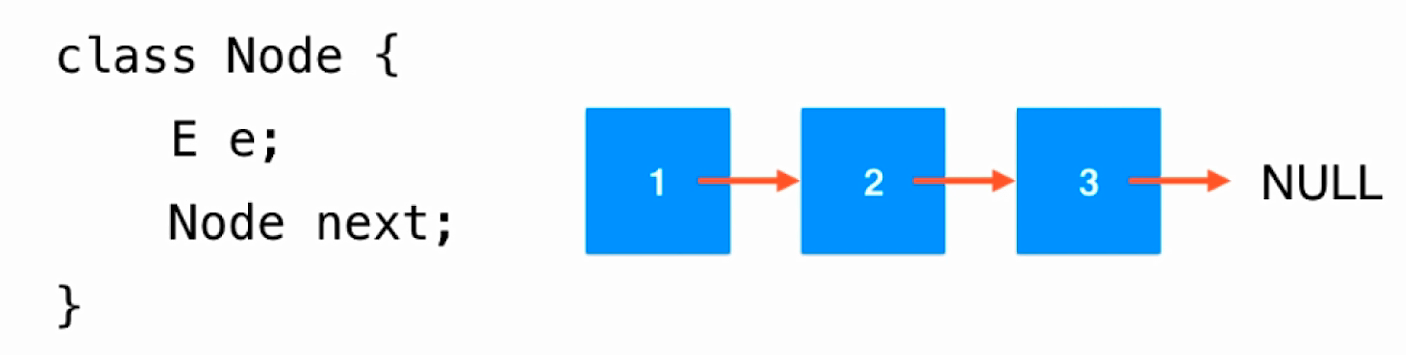
- 数据存储在"节点"(Node)中;
- 链表的形象化解释如下图:
- 链表的优点在于,它是一种真正的动态数据结构,不需要处理固定容量问题;
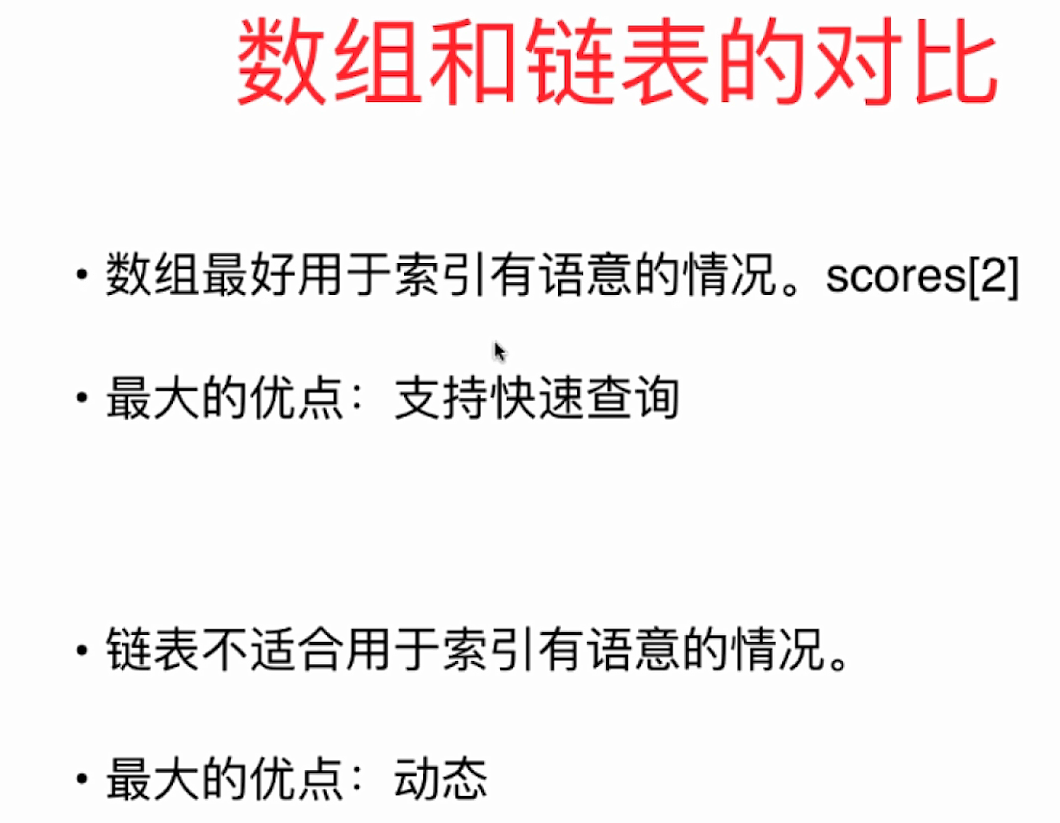
- 链表的缺点在于,相较于数组,失去了随机访问的能力;
- 数组和链表的对比如下图所示:
- 实现链表的业务逻辑如下:
public class LinkedList<E> {

    private class Node {

        public E e;

        public Node next;

        //构造函数

        public Node(E e, Node next) {

            this.e = e;

            this.next = next;

        }

        //只传了参数e的构造函数

        public Node(E e) {

            this(e, null);

        }

        //不传递参数的构造函数

        public Node() {

            this(null, null);

        }

        //方便打印测试

        @Override

        public String toString() {

            return e.toString();

        }

    }

    private Node dummyHead;

    private int size;

    //构造函数

    public LinkedList() {

        dummyHead = new Node(null, null);  //虚拟头节点

        size = 0;

    }

    //获取链表中的元素个数

    public int getSize() {

        return size;

    }

    //判断链表是否为空

    public boolean isEmpty() {

        return size == 0;

    }

    //在链表的index(0-based)位置添加新的元素e

    //在链表中不是一个常用操作

    public void add(int index, E e) {

        if (index < 0 || index > size) {

            throw new IllegalArgumentException("Add failed. Illegal index.");

        }

        Node prev = dummyHead;

        for (int i = 0; i < index; i++) {

            prev = prev.next;

        }

        prev.next = new Node(e, prev.next);

        size++;

    }

    //在链表头添加新元素e

    public void addFirst(E e) {

        add(0, e);

    }

    //在链表末尾添加新的元素e

    public void addLast(E e) {

        add(size, e);

    }

    //获取链表的index(0-based)位置的元素

    //在链表中也不是一个常用操作

    public E get(int index) {

        if (index < 0 || index > size - 1) {

            throw new IllegalArgumentException("Get failed. Illegal index.");

        }

        Node cur = dummyHead.next;

        for (int i = 0; i < index; i++) {

            cur = cur.next;

        }

        return cur.e;

    }

    //获得链表的第一个元素

    public E getFirst() {

        return get(0);

    }

    //获得链表的最后一个元素

    public E getLast() {

        return get(size - 1);

    }

    //修改链表的index(0-based)位置的元素为e

    //在链表中也不是一个常用操作

    public void set(int index, E e) {

        if (index < 0 || index > size - 1) {

            throw new IllegalArgumentException("Set failed. Illegal index.");

        }

        Node cur = dummyHead.next;

        for (int i = 0; i < index; i++) {

            cur = cur.next;

        }

        cur.e = e;

    }

    //查找链表中是否存在元素e

    public boolean contains(E e) {

        Node cur = dummyHead.next;

        while (cur != null) {

            if (cur.e.equals(e)) {

                return true;

            }

            cur = cur.next;

        }

        return false;

    }

    //删除链表的index(0-based)位置的元素,并返回该元素

    //在链表中也不是一个常用操作

    public E remove(int index) {

        if (index < 0 || index > size - 1) {

            throw new IllegalArgumentException("Remove failed. Illegal index.");

        }

        Node prev = dummyHead;

        for (int i = 0; i < index; i++) {

            prev = prev.next;

        }

        Node retNode = prev.next;

        prev.next = retNode.next;

        retNode.next = null;

        size--;

        return retNode.e;

    }

    //删除链表中的第一个元素,并返回该元素

    public E removeFirst() {

        return remove(0);

    }

    //删除链表中的最后一个元素,并返回该元素

    public E removeLast() {

        return remove(size - 1);

    }

    // 从链表中删除元素e

    public void removeElement(E e){

        Node prev = dummyHead;

        while(prev.next != null){

            if(prev.next.e.equals(e))

                break;

            prev = prev.next;

        }

        if(prev.next != null){

            Node delNode = prev.next;

            prev.next = delNode.next;

            delNode.next = null;

            size --;

        }

    }

    //方便打印测试

    @Override

    public String toString() {

        StringBuilder res = new StringBuilder();

//        Node cur = dummyHead.next;

//        while (cur != null) {

//            res.append(cur + "->");

//            cur = cur.next;

//        }

        for (Node cur = dummyHead.next; cur != null; cur = cur.next) {

            res.append(cur + "->");

        }

        res.append("NULL");

        return res.toString();

    }

}- 测试的业务逻辑如下:
public class Main {

    public static void main(String[] args) {

        LinkedList<Integer> linkedList = new LinkedList<>();

        for (int i = 0; i < 5; i++) {

            linkedList.addFirst(i);

            System.out.println(linkedList);

        }

        linkedList.add(2, 666);

        System.out.println(linkedList);

        linkedList.remove(2);

        System.out.println(linkedList);

        linkedList.removeFirst();

        System.out.println(linkedList);

        linkedList.removeLast();

        System.out.println(linkedList);

    }

}- 输出结果:
0->NULL

1->0->NULL

2->1->0->NULL

3->2->1->0->NULL

4->3->2->1->0->NULL

4->3->666->2->1->0->NULL

4->3->2->1->0->NULL

3->2->1->0->NULL

3->2->1->NULL
- 添加操作 O(n)
addLast(e)     O(n)

addFirst(e)    O(1)

add(index, e) O(n/2)=O(n)- 删除操作 O(n)
removeLase(e)     O(n)

removeFirst(e)    O(1)

remove(index, e) O(n/2)=O(n)- 修改操作 O(n)
set(index, e) O(n)
- 查找操作 O(n)
get(index)   O(n)

contains(e) O(n)- 总体来说,链表的增、删、改、查的时间复杂度都是O(n)
- 如果我们只对链表的头进行添加和删除操作,那么时间复杂度是O(1),如果我们只查链表头的元素,那么时间复杂度也是O(1),满足这些条件的数据结构,我们很容易就会想到"栈",对于"栈"而言,遵循后进先出的原则,只对栈的一端,也就是"栈顶"进行操作,无论是添加、删除还是查看元素,都在栈顶进行。所以,我们就可以把链表头当作栈顶,用链表来作为栈的底层实现,来实现出一个栈。

- 链表栈的实现及测试的业务逻辑如下:
public class LinkedListStack<E> implements Stack<E> {

    private LinkedList<E> list;

    //构造函数

    public LinkedListStack() {

        list = new LinkedList<>();

    }

    //实现getSize方法

    @Override

    public int getSize() {

        return list.getSize();

    }

    //实现isEmpty方法

    @Override

    public boolean isEmpty() {

        return list.isEmpty();

    }

    //实现push方法

    @Override

    public void push(E e) {

        list.addFirst(e);

    }

    //实现pop方法

    @Override

    public E pop() {

        return list.removeFirst();

    }

    //实现peek方法

    @Override

    public E peek() {

        return list.getFirst();

    }

    //方便打印测试

    @Override

    public String toString() {

        StringBuilder res = new StringBuilder();

        res.append("Stack: top ");

        res.append(list);

        return res.toString();

    }

    //测试

    public static void main(String[] args) {

        LinkedListStack<Integer> stack = new LinkedListStack<>();

        //测试入栈push

        for (int i = 0; i < 5; i++) {

            stack.push(i);

            System.out.println(stack);

        }

        //测试出栈

        stack.pop();

        System.out.println(stack);

    }

}- 输出结果:
Stack: top 0->NULL

Stack: top 1->0->NULL

Stack: top 2->1->0->NULL

Stack: top 3->2->1->0->NULL

Stack: top 4->3->2->1->0->NULL

Stack: top 3->2->1->0->NULL
- 测试的业务逻辑如下:
import java.util.Random;

public class Main {

    //测试使用stack运行opCount个push和pop操作所需的时间,单位:秒

    private static double testStack(Stack<Integer> stack, int opCount) {

        long startTime = System.nanoTime();

        Random random = new Random();

        for (int i = 0; i < opCount; i++) {

            stack.push(random.nextInt(Integer.MAX_VALUE));

        }

        for (int i = 0; i < opCount; i++) {

            stack.pop();

        }

        long endTime = System.nanoTime();

        return (endTime - startTime) / 1000000000.0;

    }

    public static void main(String[] args){

        int opCount = 10000;

        ArrayStack<Integer> arrayStack = new ArrayStack<>();

        double time1 = testStack(arrayStack,opCount);

        System.out.println("ArrayStack, time: " + time1 + " s");

        LinkedListStack<Integer> linkedListStack = new LinkedListStack<>();

        double time2 = testStack(linkedListStack,opCount);

        System.out.println("LinkedListStack, time: " + time2 + " s");

        // 这二者的时间比较很复杂,ArrayStack会在扩容和缩容操作上面耗费时间,LinkedListStack则会在创建新的Node上面耗费时间

    }

}- 这两种栈的时间复杂度基本处于相同的水平
- 链表队列的实现及测试的业务逻辑如下
public class LinkListQueue<E> implements Queue<E> {

    private class Node {

        public E e;

        public Node next;

        public Node(E e, Node next) {

            this.e = e;

            this.next = next;

        }

        public Node(E e) {

            this(e, null);

        }

        public Node() {

            this(null, null);

        }

        @Override

        public String toString() {

            return e.toString();

        }

    }

    private Node head, tail;

    private int size;

    public LinkListQueue() {

        head = null;

        tail = null;

        size = 0;

    }

    //实现getSize

    @Override

    public int getSize() {

        return size;

    }

    //实现isEmpty

    @Override

    public boolean isEmpty() {

        return size == 0;

    }

    //实现enqueue

    @Override

    public void enqueue(E e) {

        if (tail == null) {

            tail = new Node(e);

            head = tail;

        } else {

            tail.next = new Node(e);

            tail = tail.next;

        }

        size++;

    }

    //实现dequeue

    @Override

    public E dequeue() {

        if (isEmpty()) {

            throw new IllegalArgumentException("Cannot dequeue from an empty queue.");

        }

        Node retNode = head;

        head = head.next;

        retNode.next = null;

        if (head == null) {

            tail = null;

        }

        size--;

        return retNode.e;

    }

    //实现getFront

    public E getFront() {

        if (isEmpty()) {

            throw new IllegalArgumentException("Queue is empty.");

        }

        return head.e;

    }

    //方便打印测试

    public String toString() {

        StringBuilder res = new StringBuilder();

        res.append("Queue: front ");

        Node cur = head;

        while (cur != null) {

            res.append(cur + "->");

            cur = cur.next;

        }

        res.append("NULL");

        return res.toString();

    }

    //测试

    public static void main(String[] args) {

        LinkListQueue<Integer> queue = new LinkListQueue<>();

        for (int i = 0; i < 6; i++) {

            queue.enqueue(i);

            System.out.println(queue);

            if (i % 3 == 2) {

                queue.dequeue();

                System.out.println(queue);

            }

        }

    }

}- 输出结果:
Queue: front 0->NULL

Queue: front 0->1->NULL

Queue: front 0->1->2->NULL

Queue: front 1->2->NULL

Queue: front 1->2->3->NULL

Queue: front 1->2->3->4->NULL

Queue: front 1->2->3->4->5->NULL

Queue: front 2->3->4->5->NULL
- 测试的业务逻辑如下:
import java.util.Random;

public class Main {

    // 测试使用q运行opCount个enqueue和dequeue操作所需要的时间,单位:秒

    private static double testQueue(Queue<Integer> q, int opCount) {

        long startTime = System.nanoTime();

        Random random = new Random();

        for (int i = 0; i < opCount; i++) {

            q.enqueue(random.nextInt(Integer.MAX_VALUE));

        }

        for (int i = 0; i < opCount; i++) {

            q.dequeue();

        }

        long endTime = System.nanoTime();

        return (endTime - startTime) / 1000000000.0;

    }

    public static void main(String[] args) {

        int opCount = 100000;

        ArrayQueue<Integer> arrayQueue = new ArrayQueue<>();

        double time1 = testQueue(arrayQueue, opCount);

        System.out.println("ArrayQueue, time: " + time1 + " s");

        LoopQueue<Integer> loopQueue = new LoopQueue<>();

        double time2 = testQueue(loopQueue, opCount);

        System.out.println("LoopQueue, time: " + time2 + " s");

        LinkListQueue<Integer> linkListQueue = new LinkListQueue<>();

        double time3 = testQueue(linkListQueue, opCount);

        System.out.println("LinkListQueue, time: " + time3 + " s");

    }

}- 输出结果:
ArrayQueue, time: 3.069366801 s

LoopQueue, time: 0.010702659 s

LinkListQueue, time: 0.007079073 s
- 不使用dummyHead的实现方法
class Solution {

    public ListNode removeElements(ListNode head, int val) {

        while (head != null && head.val == val) {

            //head = head.next;

            ListNode delNode = head;

            head = head.next;

            delNode.next = null;

        }

        if (head == null) {

            return null;

        }

        ListNode prev = head;

        while (prev.next != null) {

            if (prev.next.val == val) {

                //prev.next = prev.next.next;

                ListNode delNode = prev.next;

                prev.next = delNode.next;

                delNode.next = null;

            } else {

                prev = prev.next;

            }

        }

        return head;

    }

}- 使用dummyHead的实现方法:
class Solution2 {

    public ListNode removeElements(ListNode head, int val) {

        ListNode dummyHead = new ListNode(-1);

        dummyHead.next = head;

        ListNode prev = dummyHead;

        while (prev.next != null) {

            if (prev.next.val == val) {

                //prev.next = prev.next.next;

                ListNode delNode = prev.next;

                prev.next = delNode.next;

                delNode.next = null;

            } else {

                prev = prev.next;

            }

        }

        return dummyHead.next;

    }

}
- 使用dummyHead之后,代码变得更加简洁
- 从本质上讲,递归,就是将原来的问题转化为更小的同一个问题;
- 递归举例,数组求和:
Sum(arr[0...n-1]) = arr[0] + Sum(arr[1...n-1])   <-- 转化为更小的同一个问题

Sum(arr[1...n-1]) = arr[1] + Sum(arr[2...n-1])   <-- 转化为更小的同一个问题

           ......

Sum(arr[n-1...n-1]) = arr[n-1] + Sum([]) <-- 最基本的问题- 代码简单实现:
public class Sum {

    public static int sum(int[] arr) {

        return sum(arr, 0);

    }

    //计算arr[l...n)这个区间内所有数的和

    private static int sum(int[] arr, int l) {

        if (l == arr.length) {        //  <--  求解最基本问题

            return 0;

        }

        return arr[l] + sum(arr, l + 1);   //  <-- 将原问题简化为更小的问题

    }

    //测试

    public static void main(String[] args) {

        int[] arr = {1, 2, 3, 4, 5, 6, 7, 8};

        System.out.println(sum(arr));

    }

}
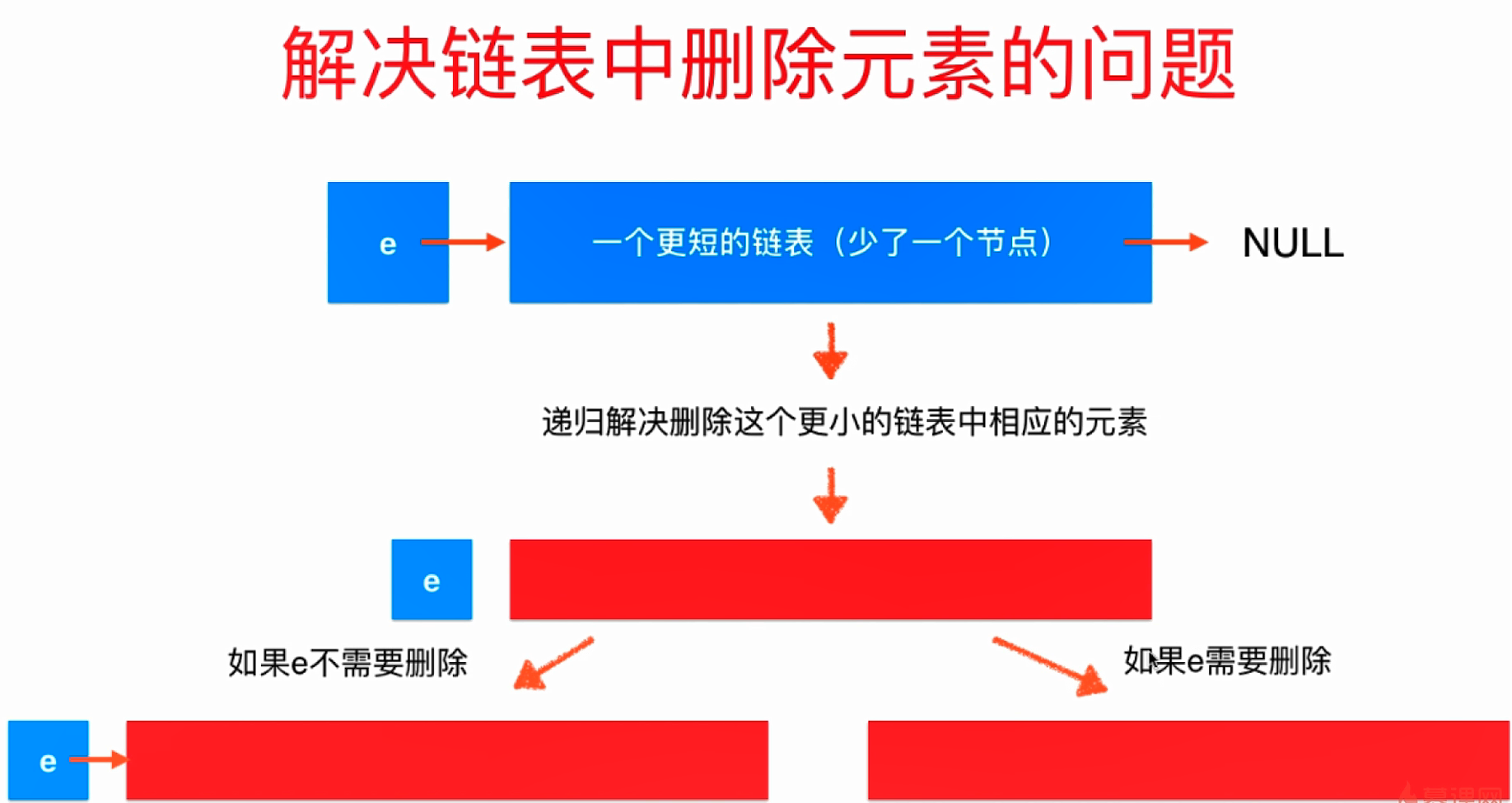
- 通过下图,很容易理解为什么链表具有天然的递归性

- 用递归的思想解决删除链表中的节点的问题,原理示意图:
- 用递归实现删除链表中所有包含指定元素的节点的业务逻辑:
class Solution3 {

    public ListNode removeElements(ListNode head, int val) {

        if (head == null) {

            return null;

        }

        head.next = removeElements(head.next, val);

        //return head.val == val ? head.next : head;

        if (head.val == val) {

            return head.next;

        } else {

            return head;

        }

    }

}
第二十五篇 玩转数据结构——链表(Linked List)的更多相关文章
- 第二十八篇 玩转数据结构——堆(Heap)和有优先队列(Priority Queue)
1.. 优先队列(Priority Queue) 优先队列与普通队列的区别:普通队列遵循先进先出的原则:优先队列的出队顺序与入队顺序无关,与优先级相关. 优先队列可以使用队列的接口,只是在 ...
- 第二十六篇 玩转数据结构——二分搜索树(Binary Search Tree)
1.. 二叉树 跟链表一样,二叉树也是一种动态数据结构,即,不需要在创建时指定大小. 跟链表不同的是,二叉树中的每个节点,除了要存放元素e,它还有两个指向其它节点的引用,分别用Node l ...
- 第二十四篇 玩转数据结构——队列(Queue)
1.. 队列基础 队列也是一种线性结构: 相比数组,队列所对应的操作数是队列的子集: 队列只允许从一端(队尾)添加元素,从另一端(队首)取出元素: 队列的形象化描述如下图: 队列是一种先进 ...
- 第二十九篇 玩转数据结构——线段树(Segment Tree)
1.. 线段树引入 线段树也称为区间树 为什么要使用线段树:对于某些问题,我们只关心区间(线段) 经典的线段树问题:区间染色,有一面长度为n的墙,每次选择一段墙进行染色(染色允许覆盖),问 ...
- 第二十五篇:在SOUI中做事件分发处理
不同的SOUI控件可以产生不同的事件.SOUI系统中提供了两种事件处理方式:事件订阅 + 事件处理映射表(参见第八篇:SOUI中控件事件的响应) 事件订阅由于直接将事件及事件处理函数连接,不存在事件分 ...
- Python之路(第二十五篇) 面向对象初级:反射、内置方法
[TOC] 一.反射 反射的概念是由Smith在1982年首次提出的,主要是指程序可以访问.检测和修改它本身状态或行为的一种能力(自省).这一概念的提出很快引发了计算机科学领域关于应用反射性的研究.它 ...
- flask第二十五篇——控制语句
有兴趣的请加船长公众号:自动化测试实战 先和大家强调一个发邮件的问题 # coding: utf-8 import smtplib from email.mime.text import MIMETe ...
- 第二十五篇:使用 sigaction 函数实现可靠信号
前言 在前文中,讲述了一个可靠信号的示例.它分成几个步骤组成( 请参考前文 ).在 Linux 系统编程中,有个方法可以将这些步骤给集成起来,让我们使用起来更加的方便. 那就是调用 sigaction ...
- SpringBoot非官方教程 | 第二十五篇:2小时学会springboot
转载请标明出处: http://blog.csdn.net/forezp/article/details/61472783 本文出自方志朋的博客 一.什么是spring boot Takes an o ...
随机推荐
- Linux运维--14.Kolla部署OpenStack使用external MariaDB Galera Cluster
使用haproxy+keepalived实现Mariadb负载均衡 controller2: 10.100.2.52 haproxy+keepalived controller3: 10.100.2. ...
- 转载:openmax bellagio
https://wenku.baidu.com/view/18472c1387c24028915fc3e9.html https://wenku.baidu.com/view/1e380bc20c22 ...
- AntDesign(React)学习-3 React基础
前面项目已经建起来了,但是没有React基础怎么办,从头学习,这个项目使用的是基于React16.X版本的几种技术集成,那么我们就从网上找一些相关的资料进行研究,我的习惯是用到哪学到哪. 一.先看一些 ...
- webpack 之loader
webpack的作用: 是 用来处理我们写的js代码.并且会自动处理js之间相关的依赖. 但是,开发中我们不仅仅有基本的js代码处理,还需要加载css,图片,也包括一些高级的 将ES6转成ES5代 ...
- 关于print()、sys.stdout、sys.stderr的一些理解
print() 方法的语法: print(*objects, sep=' ', end='\n', file=sys.stdout, flush=False) 其中file = sys.stdout的 ...
- String Buffer和String Builder(String类深入理解)
String在Java里面JDK1.8后它属于一个特殊的类,在创建一个String基本对象的时候,String会向“ 字符串常量池(String constant pool)” 进行检索是否有该数 ...
- 用户登录(php)
<!DOCTYPE HTML><html><head><meta charset="utf-8"><script type=& ...
- C++——简单程序设计
1.一个简单的程序 #include <iostream> //iostream是头文件,用来说明要使用的对象的相关信息. using namespace std; //使用命名空间,解决 ...
- C++-Typedef结构体遇上指针
继Typedef遇上结构体数组后,我们又产生了新的疑问. 上一期地址:https://www.cnblogs.com/lemaden/p/10122929.html 昨天一位朋友又问我了,说结构体数组 ...
- git 基本操作小节操作(一) init clone status add 未完,参考链接在末尾
1 $ git init 对当前所在目录进行git 管理 在当前目录初始化新仓库 2 $ git clone <url> <position> 从url克隆一个仓库到posti ...