
RNN and Language modeling in TensorFlow
RNNs and Language modeling in TensorFlow
From feed-forward to Recurrent Neural Networks (RNNs)
In the last few weeks, we've seen how feed-forward and convolutional neural networks have achieved incredible results. They perform on par with, even outperform, humans in many different tasks.
Despite their seemingly magical properties, these models are still very limited. Humans aren't built to just do linear or logistic regression, or recognize individual objects. We can understand, communicate, and create. The inputs we deal with aren't just singular data points, but sequences that are rich in information and complex in time dependencies. Languages we use are sequential. Music we listen to is sequential. TV shows we watch are sequential. The question is: how can we make our models capable of processing sequences of inputs with all their intricacies the way humans do.
RNNs were created with the aim of capturing the sequential information. The Simple Recurrent Network (SRN) was first introduced by Jeff Elman in a paper entitled "Finding structure in time" (Elman, 1990). As Professor James McClelland wrote in his book:
"The paper was groundbreaking for many cognitive scientists and psycholinguists, since it was the first to completely break away from a prior commitment to specific linguistic units (e.g. phonemes or words), and to explore the vision that these units might be emergent consequences of a learning process operating over the latent structure in the speech stream. Elman had actually implemented an earlier model in which the input and output of the network was a very low-level spectrogram-like representation, trained using a spectral information extracted from a recording of his own voice saying 'This is the voice of the neural network'."
RNNs are built on the same computational unit, known as neuron, as the feed-forward neural networks. However, they differ in the way these neurons are connected to one another. Feed forward neural networks are organized in layers: signals are passed in one direction only (from inputs to outputs) and loops aren't allowed. RNNs, on the contrary, allow neurons to connect to themselves. This allows for the notion of time to be taken into account, as the neuron from the previous step can affect the neuron at the current step.
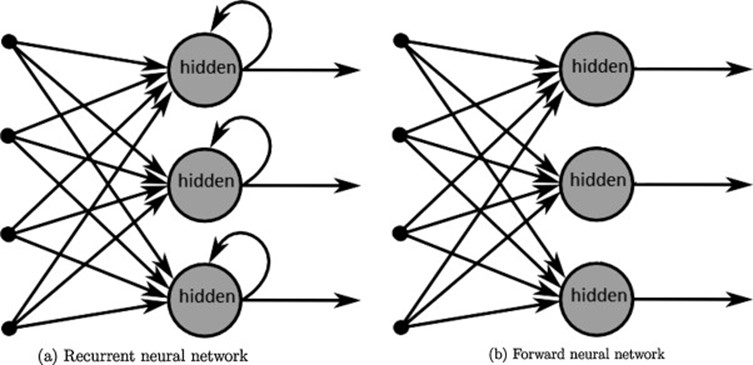
Graph from "A survey on the application of recurrent neural networks to statistical language modeling." by De Mulder et al. Computer Speech & Language 30.1 (2015): 61-98.
Elman's SRN did exactly this. In his early model, the hidden layer at this current step is a function of both the input at that step, and the hidden layer from the previous step. A few years earlier than Elman, Jordan developed a similar network, but instead of taking in the hidden layer of the previous step as the input, the hidden layer of the current step takes in the output from the previous step. Here is a side by side comparison of the two early simple neural networks on Wikipedia.

People often illustrate RNNs as neurons connecting to themselves, but you might find it easier to think of those neurons as they are unfolded: each neuron corresponds to one time step. For example, in the context of Natural Language Processing (NLP), if your input is a sentence of 10 tokens, each time step would correspond to one token. All the time steps share the same weights (because they are essentially the same neuron), which can reduce the total number of parameters we have to use.
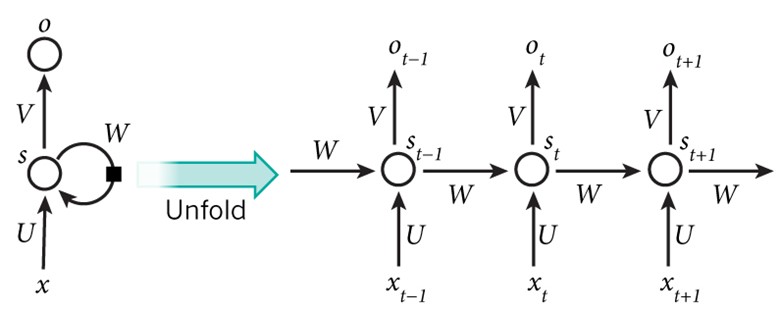
Graph by Nature
Most people think of RNNs in the context of NLP because languages are highly sequential. Indeed, the first RNNs were built for NLP tasks and many nowadays NLP tasks are solved using RNNs. However, they can also be used for tasks dealing with audio, images, videos. For example, you can train an RNN to do the object recognition task on the dataset MNIST, treating each image as a sequence of pixels.
Back-propagation through Time (BPTT)
In a feed forward or a convolutional neural network, errors are back-propagated from the loss to all the layers. These errors are used to update the parameters (weights, biases) according to the update rule that we specify (gradient descent, Adam, ...) to decrease the loss.
In a recurrent neural network, errors are back-propagated from the loss to all the timesteps. The two main differences are:
- Each layer in a feed-forward network has its own parameters while all the timesteps in a RNN share the same parameters. We use the sum of the gradients at all the timesteps to update the parameters for each training sample/batch.
- A feed-forward network has a fixed number of layers, while a RNN can have an arbitrary number of timesteps depending on the length of the sequence.
For the number 2, this means that if your sequence is long (say, 1000 steps corresponding to 1000 words in a text document), the process of back-propagating through all those steps is computationally expensive. Another problem is that this can lead to the gradients to be exponentially increasing or decreasing, depending on whether they are big or small, which lead to vanishing or exploding gradients. Denny Britz has a great blog post on the BPTT and exploding/vanishing gradients.
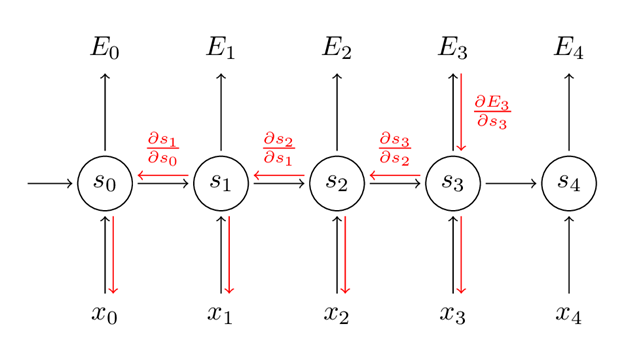
Graph by Denny Britz
To avoid having to do the full parameter update for all the timesteps, we often limit the number of timesteps, resulting in what is known as truncated BPTT. This speeds up computation at each update. The downside is that we can only back-propagate the errors back to a limited number of timesteps, and the network won't be able to learn the dependencies from the beginning of time (e.g., from the beginning of a text).
In TensorFlow, RNNs are created using the unrolled version of the network. In the non-eager mode of TensorFlow, this means that a fixed number of timesteps are specified before executing the computation, and it can only handle input with those exact number of timesteps. This can be problematic since we don't usually have inputs of the exact same length. For example, one paragraph might have 20 words while another might have 200. A common practice is to divide the data into different buckets, with samples of similar lengths into the same bucket. All samples in one bucket will either be padded with zero tokens or truncated to have the same length.
Gated Recurrent Unit (LSTM and GRU)
In practice, RNNs have proven to be really bad at capturing long-term dependencies.To address this drawback, people have been using Long Short-Term Memory (LSTM). The rise of LSTM in the last 3 years makes it seem like a new idea, but it's actually a pretty old concept. It was proposed in the mid-90s by two German researchers, Sepp Hochreiter and Jürgen Schmidhuber, as a solution to the vanishing gradient problem. Like many ideas in AI, LSTM has only become popular in the last few years thanks to the increasing computational power that allows it to work.

Google Trend, Feb 19, 2018
LSTM units use what's called a gating mechanism. They include 4 gates, generally denoted as i, o, f, and c˜, corresponding to input, output, forget, and candidate/new memory gate.
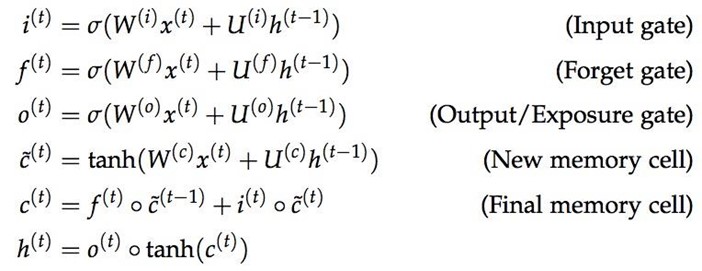
It seems like everyone in academia has a different diagram to visualize the LSTM units, all are inevitably confusing. One of the diagrams that I find less confusing is the one created by Mohammadi et al. for CS224D's lecture note.
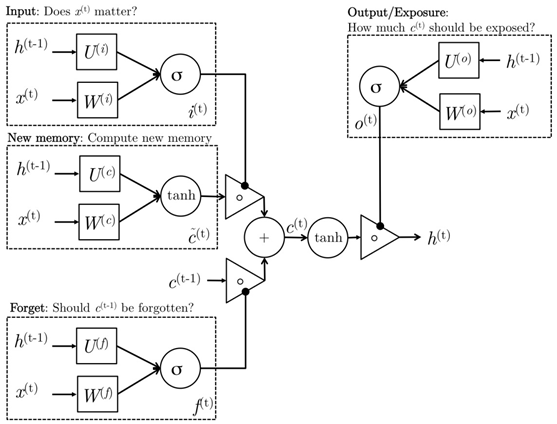
Intuitively, we can think of the gate as controlling what information to enter and emit from the cell at each timestep. All the gates have the same dimensions.
- input gate: decides how much of the current input to let through.
- forget gate: defines how much of the previous state to take into account.
- output gate: defines how much of the hidden state to expose to the next timestep.
- candidate gate: similar to the original RNN, this gate computes the candidate hidden state based on the previous hidden state and the current input.
- final memory cell: the internal memory of the unit combines the candidate hidden state with the input/forget gate information. Final memory cell is then computed with the output gate to decide how much of the final memory cell is to be output as the hidden state for this current step.
LSTM is not the only gating mechanism aimed at improving capturing long term dependencies of RNNs. GRU (gated recurrent unit) uses similar mechanism with significant simplication. It combines LSTM's forget and input gates into a single "update gate." It also merges the candidate/new cell state and the hidden state. The resulting GRU is much simpler than the standard LSTM, while its performances have been shown to be on par with that of LSTM on several benchmark tasks. The simplicity of GRU also means that it requires less computation, which, in theory, should reduce computation time. However, as far as I know, there hasn't been observation of significant improvement in runtime of GRU compared to LSTM.
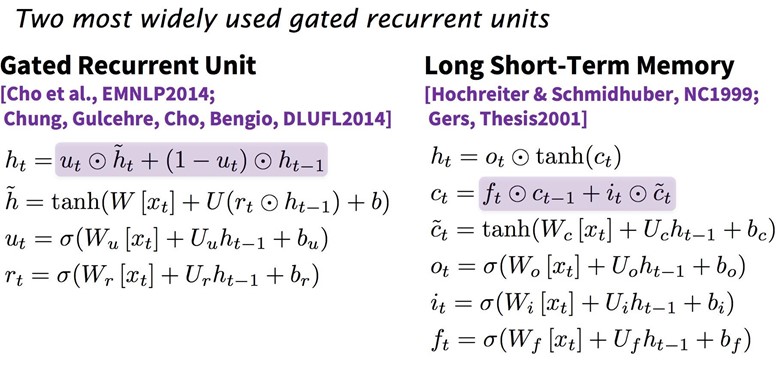
CS224D's lecture note
In TensorFlow, I prefer using GRU as it's a lot less cumbersome. GRU cells in TensorFlow output a hidden state for each layer, while LSTM cells output both candidate and hidden state.
Application: Language modeling
Given a sequence of words we want to predict the distribution of the next word given the all previous words. This ability to predict the next word gives us a generative model that allows us to generate new text by sampling from the output probabilities. Depending on what our training data is, we can generate all kinds of stuff. You can read Andrej Karpathy's blog postabout some of the funky results he got using a char-RNN, which is RNNs applied at character- instead of word-level.
When building a language model, our input is typically a sequence of words (or characters, as in the case with char-RNN, or something in between like subwords), and our output is the distribution for the next word.
In this exercise, we will build one char-RNN model on two datasets: Donald Trump's tweets and arvix abstracts. The arvix abstracts dataset consists of 20,466 unique abstracts, most in the range 500 - 2000 characters. The Donald Trump's tweets dataset consists of all his tweets up until Feb 15, 2018, with most of the retweets filtered out. There are 19,469 tweets in total, each of less than 140 characters. We did some minor data-preprocessing: replacing all URL with __HTTP__ (on hindsight, I should have used a shorter token, such as _URL_ or just _U_) and adding end token _E_.
Below are some of the outputs from our presidential tweet bot.
|
I will be interviewed on @foxandfriends tonight at 10:00 P.M. and the #1 to construct the @WhiteHouse tonight at 10:00 P.M. Enjoy __HTTP__ |
|
I will be interviewed on @foxandfriends at 7:00 A.M. and the only one that we will MAKE AMERICA GREAT AGAIN #Trump2016 __HTTP__ __HTTP__ |
|
No matter the truth and the world that the Fake News Media will be a great new book #Trump2016 __HTTP__ __HTTP__ |
|
Great poll thank you for your support of Monday at 7:30 A.M. on NBC at 7pm #Trump2016 #MakeAmericaGreatAgain #Trump2016 __HTTP__ __HTTP__ |
|
The Senate report to our country is a total disaster. The American people who want to start like a total disaster. The American should be the security 5 star with a record contract to the American peop |
|
.@BarackObama is a great president of the @ApprenticeNBC |
|
No matter how the U.S. is a complete the ObamaCare website is a disaster. |
Here's an abstract generated by our arvix abstract bot.
"Deep learning neural network architectures can be used to best developing a new architectures contros of the training and max model parametrinal Networks (RNNs) outperform deep learning algorithm is easy to out unclears and can be used to train samples on the state-of-the-art RNN more effective Lorred can be used to best developing a new architectures contros of the training and max model and state-of-the-art deep learning algorithms to a similar pooling relevants. The space of a parameter to optimized hierarchy the state-of-the-art deep learning algorithms to a simple analytical pooling relevants. The space of algorithm is easy to outions of the network are allowed at training and many dectional representations are allow develop a groppose a network by a simple model interact that training algorithms to be the activities to maximul setting, …"
For the code, please see on the class's GitHub. You can also refer to the lecture slides for more information on the code.
RNN and Language modeling in TensorFlow的更多相关文章
- Recurrent Neural Network Language Modeling Toolkit代码学习
Recurrent Neural Network Language Modeling Toolkit 工具使用点击打开链接 本博客地址:http://blog.csdn.net/wangxingin ...
- 斯坦福大学自然语言处理第四课“语言模型(Language Modeling)”
http://52opencourse.com/111/斯坦福大学自然语言处理第四课-语言模型(language-modeling) 一.课程介绍 斯坦福大学于2012年3月在Coursera启动了在 ...
- 课程五(Sequence Models),第一 周(Recurrent Neural Networks) —— 2.Programming assignments:Dinosaur Island - Character-Level Language Modeling
Character level language model - Dinosaurus land Welcome to Dinosaurus Island! 65 million years ago, ...
- 【NLP】Conditional Language Modeling with Attention
Review: Conditional LMs Note that, in the Encoder part, we reverse the input to the ‘RNN’ and it per ...
- A Language Modeling Approach to Predicting Reading Difficulty-paer
Volume:Proceedings of the Human Language Technology Conference of the North American Chapter of the ...
- Language Modeling with Gated Convolutional Networks
语言模型 所谓的语言模型,即是指在得知前面的若干个单词的时候,下一个位置上出现的某个单词的概率. 最朴素的方法是N-gram语言模型,即当前位置只和前面N个位置的单词相关.如此,问题便是,N小了,语言 ...
- NLP | 自然语言处理 - 语言模型(Language Modeling)
转:http://blog.csdn.net/lanxu_yy/article/details/29918015 为什么需要语言模型? 想象“语音识别”这样的场景,机器通过一定的算法将语音转换为文字, ...
- 语言模型(Language Modeling)与统计语言模型
1. n-grams 统计语言模型研究的是一个单词序列出现的概率分布(probability distribution).例如对于英语,全体英文单词构成整个状态空间(state space). 边缘概 ...
- Language Modeling with Gated Convolutional Networks(句子建模之门控CNN)--模型简介篇
版权声明:本文为博主原创文章,遵循CC 4.0 by-sa版权协议,转载请附上原文出处链接和本声明. 本文链接:https://blog.csdn.net/liuchonge/article/deta ...
随机推荐
- 代码中特殊的注释技术——TODO、FIXME和XXX的用处 (转载)
转自:http://blog.csdn.net/reille/article/details/7161942 作者:reille 本博客网址:http://blog.csdn.net/reille/, ...
- chrome 跨域设置-(完善博客内容)
目的完善自己的一套 ajax前端开发流程,在网上扒了一份成功的案例. 出于一些原因往往需要将浏览器设置成支持跨域的模式,好在chrome浏览器就是支持可跨域的设置,网上也有很多chrome跨域设置教程 ...
- bzoj 1621: [Usaco2008 Open]Roads Around The Farm分岔路口【dfs】
模拟就行--讲道理这个时间复杂度为啥是对的??? #include<iostream> #include<cstdio> using namespace std; int k, ...
- python orm / 表与model相互转换
orm英文全称object relational mapping,就是对象映射关系程序,简单来说我们类似python这种面向对象的程序来说一切皆对象,但是我们使用的数据库却都是关系型的,为了保证一致的 ...
- GIT学习之路最终日 标签管理+总结
本文参考廖雪峰老师的博客进行总结,完整学习请转廖雪峰博客 6.1 创建标签 命令git tag (name)用于新建一个标签,默认为HEAD,也可以指定一个commit id: git tag -a ...
- C. Coin Troubles 有依赖的背包 + 完全背包变形
http://codeforces.com/problemset/problem/283/C 一开始的时候,看着样例不懂,为什么5 * a1 + a3不行呢?也是17啊 原来是,题目要求硬币数目a3 ...
- 使用antlr4及java实现snl语言的解释器
对于antlr4的基础使用,请参考我的前一篇文章<用antlr4来实现<按编译原理的思路设计的一个计算器>中的计算器>. 其实我对于antlr4的理解也仅限于那篇文章的范围,但 ...
- MySQL 8.*版本 修改root密码
MySQL .*版本 修改root密码 查看版本:select version() from dual; 1.6. 登录mysql: 登录mysql:(因为之前没设置密码,所以密码为空,不用输入密码, ...
- 如何让不同浏览器调用不同的CSS样式
如何让不同浏览器调用不同的CSS样式 由 于对W3C标准支持程度的不同,往往导致同一个CSS样式表在各种Web浏览器中的呈现大相径庭.以目前市场占有率最高的两个浏览器Microsoft Interne ...
- (转)淘淘商城系列——导入商品数据到索引库——Service层
http://blog.csdn.net/yerenyuan_pku/article/details/72894187 通过上文的学习,我相信大家已经学会了如何使用Solrj来操作索引库.本文我们将把 ...