
多线程——Executor、ExecutorService、Executors三者的区别
Executor、ExecutorService、Executors三者的区别:
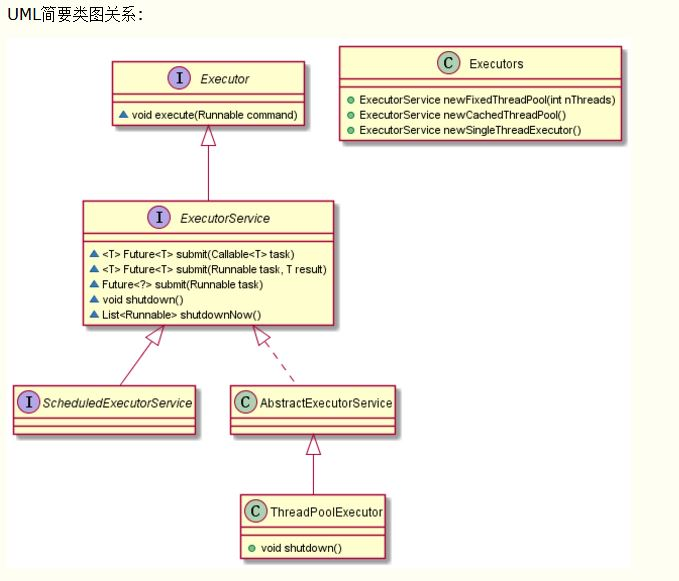
public interface ExecutorService extends Executor {}

public abstract class AbstractExecutorService implements ExecutorService {}

public interface ScheduledExecutorService extends ExecutorService {}

public class ThreadPoolExecutor extends AbstractExecutorService {}

public class ScheduledThreadPoolExecutor extends ThreadPoolExecutor implements ScheduledExecutorService {}
shutDown() 方法终止线程池。 newSingleThreadExecutor() 创建一个只有一个线程的线程池, newFixedThreadPool(int numOfThreads)来创建固定线程数的线程池, newCachedThreadPool()创建一个可缓存线程池,如果线程池长度超过处理需要,可灵活回收空闲线程,若无可回收,则新建线程。public interface Executor {
void execute(Runnable command);
}
public interface ExecutorService extends Executor {

    void shutdown();

    List<Runnable> shutdownNow();

    boolean isShutdown();

    boolean isTerminated();

    boolean awaitTermination(long timeout, TimeUnit unit) throws InterruptedException;

    <T> Future<T> submit(Callable<T> task);

    <T> Future<T> submit(Runnable task, T result);

    Future<?> submit(Runnable task);

    <T> List<Future<T>> invokeAll(Collection<? extends Callable<T>> tasks) throws InterruptedException;

    <T> List<Future<T>> invokeAll(Collection<? extends Callable<T>> tasks, throws InterruptedException;

    <T> T invokeAny(Collection<? extends Callable<T>> tasks)  throws InterruptedException, ExecutionException;

    <T> T invokeAny(Collection<? extends Callable<T>> tasks, long timeout, TimeUnit unit)

                                  throws InterruptedException,ExecutionException, TimeoutException;

}
public class Executors {

    /** Cannot instantiate. */

    private Executors() {}

    public static ExecutorService newFixedThreadPool(int nThreads) {

        return new ThreadPoolExecutor(nThreads, nThreads, 0L, TimeUnit.MILLISECONDS, new LinkedBlockingQueue<Runnable>());

    }

    public static ExecutorService newWorkStealingPool(int parallelism) {

        return new ForkJoinPool (parallelism,ForkJoinPool.defaultForkJoinWorkerThreadFactory,null, true);

    }

    public static ExecutorService newWorkStealingPool() {

        return new ForkJoinPool (Runtime.getRuntime().availableProcessors(), ForkJoinPool.defaultForkJoinWorkerThreadFactory,null, true);

    }

    public static ExecutorService newFixedThreadPool(int nThreads, ThreadFactory threadFactory) {

        return new ThreadPoolExecutor(nThreads, nThreads, 0L, TimeUnit.MILLISECONDS,  new LinkedBlockingQueue<Runnable>(),threadFactory);

    }

    public static ExecutorService newSingleThreadExecutor() {

        return new FinalizableDelegatedExecutorService(new ThreadPoolExecutor(1, 1,0L, TimeUnit.MILLISECONDS,

                                    new LinkedBlockingQueue<Runnable>()));

    }

    public static ExecutorService newSingleThreadExecutor(ThreadFactory threadFactory) {

        return new FinalizableDelegatedExecutorService(new ThreadPoolExecutor(1, 1, 0L, TimeUnit.MILLISECONDS,

                                    new LinkedBlockingQueue<Runnable>(), threadFactory));

    }

    public static ExecutorService newCachedThreadPool() {

        return new ThreadPoolExecutor(0, Integer.MAX_VALUE, 60L, TimeUnit.SECONDS,new SynchronousQueue<Runnable>());

    }

    public static ExecutorService newCachedThreadPool(ThreadFactory threadFactory) {

        return new ThreadPoolExecutor(0, Integer.MAX_VALUE,60L, TimeUnit.SECONDS, new SynchronousQueue<Runnable>(),threadFactory);

    }

    public static ScheduledExecutorService newSingleThreadScheduledExecutor() {

        return new DelegatedScheduledExecutorService (new ScheduledThreadPoolExecutor(1));

    }

    public static ScheduledExecutorService newSingleThreadScheduledExecutor(ThreadFactory threadFactory) {

        return new DelegatedScheduledExecutorService (new ScheduledThreadPoolExecutor(1, threadFactory));

    }

    public static ScheduledExecutorService newScheduledThreadPool(int corePoolSize) {

        return new ScheduledThreadPoolExecutor(corePoolSize);

    }

    public static ScheduledExecutorService newScheduledThreadPool(int corePoolSize, ThreadFactory threadFactory) {

        return new ScheduledThreadPoolExecutor(corePoolSize, threadFactory);

    }

    public static ExecutorService unconfigurableExecutorService(ExecutorService executor) {

        if (executor == null)

            throw new NullPointerException();

        return new DelegatedExecutorService(executor);

    }

    public static ScheduledExecutorService unconfigurableScheduledExecutorService(ScheduledExecutorService executor) {

        if (executor == null)

            throw new NullPointerException();

        return new DelegatedScheduledExecutorService(executor);

    }

    public static ThreadFactory defaultThreadFactory() {

        return new DefaultThreadFactory();

    }

    public static ThreadFactory privilegedThreadFactory() {

        return new PrivilegedThreadFactory();

    }

    public static <T> Callable<T> callable(Runnable task, T result) {

        if (task == null)

            throw new NullPointerException();

        return new RunnableAdapter<T>(task, result);

    }

    public static Callable<Object> callable(Runnable task) {

        if (task == null)

            throw new NullPointerException();

        return new RunnableAdapter<Object>(task, null);

    }

    public static Callable<Object> callable(final PrivilegedAction<?> action) {

        if (action == null)

            throw new NullPointerException();

        return new Callable<Object>() {

            public Object call() { return action.run(); }};

    }

    public static Callable<Object> callable(final PrivilegedExceptionAction<?> action) {

        if (action == null)

            throw new NullPointerException();

        return new Callable<Object>() {

            public Object call() throws Exception { return action.run(); }};

    }

    public static <T> Callable<T> privilegedCallable(Callable<T> callable) {

        if (callable == null)

            throw new NullPointerException();

        return new PrivilegedCallable<T>(callable);

    }

    public static <T> Callable<T> privilegedCallableUsingCurrentClassLoader(Callable<T> callable) {

        if (callable == null)

            throw new NullPointerException();

        return new PrivilegedCallableUsingCurrentClassLoader<T>(callable);

    }

}
/** 表示异步计算的结果。 */

public interface Future<V> {

    /**

     * 试图取消对此任务的执行

     */

    boolean cancel(boolean mayInterruptIfRunning);

    /**

     *如果在任务正常完成前将其取消,则返回 true。

     */

    boolean isCancelled();

    /**

     * 如果任务已完成,则返回 true。

     */

    boolean isDone();

    /**

     *如有必要,等待计算完成,然后获取其结果。

     */

    V get() throws InterruptedException, ExecutionException;

    /**

     *如有必要,最多等待为使计算完成所给定的时间之后,获取其结果(如果结果可用)。

     */

    V get(long timeout, TimeUnit unit)

        throws InterruptedException, ExecutionException, TimeoutException;

}
多线程——Executor、ExecutorService、Executors三者的区别的更多相关文章
- Executor ExecutorService Executors
Executor public interface Executor { void execute(Runnable command); } ExecutorService ExecutorServi ...
- Executor、Executors、ExecutorService多线程操作
Executor:一个接口,其定义了一个接收Runnable对象的方法executor,其方法签名为executor(Runnable command),该方法接收一个Runable实例,它用来执行一 ...
- Executor, ExecutorService 和 Executors 间的区别与联系
UML简要类图关系: 下面详细看一下三者的区别: Executor vs ExecutorService vs Executors 正如上面所说,这三者均是 Executor 框架中的一部分.Java ...
- java并发编程:Executor、Executors、ExecutorService
1.Executor和ExecutorService Executor:一个接口,其定义了一个接收Runnable对象的方法executor,其方法签名为executor(Runnable comma ...
- Executor, ExecutorService 和 Executors 间的不同
java.util.concurrent.Executor, java.util.concurrent.ExecutorService, java.util.concurrent. Executors ...
- Java并发编程 - Executor,Executors,ExecutorService, CompletionServie,Future,Callable
一.Exectuor框架简介 Java从1.5版本开始,为简化多线程并发编程,引入全新的并发编程包:java.util.concurrent及其并发编程框架(Executor框架). Executor ...
- 【Java多线程】ExecutorService和ThreadPoolExecutor
ExecutorService Java.util.concurrent.ExecutorService接口代表一种异步执行机制,它能够在后台执行任务.因此ExecutorService与thread ...
- java并发编程框架 Executor ExecutorService invokeall
首先介绍两个重要的接口,Executor和ExecutorService,定义如下: public interface Executor { void execute(Runnable command ...
- String,StringBuilder,StringBuffer三者的区别
参考 String,StringBuilder,StringBuffer三者的区别 这三个类之间的区别主要是在两个方面,即运行速度和线程安全这两方面. 1.运行速度 首先说运行速度,或者说是执行速 ...
随机推荐
- 128、View 绘制流程 & 自定义View
记清楚函数调用的顺序才能准确地进行调用. 根据调用链,可将整个绘制过程分为三部分:Measure - Layout - Draw Measure 过程 1. 测量过程由上至下,在measure过程的最 ...
- 【netcore入门】在Windows IIS上部署.NET Core 2.1项目
部署之前先检查下面2个先决条件是否满足 1.安装了 IIS 模块 win7 在 控制面板→程序和功能→打开或关闭Windows功能→勾选Internet 信息服务(Internet Informati ...
- vba 调用 countif 函数问题
源数据是A1:G18,需求是在K列显示A1:A18中各单元格重复出现的次数.在L列中是用countif函数直接计算的, Private Sub test() Dim rng As Range, i A ...
- 在服务器上搭建git仓库
文档 管理全部用户的公匙 /tmp/id_rsa.ajanuw.pub // 这里全部放在 /tmp目录下 在服务器上创建一个名叫 git 的用户 adduser git // 一路回车 passwd ...
- 中小学教育缴费----支付宝回传数据.net core 接收中文乱码
问题描述: 中小学教育缴费,发送账单到家长支付宝,家长支付成功之后,支付宝回传数据,验签的时候失败了,排查之后发现账单名称乱码了.支付宝回传的时候中文传的是GBK编码格式,但是我接收的是%D5˵%A5 ...
- 主席树||可持久化线段树||离散化||[CQOI2015]任务查询系统||BZOJ 3932||Luogu P3168
题目: [CQOI2015]任务查询系统 题解: 是一道很经典的题目.大体思路是抓优先级来当下标做主席树,用时刻作为主席树的版本.然而优先级范围到1e7去了,就离散化一遍.然后把每个事件的开始(s). ...
- .NET Core错误:The specified framework 'Microsoft.NETCore.App', version '1.0.0-rc2-3002702' was not found.
本地Dos命令行中,cd到你的项目目录下,生成, dotnet {U_Project_Name}.dll 发布 dotnet publish ,然后将发布的文件夹中的文件全部拷贝到服务器中,至此,问题 ...
- Codeforces 603A - Alternative Thinking - [字符串找规律]
题目链接:http://codeforces.com/problemset/problem/603/A 题意: 给定一个 $01$ 串,我们“交替子序列”为这个串的一个不连续子序列,它满足任意的两个相 ...
- Chap4:探究操作系统[The Linux Command Line]
1 learn some more commands: (1) ls-List directory contents (2) file -Determine file type (3) less-Vi ...
- [cloud][sdn] openstack openflow opendaylight openvswitch
https://www.quora.com/What-is-the-relation-between-OpenStack-OpenDaylight-OpenFlow-and-Open-vSwitch- ...