
6. Design Patterns with First-Class Functions
1. Refactoring Strategy
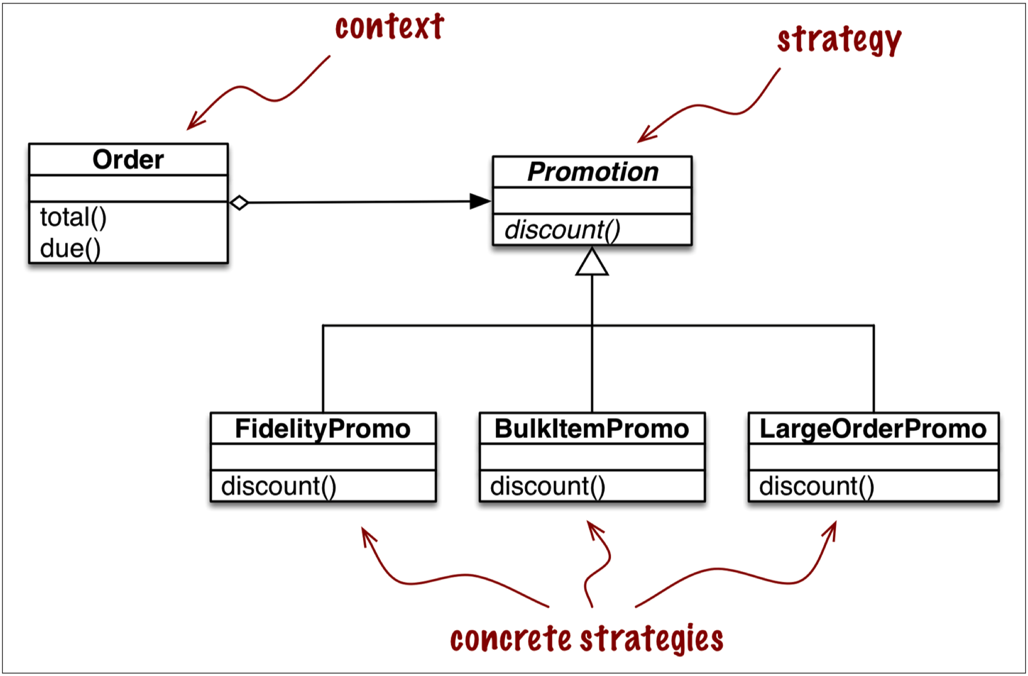
1.1 Classic Strategy
from abc import ABC, abstractmethod

from collections import namedtuple

Customer = namedtuple('Customer', 'name fidelity')

class LineItem:

	def __init__(self, product, quantity, price):

		self.product = product  # 商品名

		self.quantity = quantity  # 数量

		self.price = price  # 单价

	def total(self):  # 总价

		return self.price * self.quantity

class Order:

	def __init__(self, customer, cart, promotion=None):

		self.customer = customer  # 用户名

		self.cart = list(cart)  # 商品列表

		self.promotion = promotion  # obj

	def total(self):  # 总价

		if not hasattr(self, '__total'):

			self.__total = sum(item.total() for item in self.cart)

			return self.__total

	def due(self):  # 折扣价

		if self.promotion is None:

			discount = 0

		else:

			discount = self.promotion.discount(self)  # **********

		return self.total() - discount

	def __repr__(self):  # 打印

		fmt = '<Order total: {:.2f} due: {:.2f}>'

		return fmt.format(self.total(), self.due())

class Promotion(ABC):  # an abstract base class

	@abstractmethod

	def discount(self, order):  # 返回折扣的总钱数

		pass

class FidelityPromo(Promotion):

	"""5% discount for customers with 1000 or more fidelity points"""

	def discount(self, order):

		return order.total() * .05 if order.customer.fidelity >= 1000 else 0

class BulkItemPromo(Promotion):

	"""10% discount for each LineItem with 20 or more units"""

	def discount(self, order):

		discount = 0

		for item in order.cart:

			if item.quantity >= 20:

				discount += item.total() * .1

		return discount

class LargeOrderPromo(Promotion):

	"""7% discount for orders with 10 or more distinct items"""

	def discount(self, order):

		distinct_items = {item.product for item in order.cart}

		if len(distinct_items) >= 10:

			return order.total() * .07

		return 0

joe = Customer('John Doe', 1000)

cart = [LineItem('banana', 4, .5), LineItem('apple', 25, 1.5), LineItem('watermellon', 5, 5.0)]

print(Order(joe, cart, FidelityPromo()))  # <Order total: 64.50 due: 61.27>

print(Order(joe, cart, BulkItemPromo()))  # <Order total: 64.50 due: 60.75>

print(Order(joe, cart, LargeOrderPromo()))  # <Order total: 64.50 due: 64.50>
1.2 Function-Oriented Strategy
- A flyweight is a shared object that can be used in multiple contexts simultaneously. (享元)
from collections import namedtuple

Customer = namedtuple('Customer', 'name fidelity')

class LineItem:

	def __init__(self, product, quantity, price):

		self.product = product  # 商品名

		self.quantity = quantity  # 数量

		self.price = price  # 单价

	def total(self):  # 总价

		return self.price * self.quantity

class Order:

	def __init__(self, customer, cart, promotion=None):

		self.customer = customer  # 用户名

		self.cart = list(cart)  # 商品列表

		self.promotion = promotion  # obj

	def total(self):  # 总价

		if not hasattr(self, '__total'):

			self.__total = sum(item.total() for item in self.cart)

			return self.__total

	def due(self):  # 折扣价

		if self.promotion is None:

			discount = 0

		else:

			discount = self.promotion(self)  # **********

		return self.total() - discount

	def __repr__(self):  # 打印

		fmt = '<Order total: {:.2f} due: {:.2f}>'

		return fmt.format(self.total(), self.due())

def fidelity_promo(order):  # created just once

	"""5% discount for customers with 1000 or more fidelity points"""

	return order.total() * .05 if order.customer.fidelity >= 1000 else 0

def bulk_item_promo(order):

	"""10% discount for each LineItem with 20 or more units"""

	discount = 0

	for item in order.cart:

		if item.quantity >= 20:

			discount += item.total() * .1

	return discount

def large_order_promo(order):

	"""7% discount for orders with 10 or more distinct items"""

	distinct_items = {item.product for item in order.cart}

	if len(distinct_items) >= 10:

		return order.total() * .07

	return 0

joe = Customer('John Doe', 1000)

cart = [LineItem('banana', 4, .5), LineItem('apple', 25, 1.5), LineItem('watermellon', 5, 5.0)]

print(Order(joe, cart, fidelity_promo))  # <Order total: 64.50 due: 61.27>

print(Order(joe, cart, bulk_item_promo))  # <Order total: 64.50 due: 60.75>

print(Order(joe, cart, large_order_promo))  # <Order total: 64.50 due: 64.50>
1.3 Choosing the Best Strategy
promos = [fidelity_promo, bulk_item_promo, large_order_promo]

# promos = [globals()[name] for name in globals() if name.endswith('_promo') and name != 'best_promo']

# import inspect

# promos = [func for name, func in inspect.getmembers(promotions, inspect.isfunction)]  # promotions为自定模块

def best_promo(order):

	"""Select best discount available"""

	return max(promo(order) for promo in promos)
promos = []

def promotion(promo_func):

	promos.append(promo_func)

	return promo_func

@promotion

def fidelity_promo(order):  # created just once

	"""5% discount for customers with 1000 or more fidelity points"""

	return order.total() * .05 if order.customer.fidelity >= 1000 else 0

@promotion

def bulk_item_promo(order):

	"""10% discount for each LineItem with 20 or more units"""

	discount = 0

	for item in order.cart:

		if item.quantity >= 20:

			discount += item.total() * .1

	return discount

@promotion

def large_order_promo(order):

	"""7% discount for orders with 10 or more distinct items"""

	distinct_items = {item.product for item in order.cart}

	if len(distinct_items) >= 10:

		return order.total() * .07

	return 0
2. Command
6. Design Patterns with First-Class Functions的更多相关文章
- Learning JavaScript Design Patterns The Module Pattern
The Module Pattern Modules Modules are an integral piece of any robust application's architecture an ...
- Design Patterns Example Code (in C++)
Overview Design patterns are ways to reuse design solutions that other software developers have crea ...
- Massive Collection Of Design Patterns, Frameworks, Components, And Language Features For Delphi
Developer beNative over on GitHub has a project called Concepts which is a massive collection of Del ...
- Design Patterns Simplified - Part 3 (Simple Factory)【设计模式简述--第三部分(简单工厂)】
原文链接:http://www.c-sharpcorner.com/UploadFile/19b1bd/design-patterns-simplified-part3-factory/ Design ...
- Design Patterns Simplified - Part 2 (Singleton)【设计模式简述--第二部分(单例模式)】
原文链接: http://www.c-sharpcorner.com/UploadFile/19b1bd/design-patterns-simplified-part-2-singleton/ De ...
- Head First Design Patterns
From Head First Design Patterns. Design Principle: Idnetify the aspects of your application that var ...
- Apex Design Patterns
Apex allows you to build just about any custom solution on the Force.com platform. But what are the ...
- [Design Patterns] 4. Creation Pattern
设计模式是一套被反复使用.多数人知晓的.经过分类编目的.代码设计经验的总结,使用设计模式的目的是提高代码的可重用性,让代码更容易被他人理解,并保证代码可靠性.它是代码编制真正实现工程化. 四个关键元素 ...
- [Design Patterns] 3. Software Pattern Overview
When you're on the way which is unknown and dangerous, just follow your mind and steer the boat. 软件模 ...
- [Design Patterns] 1. Primary concept & term - UML
It's time to review design patterns, especially when I reach the turning-point of my career. That's ...
随机推荐
- 如何设置payjs的微信jsapi支付目录
首先你得是 payjs 的有效开通用户.不清楚 payjs 是干什么的可以自行百度. 设置方法非常简单,在后台菜单-系统设置-JSAPI目录设置,在右侧填写支付目录即可. 需要注意的是:支付目录需要配 ...
- python列表插入--append(), extend(), insert()
append(),extend(), insert()都是列表操作中常用的插入函数.其中前两个均接收一个参数,并插入到列表尾部.最后一个接收两个参数,将参数2插入到参数1之前. 本文主要讨论appen ...
- 《剑指offer》字符串专题 (牛客11.01)
字符串的题目难度不一,涉及到的考点有字符串处理.字符串匹配(自动机.正则).模拟,以及递归.动态规划等算法. 难度 题目 知识点 ☆ 02. 替换空格 从后往前 ☆☆ 27. 字符串的排列 回溯,St ...
- docker入门2--生命周期
容器的概念: 一句话概括容器:容器就是将软件打包成标准化单元,以用于开发.交付和部署. 容器镜像是轻量的.可执行的独立软件包 ,包含软件运行所需的所有内容:代码.运行时环境.系统工具.系统库和设置 ...
- [LuoguP2124]奶牛美容_bfs_floyd_曼哈顿距离
奶牛美容 题目链接:https://www.luogu.org/problem/P2124 数据范围:略. 题解: 发现数据范围只有$50$,显然可以直接$bfs$求出联通块,$floyd$求出相邻两 ...
- AndroidStudio下载安装教程(图文教程)
场景 Android Studio 中文社区: http://www.android-studio.org/ 下载安装包,这里选择64位Windows 等待下载完成. 注: 博客: https://b ...
- [转帖]centos7设置CPU的运行频率为performance
centos7设置CPU的运行频率为performance http://www.512873.com/archives/612.html Publish: March 6, 2019 Categor ...
- celery异步任务
1.安装 pip install celery 2.创建celery_tasks文件夹,创建config配置文件和main文件 # 在config.py文件中配置中间人broker地址信息 - red ...
- nginx访问量统计 日常分析
nginx访问量统计 0.查询某个时间段的日志 cat appapi.dayutang.cn.access.log |grep 'POST'|grep '2019:10' > 20191059. ...
- Codeforces 1247C. p-binary
传送门 首先 $n=\sum_{i=1}^{ans}(2^{x_{ans}}+p)$ 可以变成 $n-ans \cdot p=\sum_{i=1}^{ans}2^{x_{ans}}$ 注意到如果 $n ...