
2019.04.19 读书笔记 比较File.OpenRead()和File.ReadAllBytes()的差异
最近涉及到流的获取与转化,终于要还流的债了。
百度了一下,看到这样的两条回复,于是好奇心,决定看看两种写法的源码差异。
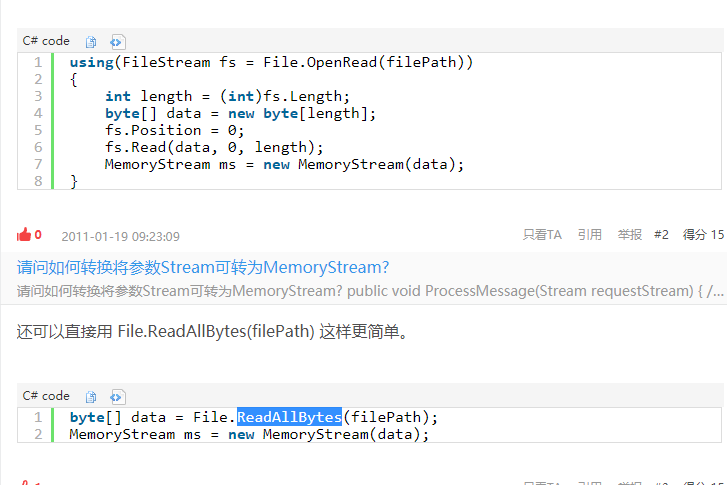
先来看看OpenRead()
public static FileStream OpenRead(string path) =>

    new FileStream(path, FileMode.Open, FileAccess.Read, FileShare.Read);

//构造函数又调用了其他构造函数,继续深入

[SecuritySafeCritical]

public FileStream(string path, FileMode mode, FileAccess access, FileShare share) : this(path, mode, access, share, 0x1000, FileOptions.None, Path.GetFileName(path), false)

{

}

//调用了Init 初始化

[SecurityCritical]

internal FileStream(string path, FileMode mode, FileAccess access, FileShare share, int bufferSize, FileOptions options, string msgPath, bool bFromProxy)

{

    Win32Native.SECURITY_ATTRIBUTES secAttrs = GetSecAttrs(share);

    this.Init(path, mode, access, , false, share, bufferSize, options, secAttrs, msgPath, bFromProxy, false, false);

}

//读取数据到流中,过程就没什么可以看的了

[SecuritySafeCritical]

private unsafe void Init(string path, FileMode mode, FileAccess access, int rights, bool useRights, FileShare share, int bufferSize, FileOptions options, Win32Native.SECURITY_ATTRIBUTES secAttrs, string msgPath, bool bFromProxy, bool useLongPath, bool checkHost)

{

    int num;

    if (path == null)

    {

        throw new ArgumentNullException("path", Environment.GetResourceString("ArgumentNull_Path"));

    }

    if (path.Length == )

    {

        throw new ArgumentException(Environment.GetResourceString("Argument_EmptyPath"));

    }

    FileSystemRights rights2 = (FileSystemRights) rights;

    this._fileName = msgPath;

    this._exposedHandle = false;

    FileShare share2 = share & ~FileShare.Inheritable;

    string paramName = null;

    if ((mode < FileMode.CreateNew) || (mode > FileMode.Append))

    {

        paramName = "mode";

    }

    else if (!useRights && ((access < FileAccess.Read) || (access > FileAccess.ReadWrite)))

    {

        paramName = "access";

    }

    else if (useRights && ((rights2 < FileSystemRights.ListDirectory) || (rights2 > FileSystemRights.FullControl)))

    {

        paramName = "rights";

    }

    else if ((share2 < FileShare.None) || (share2 > (FileShare.Delete | FileShare.ReadWrite)))

    {

        paramName = "share";

    }

    if (paramName != null)

    {

        throw new ArgumentOutOfRangeException(paramName, Environment.GetResourceString("ArgumentOutOfRange_Enum"));

    }

    if ((options != FileOptions.None) && ((options & 0x3ffbfff) != FileOptions.None))

    {

        throw new ArgumentOutOfRangeException("options", Environment.GetResourceString("ArgumentOutOfRange_Enum"));

    }

    if (bufferSize <= )

    {

        throw new ArgumentOutOfRangeException("bufferSize", Environment.GetResourceString("ArgumentOutOfRange_NeedPosNum"));

    }

    if (((!useRights && ((access & FileAccess.Write) == )) || (useRights && ((rights2 & FileSystemRights.Write) == ))) && (((mode == FileMode.Truncate) || (mode == FileMode.CreateNew)) || ((mode == FileMode.Create) || (mode == FileMode.Append))))

    {

        if (!useRights)

        {

            object[] objArray1 = new object[] { mode, access };

            throw new ArgumentException(Environment.GetResourceString("Argument_InvalidFileMode&AccessCombo", objArray1));

        }

        object[] values = new object[] { mode, rights2 };

        throw new ArgumentException(Environment.GetResourceString("Argument_InvalidFileMode&RightsCombo", values));

    }

    if (useRights && (mode == FileMode.Truncate))

    {

        if (rights2 != FileSystemRights.Write)

        {

            object[] objArray3 = new object[] { mode, rights2 };

            throw new ArgumentException(Environment.GetResourceString("Argument_InvalidFileModeTruncate&RightsCombo", objArray3));

        }

        useRights = false;

        access = FileAccess.Write;

    }

    if (!useRights)

    {

        num = (access == FileAccess.Read) ? - : ((access == FileAccess.Write) ? 0x40000000 : -);

    }

    else

    {

        num = rights;

    }

    int maxPathLength = useLongPath ? 0x7fff : (AppContextSwitches.BlockLongPaths ?  : 0x7fff);

    string fullPath = Path.NormalizePath(path, true, maxPathLength);

    this._fileName = fullPath;

    if ((!CodeAccessSecurityEngine.QuickCheckForAllDemands() || AppContextSwitches.UseLegacyPathHandling) && fullPath.StartsWith(@"\\.\", StringComparison.Ordinal))

    {

        throw new ArgumentException(Environment.GetResourceString("Arg_DevicesNotSupported"));

    }

    bool flag = false;

    if ((!useRights && ((access & FileAccess.Read) != )) || (useRights && ((rights2 & FileSystemRights.ReadAndExecute) != )))

    {

        if (mode == FileMode.Append)

        {

            throw new ArgumentException(Environment.GetResourceString("Argument_InvalidAppendMode"));

        }

        flag = true;

    }

    if (CodeAccessSecurityEngine.QuickCheckForAllDemands())

    {

        FileIOPermission.EmulateFileIOPermissionChecks(fullPath);

    }

    else

    {

        FileIOPermissionAccess noAccess = FileIOPermissionAccess.NoAccess;

        if (flag)

        {

            noAccess |= FileIOPermissionAccess.Read;

        }

        if (((!useRights && ((access & FileAccess.Write) != )) || (useRights && ((rights2 & (FileSystemRights.TakeOwnership | FileSystemRights.ChangePermissions | FileSystemRights.Delete | FileSystemRights.Write | FileSystemRights.DeleteSubdirectoriesAndFiles)) != ))) || ((useRights && ((rights2 & FileSystemRights.Synchronize) != )) && (mode == FileMode.OpenOrCreate)))

        {

            if (mode == FileMode.Append)

            {

                noAccess |= FileIOPermissionAccess.Append;

            }

            else

            {

                noAccess |= FileIOPermissionAccess.Write;

            }

        }

        AccessControlActions control = ((secAttrs != null) && (secAttrs.pSecurityDescriptor != null)) ? AccessControlActions.Change : AccessControlActions.None;

        string[] fullPathList = new string[] { fullPath };

        FileIOPermission.QuickDemand(noAccess, control, fullPathList, false, false);

    }

    share &= ~FileShare.Inheritable;

    bool flag2 = mode == FileMode.Append;

    if (mode == FileMode.Append)

    {

        mode = FileMode.OpenOrCreate;

    }

    if ((options & FileOptions.Asynchronous) != FileOptions.None)

    {

        this._isAsync = true;

    }

    else

    {

        options &= ~FileOptions.Asynchronous;

    }

    int dwFlagsAndAttributes = (int) options;

    dwFlagsAndAttributes |= 0x100000;

    int newMode = Win32Native.SetErrorMode();

    try

    {

        string str3 = fullPath;

        if (useLongPath)

        {

            str3 = Path.AddLongPathPrefix(str3);

        }

        this._handle = Win32Native.SafeCreateFile(str3, num, share, secAttrs, mode, dwFlagsAndAttributes, IntPtr.Zero);

        if (this._handle.IsInvalid)

        {

            int errorCode = Marshal.GetLastWin32Error();

            if ((errorCode == ) && fullPath.Equals(Directory.InternalGetDirectoryRoot(fullPath)))

            {

                errorCode = ;

            }

            bool flag4 = false;

            if (!bFromProxy)

            {

                try

                {

                    FileIOPermission.QuickDemand(FileIOPermissionAccess.PathDiscovery, this._fileName, false, false);

                    flag4 = true;

                }

                catch (SecurityException)

                {

                }

            }

            if (flag4)

            {

                __Error.WinIOError(errorCode, this._fileName);

            }

            else

            {

                __Error.WinIOError(errorCode, msgPath);

            }

        }

    }

    finally

    {

        Win32Native.SetErrorMode(newMode);

    }

    if (Win32Native.GetFileType(this._handle) != )

    {

        this._handle.Close();

        throw new NotSupportedException(Environment.GetResourceString("NotSupported_FileStreamOnNonFiles"));

    }

    if (this._isAsync)

    {

        bool flag5 = false;

        new SecurityPermission(SecurityPermissionFlag.UnmanagedCode).Assert();

        try

        {

            flag5 = ThreadPool.BindHandle(this._handle);

        }

        finally

        {

            CodeAccessPermission.RevertAssert();

            if (!flag5)

            {

                this._handle.Close();

            }

        }

        if (!flag5)

        {

            throw new IOException(Environment.GetResourceString("IO.IO_BindHandleFailed"));

        }

    }

    if (!useRights)

    {

        this._canRead = (access & FileAccess.Read) > ;

        this._canWrite = (access & FileAccess.Write) > ;

    }

    else

    {

        this._canRead = (rights2 & FileSystemRights.ListDirectory) > ;

        this._canWrite = ((rights2 & FileSystemRights.CreateFiles) != ) || ((rights2 & FileSystemRights.AppendData) > );

    }

    this._canSeek = true;

    this._isPipe = false;

    this._pos = 0L;

    this._bufferSize = bufferSize;

    this._readPos = ;

    this._readLen = ;

    this._writePos = ;

    if (flag2)

    {

        this._appendStart = this.SeekCore(0L, SeekOrigin.End);

    }

    else

    {

        this._appendStart = -1L;

    }

}
从上面的源码可以看出,OpenRead会把无论多大的文件都读取到FileStream中,能有多大呢?FileStream.Length可是long型的,就是2的63次方了,2的40次方是1T,大约就是8MT吧,我们的常用硬盘是没这么大的了,可以说能读出天荒地老了。那么图片中的第一中写法,读取没错,但是转换int就留下了隐患,int的最大限制是2G,如果文件超过2G,那么转换就会被截取,导致读到data里的数据就不完整了。所以一定不要偷懒,由于FileStream.Read的参数是int型的,一定要判断流的长度,如果超过了int最大值,要循环read。
再来看看File.ReadAllBytes(),上源码:
[SecurityCritical]

private static byte[] InternalReadAllBytes(string path, bool checkHost)

{

    byte[] buffer;

    using (FileStream stream = new FileStream(path, FileMode.Open, FileAccess.Read, FileShare.Read, 0x1000, FileOptions.None, Path.GetFileName(path), false, false, checkHost))//这里也是和OpenRead一样,把文件全部读取进来了

    {

        int offset = ;

        long length = stream.Length;

        if (length > 0x7fffffffL)//这里才是关键,对长度做了一个判断,如果超过了2G,就抛异常了,所以决定了这个方法的文件不能超过2G

        {

            throw new IOException(Environment.GetResourceString("IO.IO_FileTooLong2GB"));

        }

        int count = (int) length;

        buffer = new byte[count];

        while (count > )

        {

            int num4 = stream.Read(buffer, offset, count);

            if (num4 == )

            {

                __Error.EndOfFile();

            }

            offset += num4;

            count -= num4;

        }

    }

    return buffer;

}
第二种写法会导致在读取文件超过2G后抛出异常,所以使用时要确定文件的大小,否则就用OpenRead()。
所以图中两种写法都可能存在隐患的BUG。
当然,在确定了不可能超过2G的情况下,还是可以自由使用的。
2019.04.19 读书笔记 比较File.OpenRead()和File.ReadAllBytes()的差异的更多相关文章
- 2019.04.18 读书笔记 深入string
整个.net中,最特殊的就是string类型了,它有着引用类型的特性,又有着值类型的操作方式,最特殊的是,它还有字符串池,一个字符串只会有一个实例(等下就推翻!). 鉴于之前的<==与Equal ...
- 2019.04.17 读书笔记 checked与unchecked
在普通的编程中,我们是很容易去分析数据的大小,然后给出合理的类型,但是在很多数据库的累计中,缺存在很多隐患,特别是研发时,数据量小,求和也不会溢出,当程序运行几年后,再来一次大求和,隐形的BUG就出来 ...
- 2019.03.19 读书笔记 string与stringbuilder的性能
1 string与stringbuilder 并不是stringbuilder任何时候都在性能上占优势,在少量(大约个位数)的字符串时,并不比普通string操作快. string慢的原因不是stri ...
- RH253读书笔记(5)-Lab 5 Network File Sharing Services
Lab 5 Network File Sharing Services Goal: Share file or printer resources with FTP, NFS and Samba Se ...
- 2019.03.29 读书笔记 关于params与可选参数
void Method1(string str, object a){} void Method2(string str, object a,object b) { } void Method3(st ...
- 2019.03.29 读书笔记 关于override与new
差异:override:覆盖父类分方法,new 隐藏父类方法. 共同:都不能改变父类自身方法. public class Test { public string Name { get; set; } ...
- 2019.03.28 读书笔记 关于lock
多线程就离不开lock,lock的本质是一个语法糖,采用了监视器Monitor. lock的参数,错误方式有很多种,只需要记住一种:private static readonly object loc ...
- 2019.03.28 读书笔记 关于try catch
try catch 在不异常的时候不损耗性能,耗损性能的是throw ex,所以在非异常是,不要滥用throw,特别是很多代码习惯:if(age<0) throw new Exception(& ...
- 2019.03.27 读书笔记 关于GC垃圾回收
在介绍GC前,有必要对.net中CLR管理内存区域做简要介绍: 1. 堆栈:用于分配值类型实例.堆栈主要操作系统管理,而不受垃圾收集器的控制,当值类型实例所在方法结束时,其存储单位自动释放.栈的执行效 ...
随机推荐
- .NET基础 (03)生成、部署和管理
生成.部署和管理1 如何生成强签名的程序集2 如何把程序集放入GAC中3 延迟签名及其作用4 程序集的版本分哪几部分 1 如何生成强签名的程序集在生成程序集时,CLR提供了两种可选类型:强签名程序集. ...
- C# Timer 用法
System.Timers.Timer,通过.NET Thread Pool实现的,轻量,计时精确,对应用程序.消息没有特别的要求. using Timer = System.Timers.Tim ...
- web_custom_request函数详解【摘抄】
本次摘抄自:http://www.cnblogs.com/yezhaohui/p/3280239.html web_custom_request()函数是一个可以用于自定义http请求的“万能”函数, ...
- js 操作cookie cookie路径问题
这里主要不是讲这个方法,js写cookie这种代码网上一抓一把,在使用的时候遇到一点问题,就是写的cookie 是有路径问题的,在user目录下可以使用跳转到另外一个目录下cookie,经过比较coo ...
- mybatis--mapper配置总结
mapper介绍 mapper使用规则:按业务划分,一个业务模块相关的sql均定义在一个mapper文件 mapper的xml格式: doctype: <!DOCTYPE mapper PUBL ...
- httpclient 解析excel
http://www.blogjava.net/jayslong/archive/2011/04/21/convert_xls_and_xlsx_to_csv.html 分享用Java将Excel的x ...
- 忘记Oracle用户名和密码
方法一: 看看是不是Oracle服务器没有打开 打开cmd,输入sqlplus /nolog,回车---->进入sqlplus; 输入“conn /as sysdba”:以超级管理员的方式连接数 ...
- Jquery中each
1.选择器+遍历 $('div').each(function (i){ i就是索引值 this 表示获取遍历每一个dom对象 }); 2.选择器+遍历 $('div').each(function ...
- POJ - 2387 Til the Cows Come Home (最短路Dijkstra+优先队列)
Bessie is out in the field and wants to get back to the barn to get as much sleep as possible before ...
- BZOJ3510 首都
题目描述 在X星球上有N个国家,每个国家占据着X星球的一座城市.由于国家之间是敌对关系,所以不同国家的两个城市是不会有公路相连的. X星球上战乱频发,如果A国打败了B国,那么B国将永远从这个星球消失, ...