
[LeetCode] Populating Next Right Pointers in Each Node II 每个节点的右向指针之二
Given a binary tree
struct Node {

  int val;

  Node *left;

  Node *right;

  Node *next;

}
Populate each next pointer to point to its next right node. If there is no next right node, the next pointer should be set to NULL.
Initially, all next pointers are set to NULL.
Example:
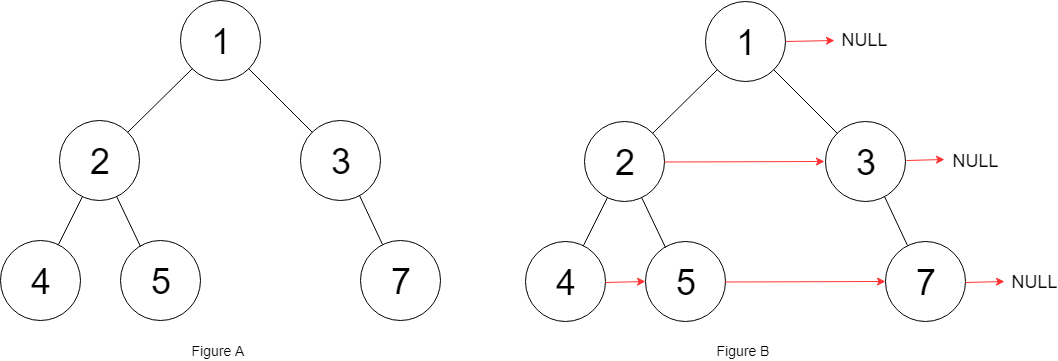
Input: {"$id":"1","left":{"$id":"2","left":{"$id":"3","left":null,"next":null,"right":null,"val":4},"next":null,"right":{"$id":"4","left":null,"next":null,"right":null,"val":5},"val":2},"next":null,"right":{"$id":"5","left":null,"next":null,"right":{"$id":"6","left":null,"next":null,"right":null,"val":7},"val":3},"val":1}

Output: {"$id":"1","left":{"$id":"2","left":{"$id":"3","left":null,"next":{"$id":"4","left":null,"next":{"$id":"5","left":null,"next":null,"right":null,"val":7},"right":null,"val":5},"right":null,"val":4},"next":{"$id":"6","left":null,"next":null,"right":{"$ref":"5"},"val":3},"right":{"$ref":"4"},"val":2},"next":null,"right":{"$ref":"6"},"val":1}

Explanation: Given the above binary tree (Figure A), your function should populate each next pointer to point to its next right node, just like in Figure B.
Note:
- You may only use constant extra space.
- Recursive approach is fine, implicit stack space does not count as extra space for this problem.
这道是之前那道 Populating Next Right Pointers in Each Node 的延续,原本的完全二叉树的条件不再满足,但是整体的思路还是很相似,仍然有递归和非递归的解法。我们先来看递归的解法,这里由于子树有可能残缺,故需要平行扫描父节点同层的节点,找到他们的左右子节点。代码如下:
解法一:
class Solution {

public:

    Node* connect(Node* root) {

        if (!root) return NULL;

        Node *p = root->next;

        while (p) {

            if (p->left) {

                p = p->left;

                break;

            }

            if (p->right) {

                p = p->right;

                break;

            }

            p = p->next;

        }

        if (root->right) root->right->next = p;

        if (root->left) root->left->next = root->right ? root->right : p;

        connect(root->right);

        connect(root->left);

        return root;

    }

};
对于非递归的方法,我惊喜的发现之前的方法直接就能用,完全不需要做任何修改,算法思路可参见之前的博客 Populating Next Right Pointers in Each Node,代码如下:
解法二:
// Non-recursion, more than constant space

class Solution {

public:

    Node* connect(Node* root) {

        if (!root) return NULL;

        queue<Node*> q;

        q.push(root);

        while (!q.empty()) {

            int len = q.size();

            for (int i = ; i < len; ++i) {

                Node *t = q.front(); q.pop();

                if (i < len - ) t->next = q.front();

                if (t->left) q.push(t->left);

                if (t->right) q.push(t->right);

            }

        }

        return root;

    }

};
虽然以上的两种方法都能通过OJ,但其实它们都不符合题目的要求,题目说只能使用constant space,可是OJ却没有写专门检测space使用情况的test,那么下面贴上constant space的解法,这个解法也是用的层序遍历,只不过没有使用queue了,我们建立一个dummy结点来指向每层的首结点的前一个结点,然后指针cur用来遍历这一层,我们实际上是遍历一层,然后连下一层的next,首先从根结点开始,如果左子结点存在,那么cur的next连上左子结点,然后cur指向其next指针;如果root的右子结点存在,那么cur的next连上右子结点,然后cur指向其next指针。此时root的左右子结点都连上了,此时root向右平移一位,指向其next指针,如果此时root不存在了,说明当前层已经遍历完了,我们重置cur为dummy结点,root此时为dummy->next,即下一层的首结点,然后dummy的next指针清空,或者也可以将cur的next指针清空,因为前面已经将cur赋值为dummy了。那么现在想一想,为什么要清空?因为我们用dummy的目的就是要指到下一行的首结点的位置即dummy->next,而一旦将root赋值为dummy->next了之后,这个dummy的使命就已经完成了,必须要断开,如果不断开的话,那么假设现在root是叶结点了,那么while循环还会执行,不会进入前两个if,然后root右移赋空之后,会进入最后一个if,之前没有断开dummy->next的话,那么root又指向之前的叶结点了,死循环诞生了,跪了。所以一定要记得清空哦,呵呵哒~
这里再来说下dummy结点是怎样指向每层的首结点的前一个结点的,过程是这样的,dummy是创建出来的一个新的结点,其目的是为了指向root结点的下一层的首结点的前一个,具体是这么做到的呢,主要是靠cur指针,首先cur指向dummy,然后cur再连上root下一层的首结点,这样dummy也就连上了。然后当root层遍历完了之后,root需要往下移动一层,这样dummy结点之后连接的位置就正好赋值给root,然后cur再指向dummy,dummy之后断开,这样又回到了初始状态,以此往复就可以都连上了,代码如下:
解法三:
// Non-recursion, constant space

class Solution {

public:

    Node* connect(Node* root) {

        Node *dummy = new Node(, NULL, NULL, NULL), *cur = dummy, *head = root;

        while (root) {

            if (root->left) {

                cur->next = root->left;

                cur = cur->next;

            }

            if (root->right) {

                cur->next = root->right;

                cur = cur->next;

            }

            root = root->next;

            if (!root) {

                cur = dummy;

                root = dummy->next;

                dummy->next = NULL;

            }

        }

        return head;

    }

};
类似题目:
Populating Next Right Pointers in Each Node
参考资料:
https://leetcode.com/problems/populating-next-right-pointers-in-each-node-ii/
LeetCode All in One 题目讲解汇总(持续更新中...)
[LeetCode] Populating Next Right Pointers in Each Node II 每个节点的右向指针之二的更多相关文章
- [LeetCode] 117. Populating Next Right Pointers in Each Node II 每个节点的右向指针 II
Follow up for problem "Populating Next Right Pointers in Each Node". What if the given tre ...
- 117 Populating Next Right Pointers in Each Node II 每个节点的右向指针 II
这是“每个节点的右向指针”问题的进阶.如果给定的树可以是任何二叉树,该怎么办?你以前的解决方案仍然有效吗?注意: 你只能使用恒定的空间.例如,给定以下二叉树, 1 / ...
- LeetCode: Populating Next Right Pointers in Each Node II 解题报告
Populating Next Right Pointers in Each Node IIFollow up for problem "Populating Next Right Poin ...
- LeetCode——Populating Next Right Pointers in Each Node II
Follow up for problem "Populating Next Right Pointers in Each Node". What if the given tre ...
- [leetcode]Populating Next Right Pointers in Each Node II @ Python
原题地址:https://oj.leetcode.com/problems/populating-next-right-pointers-in-each-node-ii/ 题意: Follow up ...
- LeetCode - Populating Next Right Pointers in Each Node II
题目: Follow up for problem "Populating Next Right Pointers in Each Node". What if the given ...
- [LeetCode] [LeetCode] Populating Next Right Pointers in Each Node II
Follow up for problem "Populating Next Right Pointers in Each Node". What if the given tre ...
- leetCode 116.Populating Next Right Pointers in Each Node (为节点填充右指针) 解题思路和方法
Given a binary tree struct TreeLinkNode { TreeLinkNode *left; TreeLinkNode *right; TreeLinkNode *nex ...
- [Leetcode] Populating next right pointer in each node 填充每个节点的右指针
Given a binary tree struct TreeLinkNode { TreeLinkNode *left; TreeLinkNode *right; TreeLinkNode *nex ...
随机推荐
- Basic Tutorials of Redis(2) - String
This post is mainly about how to use the commands to handle the Strings of Redis.And I will show you ...
- .Net语言 APP开发平台——Smobiler学习日志:快速实现应用中的图片、声音等文件上传功能
最前面的话:Smobiler是一个在VS环境中使用.Net语言来开发APP的开发平台,也许比Xamarin更方便 样式一 一.目标样式 我们要实现上图中的效果,需要如下的操作: 1.从工具栏上的&qu ...
- WinForm构造函数的作用
最近练习C#项目:何问起收藏夹(HoverTreeSCJ),实现编辑网址时,遇到这个问题:比如打开窗口后,要自动显示数据.解决方法:那么可以通过窗体的构造函数传递参数. 比如窗体类: public p ...
- Android Service
一.在MainAcitivity界面启动Service : public class MyService extends Service intent = new Intent(MainActivi ...
- spring源码:Aware接口(li)
一.spring容器中的aware接口介绍 Spring中提供了各种Aware接口,比较常见的如BeanFactoryAware,BeanNameAware,ApplicationContextAwa ...
- Java01
1.JAVA历史概述 百度百科:http://baike.baidu.com/view/29.htm 詹姆斯.高斯林 (高司令)----java之父 Sun Micros ...
- jQuery的$.ajax
在介绍JSONP之前,先简单的介绍一些JSON.JSON是JavaScript Object Notation的缩写,是一种轻量的.可读的基于文本的数据交换开放标准.源于JavsScript编程语言中 ...
- dubbo连接zookeeper注册中心因为断网导致线程无限等待问题【转】
最近维护的系统切换了网络环境,由联通换成了电信网络,因为某些过滤规则导致系统连不上zookeeper服务器(应用系统机器在深圳,网络为电信线路,zookeeper服务器在北京,网络为联通线路),因为我 ...
- 图片的赖加载(lazyLoad)
懒加载的意义(在线demo预览) 尽管很多公司的网页都有一些限制,比如页面的最大的图片大小不得大于50k,也有很多图片优化工具fis3.gulp等等,但是如果图片太多还是会影响页面的加载速度,快则几十 ...
- CSS3之盒子模型
display:box 使子元素成行排列如果父级宽度小于子级盒子 不会把超出部分挤出下面 而是直接超出 -box-orient:vertical 使盒子垂直显示 默认水平显示 -box-direct ...