
PAT003 List Leaves
题目:
Given a tree, you are supposed to list all the leaves in the order of top down, and left to right.
Input Specification:
Each input file contains one test case. For each case, the first line gives a positive integer N (<=10) which is the total number of nodes in the tree -- and hence the nodes are numbered from 0 to N-1. Then N lines follow, each corresponds to a node, and gives the indices of the left and right children of the node. If the child does not exist, a "-" will be put at the position. Any pair of children are separated by a space.
Output Specification:
For each test case, print in one line all the leaves' indices in the order of top down, and left to right. There must be exactly one space between any adjacent numbers, and no extra space at the end of the line.
Sample Input:
8

1 -

- -

0 -

2 7

- -

- -

5 -

4 6
Sample Output:
4 1 5


分析: 主要有两步,一是根据输入数据创建树,二是对树进行层序遍历。其中用到了通过链表创建的队列。
代码(c):
#include <stdio.h>

typedef struct listNode {

    int value;

    char leftIndex, rightIndex;

    struct listNode *left;

    struct listNode *right;

    struct listNode *next; // 队列用

} ListNode;

typedef struct queue {

    ListNode *front;

    ListNode *rear;

} Queue;

Queue *createQueue()

{

    Queue *queue = (Queue *)malloc(sizeof(Queue));

    queue->front = NULL;

    queue->rear = NULL;

    return queue;

}

void addToQueue(Queue *queue, ListNode *node)

{

    if (!(queue->rear)) {

        queue->rear = node;

    } else {

        queue->rear->next = node;

        queue->rear = node;

    }

    if (!(queue->front)) {

        queue->front = node;

    }

}

ListNode *deleteFromQueue(Queue *queue)

{

    ListNode *temp = queue->front;

    if (temp) {

        queue->front = queue->front->next;

        return temp;

    } else {

        return NULL;

    }

}

int isEmptyQueue(Queue *queue)

{

    if (queue->front == NULL) {

        return ;

    } else {

        return ;

    }

}

// List Leaves

int main()

{

    // 接受输入

    int nodeCount;

    scanf("%d", &nodeCount);

    ListNode a[nodeCount];

    int sum = ;

    for (int i = ; i < nodeCount; i++) {

        char leftIndex, rightIndex;

        getchar(); // 去除多余的 '\n'

        scanf("%c %c", &leftIndex, &rightIndex);

        ListNode input = *(ListNode *)malloc(sizeof(ListNode));

        input.leftIndex = leftIndex;

        input.rightIndex = rightIndex;

        input.left = NULL;

        input.right = NULL;

        input.value = i;

        a[i] = input;

        sum += (leftIndex == '-' ?  : leftIndex - '') + (rightIndex == '-' ?  : rightIndex - '');

    }

    // 建树

    for (int i = ; i < nodeCount; i++) {

        ListNode *node = &(a[i]);

        char leftIndex = node->leftIndex;

        char rightIndex = node->rightIndex;

        node->left = leftIndex != '-' ? &(a[leftIndex - '']) : NULL;

        node->right = rightIndex != '-' ? &(a[rightIndex - '']) : NULL;

    }

    // 根节点下标

    int rootIndex = (nodeCount - ) * nodeCount /  - sum;

    ListNode *root = &a[rootIndex];

    // 层次遍历 遇到叶节点输出

    Queue *queue = createQueue();

    addToQueue(queue, root);

    int flag = ;

    while (!isEmptyQueue(queue)) {

        ListNode *node = deleteFromQueue(queue);

        if (!(node->left) && !(node->right)) {

            if (flag) {

                printf("%d", node->value);

                flag = ;

            } else {

                printf(" %d", node->value);

            }

        }

        if (node->left) {

            addToQueue(queue, node->left);

        }

        if (node->right) {

            addToQueue(queue, node->right);

        }

    }

}
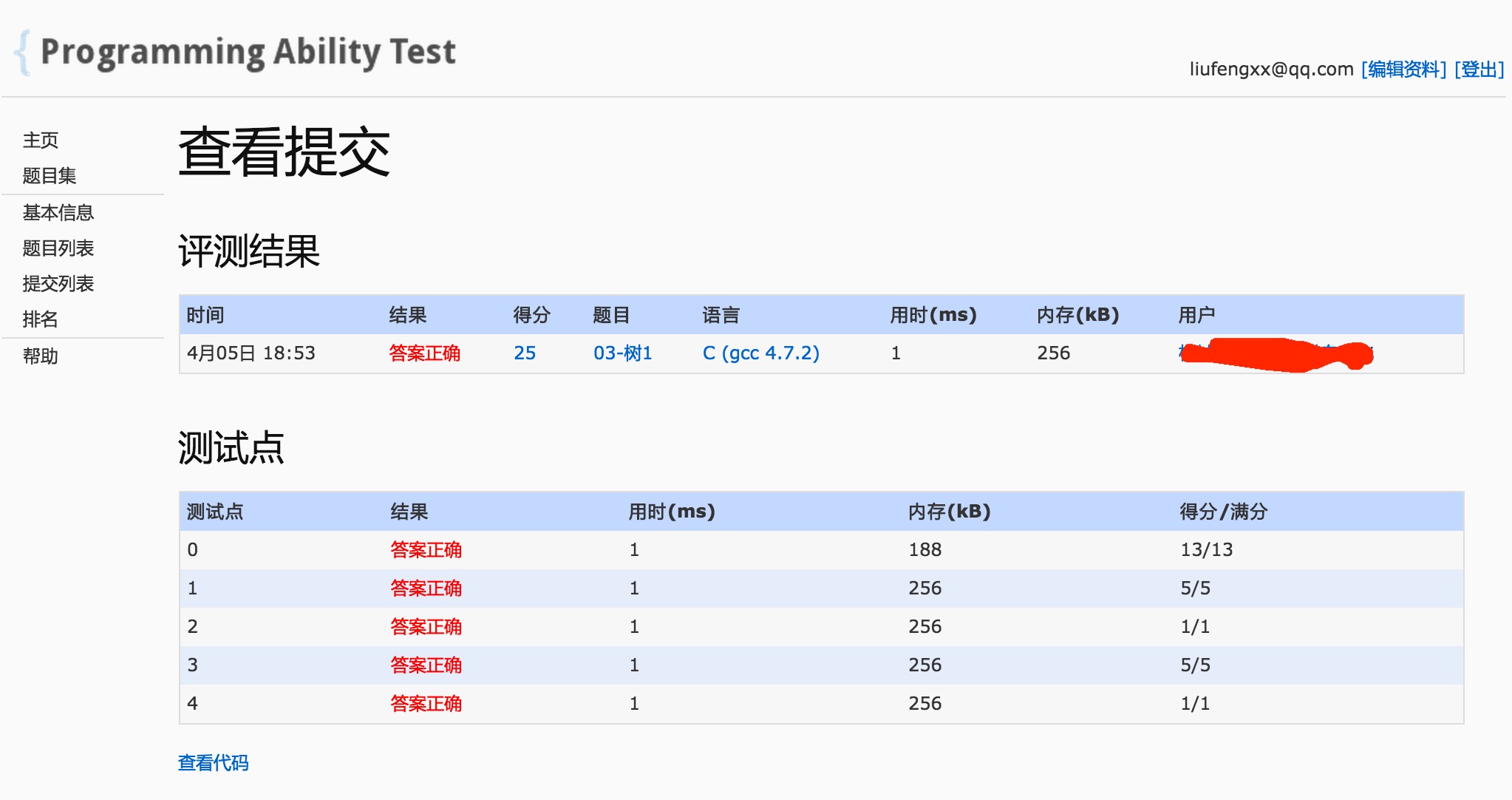
运行结果:
PAT003 List Leaves的更多相关文章
- [LeetCode] Sum of Left Leaves 左子叶之和
Find the sum of all left leaves in a given binary tree. Example: 3 / \ 9 20 / \ 15 7 There are two l ...
- [LeetCode] Find Leaves of Binary Tree 找二叉树的叶节点
Given a binary tree, find all leaves and then remove those leaves. Then repeat the previous steps un ...
- LeetCode - 404. Sum of Left Leaves
Find the sum of all left leaves in a given binary tree. Example: 3 / \ 9 20 / \ 15 7 There are two l ...
- LeetCode Sum of Left Leaves
原题链接在这里:https://leetcode.com/problems/sum-of-left-leaves/ 题目: Find the sum of all left leaves in a g ...
- Leetcode: Find Leaves of Binary Tree
Given a binary tree, collect a tree's nodes as if you were doing this: Collect and remove all leaves ...
- 1004. Counting Leaves (30)
1004. Counting Leaves (30) A family hierarchy is usually presented by a pedigree tree. Your job is ...
- 366. Find Leaves of Binary Tree
Given a binary tree, collect a tree's nodes as if you were doing this: Collect and remove all leaves ...
- 404. Sum of Left Leaves
Find the sum of all left leaves in a given binary tree. 左树的值(9+15=24) /** * Definition for a binary ...
- Sum of Left Leaves
Find the sum of all left leaves in a given binary tree. Example: 3 / \ 9 20 / \ 15 7 There are two l ...
随机推荐
- TreeView 类 事件
名称 说明 AfterCheck 在选中树节点复选框后发生. AfterCollapse 在折叠树节点后发生. AfterExpand 在展开树节点后发生. AfterLabelEdit 在编辑树节点 ...
- Android adb shell学习心得(四)
1.awk中的sub sub为替换函数.形式如 sub(/1/,"",$2) 将第二个变量的第一个1替换为空,若将sub替换为gsub.则替换全部的1. 2.awk中的-F 分隔符 ...
- TestNG测试报告美化
因TestNG自带的测试报告不太美观,可以使用testng-xslt进行美化 1.下载testng-xslt包 2.把/src/main/resources/TestNG-results.xsl放到你 ...
- Java中equals()、equalsIgnoreCase()和==的区别
用久了C#,在Java中,判断一个字符串还是习惯性的用了==,但是总是不能按照正确的判断分支运行,后来才想起来Java中是有equals的,然后就有引出了equalsIgnoreCase. 这三种 ...
- PHP多文件上传代码练习
HTML表单: <html> <head><title>upload file</title> <meta http-equiv="Co ...
- 回顾 git 常用命令
git init 在本地新建一个repo,进入一个项目目录,执行git init,会初始化一个repo,并在当前文件夹下创建一个.git文件夹. git clone 获取一个u ...
- c++11 学习
#include <iostream> // std::cout #include <functional> // std::ref #include <thread&g ...
- 最长公共子序列(LCS)问题 Longest Common Subsequence 与最长公告字串 longest common substr
问题描述:字符序列的子序列是指从给定字符序列中随意地(不一定连续)去掉若干个字符(可能一个也不去掉)后所形成的字符序列.令给定的字符序列X=“x0,x1,…,xm-1”,序列Y=“y0,y1,…,yk ...
- struts 简单前台用户名校验
一个jsp <?xml version="1.0" encoding="GB18030" ?> <%@ page language=" ...
- 体验了把做HR的感觉,上午看了40份简历,说说感受
原文链接:http://huachichi.info/2013/06/26/experience-of-being-a-hr/ 这两天准备从IBM离职,不要问我为什么要在这么bug的时间离职,总之 ...