
NopCommerce源代码分析之用户验证和权限管理
目录
1. 介绍
1.1 nopcommerce介绍
nopcommerce是国外的一个高质量的开源b2c网站系统,基于EntityFramework4.0和MVC3.0,使用Razor模板引擎,有很强的插件机制,包括支付配送功能都是通过插件来实现的.
nopcommerce主要模块从上往下Nop.Web、Nop.Admin、Nop.Web.Framework、Nop插件、Nop.Services、Nop.Core、Nop.Data。引用的第三方模块EntityFramework,Autofac(控制反转,即依赖注入),telerik.extern.mvc(后台管理用的界面,2.0后开始使用)
1.2 文章来由
我之前对ASP.NET MVC4的用户验证和权限管理这块内容理解的不深刻,一次偶然的机会使得我下载到了nopcommerce的源代码,该项目中含有访问控制功能,其功能页面如图1-1所示。
为了进一步理解MVC4的用户验证和权限管理的内容,我用了两天时间窥视了nopcommerce的访问控制功能,略有心得体会,并以我自己的理解内容写了一个Demo:AclDemo,该项目将在下一篇分析以及提供源代码。
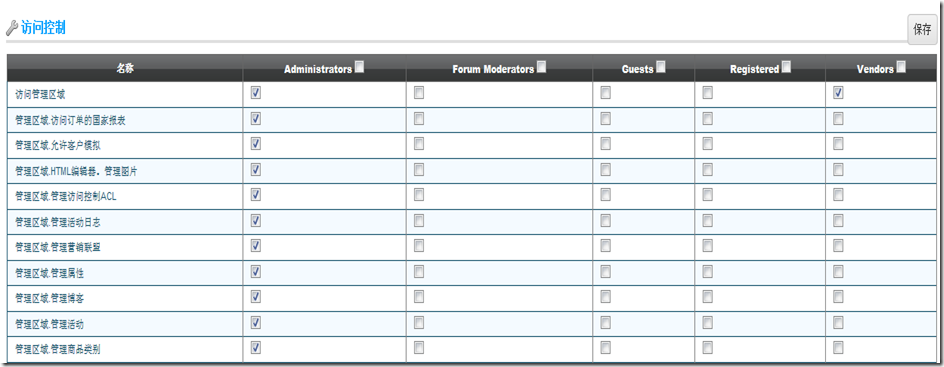
图1-1
2. UML
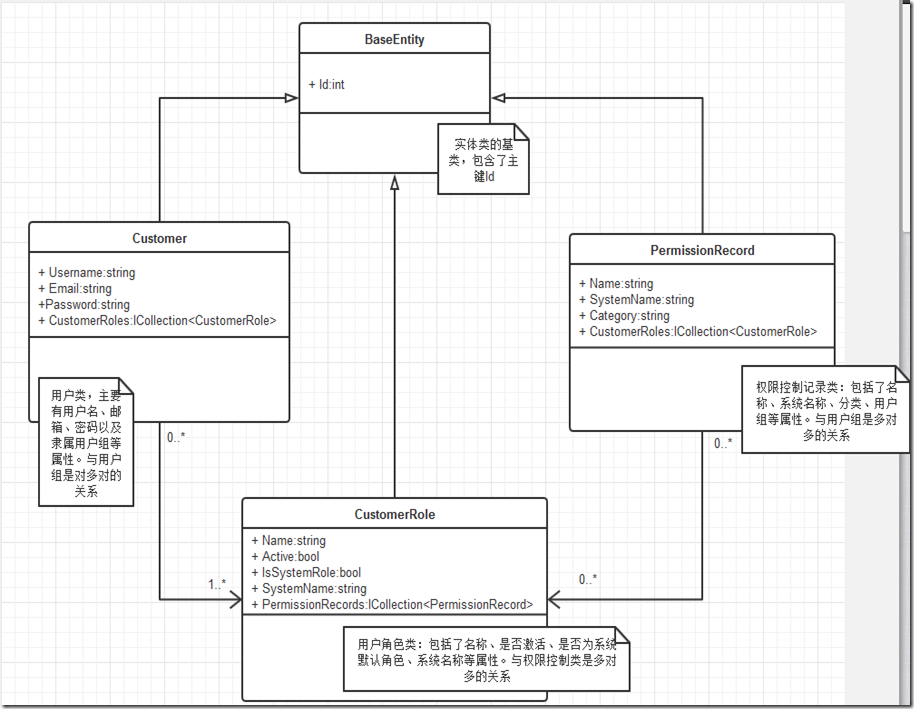
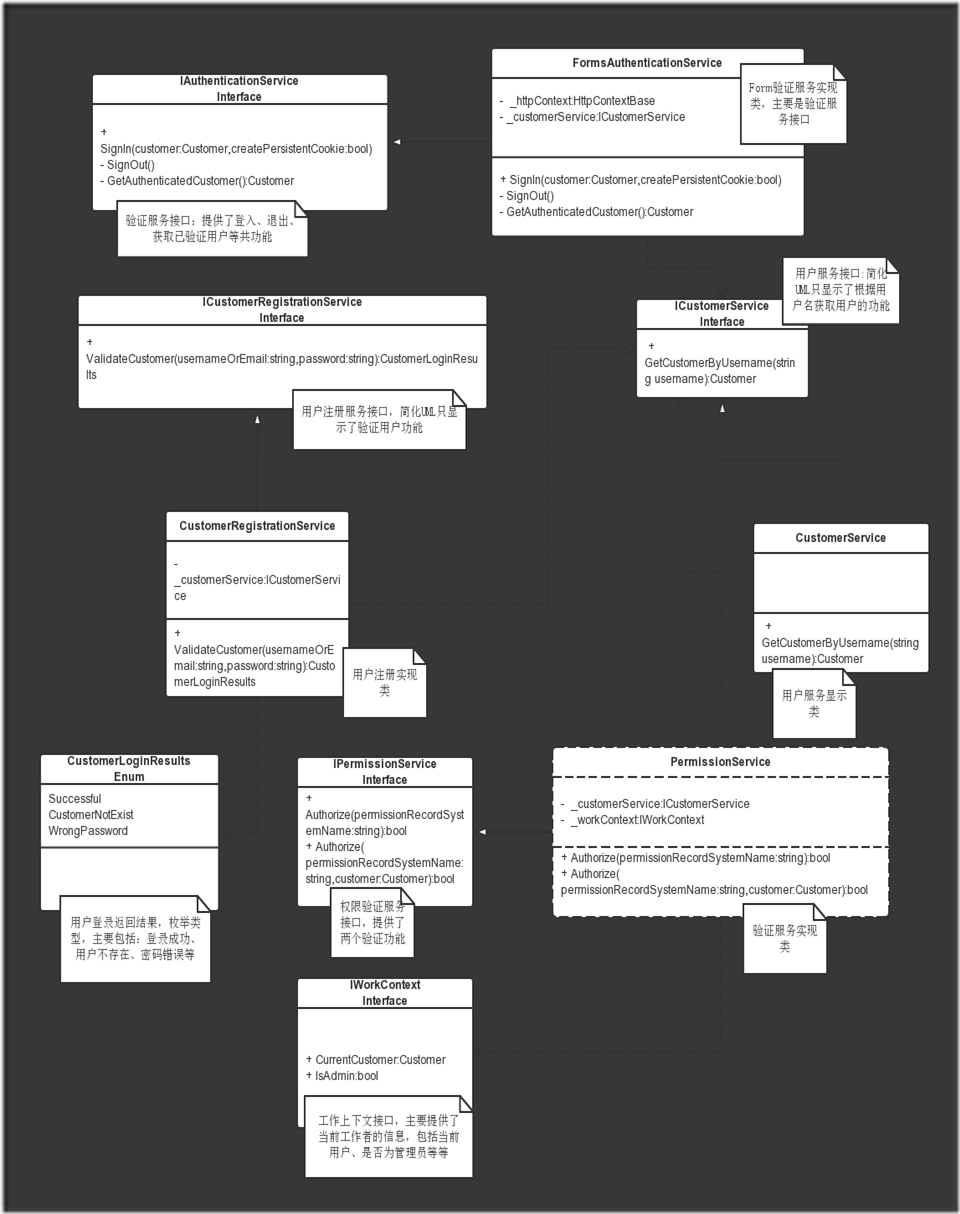
该小节主要提供了nopcommerce项目中的访问控制功能的UML类图以及类图说明,在制作UML类图的过程中,我简化了UML类图,这样是为了让UML内容不冗余。简化后的UML类图只显示了和访问控制功能有关的内容。
2.1 实体类UML图
2.2 业务相关UML图
3. 核心代码分析
3.1 实体类源代码
/// <summary> /// Represents a customer role /// </summary> public partial class CustomerRole : BaseEntity { private ICollection<PermissionRecord> _permissionRecords; /// <summary> /// Gets or sets the customer role name /// </summary> public string Name { get; set; } /// <summary> /// Gets or sets a value indicating whether the customer role is active /// </summary> public bool Active { get; set; } /// <summary> /// Gets or sets a value indicating whether the customer role is system /// </summary> public bool IsSystemRole { get; set; } /// <summary> /// Gets or sets the customer role system name /// </summary> public string SystemName { get; set; } /// <summary> /// Gets or sets the permission records /// </summary> public virtual ICollection<PermissionRecord> PermissionRecords { get { return _permissionRecords ?? (_permissionRecords = new List<PermissionRecord>()); } protected set { _permissionRecords = value; } } }
CustomerRole类
/// <summary> /// Represents a permission record /// </summary> public partial class PermissionRecord : BaseEntity { private ICollection<CustomerRole> _customerRoles; /// <summary> /// Gets or sets the permission name /// </summary> public string Name { get; set; } /// <summary> /// Gets or sets the permission system name /// </summary> public string SystemName { get; set; } /// <summary> /// Gets or sets the permission category /// </summary> public string Category { get; set; } /// <summary> /// Gets or sets discount usage history /// </summary> public virtual ICollection<CustomerRole> CustomerRoles { get { return _customerRoles ?? (_customerRoles = new List<CustomerRole>()); } protected set { _customerRoles = value; } } }
PermissionRecord类
3.2 业务相关源代码
/// <summary> /// Customer service interface /// </summary> public partial interface ICustomerService { #region Customers /// <summary> /// Get customer by username /// </summary> /// <param name="username">Username</param> /// <returns>Customer</returns> Customer GetCustomerByUsername(string username); #endregion }
ICustomerService接口
/// <summary> /// Customer service /// </summary> public partial class CustomerService : ICustomerService { #region Constants #endregion #region Fields private readonly IRepository<Customer> _customerRepository; private readonly IRepository<CustomerRole> _customerRoleRepository; #endregion #region Ctor public CustomerService( IRepository<Customer> customerRepository, IRepository<CustomerRole> customerRoleRepository,) { this._customerRepository = customerRepository; this._customerRoleRepository = customerRoleRepository; } #endregion #region Methods #region Customers /// <summary> /// Get customer by username /// </summary> /// <param name="username">Username</param> /// <returns>Customer</returns> public virtual Customer GetCustomerByUsername(string username) { if (string.IsNullOrWhiteSpace(username)) return null; var query = from c in _customerRepository.Table orderby c.Id where c.Username == username select c; var customer = query.FirstOrDefault(); return customer; } #endregion #endregion }
CustomerService类
public partial interface IAuthenticationService { void SignIn(Customer customer, bool createPersistentCookie); void SignOut(); Customer GetAuthenticatedCustomer(); }
IAuthenticationService接口
public partial class FormsAuthenticationService : IAuthenticationService { private readonly HttpContextBase _httpContext; private readonly ICustomerService _customerService; private readonly CustomerSettings _customerSettings; private readonly TimeSpan _expirationTimeSpan; private Customer _cachedCustomer; /// <summary> /// Ctor /// </summary> /// <param name="httpContext">HTTP context</param> /// <param name="customerService">Customer service</param> /// <param name="customerSettings">Customer settings</param> public FormsAuthenticationService(HttpContextBase httpContext, ICustomerService customerService, CustomerSettings customerSettings) { this._httpContext = httpContext; this._customerService = customerService; this._customerSettings = customerSettings; this._expirationTimeSpan = FormsAuthentication.Timeout; } public virtual void SignIn(Customer customer, bool createPersistentCookie) { var now = DateTime.UtcNow.ToLocalTime(); var ticket = new FormsAuthenticationTicket( 1 /*version*/, _customerSettings.UsernamesEnabled ? customer.Username : customer.Email, now, now.Add(_expirationTimeSpan), createPersistentCookie, _customerSettings.UsernamesEnabled ? customer.Username : customer.Email, FormsAuthentication.FormsCookiePath); var encryptedTicket = FormsAuthentication.Encrypt(ticket); var cookie = new HttpCookie(FormsAuthentication.FormsCookieName, encryptedTicket); cookie.HttpOnly = true; if (ticket.IsPersistent) { cookie.Expires = ticket.Expiration; } cookie.Secure = FormsAuthentication.RequireSSL; cookie.Path = FormsAuthentication.FormsCookiePath; if (FormsAuthentication.CookieDomain != null) { cookie.Domain = FormsAuthentication.CookieDomain; } _httpContext.Response.Cookies.Add(cookie); _cachedCustomer = customer; } public virtual void SignOut() { _cachedCustomer = null; FormsAuthentication.SignOut(); } public virtual Customer GetAuthenticatedCustomer() { if (_cachedCustomer != null) return _cachedCustomer; if (_httpContext == null || _httpContext.Request == null || !_httpContext.Request.IsAuthenticated || !(_httpContext.User.Identity is FormsIdentity)) { return null; } var formsIdentity = (FormsIdentity)_httpContext.User.Identity; var customer = GetAuthenticatedCustomerFromTicket(formsIdentity.Ticket); if (customer != null && customer.Active && !customer.Deleted && customer.IsRegistered()) _cachedCustomer = customer; return _cachedCustomer; } public virtual Customer GetAuthenticatedCustomerFromTicket(FormsAuthenticationTicket ticket) { if (ticket == null) throw new ArgumentNullException("ticket"); var usernameOrEmail = ticket.UserData; if (String.IsNullOrWhiteSpace(usernameOrEmail)) return null; var customer = _customerSettings.UsernamesEnabled ? _customerService.GetCustomerByUsername(usernameOrEmail) : _customerService.GetCustomerByEmail(usernameOrEmail); return customer; } }
FormsAuthenticationService类
FormsAuthenticationService类实现代码分析
SignOut方法比较简单,主要是调用了FormsAuthentication的退出方法。重点介绍SignIn()和GetAuthenticatedCustomer()方法
在SignIn()方法中,首先创建一个类型为FormsAuthenticationTicket的ticket,并且将该ticket进行加密,然后将加密后的信息保存到cookie。
在GetAuthenticatedCustomer()中,如果说已经缓存了当前用户,则直接返回,如果说当前http上下文没有使用Forms验证的话或者验证不存在的话,则直接返回空置。紧接着,获取之前已经保存的ticket,取到ticket之后,根据保存的UserData,获取到已经登录用户的信息。
public enum CustomerLoginResults { /// <summary> /// Login successful /// </summary> Successful = 1, /// <summary> /// Customer dies not exist (email or username) /// </summary> CustomerNotExist = 2, /// <summary> /// Wrong password /// </summary> WrongPassword = 3, /// <summary> /// Account have not been activated /// </summary> NotActive = 4, /// <summary> /// Customer has been deleted /// </summary> Deleted = 5, /// <summary> /// Customer not registered /// </summary> NotRegistered = 6, }
CustomerLoginResults枚举类型
public partial interface ICustomerRegistrationService { /// <summary> /// Validate customer /// </summary> /// <param name="usernameOrEmail">Username or email</param> /// <param name="password">Password</param> /// <returns>Result</returns> CustomerLoginResults ValidateCustomer(string usernameOrEmail, string password); }
ICustomerRegistrationService接口
public partial class CustomerRegistrationService : ICustomerRegistrationService { #region Fields private readonly ICustomerService _customerService; private readonly CustomerSettings _customerSettings; #endregion #region Ctor /// <summary> /// Ctor /// </summary> /// <param name="customerService">Customer service</param> /// <param name="encryptionService">Encryption service</param> /// <param name="newsLetterSubscriptionService">Newsletter subscription service</param> /// <param name="localizationService">Localization service</param> /// <param name="storeService">Store service</param> /// <param name="rewardPointsSettings">Reward points settings</param> /// <param name="customerSettings">Customer settings</param> public CustomerRegistrationService(ICustomerService customerService, CustomerSettings customerSettings) { this._customerService = customerService; this._customerSettings = customerSettings; } #endregion #region Methods /// <summary> /// Validate customer /// </summary> /// <param name="usernameOrEmail">Username or email</param> /// <param name="password">Password</param> /// <returns>Result</returns> public virtual CustomerLoginResults ValidateCustomer(string usernameOrEmail, string password) { Customer customer; if (_customerSettings.UsernamesEnabled) customer = _customerService.GetCustomerByUsername(usernameOrEmail); else customer = _customerService.GetCustomerByEmail(usernameOrEmail); if (customer == null) return CustomerLoginResults.CustomerNotExist; string pwd = ""; bool isValid = pwd == customer.Password; if (!isValid) return CustomerLoginResults.WrongPassword; //save last login date customer.LastLoginDateUtc = DateTime.UtcNow; _customerService.UpdateCustomer(customer); return CustomerLoginResults.Successful; } #endregion }
CustomerRegistrationService
CustomerRegistrationService类实现代码分析
在验证用户的方法中还是比较简单的,首先根据用户用户设置,是用户名登录还是邮箱登录,然后根据用户名或者邮箱获取到用户信息,如果用户信息为空的话,则表示用户不存在,否则,则更新登录用户的用户信息。
nopcommerce项目中实现的用户验证绝非如此简单,它提供了密码加密格式的验证,感兴趣的同学可以下载看一看。
/// <summary> /// Work context /// </summary> public interface IWorkContext { /// <summary> /// Gets or sets the current customer /// </summary> Customer CurrentCustomer { get; set; } /// <summary> /// Get or set value indicating whether we're in admin area /// </summary> bool IsAdmin { get; set; } }
IWorkContext接口:该接口主要是提供当前工作环境的信息,比如当前用户信息、当前语言等等,简化版中只提供了当前用户信息
public partial class WebWorkContext : IWorkContext { #region Const private const string CustomerCookieName = "Nop.customer"; #endregion #region Fields private readonly HttpContextBase _httpContext; private readonly ICustomerService _customerService; private readonly IAuthenticationService _authenticationService; private Customer _cachedCustomer; #endregion #region Ctor public WebWorkContext(HttpContextBase httpContext, ICustomerService customerService, IAuthenticationService authenticationService,) { this._httpContext = httpContext; this._customerService = customerService; this._authenticationService = authenticationService; } #endregion #region Utilities protected virtual HttpCookie GetCustomerCookie() { if (_httpContext == null || _httpContext.Request == null) return null; return _httpContext.Request.Cookies[CustomerCookieName]; } protected virtual void SetCustomerCookie(Guid customerGuid) { if (_httpContext != null && _httpContext.Response != null) { var cookie = new HttpCookie(CustomerCookieName); cookie.HttpOnly = true; cookie.Value = customerGuid.ToString(); if (customerGuid == Guid.Empty) { cookie.Expires = DateTime.Now.AddMonths(-1); } else { int cookieExpires = 24*365; //TODO make configurable cookie.Expires = DateTime.Now.AddHours(cookieExpires); } _httpContext.Response.Cookies.Remove(CustomerCookieName); _httpContext.Response.Cookies.Add(cookie); } } #endregion #region Properties /// <summary> /// Gets or sets the current customer /// </summary> public virtual Customer CurrentCustomer { get { if (_cachedCustomer != null) return _cachedCustomer; Customer customer = null; //registered user if (customer == null || customer.Deleted || !customer.Active) { customer = _authenticationService.GetAuthenticatedCustomer(); } //impersonate user if required (currently used for 'phone order' support) if (customer != null && !customer.Deleted && customer.Active) { var impersonatedCustomerId = customer.GetAttribute<int?>(SystemCustomerAttributeNames.ImpersonatedCustomerId); if (impersonatedCustomerId.HasValue && impersonatedCustomerId.Value > 0) { var impersonatedCustomer = _customerService.GetCustomerById(impersonatedCustomerId.Value); if (impersonatedCustomer != null && !impersonatedCustomer.Deleted && impersonatedCustomer.Active) { //set impersonated customer _originalCustomerIfImpersonated = customer; customer = impersonatedCustomer; } } } //load guest customer if (customer == null || customer.Deleted || !customer.Active) { var customerCookie = GetCustomerCookie(); if (customerCookie != null && !String.IsNullOrEmpty(customerCookie.Value)) { Guid customerGuid; if (Guid.TryParse(customerCookie.Value, out customerGuid)) { var customerByCookie = _customerService.GetCustomerByGuid(customerGuid); if (customerByCookie != null && //this customer (from cookie) should not be registered !customerByCookie.IsRegistered()) customer = customerByCookie; } } } //create guest if not exists if (customer == null || customer.Deleted || !customer.Active) { customer = _customerService.InsertGuestCustomer(); } //validation if (!customer.Deleted && customer.Active) { SetCustomerCookie(customer.CustomerGuid); _cachedCustomer = customer; } return _cachedCustomer; } set { SetCustomerCookie(value.CustomerGuid); _cachedCustomer = value; } } /// <summary> /// Get or set value indicating whether we're in admin area /// </summary> public virtual bool IsAdmin { get; set; } #endregion }
WebWorkContext类:该类实现了IWorkContext接口,提供了web下的工作环境
WebWorkContext类实现代码分析
该类的CurrentCustomer属性的实现简化了一部分,我们首先判断用户信息是否已经缓存,如果已经缓存了,则直接返回,如果没有,则需要从FormsAuthenticationService中重新获取用户信息,根据该用户的信息,设置单个用户的cookie。更加详细的实现内容请下载nopcommerce源码。
/// <summary> /// Authorize permission /// </summary> /// <param name="permission">Permission record</param> /// <returns>true - authorized; otherwise, false</returns> bool Authorize(PermissionRecord permission); /// <summary> /// Authorize permission /// </summary> /// <param name="permission">Permission record</param> /// <param name="customer">Customer</param> /// <returns>true - authorized; otherwise, false</returns> bool Authorize(PermissionRecord permission, Customer customer); /// <summary> /// Authorize permission /// </summary> /// <param name="permissionRecordSystemName">Permission record system name</param> /// <returns>true - authorized; otherwise, false</returns> bool Authorize(string permissionRecordSystemName); /// <summary> /// Authorize permission /// </summary> /// <param name="permissionRecordSystemName">Permission record system name</param> /// <param name="customer">Customer</param> /// <returns>true - authorized; otherwise, false</returns> bool Authorize(string permissionRecordSystemName, Customer customer);
IPermissionService接口
public partial class PermissionService : IPermissionService { #region Constants /// <summary> /// Key pattern to clear cache /// </summary> private const string PERMISSIONS_PATTERN_KEY = "Nop.permission."; #endregion #region Fields private readonly IRepository<PermissionRecord> _permissionRecordRepository; private readonly ICustomerService _customerService; private readonly IWorkContext _workContext; #endregion #region Ctor /// <summary> /// Ctor /// </summary> /// <param name="permissionRecordRepository">Permission repository</param> /// <param name="customerService">Customer service</param> /// <param name="workContext">Work context</param> /// <param name="localizationService">Localization service</param> /// <param name="languageService">Language service</param> /// <param name="cacheManager">Cache manager</param> public PermissionService(IRepository<PermissionRecord> permissionRecordRepository, ICustomerService customerService, IWorkContext workContext) { this._permissionRecordRepository = permissionRecordRepository; this._customerService = customerService; this._workContext = workContext; } #endregion #region Methods /// <summary> /// Authorize permission /// </summary> /// <param name="permission">Permission record</param> /// <returns>true - authorized; otherwise, false</returns> public virtual bool Authorize(PermissionRecord permission) { return Authorize(permission, _workContext.CurrentCustomer); } /// <summary> /// Authorize permission /// </summary> /// <param name="permission">Permission record</param> /// <param name="customer">Customer</param> /// <returns>true - authorized; otherwise, false</returns> public virtual bool Authorize(PermissionRecord permission, Customer customer) { if (permission == null) return false; if (customer == null) return false; //old implementation of Authorize method //var customerRoles = customer.CustomerRoles.Where(cr => cr.Active); //foreach (var role in customerRoles) // foreach (var permission1 in role.PermissionRecords) // if (permission1.SystemName.Equals(permission.SystemName, StringComparison.InvariantCultureIgnoreCase)) // return true; //return false; return Authorize(permission.SystemName, customer); } /// <summary> /// Authorize permission /// </summary> /// <param name="permissionRecordSystemName">Permission record system name</param> /// <returns>true - authorized; otherwise, false</returns> public virtual bool Authorize(string permissionRecordSystemName) { return Authorize(permissionRecordSystemName, _workContext.CurrentCustomer); } /// <summary> /// Authorize permission /// </summary> /// <param name="permissionRecordSystemName">Permission record system name</param> /// <param name="customer">Customer</param> /// <returns>true - authorized; otherwise, false</returns> public virtual bool Authorize(string permissionRecordSystemName, Customer customer) { if (String.IsNullOrEmpty(permissionRecordSystemName)) return false; var customerRoles = customer.CustomerRoles.Where(cr => cr.Active); foreach (var role in customerRoles) if (Authorize(permissionRecordSystemName, role)) //yes, we have such permission return true; //no permission found return false; } #endregion #region Utilities /// <summary> /// Authorize permission /// </summary> /// <param name="permissionRecordSystemName">Permission record system name</param> /// <param name="customerRole">Customer role</param> /// <returns>true - authorized; otherwise, false</returns> protected virtual bool Authorize(string permissionRecordSystemName, CustomerRole customerRole) { if (String.IsNullOrEmpty(permissionRecordSystemName)) return false; string key = string.Format(PERMISSIONS_ALLOWED_KEY, customerRole.Id, permissionRecordSystemName); return _cacheManager.Get(key, () => { foreach (var permission1 in customerRole.PermissionRecords) if (permission1.SystemName.Equals(permissionRecordSystemName, StringComparison.InvariantCultureIgnoreCase)) return true; return false; }); } #endregion }
PermissionService类实现代码分析
PermissionService类实现代码分析
分析Authorize代码可以知道,首先是要获取当前用户所隶属的所有用户组,然后根据权限名称和用户组判断是否具有某个模块的访问权限。
3.3 相关控制器源代码
PermissionController类:主要是两个登录的Action,通过一下代码可以看出,当用户登录成功之后,需要调用 _authenticationService的登录方法,通过该方法记录已经登录用户的ID
[NopHttpsRequirement(SslRequirement.Yes)] public ActionResult Login(bool? checkoutAsGuest) { var model = new LoginModel(); model.UsernamesEnabled = _customerSettings.UsernamesEnabled; model.CheckoutAsGuest = checkoutAsGuest.GetValueOrDefault(); model.DisplayCaptcha = _captchaSettings.Enabled && _captchaSettings.ShowOnLoginPage; return View(model); } [HttpPost] [CaptchaValidator] public ActionResult Login(LoginModel model, string returnUrl, bool captchaValid) { //validate CAPTCHA if (_captchaSettings.Enabled && _captchaSettings.ShowOnLoginPage && !captchaValid) { ModelState.AddModelError("", _localizationService.GetResource("Common.WrongCaptcha")); } if (ModelState.IsValid) { if (_customerSettings.UsernamesEnabled && model.Username != null) { model.Username = model.Username.Trim(); } var loginResult = _customerRegistrationService.ValidateCustomer(_customerSettings.UsernamesEnabled ? model.Username : model.Email, model.Password); switch (loginResult) { case CustomerLoginResults.Successful: { var customer = _customerSettings.UsernamesEnabled ? _customerService.GetCustomerByUsername(model.Username) : _customerService.GetCustomerByEmail(model.Email); //migrate shopping cart _shoppingCartService.MigrateShoppingCart(_workContext.CurrentCustomer, customer, true); //sign in new customer _authenticationService.SignIn(customer, model.RememberMe); //activity log _customerActivityService.InsertActivity("PublicStore.Login", _localizationService.GetResource("ActivityLog.PublicStore.Login"), customer); if (String.IsNullOrEmpty(returnUrl) || !Url.IsLocalUrl(returnUrl)) return RedirectToRoute("HomePage"); return Redirect(returnUrl); } case CustomerLoginResults.CustomerNotExist: ModelState.AddModelError("", _localizationService.GetResource("Account.Login.WrongCredentials.CustomerNotExist")); break; case CustomerLoginResults.Deleted: ModelState.AddModelError("", _localizationService.GetResource("Account.Login.WrongCredentials.Deleted")); break; case CustomerLoginResults.NotActive: ModelState.AddModelError("", _localizationService.GetResource("Account.Login.WrongCredentials.NotActive")); break; case CustomerLoginResults.NotRegistered: ModelState.AddModelError("", _localizationService.GetResource("Account.Login.WrongCredentials.NotRegistered")); break; case CustomerLoginResults.WrongPassword: default: ModelState.AddModelError("", _localizationService.GetResource("Account.Login.WrongCredentials")); break; } } //If we got this far, something failed, redisplay form model.UsernamesEnabled = _customerSettings.UsernamesEnabled; model.DisplayCaptcha = _captchaSettings.Enabled && _captchaSettings.ShowOnLoginPage; return View(model); }
SecurityController类:安全控制器,当用户权限不足时,则展示AccessDenied界面。Permissions是访问控制界面的Action
 /// <summary>

         /// 拒绝访问

         /// </summary>

         /// <param name="pageUrl"></param>

         /// <returns></returns>

         public ActionResult AccessDenied(string pageUrl)

         {

             var currentCustomer = _workContext.CurrentCustomer;

             if (currentCustomer == null || currentCustomer.IsGuest())

             {

                 _logger.Information(string.Format("Access denied to anonymous request on {0}", pageUrl));

                 return View();

             }

             _logger.Information(string.Format("Access denied to user #{0} '{1}' on {2}", currentCustomer.Email, currentCustomer.Email, pageUrl));

             return View();

         }

         /// <summary>

         /// GET:/Admin/Security/Permissions

         /// 获取权限列表

         /// </summary>

         /// <returns></returns>

         public ActionResult Permissions()

         {

             if (!_permissionService.Authorize(StandardPermissionProvider.ManageAcl))

                 return AccessDeniedView();

             var model = new PermissionMappingModel();

             var permissionRecords = _permissionService.GetAllPermissionRecords();

             var customerRoles = _customerService.GetAllCustomerRoles(true);

             foreach (var pr in permissionRecords)

             {

                 model.AvailablePermissions.Add(new PermissionRecordModel

                 {

                     //Name = pr.Name,

                     Name = pr.GetLocalizedPermissionName(_localizationService, _workContext),

                     SystemName = pr.SystemName

                 });

             }

             foreach (var cr in customerRoles)

             {

                 model.AvailableCustomerRoles.Add(new CustomerRoleModel

                 {

                     Id = cr.Id,

                     Name = cr.Name

                 });

             }

             foreach (var pr in permissionRecords)

                 foreach (var cr in customerRoles)

                 {

                     bool allowed = pr.CustomerRoles.Count(x => x.Id == cr.Id) > ;

                     if (!model.Allowed.ContainsKey(pr.SystemName))

                         model.Allowed[pr.SystemName] = new Dictionary<int, bool>();

                     model.Allowed[pr.SystemName][cr.Id] = allowed;

                 }

             return View(model);

         }

         /// <summary>

         /// GET:/Admin/Security/Permissions

         /// 提交访问权限

         /// </summary>

         /// <param name="form"></param>

         /// <returns></returns>

         [HttpPost, ActionName("Permissions")]

         public ActionResult PermissionsSave(FormCollection form)

         {

             if (!_permissionService.Authorize(StandardPermissionProvider.ManageAcl))

                 return AccessDeniedView();

             var permissionRecords = _permissionService.GetAllPermissionRecords();

             var customerRoles = _customerService.GetAllCustomerRoles(true);

             foreach (var cr in customerRoles)

             {

                 string formKey = "allow_" + cr.Id;

                 var permissionRecordSystemNamesToRestrict = form[formKey] != null ? form[formKey].Split(new [] { ',' }, StringSplitOptions.RemoveEmptyEntries).ToList() : new List<string>();

                 foreach (var pr in permissionRecords)

                 {

                     bool allow = permissionRecordSystemNamesToRestrict.Contains(pr.SystemName);

                     if (allow)

                     {

                         if (pr.CustomerRoles.FirstOrDefault(x => x.Id == cr.Id) == null)

                         {

                             pr.CustomerRoles.Add(cr);

                             _permissionService.UpdatePermissionRecord(pr);

                         }

                     }

                     else

                     {

                         if (pr.CustomerRoles.FirstOrDefault(x => x.Id == cr.Id) != null)

                         {

                             pr.CustomerRoles.Remove(cr);

                             _permissionService.UpdatePermissionRecord(pr);

                         }

                     }

                 }

             }

             SuccessNotification(_localizationService.GetResource("Admin.Configuration.ACL.Updated"));

             return RedirectToAction("Permissions");

         }
3.4 相关View源代码
PermissionMappingModel:访问控制管理界面模型
public partial class PermissionMappingModel : BaseNopModel { public PermissionMappingModel() { AvailablePermissions = new List<PermissionRecordModel>(); AvailableCustomerRoles = new List<CustomerRoleModel>(); Allowed = new Dictionary<string, IDictionary<int, bool>>(); } public IList<PermissionRecordModel> AvailablePermissions { get; set; } public IList<CustomerRoleModel> AvailableCustomerRoles { get; set; } //[permission system name] / [customer role id] / [allowed] public IDictionary<string, IDictionary<int, bool>> Allowed { get; set; } }
Permissions.cshtml:访问控制管理界面
 @model PermissionMappingModel

 @{                    //page title     ViewBag.Title = T("Admin.Configuration.ACL").Text;

 }

 @using (Html.BeginForm())

 {     @Html.AntiForgeryToken()     <div class="section-header">         <div class="title">             <img src="@Url.Content("~/Administration/Content/images/ico-configuration.png")" alt="" />             @T("Admin.Configuration.ACL")         </div>         <div class="options">             <input type="submit" name="save" class="k-button" value="@T("Admin.Common.Save")" />         </div>     </div>          <table class="adminContent">         <tr>             <td>                 @if (Model.AvailablePermissions.Count == 0)                 {                     <text>No permissions defined</text>                 }                 else if (Model.AvailableCustomerRoles.Count == 0)                 {                     <text>No customer roles available</text>                 }                 else                 {                     <script type="text/javascript">                         $(document).ready(function () {                                         @foreach (var cr in Model.AvailableCustomerRoles)                             {                                 <text>                                 $('#selectall-@(cr.Id)').click(function () {                                     $('.allow_@(cr.Id)').attr('checked', $(this).is(':checked')).change();                                     });                                 </text>                             }                         });                     </script>                     <table class="tablestyle" cellspacing="0" rules="all" border="1" style="width: 100%;                         border-collapse: collapse;">                         <tbody>                             <tr class="headerstyle">                                 <th scope="col">                                     <strong>@T("Admin.Configuration.ACL.Permission")</strong>                                 </th>                                 @foreach (var cr in Model.AvailableCustomerRoles)                                 {                                     <th scope="col">                                         <strong>@cr.Name</strong>                                         <input type="checkbox" id="selectall-@(cr.Id)" />                                     </th>                                 }                             </tr>                             @{                                 bool altRow = true;                             }                             @foreach (var pr in Model.AvailablePermissions)                             {                                 altRow = !altRow;                                 <tr class="@(altRow ? "altrowstyle" : "rowstyle")">                                     <td>                                         <span>@pr.Name</span>                                     </td>                                     @foreach (var cr in Model.AvailableCustomerRoles)                                     {                                         var allowed = Model.Allowed.ContainsKey(pr.SystemName) && Model.Allowed[pr.SystemName][cr.Id];                                         <td>                                             <input class="allow_@(cr.Id)" class="allow_@(cr.Id)" type="checkbox" value="@(pr.SystemName)" name="allow_@(cr.Id)" @(allowed ? " checked=checked" : null) />                                         </td>                                     }                                 </tr>                             }                         </tbody>                     </table>                 }             </td>         </tr>     </table>

 }
4. 总结
通过对nopcommerce项目中的访问控制代码的分析,使得我对MVC4下的用户验证的实现有了进一步的了解:通过FormsAuthentication和HttpCookie来进行用户验证以及具体的实现过程。
该项目中的访问控制也是值得学习的,使得权限记录和用户组发送多对多的关系,当能查询到某个用户组含有对应的访问权限,则表示该用户组对这个模块有访问权限。
通过学习nopcommerce项目代码,我也编写了一个小Demo:AclDemo,该项目将在下一篇进行分析和源代码下载,敬请期待,感兴趣的可以关注我。
NopCommerce源代码分析之用户验证和权限管理的更多相关文章
- MongoDB用户验证和权限管理
官方参考页面: https://docs.mongodb.com/v3.6/tutorial/enable-authentication/ https://docs.mongodb.com/v3.6/ ...
- mvc5+ef6+Bootstrap 项目心得--身份验证和权限管理
1.mvc5+ef6+Bootstrap 项目心得--创立之初 2.mvc5+ef6+Bootstrap 项目心得--身份验证和权限管理 3.mvc5+ef6+Bootstrap 项目心得--WebG ...
- [转]mvc5+ef6+Bootstrap 项目心得--身份验证和权限管理
本文转自:http://www.cnblogs.com/shootingstar/p/5629668.html 1.mvc5+ef6+Bootstrap 项目心得--创立之初 2.mvc5+ef6+B ...
- MySQL数据库(6)_用户操作与权限管理、视图、存储过程、触发器、基本函数
用户操作与权限管理 MySQL用户操作 创建用户 方法一: CREATE USER语句创建 CREATE USER "用户名"@"IP地址" IDENTIFIE ...
- (大数据工程师学习路径)第一步 Linux 基础入门----用户及文件权限管理
用户及文件权限管理 实验介绍 1.Linux 中创建.删除用户,及用户组等操作. 2.Linux 中的文件权限设置. 一.Linux 用户管理 Linux 是一个可以实现多用户登陆的操作系统,比如“李 ...
- Linux用户及文件权限管理
Linux用户及文件权限管理
- 实验楼学习linux第一章第三节用户及文件权限管理
用户及文件权限管理 常用命令 查看用户 whoami 创建用户 sudo adduser 用户名 切换账户 su 用户名 删除账户 sudo deluser 用户名 --remove-home 查看用 ...
- WordPress用户角色及其权限管理编辑插件:User Role Editor汉化版
如果Wordpress默认的用户角色及权限不能满足您的需求,又觉得修改代码编辑用户权限太麻烦.那不妨试试User Role Editor,Wordpress用户角色及其权限管理编辑插件. User R ...
- solaris用户与文件权限管理
此文章已于 20:45:28 2015/3/22 重新发布到 zhuxuekui3 solaris用户与文件权限管理1 类别 「网站分类」Oracle 一.用户与用户组管理 三种用户:超级用户. ...
随机推荐
- JavaScript初探 一(认识JavaScript)
JavaScript 初探 JavaScript插入HTML中 内嵌的Js代码 <!DOCTYPE html> <html> <head> <meta cha ...
- GBT22239-2019等保2.0三级要求
1 第三级安全要求 1.1 安全通用要求 1.1.1 安全物理环境 1.1.1.1 物理位置选择 本项要求包括: a) 机房场地应选择在具有防震.防风和防雨等能力的建筑内: b) 机房场地应避免设在建 ...
- Linux(ubuntu) 一行代码搞定查看文件目录
ls 命令:• ls 是英文单词 list 的简写,其功能为列出目录的内容,是用户最常用的命令之一,类似于 DOS 下的 dir 命令 ls命令之后加各种参数的作用: ls -a 显示指定目录下所有子 ...
- 记录C#-WPF打开/关闭>>事件执行顺序
打开执行顺序 关闭执行顺序
- Java面试中遇到的坑【篇二面试干货】
俗话说早起的鸟儿有虫吃,现在临年关越来越近,有跳槽的想法的同事也都打算年前做好功课年后入职,所谓年终奖拿了,工作换的也是水到渠成. 说到这里想必有同学要说了,年底了放着年终奖不拿为何要跳槽呢?这个就要 ...
- 一、man、系统工作、系统检测命令
目录 一.man命令 (一)常用按键 (二)结构意义 二.常用系统工作命令 (一) echo (二)date (三)reboot (四)powoff (五)wget (六)ps (七)top (八)p ...
- 14 opencv读取XML
https://blog.csdn.net/A_L_A_N/article/details/83272772 FileStorage类 FileStorage类将各种OpenCV数据结构的数据存储为X ...
- python实现异步调用函数执行
在实现异步调用之前我们先进行什么是同步调用和异步调用 同步:是指完成事务的逻辑,先执行第一个事务,如果阻塞了,会一直等待,直到这个事务完成,再执行第二个事务,顺序执行 异步:是和同步相对的,异步是指在 ...
- 纯CSS打造BiliBili样式博客主题
前言 一直以来,我都在思考如何减少不必要的JS代码,仅通过CSS来实现博客园主题美化.CSS有很多魔法代码,例如:before,iconfont,order,等等,利用好这些技巧,也能实现很好美化效果 ...
- Java实现字符串反转【Leetcode】
Write a function that reverses a string. The input string is given as an array of characters char[]. ...