
POJ 2697 A Board Game(Trie判重+BFS)
| Time Limit: 1000MS | Memory Limit: 65536K | |
| Total Submissions: 551 | Accepted: 373 |
Description
- 1. You first move a white stone, and then a black stone. You then alternatively move a white stone and a black stone.
- 2. A stone can be moved horizontally, vertically or diagonally. A stone must be moved in a direction until the boarder or another stone is encountered. There is no capture or jump.
- 3. During each move, you need to move a stone of the right color. You cannot pass.
An example of a sequence of legal moves is shown in the following figure. This move sequence takes 4 moves. This is not a sequence of legal moves

using the least number of moves assume the leftmost board is the initial position and the rightmost board is the final position. A sequence of moves using only 3 moves is shown below.
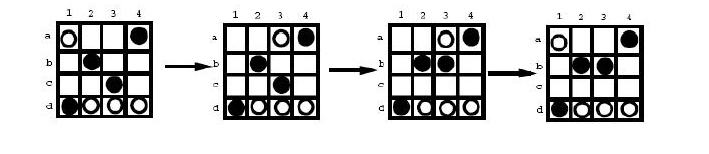
Given an initial position and a final position, your task is to report the minimum number of moves from the initial position to the final position.
Input
Output
Sample Input
2

w**b

*wb*

*bw*

b**w

w**b

*wb*

*bw*

bw**

w**b

*b**

**b*

bwww

w**b

*bb*

****

bwww
Sample Output
1

3
题目链接:POJ 2697
题如其名,很无聊,难怪题目里的S-Dao是一个人玩的游戏,给你一个4*4的棋盘和4颗黑棋、4颗白旗,每一次可以向八个方向移动,但是只能撞到边界或者撞到棋子才能停止移动,求初始态到目标态最少的移动次数,这题由于每个格子的颜色不是唯一的,康托不好用,只能用STL或者字典树,然后看一共有多少种状态,显然是$\binom{16}{4} * \binom{12}{4} = 900900$,然而想想STL这么慢还是字典树吧,顺便再熟练一下数组版字典树的写法,虽然代码量有点大,但是细心点还是不会错的,写斜方向移动函数的时候突然感觉有点想起以前玩魔方的公式了,怀念1s。
代码:
#include <stdio.h>

#include <iostream>

#include <algorithm>

#include <cstdlib>

#include <sstream>

#include <cstring>

#include <bitset>

#include <string>

#include <deque>

#include <stack>

#include <cmath>

#include <queue>

#include <set>

#include <map>

using namespace std;

#define INF 0x3f3f3f3f

#define CLR(arr,val) memset(arr,val,sizeof(arr))

#define LC(x) (x<<1)

#define RC(x) ((x<<1)+1)

#define MID(x,y) ((x+y)>>1)

typedef pair<int,int> pii;

typedef long long LL;

const double PI=acos(-1.0);

const int N=900900+7;

struct info

{

    char st[4][4];

    bool bw;

    int step;

    inline bool operator==(const info &t)const

    {

        for (int i=0; i<4; ++i)

            for (int j=0; j<4; ++j)

                if(st[i][j]!=t.st[i][j])

                    return false;

        return true;

    }

    inline void Lmove(const int &x,const int &y)

    {

        int yy=y;

        while (yy-1>=0&&st[x][yy-1]=='0')

            --yy;

        swap(st[x][y],st[x][yy]);

        ++step;

        bw^=1;

    }

    inline void Rmove(const int &x,const int &y)

    {

        int yy=y;

        while (yy+1<4&&st[x][yy+1]=='0')

            ++yy;

        swap(st[x][y],st[x][yy]);

        ++step;

        bw^=1;

    }

    inline void Umove(const int &x,const int &y)

    {

        int xx=x;

        while (xx-1>=0&&st[xx-1][y]=='0')

            --xx;

        swap(st[x][y],st[xx][y]);

        ++step;

        bw^=1;

    }

    inline void Dmove(const int &x,const int &y)

    {

        int xx=x;

        while (xx+1<4&&st[xx+1][y]=='0')

            ++xx;

        swap(st[x][y],st[xx][y]);

        ++step;

        bw^=1;

    }

    inline void RU(const int &x,const int &y)

    {

        int xx=x;

        int yy=y;

        while (xx-1>=0&&yy+1<4&&st[xx-1][yy+1]=='0')

            --xx,++yy;

        swap(st[x][y],st[xx][yy]);

        ++step;

        bw^=1;

    }

    inline void RD(const int &x,const int &y)

    {

        int xx=x;

        int yy=y;

        while (xx+1<4&&yy+1<4&&st[xx+1][yy+1])

            ++xx,++yy;

        swap(st[x][y],st[xx][yy]);

        ++step;

        bw^=1;

    }

    inline void LU(const int &x,const int &y)

    {

        int xx=x;

        int yy=y;

        while (xx-1>=0&&yy-1>=0&&st[xx-1][yy-1]=='0')

            --xx,--yy;

        swap(st[x][y],st[xx][yy]);

        ++step;

        bw^=1;

    }

    inline void LD(const int &x,const int &y)

    {

        int xx=x;

        int yy=y;

        while (xx+1<4&&yy-1>=0&&st[xx+1][yy-1]=='0')

            ++xx,--yy;

        swap(st[x][y],st[xx][yy]);

        ++step;

        bw^=1;

    }

};

struct Trie

{

    int nxt[3];

    inline void init()

    {

        nxt[0]=nxt[1]=nxt[2]=0;

    }

};

Trie L[N*3];

int tot;

info S,T;

enum {B=true,W=false};

void init()

{

    L[0].init();

    tot=1;

}

bool update(const info &t)

{

    int now=0;

    bool any=false;

    for (int i=0; i<16; ++i)

    {

        int v=t.st[i>>2][i%4]-'0';

        if(!L[now].nxt[v])

        {

            L[tot].init();

            L[now].nxt[v]=tot++;

            any=true;

        }

        now=L[now].nxt[v];

    }

    return any;

}

int bfs(const info &s)

{

    queue<info>Q;

    Q.push(s);

    update(s);

    info now,v;

    while (!Q.empty())

    {

        now=Q.front();

        if(now==T)

            return now.step;

        Q.pop();

        if(!now.bw)///白色

        {

            for (int i=0; i<16; ++i)

            {

                if(now.st[i>>2][i%4]=='1')

                {

                    v=now;

                    v.Dmove(i>>2,i%4);

                    if(update(v))

                        Q.push(v);

                    v=now;

                    v.Umove(i>>2,i%4);

                    if(update(v))

                        Q.push(v);

                    v=now;

                    v.Lmove(i>>2,i%4);

                    if(update(v))

                        Q.push(v);

                    v=now;

                    v.Rmove(i>>2,i%4);

                    if(update(v))

                        Q.push(v);

                    v=now;

                    v.LU(i>>2,i%4);

                    if(update(v))

                        Q.push(v);

                    v=now;

                    v.RU(i>>2,i%4);

                    if(update(v))

                        Q.push(v);

                    v=now;

                    v.LD(i>>2,i%4);

                    if(update(v))

                        Q.push(v);

                }

            }

        }

        else///黑色

        {

            for (int i=0; i<16; ++i)

            {

                if(now.st[i>>2][i%4]=='2')

                {

                    v=now;

                    v.Dmove(i>>2,i%4);

                    if(update(v))

                        Q.push(v);

                    v=now;

                    v.Umove(i>>2,i%4);

                    if(update(v))

                        Q.push(v);

                    v=now;

                    v.Lmove(i>>2,i%4);

                    if(update(v))

                        Q.push(v);

                    v=now;

                    v.Rmove(i>>2,i%4);

                    if(update(v))

                        Q.push(v);

                    v=now;

                    v.LU(i>>2,i%4);

                    if(update(v))

                        Q.push(v);

                    v=now;

                    v.RU(i>>2,i%4);

                    if(update(v))

                        Q.push(v);

                    v=now;

                    v.LD(i>>2,i%4);

                    if(update(v))

                        Q.push(v);

                }

            }

        }

    }

    return -1;

}

int main(void)

{

    int tcase,i,j;

    scanf("%d",&tcase);

    getchar();

    while (tcase--)

    {

        init();

        for (i=0; i<4; ++i)

        {

            for (j=0; j<4; ++j)

            {

                scanf("%c",&S.st[i][j]);

                if(S.st[i][j]=='*')

                    S.st[i][j]='0';

                else if(S.st[i][j]=='w')

                    S.st[i][j]='1';

                else

                    S.st[i][j]='2';

            }

            getchar();

        }

        S.step=0;

        S.bw=W;

        for (i=0; i<4; ++i)

        {

            for (j=0; j<4; ++j)

            {

                scanf("%c",&T.st[i][j]);

                if(T.st[i][j]=='*')

                    T.st[i][j]='0';

                else if(T.st[i][j]=='w')

                    T.st[i][j]='1';

                else

                    T.st[i][j]='2';

            }

            getchar();

        }

        printf("%d\n",bfs(S));

    }

    return 0;

}
POJ 2697 A Board Game(Trie判重+BFS)的更多相关文章
- 洛谷 P1379 八数码难题 Label:判重&&bfs
特别声明:紫书上抄来的代码,详见P198 题目描述 在3×3的棋盘上,摆有八个棋子,每个棋子上标有1至8的某一数字.棋盘中留有一个空格,空格用0来表示.空格周围的棋子可以移到空格中.要求解的问题是:给 ...
- poj 2697 A Board Game(bfs+hash)
Description Dao was a simple two-player board game designed by Jeff Pickering and Ben van Buskirk at ...
- POJ 2697 A Board Game (bfs模拟)
比较水的一道题,在4*4的棋盘上有黑白子,现在有某种移动方式,问能否通过它将棋盘从某个状态移动到另一种状态 只要想好怎么保存hash表来去重,其他就差不多了... #include <iostr ...
- poj 1564 Sum It Up | zoj 1711 | hdu 1548 (dfs + 剪枝 or 判重)
Sum It Up Time Limit : 2000/1000ms (Java/Other) Memory Limit : 65536/32768K (Java/Other) Total Sub ...
- POJ 1945 暴搜+打表 (Or 暴搜+判重)
思路: 呃呃 暴搜+打表 暴搜的程序::稳稳的TLE+MLE (但是我们可以用来打表) 然后我们就可以打表过了 hiahiahia 可以证明最小的那个数不会超过200(怎么证明的我也不知道),然后就直 ...
- poj 1465 Multiple(bfs+余数判重)
题意:给出m个数字,要求组合成能够被n整除的最小十进制数. 分析:用到了余数判重,在这里我详细的解释了.其它就没有什么了. #include<cstdio> #include<cma ...
- POJ 3668 Game of Lines (暴力,判重)
题意:给定 n 个点,每个点都可以和另一个点相连,问你共有多少种不同斜率的直线. 析:那就直接暴力好了,反正数也不大,用set判重就好,注意斜率不存在的情况. 代码如下: #include <c ...
- poj 3131 双向搜索+hash判重
题意: 初始状态固定(朝上的全是W,空格位置输入给出),输入初始状态的空格位置,和最终状态朝上的位置,输出要多少步才能移动到,超过30步输出-1. 简析: 每一个格子有6种状态,分别是 0WRB, 1 ...
- POJ 2458 DFS+判重
题意: 思路: 搜+判重 嗯搞定 (听说有好多人用7个for写得-.) //By SiriusRen #include <bitset> #include <cstdio>0 ...
随机推荐
- express-7 请求和响应对象(2)
获取更多信息 如果正在寻找某些功能,首先要查看Express的API文档 如果需要的信息没在文档中,有时就不得不深入研究Express源码; 下面是Express源码的路径说明 lib/applica ...
- Swift3.0语言教程字符串与文件的数据转换
Swift3.0语言教程字符串与文件的数据转换 Swift3.0语言教程字符串与文件的数据转换,如果想要对字符串中的字符进行永久保存,可以将字符串中的字符写入到文件中.当然,开发者也可以将写入的内容进 ...
- WordPress ”无法发送电子邮件,可能原因:您的主机禁用了mail()函数“的解决办法
WordPress网站中出现 "无法发送电子邮件,可能原因:您的主机禁用了mail()函数"的情况一般都是因为所在主机环境不支持在线邮件收发功能导致,如果不支持的话,那么像类似 N ...
- jquery上传文件控件Uploadify
基于jquery的文件上传控件,支持ajax无刷新上传,多个文件同时上传,上传进行进度显示,删除已上传文件. 要求使用jquery1.4或以上版本,flash player 9.0.24以上. 有两个 ...
- CF#335 Intergalaxy Trips
Intergalaxy Trips time limit per test 2 seconds memory limit per test 256 megabytes input standard ...
- ACM: I Hate It 解题报告 - 线段树
I Hate It Time Limit:3000MS Memory Limit:32768KB 64bit IO Format:%I64d & %I64u Submit Status Des ...
- Vijos1448校门外的树 题解
Vijos1448校门外的树 题解 描述: 校门外有很多树,有苹果树,香蕉树,有会扔石头的,有可以吃掉补充体力的…… 如今学校决定在某个时刻在某一段种上一种树,保证任一时刻不会出现两段相同种类的树,现 ...
- BZOJ4027: [HEOI2015]兔子与樱花 贪心
觉得是贪心,但是一开始不太肯定...然后就A了 一个点对它的父亲的贡献就是自己的权值加儿子的个数 #include<bits/stdc++.h> using namespace std; ...
- 内存和flash存储的区别
http://bbs.21ic.com/icview-202550-1-1.html 一.内存 我们一般说的内存指的是DRAM,其主要特点是断电会丢失数据,可读写 二.ROM 断电不会丢失数据,数据只 ...
- Android---表格布局
最简单的表格布局