
Java Bean拷贝工具Orika原理解析
最近面试被问及对象拷贝怎样才能高效,实际上问的就是Orika或者BeanCopier的原理。由于网上对Orika原理的解析并不太多~因此本文重点讲解一下Orika的原理。(Orika是基于JavaBean规范的属性拷贝框架,所以不了解什么是JavaBean的话请先百度)
首先,先纠正一下一些网上的错误说法,Java反射慢,所以要使用Orika基于Javasisst效率更好,我要说明的是Orika的整个流程是需要使用到Java的反射的,只是在真正拷贝的属性的时候没有使用反射。这里先简单讲解一下Orika的执行流程:先通过内省(反射)把JavaBean的属性(getset方法等)解析出来,进而匹配目标和源的属性-->接着根据这些属性和目标/源的匹配情况基于javasisst生成一个 GeneratedMapper的代理对象(真正的执行复制的对象)并放到缓存中-->接着就基于这个对象的 mapAtoB和mapBtoA方法对属性进行复制。
有了上面的流程其实只需要看看GeneratedMapper这个代理对象到底是怎样的估计大家就明白了,直接贴出来。虚线上面就是复制的Orika需要复制的属性值,分别为id和productName,虚线下面就是GeneratedMapper的代理实现,可以看到实际上就是生成了一个get set的拷贝方法。看到这里大家就知道了实际上复制就是调用了GeneratedMapper.mapAtoB
CanalSyncMapper canalSyncMapper = new CanalSyncMapper();
canalSyncMapper.setId(1L);
canalSyncMapper.setProductName("你好再见");
TestProduct map = new DefaultMapperFactory.Builder().build().getMapperFacade().map(canalSyncMapper, TestProduct.class);
-------------------------------------GeneratedMapper------------------------------------------------------------------------------------
public void mapAtoB(java.lang.Object a, java.lang.Object b, ma.glasnost.orika.MappingContext mappingContext) {

   super.mapAtoB(a, b, mappingContext);

   // sourceType: CanalSyncMapper

   cn.danvid.canal_test.mapper.CanalSyncMapper source = ((cn.danvid.canal_test.mapper.CanalSyncMapper)a);

   // destinationType: TestProduct

   cn.danvid.canal_test.mapper.TestProduct destination = ((cn.danvid.canal_test.mapper.TestProduct)b);

   destination.setId(((java.lang.Long)source.getId()));

   destination.setProductName(((java.lang.String)source.getProductName()));#如果有多个字段需要复制就多个getset

   if(customMapper != null) {

      customMapper.mapAtoB(source, destination, mappingContext);

   }

}

public void mapBtoA(java.lang.Object a, java.lang.Object b, ma.glasnost.orika.MappingContext mappingContext) {

   super.mapBtoA(a, b, mappingContext);

       // sourceType: TestProduct

   cn.danvid.canal_test.mapper.TestProduct source = ((cn.danvid.canal_test.mapper.TestProduct)a);

       // destinationType: CanalSyncMapper

   cn.danvid.canal_test.mapper.CanalSyncMapper destination = ((cn.danvid.canal_test.mapper.CanalSyncMapper)b);

   destination.setId(((java.lang.Long)source.getId()));

   destination.setProductName(((java.lang.String)source.getProductName()));#如果有多个字段需要复制就多个getset

   if(customMapper != null) {

      customMapper.mapBtoA(source, destination, mappingContext);

   }

}
可以看到实际上Orika使用map的时候,目标对象我们传的是class类,但到了GeneratedMapper.mapAtoB传入的是一个对象那么实际上目标对象是先基于Java反射创建出来,然后再复制的,所以Orika也要用到反射。
其实到这里大概原理都讲完了,如果大家有兴趣也可以接着看我把细节再讲一下。
==========================================================================================================================
大家点击MappFacade.map里面实际上源码是这样
 public <S, D> D map(final S sourceObject, final Class<D> destinationClass, final MappingContext context) {

        MappingStrategy strategy = null;

        try {

            if (destinationClass == null) {

                throw new MappingException("'destinationClass' is required");

            }

            if (sourceObject == null) {

                return null;

            }

            D result = context.getMappedObject(sourceObject, TypeFactory.valueOf(destinationClass));

            if (result == null) {

                strategy = resolveMappingStrategy(sourceObject, null, destinationClass, false, context);#1.实际上就是创建GeneratedMapper

                result = (D) strategy.map(sourceObject, null, context);                               #2.实际上调用的是这个方法

            }

            return result;

        } catch (MappingException e) {

            throw exceptionUtil.decorate(e);

        } catch (RuntimeException e) {

            if (!ExceptionUtility.originatedByOrika(e)) {

                throw e;

            }

            MappingException me = exceptionUtil.newMappingException(e);

            me.setSourceClass(sourceObject.getClass());

            me.setDestinationType(TypeFactory.valueOf(destinationClass));

            me.setMappingStrategy(strategy);

            throw me;

        }

    }
上面代码备注上有亮点,先讲第二点=>打断点会发现,在执行strategy.map的时候最终就是调用了GeneratedMapper.mapAtoB方法。
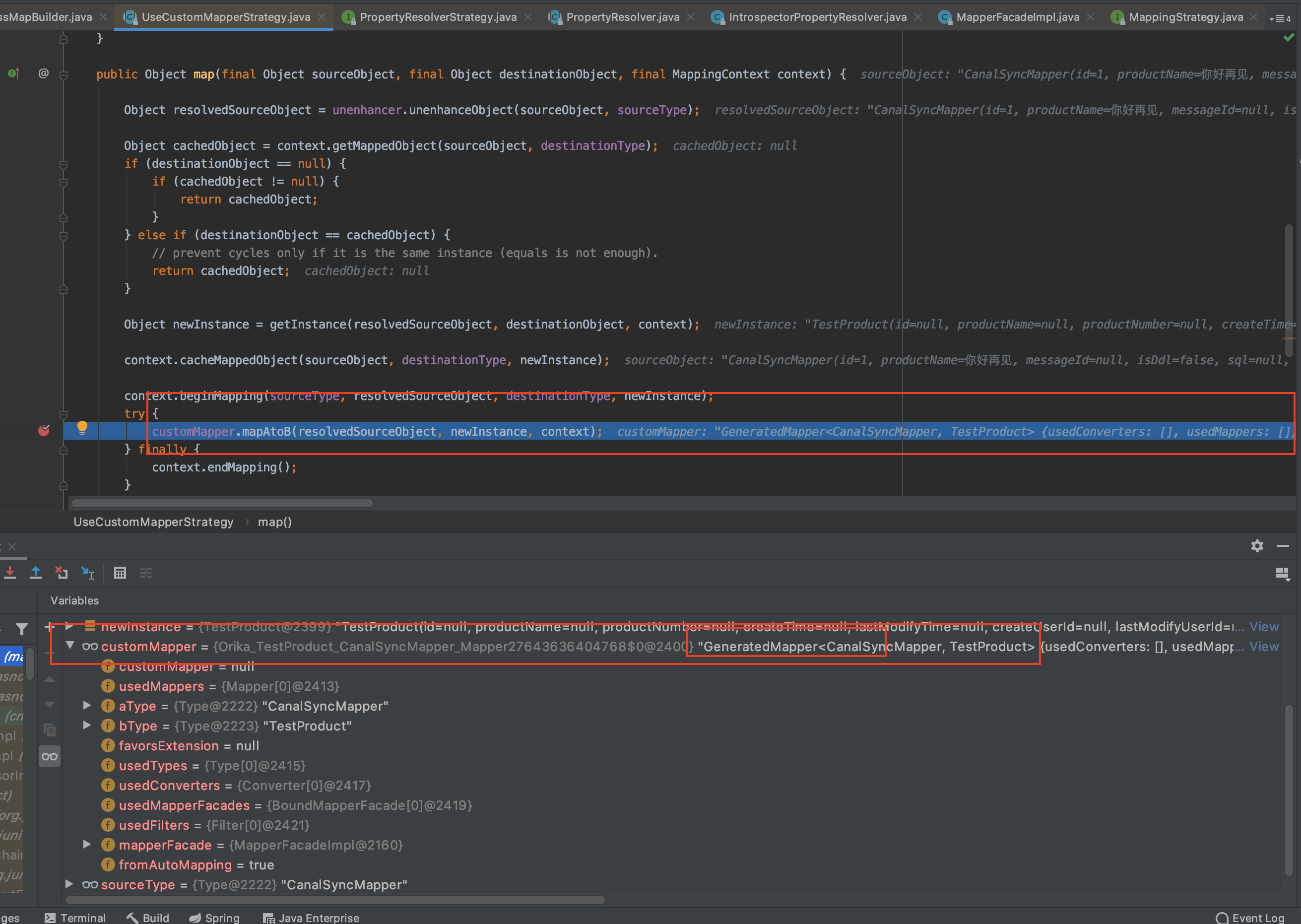
讲完第二点实际上我们就是关注这个 GeneratedMapper的生成过程,也就是备注的第一点 strategy = resolveMappingStrategy(sourceObject, null, destinationClass, false, context);这个方法,从下面代码可以看出来strategy会被缓存起来。
  public <S, D> MappingStrategy resolveMappingStrategy(final S sourceObject, final java.lang.reflect.Type initialSourceType,

            final java.lang.reflect.Type initialDestinationType, final boolean mapInPlace, final MappingContext context) {

        Key key = new Key(getClass(sourceObject), initialSourceType, initialDestinationType, mapInPlace);

        MappingStrategy strategy = strategyCache.get(key);

        if (strategy == null) {

          ......

        }

        /*

         * Set the resolved types on the current mapping context; this can be

         * used by downstream Mappers to determine the originally resolved types

         */

        context.setResolvedSourceType(strategy.getAType());

        context.setResolvedDestinationType(strategy.getBType());

        context.setResolvedStrategy(strategy);

        return strategy;

    }
接着我们就看看if (strategy == null)里面干了什么,如下,我们重点看备注部分
            @SuppressWarnings("unchecked")

            Type<S> sourceType = (Type<S>) (initialSourceType != null ? TypeFactory.valueOf(initialSourceType)

                    : typeOf(sourceObject));

            Type<D> destinationType = TypeFactory.valueOf(initialDestinationType);

            MappingStrategyRecorder strategyRecorder = new MappingStrategyRecorder(key, unenhanceStrategy);

            final Type<S> resolvedSourceType = normalizeSourceType(sourceObject, sourceType, destinationType);

            strategyRecorder.setResolvedSourceType(resolvedSourceType);

            strategyRecorder.setResolvedDestinationType(destinationType);

            if (!mapInPlace && canCopyByReference(destinationType, resolvedSourceType)) {

                /*

                 * We can copy by reference when destination is assignable from

                 * source and the source is immutable

                 */

                strategyRecorder.setCopyByReference(true);

            } else if (!mapInPlace && canConvert(resolvedSourceType, destinationType)) {

                strategyRecorder.setResolvedConverter(mapperFactory.getConverterFactory().getConverter(resolvedSourceType, destinationType));

            } else {

                strategyRecorder.setInstantiate(true);

                Type<? extends D> resolvedDestinationType = resolveDestinationType(context, sourceType, destinationType,

                        resolvedSourceType);

                strategyRecorder.setResolvedDestinationType(resolvedDestinationType);

                strategyRecorder.setResolvedMapper(resolveMapper(resolvedSourceType, resolvedDestinationType, context));#重点关注
if (!mapInPlace) { strategyRecorder.setResolvedObjectFactory( mapperFactory.lookupObjectFactory(resolvedDestinationType, resolvedSourceType, context)); } } strategy = strategyRecorder.playback(); if (log.isDebugEnabled()) { log.debug(strategyRecorder.describeDetails()); } MappingStrategy existing = strategyCache.putIfAbsent(key, strategy); if (existing != null) { strategy = existing; }
重点关注resolveMapper(resolvedSourceType, resolvedDestinationType, context)这个方法,里面实际调用了mapperFactory.lookupMapper(mapperKey, context)方法,如下
  public Mapper<Object, Object> lookupMapper(MapperKey mapperKey, MappingContext context) {

        Mapper<?, ?> mapper = getRegisteredMapper(mapperKey.getAType(), mapperKey.getBType(), false);

        if (internalMapperMustBeGenerated(mapper, mapperKey)) {

            mapper = null;

        }

        if (mapper == null && useAutoMapping) {

            synchronized (this) {

                mapper = getRegisteredMapper(mapperKey.getAType(), mapperKey.getBType(), false);

                boolean internalMapperMustBeGenerated = internalMapperMustBeGenerated(mapper, mapperKey);

                if (internalMapperMustBeGenerated) {

                    mapper = null;

                }

                if (mapper == null) {

                    try {

                        ...

                        ClassMapBuilder<?, ?> builder = classMap(mapperKey.getAType(), mapperKey.getBType()).byDefault(); #1.基于内省收集属性

                        for (MapperKey key : discoverUsedMappers(builder)) {

                            builder.use(key.getAType(), key.getBType());

                        }

                        final ClassMap<?, ?> classMap = builder.toClassMap();

                        buildObjectFactories(classMap, context);

                        mapper = buildMapper(classMap, true, context);                #2.根据收集的属性创建GeneratedMapper

                        initializeUsedMappers(mapper, classMap, context);

                       ...

                    } catch (MappingException e) {

                        e.setSourceType(mapperKey.getAType());

                        e.setDestinationType(mapperKey.getBType());

                        throw exceptionUtil.decorate(e);

                    }

                }

            }

        }

        return (Mapper<Object, Object>) mapper;

    }
#1.基于内省收集属性:ClassMapBuilder<?, ?> builder = classMap(mapperKey.getAType(), mapperKey.getBType()).byDefault();这个方法里面最终会调用到下面这个
protected ClassMapBuilder(Type<A> aType, Type<B> bType, MapperFactory mapperFactory, PropertyResolverStrategy propertyResolver,

            DefaultFieldMapper... defaults) {

        if (aType == null) {

            throw new MappingException("[aType] is required");

        }

        if (bType == null) {

            throw new MappingException("[bType] is required");

        }

        this.mapperFactory = mapperFactory;

        this.propertyResolver = propertyResolver;

        this.defaults = defaults;

        aProperties = propertyResolver.getProperties(aType);#这里就是使用了内省机制获取属性

        bProperties = propertyResolver.getProperties(bType);#这里就是使用了内省机制获取属性
propertiesCacheA = new LinkedHashSet<String>(); propertiesCacheB = new LinkedHashSet<String>(); this.aType = aType; this.bType = bType; this.fieldsMapping = new LinkedHashSet<FieldMap>(); this.usedMappers = new LinkedHashSet<MapperKey>(); }
最终会调用IntrospectorPropertyResolver.collectProperties 下面就是内省收集属性了。
protected void collectProperties(Class<?> type, Type<?> referenceType, Map<String, Property> properties) {

        try {

            BeanInfo beanInfo = Introspector.getBeanInfo(type);

            PropertyDescriptor[] descriptors = beanInfo.getPropertyDescriptors();

            for (final PropertyDescriptor pd : descriptors) {

                try {

                    Method readMethod = getReadMethod(pd, type);

                    if (!includeTransientFields && isTransient(readMethod)) {

                        continue;

                    }

                    Method writeMethod = getWriteMethod(pd, type, null);

                    Property property =

                            processProperty(pd.getName(), pd.getPropertyType(), readMethod, writeMethod, type, referenceType, properties);

                    postProcessProperty(property, pd, readMethod, writeMethod, type, referenceType, properties);

                } catch (final Exception e) {

                    /*

                     * Wrap with info for the property we were trying to

                     * introspect

                     */

                    throw new RuntimeException("Unexpected error while trying to resolve property " + referenceType.getCanonicalName()

                            + ", [" + pd.getName() + "]", e);

                }

            }

        } catch (IntrospectionException e) {

            throw new MappingException(e);

        }

    }
#2.根据收集的属性创建GeneratedMapper:有了属性就可以基于Javasisst创建GeneratedMapper了,如下:
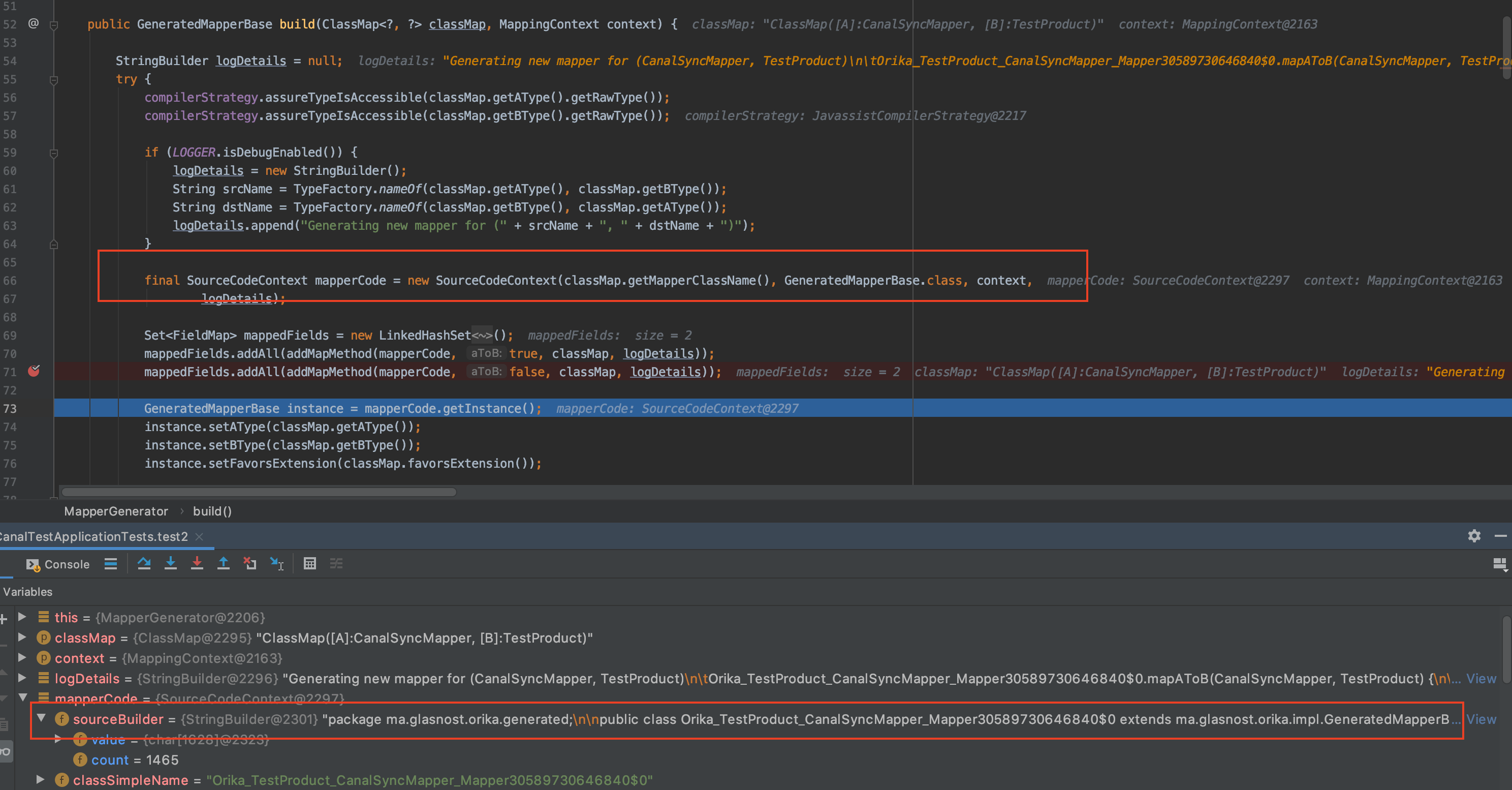
可以看到mapperCode已经拼接生成了一个class的字符串(sourceBuilder),这个字符串如下
package ma.glasnost.orika.generated;

public class Orika_TestProduct_CanalSyncMapper_Mapper30589730646840$0 extends ma.glasnost.orika.impl.GeneratedMapperBase {

    public void mapAtoB(java.lang.Object a, java.lang.Object b, ma.glasnost.orika.MappingContext mappingContext) {

      super.mapAtoB(a, b, mappingContext);

      // sourceType: CanalSyncMapper

      cn.danvid.canal_test.mapper.CanalSyncMapper source = ((cn.danvid.canal_test.mapper.CanalSyncMapper)a);

      // destinationType: TestProduct

      cn.danvid.canal_test.mapper.TestProduct destination = ((cn.danvid.canal_test.mapper.TestProduct)b);

      destination.setId(((java.lang.Long)source.getId()));

      destination.setProductName(((java.lang.String)source.getProductName()));

      if(customMapper != null) {

             customMapper.mapAtoB(source, destination, mappingContext);

      }

    }

    public void mapBtoA(java.lang.Object a, java.lang.Object b, ma.glasnost.orika.MappingContext mappingContext) {

    super.mapBtoA(a, b, mappingContext);

    // sourceType: TestProduct

    cn.danvid.canal_test.mapper.TestProduct source = ((cn.danvid.canal_test.mapper.TestProduct)a);

    // destinationType: CanalSyncMapper

    cn.danvid.canal_test.mapper.CanalSyncMapper destination = ((cn.danvid.canal_test.mapper.CanalSyncMapper)b);

    destination.setId(((java.lang.Long)source.getId()));

    destination.setProductName(((java.lang.String)source.getProductName()));

        if(customMapper != null) {

             customMapper.mapBtoA(source, destination, mappingContext);

        }

    }
}
至此,应该明白的整个流程了把~
Java Bean拷贝工具Orika原理解析的更多相关文章
- Java volatile 关键字底层实现原理解析
本文转载自Java volatile 关键字底层实现原理解析 导语 在Java多线程并发编程中,volatile关键词扮演着重要角色,它是轻量级的synchronized,在多处理器开发中保证了共享变 ...
- [性能] Bean拷贝工具类性能比较
Bean拷贝工具类性能比较 引言 几年前做过一个项目,接入新的api接口.为了和api实现解耦,决定将api返回的实体类在本地也建一个.这样做有两个好处 可以在api变更字段的时候保持应用稳定性 可以 ...
- Java并发包JUC核心原理解析
CS-LogN思维导图:记录CS基础 面试题 开源地址:https://github.com/FISHers6/CS-LogN JUC 分类 线程管理 线程池相关类 Executor.Executor ...
- java bean 转换工具
考量要素: 1.简单的约定优于配置的同名属性copy 2.嵌套属性copy 3.flattern(扁平化)支持,要支持N层结构的copy到一层结构. 4.性能 如下这个网页,里面提到了好多工具. ht ...
- 就因为加了Lombok的@Accessors(chain = true),bean拷贝工具类不干活了
前言 这次新建了一个工程,因为 Lombok 用得很习惯,但以前的话,一般只用了@Data,@AllArgsConstructor,@EqualsAndHashCode等常规注解:那这个Accesso ...
- Bean拷贝工具
Apache BeanUtils Spring BeanUtils cglib BeanCopier Hutool BeanUtil Mapstruct Dozer 1.Apache BeanUti ...
- Java 7 和 Java 8 中的 HashMap原理解析
HashMap 可能是面试的时候必问的题目了,面试官为什么都偏爱拿这个问应聘者?因为 HashMap 它的设计结构和原理比较有意思,它既可以考初学者对 Java 集合的了解又可以深度的发现应聘者的数据 ...
- Java - "JUC线程池" ThreadPoolExecutor原理解析
Java多线程系列--“JUC线程池”02之 线程池原理(一) ThreadPoolExecutor简介 ThreadPoolExecutor是线程池类.对于线程池,可以通俗的将它理解为"存 ...
- JAVA MD5加密算法实现与原理解析
public static String md5Encode(String inputStr) { MessageDigest md5 = null; try { md5 = MessageDiges ...
随机推荐
- Stream(二)
public class Test { /* * Stream接口: * 实现类 * IntStream * DoubleStream * LongStream * * 一.创建Stream * 1. ...
- MAP;MLE
判别学习算法:直接对问题进行求解,比如二分类问题,都是在空间中寻找一条直线从而把类别的样例分开,对于新的样例只要判断在直线的那一侧就可. ==>这种直接求解的方法称为判别学习方法 生成学习算法: ...
- ServletUtils取值(限foton)
1.String query = ServletUtils.getStringValue(request, "query", null); 2.boolean reload = S ...
- Reading Face, Read Health论文阅读笔记
摘要: 随着计算技术觉.人工智能和移动技术的发展,利用计算机读脸技术去识别每个人每天的健康是可行的.怎么去设计一个基于FRT(face reading technologies)的用于得到每天的保健实 ...
- 使用微创联合M5S空气检测仪、树莓派3b+、prometheus、grafana实现空气质量持续监控告警WEB可视化
1.简介 使用微创联合M5S空气检测仪.树莓派3b+.prometheus.grafana实现空气质量持续监控告警WEB可视化 grafana dashboard效果: 2.背景 2.1 需求: 1. ...
- 04 . Go+Vue开发一个线上外卖应用(用户名密码和图形验证码)
图形化验证码生成和验证 功能介绍 在使用用户名和密码登录功能时,需要填写验证码,验证码是以图形化的方式进行获取和展示的. 验证码使用原理 验证码的使用流程和原理为:在服务器端负责生成图形化验证码,并以 ...
- (2)ASP.NET Core3.1 Ocelot路由
1.路由 前一个章节我们已经介绍过Ocelot,相信大家也了解到,Ocelot的主要功能是接收客户端等传入的HTTP请求,并将其转发到下游服务.Ocelot当前仅以另一个http请求的形式支持此功能( ...
- WEB系统防退出账户,回退主页问题(2020最新最有效的方式没有之一)
WEB系统防退出账户,回退主页问题(2020最新最有效的方式没有之一) 很多小伙伴在web开发中都遇倒的问题? JavaWeb项目注销后,可能存在通过浏览器缓存回退的方式进入主页系统 WEB项目 ...
- 解决Python参考文档乱码问题
问题如下: 解决方案: 打开IE浏览器,随便输入一个网址,在页面空白处点击右键->编码->自动选择 再次重新开启python3 帮助文档即可
- 经典c程序100例==21--30
[程序21] 题目:猴子吃桃问题:猴子第一天摘下若干个桃子,当即吃了一半,还不瘾,又多吃了一个 第二天早上又将剩下的桃子吃掉一半,又多吃了一个.以后每天早上都吃了前一天剩下 的一半零一个.到第10天早 ...