
POJ 3449 Geometric Shapes(判断几个不同图形的相交,线段相交判断)
| Time Limit: 2000MS | Memory Limit: 65536K | |
| Total Submissions: 1243 | Accepted: 524 |
Description
While creating a customer logo, ACM uses graphical utilities to draw a picture that can later be cut into special fluorescent materials. To ensure proper processing, the shapes in the picture cannot intersect. However, some logos contain such intersecting shapes. It is necessary to detect them and decide how to change the picture.
Given a set of geometric shapes, you are to determine all of their intersections. Only outlines are considered, if a shape is completely inside another one, it is not counted as an intersection.
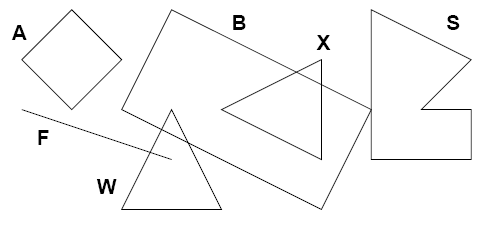
Input
Input contains several pictures. Each picture describes at most 26 shapes, each specified on a separate line. The line begins with an uppercase letter that uniquely identifies the shape inside the corresponding picture. Then there is a kind of the shape and two or more points, everything separated by at least one space. Possible shape kinds are:
• square: Followed by two distinct points giving the opposite corners of the square.
• rectangle: Three points are given, there will always be a right angle between the lines connecting the first point with the second and the second with the third.
• line: Specifies a line segment, two distinct end points are given.
• triangle: Three points are given, they are guaranteed not to be co-linear.
• polygon: Followed by an integer number N (3 ≤ N ≤ 20) and N points specifying vertices of the polygon in either clockwise or anti-clockwise order. The polygon will never intersect itself and its sides will have non-zero length.
All points are always given as two integer coordinates X and Y separated with a comma and enclosed in parentheses. You may assume that |X|, |Y | ≤ 10000.
The picture description is terminated by a line containing a single dash (“-”). After the last picture, there is a line with one dot (“.”).
Output
For each picture, output one line for each of the shapes, sorted alphabetically by its identifier (X). The line must be one of the following:
• “X has no intersections”, if X does not intersect with any other shapes.
• “X intersects with A”, if X intersects with exactly 1 other shape.
• “X intersects with A and B”, if X intersects with exactly 2 other shapes.
• “X intersects with A, B, . . ., and Z”, if X intersects with more than 2 other shapes.
Please note that there is an additional comma for more than two intersections. A, B, etc. are all intersecting shapes, sorted alphabetically.
Print one empty line after each picture, including the last one.
Sample Input
A square (1,2) (3,2)

F line (1,3) (4,4)

W triangle (3,5) (5,5) (4,3)

X triangle (7,2) (7,4) (5,3)

S polygon 6 (9,3) (10,3) (10,4) (8,4) (8,1) (10,2)

B rectangle (3,3) (7,5) (8,3)

-

B square (1,1) (2,2)

A square (3,3) (4,4)

-

.
Sample Output
A has no intersections

B intersects with S, W, and X

F intersects with W

S intersects with B

W intersects with B and F

X intersects with B

A has no intersections

B has no intersections
Source
#include <iostream>

#include <stdio.h>

#include <string.h>

#include <algorithm>

#include <queue>

#include <map>

#include <vector>

#include <set>

#include <string>

#include <math.h>

using namespace std;

const double eps = 1e-;

int sgn(double x)

{

    if(fabs(x) < eps)return ;

    if(x < )return -;

    else return ;

}

struct Point

{

    double x,y;

    Point(){}

    Point(double _x,double _y)

    {

        x = _x;y = _y;

    }

    Point operator -(const Point &b)const

    {

        return Point(x - b.x,y - b.y);

    }

    //叉积

    double operator ^(const Point &b)const

    {

        return x*b.y - y*b.x;

    }

    //点积

    double operator *(const Point &b)const

    {

        return x*b.x + y*b.y;

    }

};

struct Line

{

    Point s,e;

    Line(){}

    Line(Point _s,Point _e)

    {

        s = _s;e = _e;

    }

};

//*判断线段相交

bool inter(Line l1,Line l2)

{

    return

    max(l1.s.x,l1.e.x) >= min(l2.s.x,l2.e.x) &&

    max(l2.s.x,l2.e.x) >= min(l1.s.x,l1.e.x) &&

    max(l1.s.y,l1.e.y) >= min(l2.s.y,l2.e.y) &&

    max(l2.s.y,l2.e.y) >= min(l1.s.y,l1.e.y) &&

    sgn((l2.s-l1.e)^(l1.s-l1.e))*sgn((l2.e-l1.e)^(l1.s-l1.e)) <=  &&

    sgn((l1.s-l2.e)^(l2.s-l2.e))*sgn((l1.e-l2.e)^(l2.s-l2.e)) <= ;

}

struct Node

{

    char id;

    int n;//点数

    Point p[];

}node[];

bool cmp(Node a,Node b)

{

    return a.id < b.id;

}

char str[];

bool check(Node a,Node b)

{

    for(int i = ;i < a.n;i++)

        for(int j = ;j < b.n;j++)

           if(inter(Line(a.p[i],a.p[(i+)%a.n]),Line(b.p[j],b.p[(j+)%b.n])))

              return true;

    return false;

}

bool ff[];

int main()

{

    //freopen("in.txt","r",stdin);

    //freopen("out.txt","w",stdout);

    int n;

    while(scanf("%s",str) == )

    {

        if(str[] == '.')break;

        node[].id = str[];

        scanf("%s",str);

        if(strcmp(str,"square")==)

        {

            node[].n = ;

            scanf(" (%lf,%lf)",&node[].p[].x,&node[].p[].y);

            //cout<<node[0].p[0].x<<" "<<node[0].p[0].y<<endl;

            scanf(" (%lf,%lf)",&node[].p[].x,&node[].p[].y);

           // cout<<node[0].p[2].x<<" "<<node[0].p[2].y<<endl;

            node[].p[].x = ((node[].p[].x+node[].p[].x)+(node[].p[].y-node[].p[].y))/;

            node[].p[].y = ((node[].p[].y+node[].p[].y)+(node[].p[].x-node[].p[].x))/;

            node[].p[].x = ((node[].p[].x+node[].p[].x)-(node[].p[].y-node[].p[].y))/;

            node[].p[].y = ((node[].p[].y+node[].p[].y)-(node[].p[].x-node[].p[].x))/;

        }

        else if(strcmp(str,"line")==)

        {

            node[].n = ;

            scanf(" (%lf,%lf)",&node[].p[].x,&node[].p[].y);

            scanf(" (%lf,%lf)",&node[].p[].x,&node[].p[].y);

        }

        else if(strcmp(str,"triangle")==)

        {

            node[].n = ;

            scanf(" (%lf,%lf)",&node[].p[].x,&node[].p[].y);

            scanf(" (%lf,%lf)",&node[].p[].x,&node[].p[].y);

            scanf(" (%lf,%lf)",&node[].p[].x,&node[].p[].y);

        }

        else if(strcmp(str,"rectangle")==)

        {

            node[].n = ;

            scanf(" (%lf,%lf)",&node[].p[].x,&node[].p[].y);

            scanf(" (%lf,%lf)",&node[].p[].x,&node[].p[].y);

            scanf(" (%lf,%lf)",&node[].p[].x,&node[].p[].y);

            node[].p[].x = node[].p[].x + (node[].p[].x - node[].p[].x);

            node[].p[].y = node[].p[].y + (node[].p[].y - node[].p[].y);

        }

        else if(strcmp(str,"polygon")==)

        {

            scanf("%d",&node[].n);

            for(int i = ;i < node[].n;i++)

            {

                scanf(" (%lf,%lf)",&node[].p[i].x,&node[].p[i].y);

            }

        }

        n = ;

        while(scanf("%s",str)==)

        {

            //cout<<str<<endl;

            if(str[] == '-')break;

            node[n].id = str[];

            scanf("%s",str);

            if(strcmp(str,"square")==)

            {

                node[n].n = ;

                scanf(" (%lf,%lf)",&node[n].p[].x,&node[n].p[].y);

                scanf(" (%lf,%lf)",&node[n].p[].x,&node[n].p[].y);

                node[n].p[].x = ((node[n].p[].x+node[n].p[].x)+(node[n].p[].y-node[n].p[].y))/;

                node[n].p[].y = ((node[n].p[].y+node[n].p[].y)+(node[n].p[].x-node[n].p[].x))/;

                node[n].p[].x = ((node[n].p[].x+node[n].p[].x)-(node[n].p[].y-node[n].p[].y))/;

                node[n].p[].y = ((node[n].p[].y+node[n].p[].y)-(node[n].p[].x-node[n].p[].x))/;

            }

            else if(strcmp(str,"line")==)

            {

                node[n].n = ;

                scanf(" (%lf,%lf)",&node[n].p[].x,&node[n].p[].y);

                scanf(" (%lf,%lf)",&node[n].p[].x,&node[n].p[].y);

            }

            else if(strcmp(str,"triangle")==)

            {

                node[n].n = ;

                scanf(" (%lf,%lf)",&node[n].p[].x,&node[n].p[].y);

                scanf(" (%lf,%lf)",&node[n].p[].x,&node[n].p[].y);

                scanf(" (%lf,%lf)",&node[n].p[].x,&node[n].p[].y);

            }

            else if(strcmp(str,"rectangle")==)

            {

                node[n].n = ;

                scanf(" (%lf,%lf)",&node[n].p[].x,&node[n].p[].y);

                scanf(" (%lf,%lf)",&node[n].p[].x,&node[n].p[].y);

                scanf(" (%lf,%lf)",&node[n].p[].x,&node[n].p[].y);

                node[n].p[].x = node[n].p[].x + (node[n].p[].x - node[n].p[].x);

                node[n].p[].y = node[n].p[].y + (node[n].p[].y - node[n].p[].y);

            }

            else if(strcmp(str,"polygon")==)

            {

                scanf("%d",&node[n].n);

                for(int i = ;i < node[n].n;i++)

                {

                    scanf(" (%lf,%lf)",&node[n].p[i].x,&node[n].p[i].y);

                }

            }

            n++;

        }

        sort(node,node+n,cmp);

        for(int i = ;i < n;i++)

        {

            printf("%c ",node[i].id);

            memset(ff,false,sizeof(ff));

            int cnt = ;

            for(int j = ;j < n;j++)

                if(i != j)

                  if(check(node[i],node[j]))

                    {

                        cnt++;

                        ff[j] = true;

                    }

            if(cnt == )printf("has no intersections\n");

            else if(cnt == )

            {

                printf("intersects with ");

                for(int j =  ; j < n;j++)

                    if(ff[j])

                {

                    printf("%c\n",node[j].id);

                    break;

                }

            }

            else if(cnt == )

            {

                printf("intersects with ");

                for(int j =  ; j < n;j++)

                    if(ff[j])

                {

                    if(cnt==)printf("%c ",node[j].id);

                    if(cnt==)printf("and %c\n",node[j].id);

                    cnt--;

                }

            }

            else

            {

                printf("intersects with ");

                for(int j =  ; j < n;j++)

                    if(ff[j])

                {

                    if(cnt > )printf("%c, ",node[j].id);

                    if(cnt==)printf("and %c\n",node[j].id);

                    cnt--;

                }

            }

        }

        printf("\n");

    }

}
POJ 3449 Geometric Shapes(判断几个不同图形的相交,线段相交判断)的更多相关文章
- POJ 3449 Geometric Shapes 判断多边形相交
题意不难理解,给出多个多边形,输出多边形间的相交情况(嵌套不算相交),思路也很容易想到.枚举每一个图形再枚举每一条边 恶心在输入输出,不过还好有sscanf(),不懂可以查看cplusplus网站 根 ...
- POJ 3449 Geometric Shapes (求正方形的另外两点)
Geometric Shapes Time Limit: 2000MS Memory Limit: 65536K Total Submissions: 1470 Accepted: 622 D ...
- 简单几何(线段相交)+模拟 POJ 3449 Geometric Shapes
题目传送门 题意:给了若干个图形,问每个图形与哪些图形相交 分析:题目说白了就是处理出每个图形的线段,然后判断是否相交.但是读入输出巨恶心,就是个模拟题加上线段相交的判断,我第一次WA不知道输出要按字 ...
- POJ 3449 Geometric Shapes --计算几何,线段相交
题意: 给一些多边形或线段,输出与每一个多边形或线段的有哪一些多边形或线段. 解法: 想法不难,直接暴力将所有的图形处理成线段,然后暴力枚举,相交就加入其vector就行了.主要是代码有点麻烦,一步一 ...
- POJ 3449 Geometric Shapes
判断两个多边形是否相交,只需判断边是否有相交. 编码量有点大,不过思路挺简单的. #include<cstdio> #include<cstring> #include< ...
- 线段相交 poj 1066
// 线段相交 poj 1066 // 思路:直接枚举每个端点和终点连成线段,判断和剩下的线段相交个数 // #include <bits/stdc++.h> #include <i ...
- Geometric Shapes - POJ 3449(多边形相交)
题目大意:给一些几何图形的编号,求出来这些图形都和那些相交. 分析:输入的正方形对角线上的两个点,所以需要求出来另外两个点,公式是: x2:=(x1+x3+y3-y1)/2; y2:=(y1+y3 ...
- TZOJ 2560 Geometric Shapes(判断多边形是否相交)
描述 While creating a customer logo, ACM uses graphical utilities to draw a picture that can later be ...
- poj3449 Geometric Shapes【计算几何】
含[判断线段相交].[判断两点在线段两侧].[判断三点共线].[判断点在线段上]模板 Geometric Shapes Time Limit: 2000MS Memory Limit: 655 ...
随机推荐
- Linux进程控制(一)
1. Linux进程概述 进程是一个程序一次执行的过程,它和程序有本质区别.程序是静态的,它是一些保存在磁盘上的指令的有序集合:而进程是一个动态的概念,它是一个运行着的程序,包含了进程的动态创建.调度 ...
- 示例可重用的web component方式组织angular应用模块
在online web应用中,经常有这样的需求,能够让用户通过浏览器来输入代码,同时能够根据不同的代码来做语法高亮.大家已知有很多相应的javascript库来实现语法高亮的功能,比如codemirr ...
- LeetCode Valid Number 有效数字(有限自动机)
题意:判断一个字符串是否是一个合法的数字,包括正负浮点数和整形. 思路:有限自动机可以做,画个图再写程序就可以解决啦,只是实现起来代码的长短而已. 下面取巧来解决,分情况讨论: (1)整数 (2)浮点 ...
- java实现的kmp算法
package DataStructure; import java.util.ArrayList; import java.util.List; //KMP算法的实现 //以下代码由freedom结 ...
- Linux Shell编程(4): 逻辑运算符、逻辑表达式详解
shell的逻辑运算符 涉及有以下几种类型,因此只要适当选择,可以解决我们很多复杂的判断,达到事半功倍效果. 一.逻辑运算符 逻辑卷标 表示意思 1. 关于档案与目录的侦测逻辑卷标! -f 常用!侦测 ...
- 三 最简单的 AndEngine 程序框架
package com.example.AndEngineExample; import org.anddev.andengine.engine.Engine;import org.anddev.an ...
- 【转】Github轻松上手4-常用的git命令
转自:http://blog.sina.com.cn/s/blog_4b55f6860100zzih.html 附上一些git的常见命令: • git remote add origin git ...
- IconRes提供免费高质量的Material风格android官方图标库
连接地址: http://www.iconres.com/android/index.php
- javac 命令用法
引用自己写的Class 在java中手动编译时,总提示找不到类,调试成功后,特把目录结构与编译成功的命令列出: 样例一: 文件名 MessageStore.java Hello.java 源码 pac ...
- Java RunTime Environment (JRE) or Java Development Kit (JDK) must be available in order to run Eclipse. ......
mkdir jre cd jre ln -s 你的JDK目录/bin bin 例如:ln -s /usr/lib/jvm/jdk1.8.0_25/bin bin 原文地址:http://www.cnb ...