
680C. Bear and Prime 100 数学
This is an interactive problem. In the output section below you will see the information about flushing the output.
Bear Limak thinks of some hidden number — an integer from interval [2, 100]. Your task is to say if the hidden number is prime or composite.
Integer x > 1 is called prime if it has exactly two distinct divisors, 1 and x. If integer x > 1 is not prime, it's called composite.
You can ask up to 20 queries about divisors of the hidden number. In each query you should print an integer from interval [2, 100]. The system will answer "yes" if your integer is a divisor of the hidden number. Otherwise, the answer will be "no".
For example, if the hidden number is 14 then the system will answer "yes" only if you print 2, 7 or 14.
When you are done asking queries, print "prime" or "composite" and terminate your program.
You will get the Wrong Answer verdict if you ask more than 20 queries, or if you print an integer not from the range [2, 100]. Also, you will get the Wrong Answer verdict if the printed answer isn't correct.
You will get the Idleness Limit Exceeded verdict if you don't print anything (but you should) or if you forget about flushing the output (more info below).
After each query you should read one string from the input. It will be "yes" if the printed integer is a divisor of the hidden number, and "no" otherwise.
Up to 20 times you can ask a query — print an integer from interval [2, 100] in one line. You have to both print the end-of-line character and flush the output. After flushing you should read a response from the input.
In any moment you can print the answer "prime" or "composite" (without the quotes). After that, flush the output and terminate your program.
To flush you can use (just after printing an integer and end-of-line):
- fflush(stdout) in C++;
- System.out.flush() in Java;
- stdout.flush() in Python;
- flush(output) in Pascal;
- See the documentation for other languages.
Hacking. To hack someone, as the input you should print the hidden number — one integer from the interval [2, 100]. Of course, his/her solution won't be able to read the hidden number from the input.
yes
no
yes
2
80
5
composite
no
yes
no
no
no
58
59
78
78
2
prime
The hidden number in the first query is 30. In a table below you can see a better form of the provided example of the communication process.
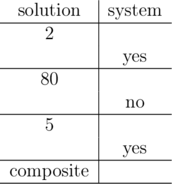
The hidden number is divisible by both 2 and 5. Thus, it must be composite. Note that it isn't necessary to know the exact value of the hidden number. In this test, the hidden number is 30.
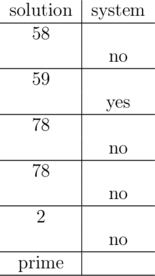
59 is a divisor of the hidden number. In the interval [2, 100] there is only one number with this divisor. The hidden number must be 59, which is prime. Note that the answer is known even after the second query and you could print it then and terminate. Though, it isn't forbidden to ask unnecessary queries (unless you exceed the limit of 20 queries).
题目链接:http://codeforces.com/contest/680/problem/C
题意:人机交互。codeforces评测系统随机给出一个区间在[2,100]的数x。通过一些操作来判断x是质数还是合数。操作为:你输出一个数m,OJ进行判断,如果x%m==0,OJ输入yes,否则OJ输出no。操作不能操作20次。
思路:这种题目理解题意才是难点(▄█▀█●给跪了)。题意就是最多通过20个数可以判断[2,100]区间内任意一个数是素数还是合数。只要x分别除以2,3,5,7,11,13,17,19,23,29,31,37,41,43,47(2*47=94)来进行判断。x%sign[i]==0的话,cou++。如果cou>1,那么就是合数。光这几个数还是不够的,还需要一些特殊的数4,9,25。
代码:
#include<bits/stdc++.h>

using namespace std;

string str;

int sign[]= {,,,,,,,,,,,,,,,,,,};

int main()

{

    int i,ans=;

    for(i=; i<; i++)

    {

        printf("%d\n",sign[i]);

        fflush(stdout);

        cin>>str;

        if(str=="yes") ans++;

    }

    if(ans>=) printf("composite\n"),fflush(stdout);

    else printf("prime\n"),fflush(stdout);

    return ;

}
680C. Bear and Prime 100 数学的更多相关文章
- codeforces 356 div2 C.Bear and Prime 100 数学
C. Bear and Prime 100 time limit per test 1 second memory limit per test 256 megabytes input standar ...
- codeforces 680C C. Bear and Prime 100(数论)
题目链接: C. Bear and Prime 100 time limit per test 1 second memory limit per test 256 megabytes input s ...
- Codeforces Round #356 (Div. 2) C. Bear and Prime 100(转)
C. Bear and Prime 100 time limit per test 1 second memory limit per test 256 megabytes input standar ...
- Codeforces A - Bear and Prime 100(交互题)
A - Bear and Prime 100 思路:任何一个合数都可以写成2个以上质数的乘积.在2-100中,除了4,9,25,49外都可以写成两个以上不同质数的乘积. 所以打一个质数加这四个数的表: ...
- Codeforces Round #356 (Div. 2) C. Bear and Prime 100 水题
C. Bear and Prime 100 题目连接: http://www.codeforces.com/contest/680/problem/C Description This is an i ...
- 【CodeForces】679 A. Bear and Prime 100
[题目]A. Bear and Prime 100 [题意]有一数字x,每次可询问一个数字y是否x的因子,最后输出数字x是否素数,要求询问次数<=20. [题解]容易发现[2,100]范围内的非 ...
- 暑假练习赛 006 B Bear and Prime 100
Bear and Prime 100Crawling in process... Crawling failed Time Limit:1000MS Memory Limit:262144KB ...
- CF #356 div1 A. Bear and Prime 100
题目链接:http://codeforces.com/contest/679/problem/A CF有史以来第一次出现交互式的题目,大致意思为选择2到100中某一个数字作为隐藏数,你可以询问最多20 ...
- CF385C Bear and Prime Numbers 数学
题意翻译 给你一串数列a.对于一个质数p,定义函数f(p)=a数列中能被p整除的数的个数.给出m组询问l,r,询问[l,r]区间内所有素数p的f(p)之和. 题目描述 Recently, the be ...
随机推荐
- 线程池,queue模块增加用法
1 同一个进程内的队列(多线程) import queue queue.Queue() 先进先出 queue.LifoQueue() 后进先出 queue.PriorityQueue() 优先级队列 ...
- jmeter测试20个QPS下的响应时间-设置QPS限制
添加--->定时器--->Constant Throughput Timer Constant Throughput Timer 的主要属性介绍: 名称:定时器的名称 Target thr ...
- MYSQL体系结构-来自期刊
MySQL三层体系结构 |-----------------------------------------------------------------------------------| | ...
- uva-784-水题-搜索
题意:从*点开始,标记所有能走到的点,X代表墙,下划线原样输出 AC:40ms #include<stdio.h> #include<iostream> #include< ...
- [Ora]-1309. OCI is not properly installed on this machine (NOE1/INIT)
When the Oracle client software has not been properly installed, you will get an exception when tryi ...
- H5 缓存机制解析
在web项目开发中,我们可能都曾碰到过这样一个棘手的问题: 线上项目需要更新一个有问题的资源(可能是图片,js,css,json数据等),这个资源已经发布了很长一段时间,为什么页面在浏览器里打开还是没 ...
- UGUI Auto Layout 自动布局
Layout Element 首先分配 Minimum Size 如果还有足够空间,分配 Preferred Size 如果还有额外空间,分配 Flexible Size 比较特别的是 Flexibl ...
- JS中数组的创建方法
<!DOCTYPE html><html lang="en"><head> <meta charset="UTF-8" ...
- shell 一次移动很多个命名相似的文件
文件夹下面有很多类似下面命名的文件 aaaaaa01bbb aaaaaa01cc aaaaaa01dd aaaaaa02bbb aaaaaa02cc 要把 aaaaaa01 的文件移走 用 mv / ...
- oracle 基本信息
查看Oracle是32位还是64位的方法: 方法一:使用sqlplus 64位: [oracle@qs-wg-db2 ~]$ sqlplus / as sysdba; SQL*Plus: Rele ...