
20135319zl内核模块编译报告
内核模块编程学习报告
1.编写一个简单的输出信息的模块
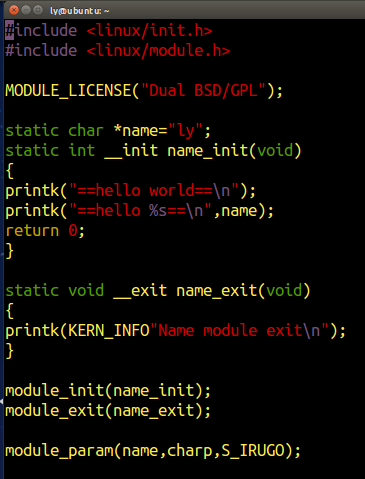
源代码:
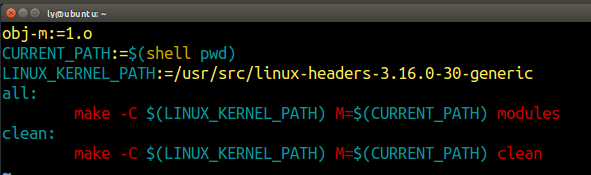
Makefile
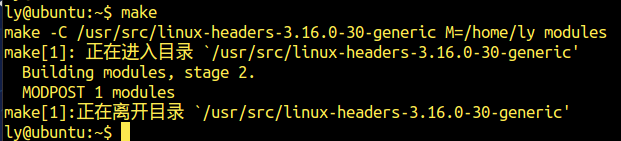
编译模块
加载模块

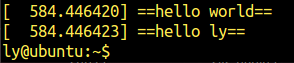
测试模块(dmesg)
卸载模块
Sudo rmmod 1
使用dmesg查看情况
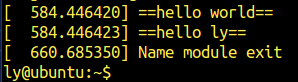
2.输出当前进程信息
源代码(作为2.c)
修改makefile中的目标文件为2.o
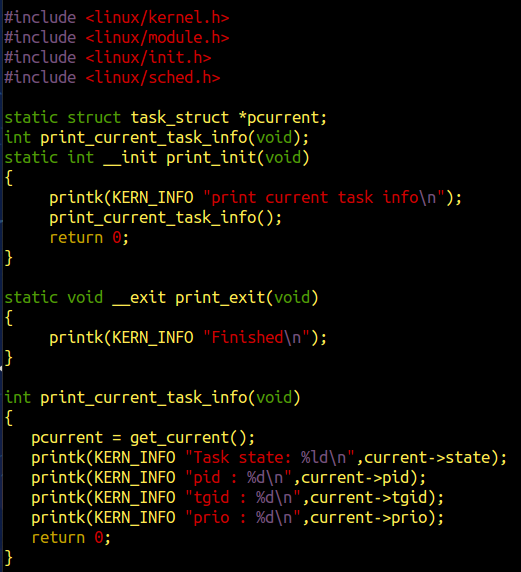
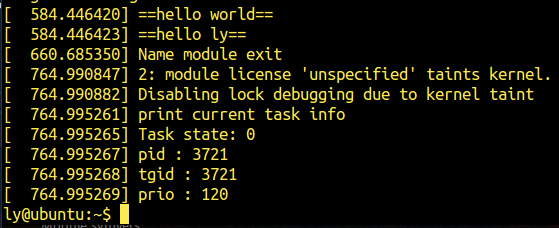
编译,加载并测试模块
3.进程列表读取功能(3.c)
源代码
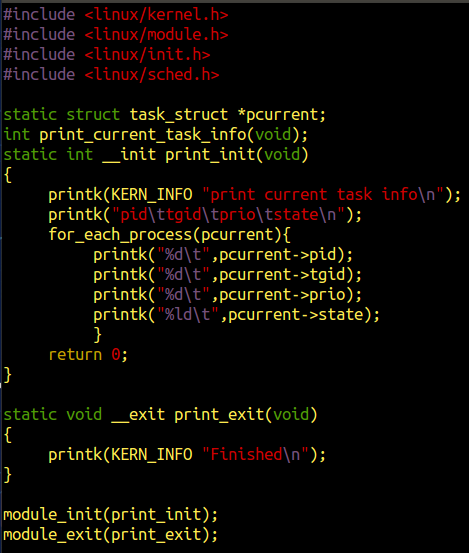
修改makefile为3.o
编译,加载并测试模块:

4.可读写的文件节点内核模块
在/proc文件系统中创建一个文件节点exp2
源代码
#include <linux/module.h>

#include <linux/init.h>

#include <linux/kernel.h>

#include <linux/fs.h>     // for basic filesystem

#include <linux/proc_fs.h>    // for the proc filesystem

#include <linux/seq_file.h>   // for sequence files

#include <linux/jiffies.h>    // for jiffies

#include <linux/slab.h>       // for kzalloc, kfree

#include <linux/uaccess.h>    // for copy_from_user

//static struct task_struct *pcurrent;

int print_current_task_info(void);

    // global var

    static char *str = NULL;

    // seq_operations -> show

    static int jif_show(struct seq_file *m, void *v)

    {

        //seq_printf(m, "current kernel time is %llu\n", (unsigned long long) get_jiffies_64());

        seq_printf(m, "str is %s\n", str);

        return 0; //!! must be 0, or will show nothing T.T

    }

    // file_operations -> write

 static ssize_t jif_write(struct file *file, const char __user *buffer, size_t count, loff_t *f_pos)

    {

        //分配临时缓冲区

        char *tmp = kzalloc((count+1), GFP_KERNEL);

        if (!tmp)

            return -ENOMEM;

        //将用户态write的字符串拷贝到内核空间

        //copy_to|from_user(to,from,cnt)

        if (copy_from_user(tmp, buffer, count)) {

            kfree(tmp);

            return -EFAULT;

        }

        //将str的旧空间释放,然后将tmp赋值给str

        kfree(str);

        str = tmp;

        return count;

    }

    // seq_operations -> open

    static int jif_open(struct inode *inode, struct file *file)

    {

        return single_open(file, jif_show, NULL);

    }

    static const struct file_operations jif_fops =

 {

        .owner      = THIS_MODULE,

        .open       = jif_open,

        .read       = seq_read,

        .write      = jif_write,

        .llseek     = seq_lseek,

        .release    = single_release,

    };

    // module init

    static int __init jif_init(void)

    {

        struct proc_dir_entry* jif_file;

        jif_file = proc_create("exp2", 0, NULL, &jif_fops);

        if (NULL == jif_file)

        {

            return -ENOMEM;

        }

        return 0;

    }

    // module exit

    static void __exit jif_exit(void)

    {

        printk("******************************************\n");

        remove_proc_entry("exp2", NULL);

        kfree(str);

    }

    module_init(jif_init);

    module_exit(jif_exit);

    MODULE_AUTHOR("why");

    MODULE_LICENSE("GPL");
编译,加载模块
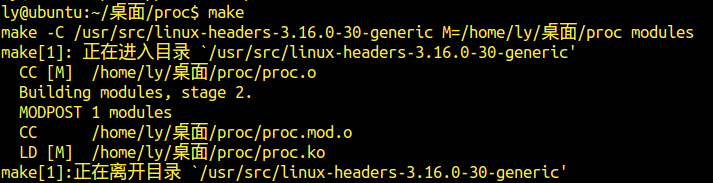
往新建立的exp2文件中写入字符串”zhuli”,可见结果:

5.虚拟地址转换模块
源代码:
#include <linux/module.h>

#include <asm/pgtable.h>

#include <linux/version.h>

#include <asm/page.h>

#include <linux/gfp.h>

#include <linux/page-flags.h>

#include <linux/sched.h>//find_task_by_vpid

#include <linux/mm.h>//find_vma

MODULE_LICENSE("GPL");

MODULE_DESCRIPTION("CONVERT USER VIRTUAL ADDRESS TO PHYADDRESS");

static int pid;

static unsigned long va;

module_param(pid,int,0644);

module_param(va,ulong,0644);

static int find_pgd_init(void)

{

    	unsigned long pa=0;

    	struct task_struct *pcb_tmp=NULL;

    	pgd_t *pgd_tmp=NULL;

    	pud_t *pud_tmp=NULL;

    	pmd_t *pmd_tmp=NULL;

    	pte_t *pte_tmp=NULL;

    	printk(KERN_ALERT "test:va=0x%lx,pid=%d.\n",va,pid);

    	rcu_read_lock();

    	if( !( pcb_tmp = pid_task(find_vpid(pid), PIDTYPE_PID) ) )

    	{

        	rcu_read_unlock();

        	printk(KERN_ALERT "Can't find the task %d.\n",pid);

        	return 0;

    	}

    	rcu_read_unlock();

	printk("The page index_table address = 0x%p\n\n",pcb_tmp->mm->pgd);

    	printk(KERN_ALERT "pgd=0x%p\n",pcb_tmp->mm->pgd);

    	if(!find_vma(pcb_tmp->mm,va))

    	{

        	printk(KERN_ALERT "virt_addr 0x%lx not available.\n",va);

        	return 0;

    	}

    	pgd_tmp=pgd_offset(pcb_tmp->mm,va);

    	printk(KERN_ALERT "pgd_tmp=0x%p\n",pgd_tmp);

    	printk(KERN_ALERT "pgd_val(*pgd_tmp)=0x%lx\n\n",pgd_val(*pgd_tmp));

   	 if(pgd_none(*pgd_tmp))

    	{

     	   printk(KERN_ALERT "Not mapped in pgd.\n");

     	   return 0;

    	}

    	pud_tmp=pud_offset(pgd_tmp,va);

    	pmd_tmp=pmd_offset(pud_tmp,va);

    	pte_tmp=pte_offset_kernel(pmd_tmp,va);

    	if(pte_none(*pte_tmp))

    	{

        	printk(KERN_ALERT "Not mapped in pte.\n");

        	return 0;

    	}

    	if(!pte_present(*pte_tmp))

    	{

   	     	printk(KERN_ALERT "pte not in RAM,maybe swaped.\n");

    	    	return 0;

    	}

    	pa=(pte_val(*pte_tmp)&PAGE_MASK)|(va&~PAGE_MASK);

    	printk(KERN_ALERT "Virtual address: 0x%lx in RAM is 0x%lx.\n",va,pa);

    	printk(KERN_ALERT "Part content in 0x%lx is 0x%lx.\n",pa,*(unsigned long*)((char *)pa+PAGE_OFFSET));

	int i;

	printk("some content:\n");

	for(i=0;i<40;i=i+4)

	{

		printk("%lx\n",*(unsigned long*)((char*)pa+PAGE_OFFSET+i));

	}

    return 0;

}

static void find_pgd_exit(void)

{

    	printk(KERN_ALERT "Goodbye.\n");

}

module_init(find_pgd_init);

module_exit(find_pgd_exit);

MODULE_LICENSE("GPL");

MODULE_AUTHOR("Why");

MODULE_DESCRIPTION("GET WESSAGE");
源代码中find_pgd_init()为模块初始化函数,find_pgd_exit为模块析构函数。
代码中还定义了所要传入的参数,即所指定进程的进程号pid,数据类型为int,模块参数以module_param(name,type,perm)的形式定义,其中name为参数名,type为参数的数据类型,perm是一个权限值,控制谁可以存取模块参数在sysfs中的表示。此处还要注意的是要对内核模块的初始化函数和析构函数进行声明,即指明哪个函数是内核模块的初始化函数,哪个是内核模块的析构函数。
module_init()指明的是模块初始化函数,module_exit()指明的是模块析构函数。
MODULE LICENSE、MODULE_AUTHOR、MODULE_DESCRIPTION 分别为模块证书、模块作者和模块描述。
选取gedit验证模块
查询当前开启的gedit的pid

查询gedit的虚拟地址
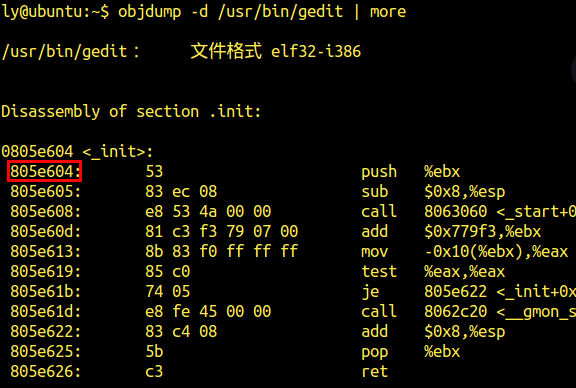
可见此时gedit的pid为5207,虚拟地址的16进制表示为0x805e604,使用计算器转换为10进制为134604292
编译,加载并测试模块,可见:(加载模块时需要做如下操作)

测试结果:
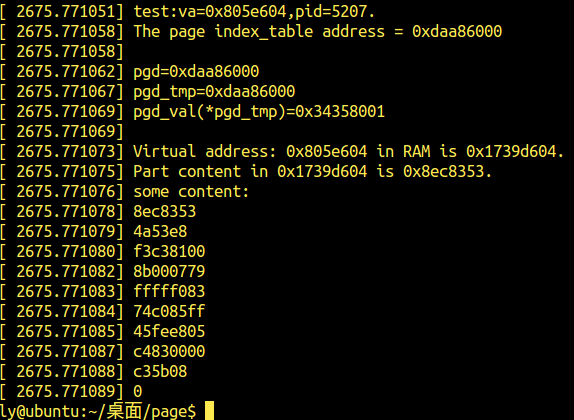
可见,输出序列为53,83,ec ,08…
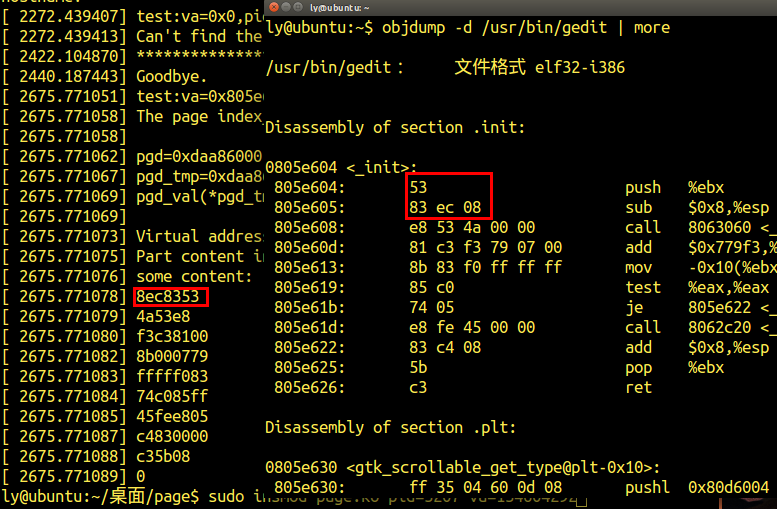
验证模块功能
6.使用文件节点存储页表查询结果
源代码:
#include <linux/module.h>

#include <linux/init.h>

#include <linux/kernel.h>

#include <linux/fs.h>     // for basic filesystem

#include <linux/proc_fs.h>    // for the proc filesystem

#include <linux/seq_file.h>   // for sequence files

#include <linux/jiffies.h>    // for jiffies

#include <linux/slab.h>       // for kzalloc, kfree

#include <linux/uaccess.h>    // for copy_from_user

#include <asm/pgtable.h>

#include <linux/version.h>

#include <asm/page.h>

#include <linux/gfp.h>

#include <linux/page-flags.h>

#include <linux/sched.h>//find_task_by_vpid

#include <linux/mm.h>//find_vma

static unsigned long pid=5263;

static unsigned long va=134604292;

int i=0;

unsigned long pa = 0;

//static struct task_struct *pcurrent;

int print_current_task_info(void);

static int jif_show(struct seq_file *m, void *v);

// global var

//static char *str = NULL;

    // file_operations -> write

    static ssize_t jif_write(struct file *file, const char __user *buffer, size_t count, loff_t *f_pos)

    {

        unsigned  long *tmp = kzalloc((count+1), GFP_KERNEL);

        if (!tmp)

            return -ENOMEM;

        //copy_to|from_user(to,from,cnt)

        if (copy_from_user(tmp, buffer, count)) {

            kfree(tmp);

            return -EFAULT;

        }

        kfree(tmp);

        //pid = *tmp;

        return count;

    }

    // seq_operations -> open

    static int jif_open(struct inode *inode, struct file *file)

    {

        return single_open(file, jif_show, NULL);

    }

    static const struct file_operations jif_fops =

    {

        .owner      = THIS_MODULE,

        .open       = jif_open,

        .read       = seq_read,

        .write      = jif_write,

        .llseek     = seq_lseek,

        .release    = single_release,

    };

    // module init

    static int __init jif_init(void)

    {

        struct proc_dir_entry* jif_file;

        jif_file = proc_create("exp4", 0, NULL, &jif_fops);

        if (NULL == jif_file)

        {

            return -ENOMEM;

        }

        return 0;

    }

    // module exit

    static void __exit jif_exit(void)

    {

	printk("******************************************\n");

        remove_proc_entry("exp4", NULL);

        kfree(pid);

    }

static int find_pgd_init(struct seq_file *m)

{

	struct task_struct *pcb_tmp = NULL;

	pgd_t *pgd_tmp = NULL;

	pte_t *pte_tmp = NULL;

    pud_t *pud_tmp = NULL;

    pmd_t *pmd_tmp = NULL;

    seq_printf(m,"test:va=0x%lx,pid=%ld.\n",va,pid);

	rcu_read_lock();

	if(!(pcb_tmp = pid_task(find_vpid(pid),PIDTYPE_PID)))

	{

		seq_printf(m,"can not find pro %ld .\n", pid);

		return 0;

	}

	rcu_read_unlock();

	seq_printf(m,"ye_mu_lu_biao_ji_zhi = 0x%p\n",pcb_tmp->mm->pgd);

	if(!find_vma(pcb_tmp->mm,va))

        {

        	seq_printf(m,"xu_ni_di_zhi%lxbu_cun_zai\n",va);

        	return 0;

	}

	pgd_tmp=pgd_offset(pcb_tmp->mm,va);

	seq_printf(m,"\npgd=----0x%p\n",pgd_tmp);

    pud_tmp=pud_offset(pgd_tmp,va);

    pmd_tmp=pmd_offset(pud_tmp,va);

    pte_tmp=pte_offset_kernel(pmd_tmp,va);

	seq_printf(m,"\npte=----0x%p\n",pte_tmp);

	seq_printf(m,"\n\n pid=%ld\nva=%lx\n\n",pid,va);

	pa=(pte_val(*pte_tmp)&PAGE_MASK)|(va&~PAGE_MASK);

	seq_printf(m, "xu_ni_di_zhi %lx qi_zai_nei_cun_zhong %lx.\n",va,pa);

	seq_printf(m, "bu_fen_nei_rong  0x%lx is  0x%lx.\n.\n",pa,pa);

	for(i=0;i<40;i=i+4)

	seq_printf(m,"\t%lx\n",*(unsigned long*)((char*)pa+PAGE_OFFSET+i));

	return 0;

}

// seq_operations -> show

     static int jif_show(struct seq_file *m, void *v)

    {

        //seq_printf(m, "current kernel time is %llu\n", (unsigned long long) get_jiffies_64());

            //seq_printf(m, "str is %s\n", str);

                find_pgd_init(m);

        return 0; //!! must be 0, or will show nothing T.T

    }

MODULE_LICENSE("GPL");

MODULE_AUTHOR("ny");

MODULE_DESCRIPTION("GET WESSAGE");

module_init(jif_init);

module_exit(jif_exit);
其中参数pid和va在一开始写入源代码。
编译,加载模块后,直接显示创建的文件exp4内容,可见:

模块功能实现
20135319zl内核模块编译报告的更多相关文章
- linux/module.h: No such file or directory 内核模块编译过程
1.缺少Linux kernel头文件 To install just the headers in Ubuntu: sudo apt-get install linux-headers-$(unam ...
- linux内核模块编译makefile
linux内核可加载模块的makefile 在开发linux内核驱动时,免不了要接触到makefile的编写和修改,尽管网上的makefile模板一大堆,做一些简单的修改就能用到自己的项目上,但是,对 ...
- Ubuntu 编译安装 Linux 4.0.5 内核,并修复 vmware 网络内核模块编译错误
. . . . . 今天把 Ubuntu 14.04 升级到了最新的 4.0.5 的内核版本,本来不打算记录下来的,但是升级的过程中确实遇到了一些问题,所以还是记录下来,分享给遇到同样问题的猿友. 先 ...
- ubuntu下helloworld内核模块编译
1.hello.c #include<linux/init.h> #include<linux/module.h> MODULE_LICENSE("Dual BSD/ ...
- firefly rk3288 内核模块编译
在驱动开发的过程中,常常需要对代码进行返回的调试,如果返回的编译再烧写内核,势必会浪费开发人员大量的时间和心力,加班加点那是时常的事.为此linux提供了编译内核模块的方式,无需返回烧写内核,只需in ...
- 20135323符运锦----LINUX第二次实践:内核模块编译
Linux实践二--模块 一.知识点总结 ①Linux模块是一些可以作为独立程序来编译的函数和数据类型的集合.之所以提供模块机制,是因为Linux本身是一个单内核.单内核由于所有内容都集成在一起,效率 ...
- Android内核模块编译执行
Author: GeneBlue 0X01 前言 内核驱动是漏洞的高发区,了解Android驱动代码的编写是分析.利用驱动漏洞的基础.本文以一个"hello"驱动为例,简单介绍内核 ...
- Linux 4.1内核编译报告
编译环境 Arch Linux on VirtualBox 下载内核 https://www.kernel.org/ 下载的内核压缩包,此时的最新内核版本为4.1: 解压包 # tar -xvJf l ...
- Linux 内核模块编译 Makefile
驱动编译分为静态编译和动态编译:静态编译即为将驱动直接编译进内核,动态编译即为将驱动编译成模块. 而动态编译又分为两种: a -- 内部编译 在内核源码目录内编译 b -- 外部编译 在内核源码的目录 ...
随机推荐
- 新手Python第二天(存储)
Python 列表的创建 创建一个空列表 例如:fruit=[] 创建一个有元素的列表 例如:fruit=['apple','banana','cherry'] 创建嵌套列表 例如:fruit=[[ ...
- Acer 4750G安装OS X 10.9 DP4(简版)
一.下载os x 10.9懒人版:http://bbs.pcbeta.com/viewthread-1384504-1-1.html 二.用系统自带的磁盘分区工具划分一个5G左右的临时安装盘(新建分区 ...
- SQL-Server collation, what is it and how to change db/column collation
The thing about collations is that although database have it's own collation, every table, and every ...
- Oracle purge 用法介绍
http://blog.csdn.net/indexman/article/details/27379597
- Virtual DOM的简单实现
了解React的同学都知道,React提供了一个高效的视图更新机制:Virtual DOM,因为DOM天生就慢,所以操作DOM的时候要小心翼翼,稍微改动就会触发重绘重排,大量消耗性能. 1.Virtu ...
- 20172332 2017-2018-2 《程序设计与数据结构》Java哈夫曼编码实验--哈夫曼树的建立,编码与解码
20172332 2017-2018-2 <程序设计与数据结构>Java哈夫曼编码实验--哈夫曼树的建立,编码与解码 哈夫曼树 1.路径和路径长度 在一棵树中,从一个结点往下可以达到的孩子 ...
- angualrJs指令起名的bug
我在写一个demo时: <div ng-repeat="user in users" my-template2 my-template> //my-template2 ...
- The Begining
学习记录之旅,就此开始.软件工程,Java神马的统统到我碗里来.
- 经验分享(Android开发)
以前对于Android开发一点了解都没有,当然,以前觉得是一件很高大上的事情,而且是我没有能力去做的工作,但是在这个小组合作开发Android后,我觉得我有了很大的进步,当然我的进步也是Android ...
- 【CS231N】2、多类SVM
一.疑问 1. assignments1 linear_svm.py文件的函数 svm_loss_naive中,使用循环的方式实现梯度计算 linear_svm.py文件的函数 svm_loss_ve ...