
Odds calculation required for the python strategy library
Bet Class
- class
strats.Bet(inp)[source] -
Here is an example of the expected string input on instantiation of the class. It is expecting a string using the POST method in a cgi script receiving a textarea input from an HTML form.
As one can see, the expected text that looks like Python code. This means that these variables can be immediately “compiled” into the code for the class upon instantiation. This is an example of a string for betting on the trifecta that is passed to the class instantiation code,
__init__().self.bet_type = "Trifecta"
self.nraces = 1
self.horse_ids.append([1,2,4,5,6,8,9])
self.user_odds.append([2.0,4.2,4.2,5.5,5.9,9.4,11.0])
self.tab_odds.append([3.9,7.2,4.2,5.5,5.9,9.4,11.0])
self.jockeys.append([1,2,3,4,5,6,7])
self.trainers.append([1,2,3,4,5,6,7])
self.standouts_1.append([1,2])
self.standouts_2.append([1,2,4,5])
self.standouts_3.append([])
self.value = True
self.scale_var = 100
user_div_range = (0,750)
tab_div_range = (750,5000)Note
- I think there needs to be some variables to describe what to do with the jockey and trainer info?
- I don’t understand
max_tab_market_oddswell enough to code it. - Do we need the client’s ID?
- Do we need the Race ID?
- I think we will need to establish an order in which the rules are applied.
- Do we need to specify the stake for flat staking?
- Is there some kind of incosistency between enforcing total outlay as a restriction and the staking rules including round the rounding rules?
__init__(inp)[source]-
Parameters: inp (string) – user input as string probably from digesting a cgi transmission of a textarea html form element Returns: None
__module__= 'strats'
bet_type= None-
One of Quinella, Exacta, Trifecta, Pick 4, Pick 6, Quaddy, Superfecta
error_message(msg)[source]-
This routine sends a error_message to the user. (usually because there is something wrong with the input.)
Return type: None Parameters: msg – error_message string Returns: nil
fifth= []-
fifth place standouts (after [] substitution)
find_common_combinations_and_sort(tabres, userres)[source]-
Due to restrictions on win price lines and trifecta probabilities is is possible for the tab and user lists of probabilites mto not have the same combinations. This routine finds the common combinations and applies the overlay if specified.
Parameters: - tabres – list of tuples of (combinations,tab probabilities)
- userres –
Returns: list of tuples containing (combination, tab probability, user probability)
first= []-
first place standouts (after [] substitution)
flat_stakes= True-
Flat stakes flag, if True, must define stake
fourth= []-
fourth place standouts (after [] substitution)
get_multi_tab_restricted_ids(p, w, n)[source]-
This routine restricts a price line according to
Return type: list of ints
Parameters: - p – user or tab probability from win price line
- w – one of [tabodds1, tabodds2, ..., userodds1, userodds2,...] odds limits for price line and position
- n – for nth race
Returns: tab ids consistent with odds restrictions
get_tab_restricted_ids(p, w)[source]-
This routine restricts a price line according to
Parameters: - p – user or tab probability from win price line
- w – one of [tabodds1, tabodds2, ..., userodds1, userodds2,...] odds limits for price line and position
Returns: tab ids consistent with odds restrictions
handle_both_price_lines(tabres, userres)[source]-
Once the combination probabilities are calculated (including standouts and odds restrctions), this routine applies all of the other rules for betting if both tab and user price lines are provided. The logic is
- convert (id,prob) tuples into dictionaries
- find common TAB ids (odds restrictions enforce this)
- restrict combinations for overlay if required
- restrict combination by % number, % value, or total stake
- calculate staking for each combination according to flat_staking flag and rounding option
- print results
Parameters: - tabres – list of tuples (combinations, tab probabilities)
- userres – list of tuples (combinations, user probabilities)
Returns: None
Return type:
handle_exacta()[source]-
This routine handles the details of impmenting the rules when betting on the exacta.
Return type: None Returns: number of bets, outlay, list of combinations
handle_pick4()[source]-
This routine handles the details of impmenting the rules when betting on the pick 4 pools.
Return type: None Returns: number of bets, outlay, list of combinations
handle_pick6()[source]-
This routine handles the details of impmenting the rules when betting on the pick 6 pools.
Return type: None Returns: number of bets, outlay, list of combinations
handle_quaddie()[source]-
This routine handles the details of impmenting the rules when betting on the pick 4 pools.
Return type: None Returns: number of bets, outlay, list of combinations
handle_quinella()[source]-
This routine handles the details of impmenting the rules when betting on the exacta.
Return type: None Returns: number of bets, outlay, list of combinations
handle_single_price_line(singleres)[source]-
Once the combination probabilities are calculated (including standouts and odds restrctions), this routine applies all of the other rules for betting if both tab and user price lines are provided. The logic is
- restrict combination by % number, % value, or total stake
- calculate staking for each combination according to flat_staking flag and rounding option
- print results
Parameters: singleres – list of tuples (combinations, tab or user probabilities) Returns: None Return type: None
handle_superfecta()[source]-
This routine handles the details of impmenting the rules when betting on tsuperfecta.
Return type: None Returns: number of bets, outlay, list of combinations
handle_trifecta()[source]-
This routine handles the details of impmenting the rules when betting on the trifecta.
Return type: None Returns: number of bets, outlay, list of combinations
horse_ids= []-
list of lists of TAB ids for horses (one list for each race)
jockey_list= []-
list of lists of jockeys (one for each race) This parameter is only for multiple race bets.
max_tab_market_odds= (0, 0)-
I don’t know how to define this. Currently unimplemented
multi_race_preprocess(nraces)[source]-
This routine handles the preprocessing for multiple race betting pools:
nracesneeds to be 1- at least one of user odds or TAB odds must be provided
- ensure that odds are only for one race
- list of horse TAB ids must be provided and be of same length as odds provided
- check to make sure jockey and trainer info not provided
Process input in the following order
- remove scratchings, taking care to delete runner info from end of the appropriate lists
- scale TAB and/or user odds
- process standouts
Parameters: nraces (int) – number of races for pool Returns: Flag for tab divs, flag for user divs, tab prob list, user prob list
multi_race_scale_odds(ntabodds, nuserodds)[source]-
This routine scales the odds and calculates the relevant probability of the user and/or tab win price line.
Parameters: - ntabodds – 1 if have tab odds, 0 otherwise
- nuserodds – 1 if have user odds, 0 otherwise
Returns: tab prob list, user prob list
multi_race_scratchings(ntabodds, nuserodds)[source]-
Parameters: - ntabodds – 1 if tab odds present, 0 otherwise
- nuserodds – 1 if user odds present, 0 otherwise
Returns: None
multi_race_validation(nraces)[source]-
This routine checks for a number of possible input errors for a single race pool.
Returns:
nraces= 0-
number of races for which data is input
outlay_amount= 10000000.0-
cap on outlay be in order of probability
overlay= False-
True if value betting; else False
overlay_scale= 1.0-
If value betting, bet if (user_div * overlay_scale) <= tab_div
percent_by_number= 0-
Top percent of bets by number accepted after all other conditions applied if 100, accept all, if <= 0 dont’t calculate
percent_by_value= 0-
Top percent of bets by value accepted after all other conditions applied if 100, accept all, , if <= 0, don’t calculate
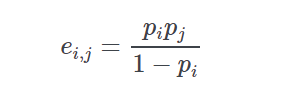
prob_exacta(prob, s1, s2, sort=False)[source]-
This routine calculates the normalized exacta probabilites given an input list of horse ids and normalized win probabilities.
If pp is the vector of normalized win probabilities derived from a price line then the probability of runner ii (first) and jj (second) as the winning combination is given by
-
Return type: Parameters: - prob – list of tuples of form (id,win probability)
- s1 – list of allowed first place ids defined by odds range
- s2 – list of allowed second place ids defined by odds range
- sort – Boolean if True, result is sorted, highest probability first
Returns: list of tuples of form ((id1,id2),exacta_probability)
So if we input prob as:
(1, 0.15557814847495188)

(2, 0.20438859122263553)

(3, 0.3708534602327072)

(4, 0.19948464099114765)

(5, 0.034061786039927267)

(6, 0.021204203862783776)

(7, 0.0031196067348740163)

(8, 0.01130956244097265)
The first few exacta probabilities (if unsorted) would be:
(1, 2) 0.0476639105054

(1, 3) 0.117045542403

(1, 4) 0.0461010957068

(1, 5) 0.00569989602184

(1, 6) 0.00345321559886

(1, 7) 0.000488654491335

(1, 8) 0.0018032135443
If sorted, the first few exacta probabilities would be:
(3, 2) 0.12047784021

(3, 4) 0.11758718311

(2, 3) 0.0952703989043

(4, 3) 0.0924149281363

(3, 1) 0.0917062894757

(1, 3) 0.0683268612653

(2, 4) 0.0512466064374
prob_pick4(prob, s1, s2, s3, s4, sort=False)[source]-
This routine calculates the normalized first four probabilites given an input list of horse ids and normalized win probabilities.
If pp is the vector of normalized win probabilities derived from a price line then the probability of runner ii (first), jj (second), kk (third), and ll (fourth)as the winning combination is given by

-
Return type: Parameters: - prob – list of tuples of form (id,win probability)
- s1 – list of allowed first place ids defined by odds range
- s2 – list of allowed second place ids defined by odds range
- s3 – list of allowed third place ids defined by odds range
- s4 – list of allowed fourth place ids defined by odds range
- sort – Boolean if True, result is sorted, highest probability first
Returns: list of tuples of form ((id1,id2,id3,id4),pick 4 probability)
So if we input prob as:
(1, 0.15557814847495188)

(2, 0.20438859122263553)

(3, 0.3708534602327072)

(4, 0.19948464099114765)

(5, 0.034061786039927267)

(6, 0.021204203862783776)

(7, 0.0031196067348740163)

(8, 0.01130956244097265)
The first few pick 4 probabilities (if unsorted) would be:
(1, 2, 3, 4) 0.0161700951381

(1, 2, 3, 5) 0.00276102620283

(1, 2, 3, 6) 0.00171879896159

(1, 2, 3, 7) 0.000252873291125

(1, 2, 3, 8) 0.000916745769159

(1, 2, 4, 3) 0.00988009673754

(1, 2, 4, 5) 0.000907457465589

(1, 2, 4, 6) 0.000564912041741

(1, 2, 4, 7) 8.3111038803e-05

(1, 2, 4, 8) 0.000301303838195
If sorted, the first few pick 4 probabilities would be:
(1, 2, 3, 4) 0.0161700951381

(1, 2, 3, 5) 0.00276102620283

(1, 2, 3, 6) 0.00171879896159

(1, 2, 3, 7) 0.000252873291125

(1, 2, 3, 8) 0.000916745769159

(1, 2, 4, 3) 0.00988009673754

(1, 2, 4, 5) 0.000907457465589

(1, 2, 4, 6) 0.000564912041741

(1, 2, 4, 7) 8.3111038803e-05

(1, 2, 4, 8) 0.000301303838195
prob_pick6(prob, s1, s2, s3, s4, s5, s6, sort=False)[source]-
This routine calculates the normalized first six probabilites given an input list of horse ids and normalized win probabilities.
If pp is the vector of normalized win probabilities derived from a price line then the probability of runner ii (first), jj (second), kk (third), :param s1: ll (fourth), mm (fifth), and nn (sixth) as the winning combination is given by

-
Return type: Parameters: - prob – list of tuples of form (id,win probability)
- s1 – list of allowed first place ids defined by odds range
- s2 – list of allowed second place ids defined by odds range
- s3 – list of allowed third place ids defined by odds range
- s4 – list of allowed fourth place ids defined by odds range
- s5 – list of allowed fifth place ids defined by odds range
- s6 – list of allowed sixth place ids defined by odds range
- sort – Boolean if True, result is sorted, highest probability first
Returns: list of tuples of form ((id1,id2,id3,id4,id5,id6),pick 6 probability)
So if we input prob as:
(1, 0.15557814847495188)

(2, 0.20438859122263553)

(3, 0.3708534602327072)

(4, 0.19948464099114765)

(5, 0.034061786039927267)

(6, 0.021204203862783776)

(7, 0.0031196067348740163)

(8, 0.01130956244097265)
The first few pick 6 probabilities (if unsorted) would be:
(1, 2, 3, 4, 5, 6) 0.00470264737409

(1, 2, 3, 4, 5, 7) 0.000691863298187

(1, 2, 3, 4, 5, 8) 0.00250822357959

(1, 2, 3, 4, 6, 5) 0.00345572050302

(1, 2, 3, 4, 6, 7) 0.000316498052757

(1, 2, 3, 4, 6, 8) 0.00114740568101

(1, 2, 3, 4, 7, 5) 0.000370307449629

(1, 2, 3, 4, 7, 6) 0.000230524454726
If sorted, the first few pick 6 probabilities would be:
(3, 2, 4, 1, 5, 6) 0.0113643296974

(3, 4, 2, 1, 5, 6) 0.0112346228107

(3, 2, 1, 4, 5, 6) 0.00951066959114

(3, 4, 1, 2, 5, 6) 0.0092338952488

(2, 3, 4, 1, 5, 6) 0.00898658393663

(4, 3, 2, 1, 5, 6) 0.00882959207139

(3, 1, 2, 4, 5, 6) 0.00853040992409

(3, 1, 4, 2, 5, 6) 0.00837778246743
Timings of routine with n sized fields n Unsorted (sec) Sorted (sec) 6 0.002 0.004 8 0.037 0.128 10 0.247 1.12 12 1.10 5.60 14 3.95 23.8 16 13.1 97.2 18 62.3 20 Memory
prob_quaddie(ids, prob, s1, s2, s3, s4, sort=False)[source]-
This routine calculates the quaddie probabilites given an input list of horse ids and normalized win probabilities for each of the four races
If pp is the vector of normalized win probabilities derived from a price line then the probability of runner ii (in the first race), jj (in the second race), kk (in the third race), and ll (in the fourth race)as the winning combination is given by

-
Parameters: - sort – if True sor by increasing probability
- ids – list of lists of TAB horse ids
- prob – list of lists of tuples of win probability) for each race
- s1 – list of horse ids to be considered for win in first race
- s2 – list of horse ids to be considered for win in second race
- s3 – list of horse ids to be considered for win in third race
- s4 – list of horse ids to be considered for win in fourth race
Return type: Returns: list of tuples of form ((id1,id2,id3,id4),quaddie probability)
So if we input the four race probabilities as:
 1 0.15558  1 0.86564  1 0.04397  1 0.76204

 2 0.20439  2 0.02050  2 0.04988  2 0.10846

 3 0.37085  3 0.02690  3 0.85491  3 0.08160

 4 0.19948  4 0.06478  4 0.04690  4 0.01898

 5 0.03406  5 0.01119  5 0.00072  5 0.01083

 6 0.02120  6 0.00605  6 0.00096  6 0.01692

 7 0.00312  7 0.00172  7 0.00267  7 0.00117

 8 0.00788  8 0.00068             8 0.00000

 9 0.00180  9 0.00230             9 0.00001

10 0.00068 10 0.00024            10 0.00000

11 0.00009                       11 0.00000

12 0.00087
The first few quaddie probabilities (if unsorted) would be:
(1, 1, 1, 1) 0.00451204255393

(1, 1, 1, 2) 0.000642180234069

(1, 1, 1, 3) 0.000483129743111

(1, 1, 1, 4) 0.000112363248935

(1, 1, 1, 5) 6.41234861406e-05

(1, 1, 1, 6) 0.000100176763996

(1, 1, 1, 7) 6.93229347721e-06

(1, 1, 1, 8) 1.50345086741e-08

(1, 1, 1, 9) 5.73763223463e-08
If sorted, the first few quaddie probabilities would be:
(3, 1, 3, 1) 0.2091383481

(2, 1, 3, 1) 0.115262487539

(4, 1, 3, 1) 0.112496963793

(1, 1, 3, 1) 0.0877364254662

(3, 1, 3, 2) 0.0297657904886

(3, 1, 3, 3) 0.0223936177872

(5, 1, 3, 1) 0.0192087345262

(2, 1, 3, 2) 0.0164048300393

(4, 1, 3, 2) 0.0160112245568

(3, 4, 3, 1) 0.0156519771072
Timings of routine with n sized fields for 4 races n Unsorted (sec) Sorted (sec) 2 0 0 4 0 .003 6 .002 .007 8 .003 .018 10 .006 .049 12 .012 .109 14 .02 .215 16 .037 .40 18 .059 .648 20 .288 2.62
prob_quinella(prob, s1, s2, sort=False)[source]-
This routine calculates the normalized quinella probabilites given an input list of horse ids and normalized win probabilities.
If pp is the vector of normalized win probabilities derived from a price line then the probability of runner ii and jj as the winning combination is given by

-
Return type: Parameters: - prob – list of tuples of form (id,win probability)
- s1 – list of allowed first place ids defined by odds range
- s2 – list of allowed second place ids defined by odds range
- sort – Boolean if True, result is sorted, highest probability first
Returns: list of tuples of form ((id1,id2),quinella_probability)
So if we input prob as:
(1, 0.15557814847495188)

(2, 0.20438859122263553)

(3, 0.3708534602327072)

(4, 0.19948464099114765)

(5, 0.034061786039927267)

(6, 0.021204203862783776)

(7, 0.0031196067348740163)

(8, 0.01130956244097265)
The first few quinella probabilities (if unsorted) would be:
(1, 0.15557814847495188)

(2, 0.20438859122263553)

(3, 0.3708534602327072)

(4, 0.19948464099114765)

(5, 0.034061786039927267)

(6, 0.021204203862783776)

(7, 0.0031196067348740163)

(8, 0.01130956244097265)
If sorted, the first few quinella probabilities would be:
(2, 3) 0.215748239115

(3, 4) 0.210002111247

(1, 3) 0.160033150741

(2, 4) 0.102179276603

(1, 2) 0.0776242539698

(1, 4) 0.0755228299148

(3, 5) 0.0331552537388

(3, 6) 0.0205329272655

(2, 5) 0.0159576376265
prob_superfecta(ids, prob, s1, s2, s3, s4, s5, s6, sort=False)[source]-
This routine calculates the quaddie probabilites given an input list of horse ids and normalized win probabilities for each of the four races
If pp is the vector of normalized win probabilities derived from a price line then the probability of runner ii (in the first race), jj (in the second race), kk (in the third race), and ll (in the fourth race)as the winning combination is given by

-
Parameters: - sort – if True sor by increasing probability
- ids – list of lists of TAB horse ids
- prob – list of lists of tuples of win probability) for each race
- s1 – list of horse ids to be considered for win in first race
- s2 – list of horse ids to be considered for win in second race
- s3 – list of horse ids to be considered for win in third race
- s4 – list of horse ids to be considered for win in fourth race
- s5 – list of horse ids to be considered for win in fifth race
- s6 – list of horse ids to be considered for win in sixth race
Return type: Returns: list of tuples of form ((id1,id2,id3,id4,id5,id6),quaddie probability)
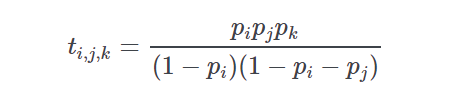
prob_trifecta(prob, s1, s2, s3, sort=False)[source]-
This routine calculates the trifecta probabilites given an input list of horse ids and normalized win probabilities.
If pp is the vector of win probabilities derived from a price line then the probability of runner ii (first), jj (second), and kk (third) as the winning combination is given by
-
Return type: Parameters: - prob – list of tuples of form (id,win probability)
- s1 – list of allowed first place ids defined by odds range
- s2 – list of allowed second place ids defined by odds range
- s3 – list of allowed third place ids defined by odds range
- sort – Boolean if True, result is sorted, highest probability first
Returns: list of tuples of form ((id1,id2,id3),trifecta_probability)
So if we input prob as:
(1, 0.15557814847495188)

(2, 0.20438859122263553)

(3, 0.3708534602327072)

(4, 0.19948464099114765)

(5, 0.034061786039927267)

(6, 0.021204203862783776)

(7, 0.0031196067348740163)

(8, 0.01130956244097265)
The first few trifecta probabilities (if unsorted) would be:
(1, 2, 3) 0.0218195393628

(1, 2, 4) 0.0117368811219

(1, 2, 5) 0.0020040597189

(1, 2, 6) 0.00124757083445

(1, 2, 7) 0.000183545225398

(1, 2, 8) 0.000665409573642

(1, 3, 2) 0.0294893645215

(1, 3, 4) 0.0287818182974
If sorted, the first few trifecta probabilities would be:
(3, 2, 4) 0.0565815867228

(3, 4, 2) 0.0559357922362

(2, 3, 4) 0.0447430857683

(3, 2, 1) 0.0441280013156

(4, 3, 2) 0.0439614427612

(3, 4, 1) 0.0425776553257

(3, 1, 2) 0.0395797516406

(3, 1, 4) 0.0386301040548

(2, 3, 1) 0.0348951498537
process_multi_race_standouts()[source]-
Define single race standouts for first, second, third, fourth, fifth, sixth
Returns: None
process_single_race_standouts()[source]-
Define single race standouts for first, second, third, fourth, fifth, sixth
Returns: None
rounding= 'Round Up'-
type of rounding, one of [“Exact”,”Round Up”,”Round_Down”,”Nearest”]
roundit(y)[source]-
Parameters: y – stake amount Returns: stake amount rounded according to rounding parameter
scale_tab= 0-
scale TAB market by % (0 is normalized, -1 unscaled, otherwise < 100)
scale_user= 0-
scale user market by % (0 is normalized, -1 unscaled, otherwise < 100)
second= []-
second place standouts (after [] substitution)
single_race_preprocess()[source]-
This routine handles the preprocessing for single race betting pools:
nracesneeds to be 1- at least one of user odds or TAB odds must be provided
- ensure that odds are only for one race
- list of horse TAB ids must be provided and be of same length as odds provided
- check to make sure jockey and trainer info not provided
Process input in the following order
- remove scratchings, taking care to delete runner info from end of the appropriate lists
- scale TAB and/or user odds
- process standouts
Returns: Flag for tab divs, flag for user divs, tab prob list, user prob list
single_race_scale_odds(ntabodds, nuserodds)[source]-
This routine scales the odds and calculates the relevant probability of the user and/or tab win price line.
Parameters: - ntabodds – 1 if have tab odds, 0 otherwise
- nuserodds – 1 if have user odds, 0 otherwise
Returns: tab prob list, user prob list
single_race_scratchings(ntabodds, nuserodds)[source]-
Parameters: - ntabodds – 1 if tab odds present, 0 otherwise
- nuserodds – 1 if user odds present, 0 otherwise
Returns: None
single_race_validation()[source]-
This routine checks for a number of possible input errors for a single race pool.
Returns:
sixth= []-
sixth place standouts (after [] substitution)
stake= 0.5-
Amount to stake on each combination if flat_stakes is True
standouts_1= []-
list of standouts for first place. Generally speaking, if standouts are given for any place in one race pools or any leg for multi race pools, the rest must be specified as well. If one wants to bet the field then the entry shoud be the empty list.
example for a single race, [1,3,4]
Alternatively for multi-race bets, it standouts for first in the first race
standouts_2= []-
list of standouts for second place. Alternatively for multi-race bets, it standouts for first in the second race
standouts_3= []-
list of standouts for third place. Alternatively for multi-race bets, it standouts for first in the third race
standouts_4= []-
list of standouts for fourth place. Alternatively for multi-race bets, it standouts for first in the fourth race
standouts_5= []-
list of standouts for fifth place. Alternatively for multi-race bets, it standouts for first in the fifth race
standouts_6= []-
list of standouts for sixth place. Alternatively for multi-race bets, it standouts for first in the sixth race
tab_div_range= False-
Dividend range for TAB price line; eg, (100,1000), or False for no check
tab_odds= []-
list of lists of TAB odds (one list for each race)
tabodds1= []-
1st favourite restricted to (min,max) tab odds, empty list accept all odds
tabodds2= []-
2nd favourite restricted to (min,max) tab odds, empty list accept all odds
tabodds3= []-
3rd favourite restricted to (min,max) tab odds, empty list accept all odds
tabodds4= []-
4th favourite restricted to (min,max) tab odds, empty list accept all odds
tabodds5= []-
5th favourite restricted to (min,max) tab odds, empty list accept all odds
tabodds6= []-
6rd favourite restricted to (min,max) tab odds, empty list accept all odds
takeout= 100-
Takeout amount
takeout_priceline= 'tab'-
price line use for takeout cqalculation, must be one of [“tab”,”user”]
third= []-
third place standouts (after [] substitution)
trainer_list= []-
list of lists of trainer lists (one for each race) This parameter is only for multiple race bets.
user_div_range= False-
Dividend range for user price line; eg, (100,1000), or False for no check
user_odds= []-
list of lists of user odds (one list for each race)
userodds1= []-
1st favourite restricted to (min,max) user odds, empty list accept all odds
userodds2= []-
2nd favourite restricted to (min,max) user odds, empty list accept all odds
userodds3= []-
3rd favourite restricted to (min,max) user odds, empty list accept all odds
userodds4= []-
4th favourite restricted to (min,max) user odds, empty list accept all odds
userodds5= []-
5th favourite restricted to (min,max) user odds, empty list accept all odds
userodds6= []-
6rd favourite restricted to (min,max) user odds, empty list accept all odds
-
-
-
-
-
-
-
Odds calculation required for the python strategy library的更多相关文章
- Python Standard Library
Python Standard Library "We'd like to pretend that 'Fredrik' is a role, but even hundreds of vo ...
- CentOS 6.5 Python Image Library 配置
转自:http://www.cnblogs.com/way_testlife/archive/2011/04/17/2019013.html PIL 下载: http://www.pythonware ...
- Python语言中对于json数据的编解码——Usage of json a Python standard library
一.概述 1.1 关于JSON数据格式 JSON (JavaScript Object Notation), specified by RFC 7159 (which obsoletes RFC 46 ...
- 使用Python Shapefile Library创建和编辑Shapefile文件
介绍 shapefile是GIS中非常重要的一种数据类型,在ArcGIS中被称为要素类(Feature Classes),主要包括点(point).线(polyline)和多边形(polygon).P ...
- Windows环境下安装PIL(Python Imaging Library)库
微信小程序--跳一跳最近火了一把,于是整了个辅助进行试玩,不过在运行程序过程中出现了个报错如图所示: 显然是缺少PIL(Python Imaging Library)库文件,于是通过pip命令行进行安 ...
- SimpleCV install and "You need the python image library to save by filehandle"
2015年5月3日 22:15:43 在win7下安装了python.simplecv,试着运行simplecv官网第一个hello world程序结果报错,提示说%python%/lib/site- ...
- The Python Standard Library
The Python Standard Library¶ While The Python Language Reference describes the exact syntax and sema ...
- pycurl,Python cURL library
pycurl — A Python interface to the cURL library Pycurl包是一个libcurl的Python接口.pycurl已经成功的在Python2.2到Pyt ...
- 《The Python Standard Library》——http模块阅读笔记1
官方文档:https://docs.python.org/3.5/library/http.html 偷个懒,截图如下: 即,http客户端编程一般用urllib.request库(主要用于“在这复杂 ...
随机推荐
- C#安装和卸载windowsService的bat指令
只需新建2个文本文档,将2个指令分别复制进去,再将txt格式改为bat格式,以管理员身份运行 安装指令 %SystemRoot%\Microsoft.NET\Framework\v4.0.30319\ ...
- Navicat 破解版(操作非常简单)
Navicat 破解版(操作非常简单) 参考这位老哥的博客,之前试过好多个,只有这个是最简单有效的 https://blog.csdn.net/WYpersist/article/details/86 ...
- linuxmint安装Tools找不到Tools的压缩包问题
安装Linuxmint之后按照惯例安装Tools,打开桌面上的Tools光盘之后找不到压缩包. PS:因为已经装好了,就不上图了,按照下面的步骤做就没有问题了. 1:找到vmware的安装目录下的li ...
- 在HTML网页中嵌入脚本的方式
在HTML标记的事件属性中直接添加脚本 <!doctype html> <html> <head> <meta charset="utf-8&quo ...
- drf--ModelSerializers序列化
目录 drf--ModelSerializers序列化 项目准备 配置 settings.py 路由 多表设计 表关系分析 创建models 模型序列化 自定义模型序列化 api/serializer ...
- [摘录]flutter打包后无法访问接口
打开文件{{flutterPorject}}\android\app\src\main\AndroidManifest.xml这个文件增加权限信息: <uses-permission andro ...
- 英语fieldyellowstone田黄石fieldyellowstone单词
田黄石(Field yellow stone),简称“田黄”,产于福州市寿山乡“寿山溪”两旁之水稻田底下.呈黄色而得名.寿山石优良品种.狭义的田黄石指“田坑石”,广义的田黄石是指其化学成分相同的一类印 ...
- .Net core 在类库中获取配置文件Appsettings中的值
大多数情况,我们开发的程序中都含有很多个类库和文件夹,有时候,我们会遇到程序中的类库需要获取配置文件的信息的情况. 像dapper 中需要使用连接字符串的时候,那么我们一直从主程序中传值这是个不好的方 ...
- windows10安装redis
下载 github上下载最新(或者你需要的版本)的redis安装包,下载地址如下: https://github.com/microsoftarchive/redis/releases 打开点击版本号 ...
- 接口自动化--日志类封装(logging)
上篇随笔已经写到了读取Excel类的封装了,下面就写下日志类, 日志类在我们自动化的过程中是十分重要的,在我们的自动化程序出现异常的时候就可以打印日志 下面是我自己封装的日志类 import logg ...