
Linked List-1
链表一直是面试的重点问题,恰好最近看到了Stanford的一篇材料,涵盖了链表的基础知识以及派生的各种问题。
第一篇主要是关于链表的基础知识。
一、基本结构
1、数组回顾
链表和数组都是用来存储一堆数据的集合,其中单个元素的类型可以有很多种。
通过数组下标可以直接访问数组中的元素,比如:
void ArrayTest()

{

	int scores[100];

	//初始化前3个元素

	scores[0] = 1;

	scores[1] = 2;

	scores[2] = 3;

}
最关键的是:整个数组被分配了一整块内存:
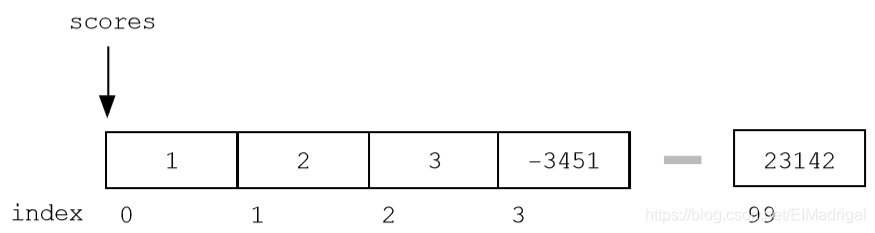
数组元素之所以能被快速访问,原因在于其地址的计算是通过首地址加上偏移值得到的,只有一次乘法和一次加法运算而已。
数组的缺点在于:
- 数组的大小是固定的:数组的规模在编译时就被确定,当然你可以在运行时通过
malloc在堆中改变数组的大小,不过很麻烦; - 由于上述原因,所以很多人就会定义一个很大的数组,不过这又会导致两个问题:
1)数组的大部分空间可能被浪费掉;
2)如果程序需要更大的空间,就会崩溃。 - 在数组前面插入元素代价很大,需要移动很多元素。
链表也有自己的优缺点,只不过和数组刚好互补:链表会在需要时为每个节点单独分配内存。
2、指针回顾
指针存储了变量的地址,如果指针的值是NULL(c/c++中NULL可以表示逻辑false),那么该指针不指向任何变量。
在c/c++中,没有初始化的指针就是野指针,对野指针进行dereference操作可能导致程序崩溃。
两个指针的赋值结果就是都指向相同的内存区域。
malloc()函数用来在堆中申请一块内存,并且返回一个指向该块的指针,如果申请失败,会返回NULL,使用后,需要用free()去释放。这些堆函数原型都在stdlib.h头文件中声明。
3、链表
一个包含{1,2,3}三个元素的链表:
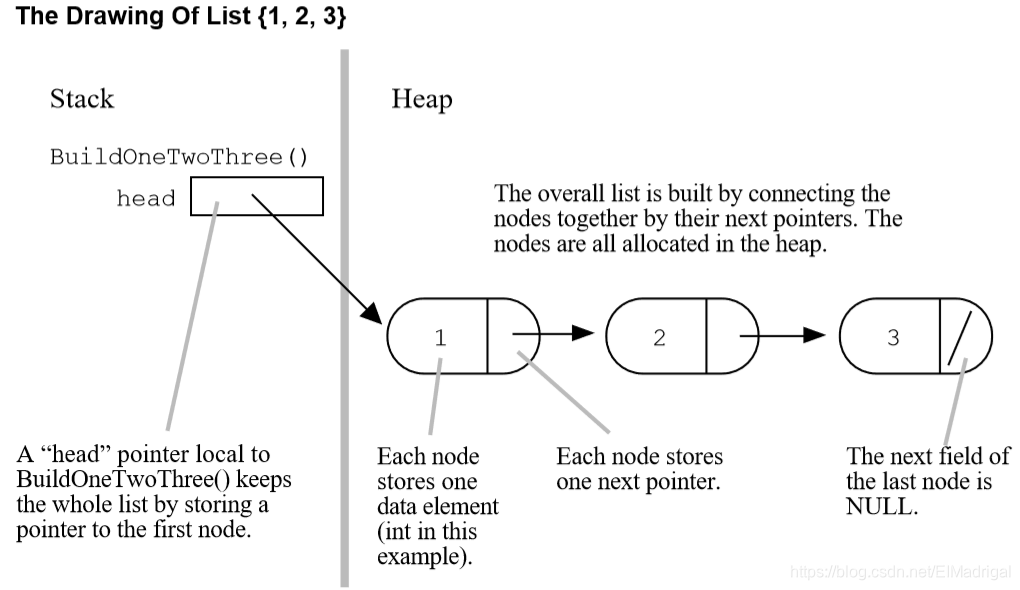
空链表的head的值是NULL,编程时要考虑到这种边界情况。
节点的定义:
struct node {

	int data;

	struct node* next;

};
指向节点的指针类型是struct node*。
接着看看上图中的链表是怎么建立的?
/*

Build the list {1,2,3} in the heap and store

its head pointer in a local stack variable.

Returns the head pointer to the caller.

*/

struct node* BuildOneTwoThree()

{

	//there are three pointers in the stack, but pointer assignment link the list.

	struct node* head = NULL;

	struct node* second = NULL;

	struct node* third = NULL;

	//allocate 3 nodes

	head = (struct node*)malloc(sizeof(struct node));

	second = (struct node*)malloc(sizeof(struct node));

	third = (struct node*)malloc(sizeof(struct node));

	head->data = 1;    //setup first node

	head->next = second;   //note:pointer assignment rule

	second->data = 2;    //setup second node

	second->next = third;

	third->data = 3;    //setup third node

	third->next = NULL;

	//at this point, the linked list referenced by "head"

	//matches the list in the drawing.

	return head;

}
如何求链表中的元素个数呢?
/*

Given a linked list head pointer, compute

and return the number of nodes in the list.

*/

int Length(struct node* head)

{

	struct node* current = head;

	int count = 0;

	while (current != NULL)

	{

		count++;

		current = current->next;

	}

	return count;

}
可以看到,传递进函数的只是头指针,这样调用者和被调用者都有了头指针,但是却共享了整个链表。
current指针占据的空间会被自动释放,但是堆中的链表仍然保留;while循环已经考虑了空链表的情况;current最后的值会是NULL。
调用Length():
void LengthTest()

{

	struct node* myList = BuildOneTwoThree();

	int len = Length(myList);    //results in len == 3

}
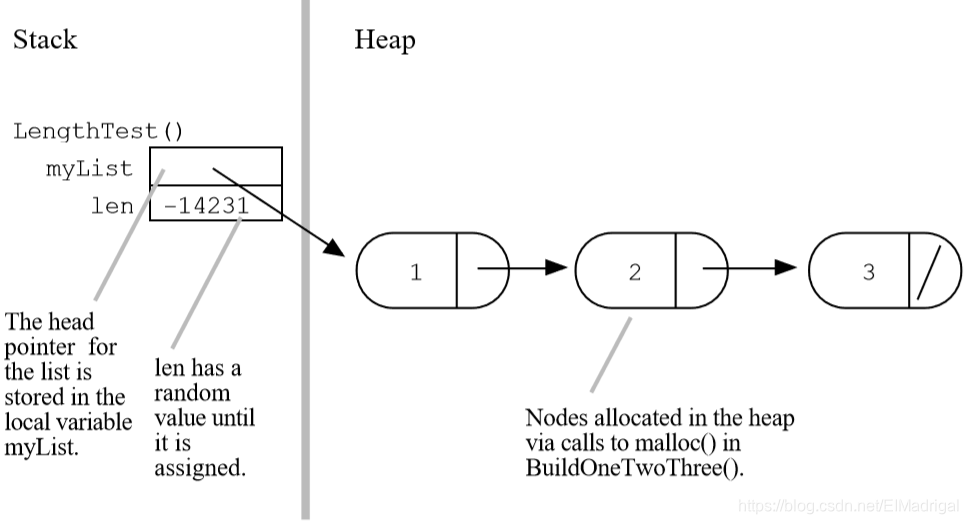
- 调用
Length()之前:
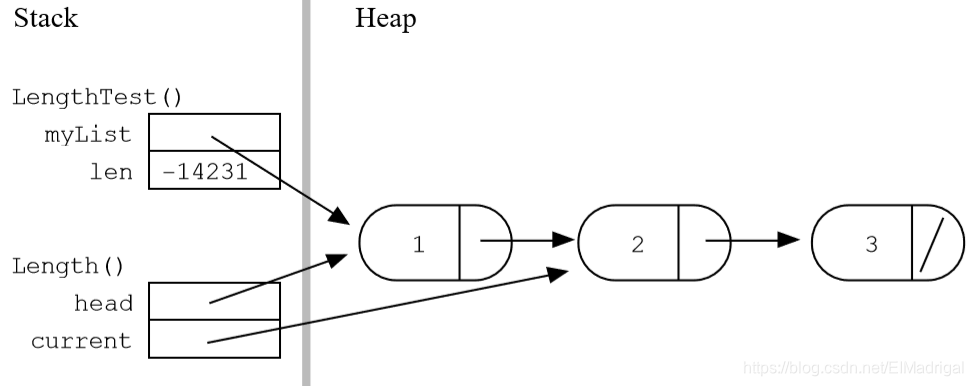
- 执行
Length()过程中:
二、链表建立
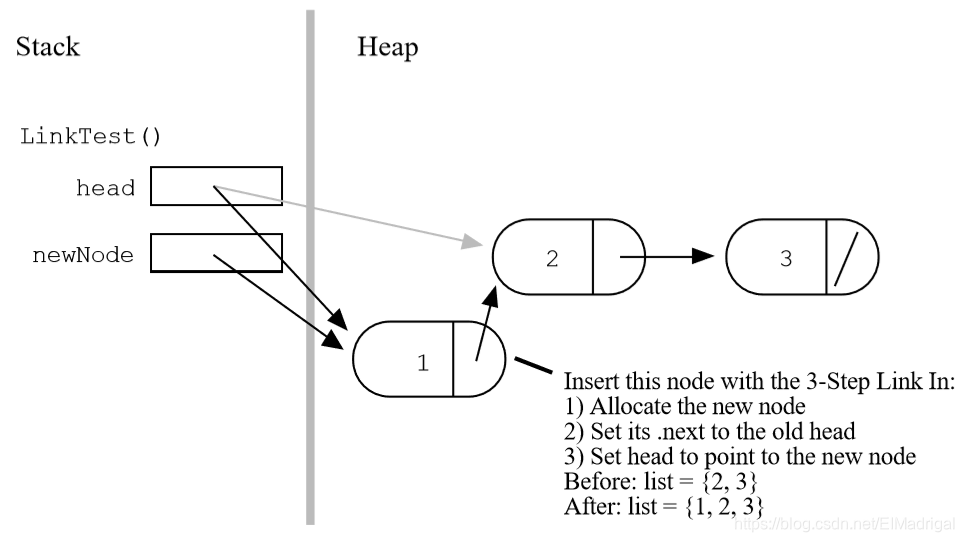
用BuildOneTwoThree()函数来建立链表未免有些古板,下面用头插法建立链表:
1、分配节点:
struct node* newNode;

newNode = (struct node*)malloc(sizeof(struct node));

newNode->data = data_client_wants_stored;
2、让新节点的next指向当前链表的第一个节点:
newNode->next = head;
3、让head指针指向链表的第一个节点:
head = newNode;
整理下:
void LinkTest()

{

	struct node* head = buildTwoThree();  //suppose this builds list {2,3}

	struct node* newNode;

	newNode = (struct node*)malloc(sizeof(struct node));  //allocate

	newNode->data = 1;

	newNode->next = head;   //link next

	head = newNode;   //link head

	//now head points to the list {1,2,3}

}
如图:
先看一个错误的示范:
void WrongPush(struct node* head,int data)

{

	struct node* newNode = (struct node*)malloc(sizeof(struct node));

	newNode->data = data;

	newNode->next = head;

	head = newNode;    //NO this line does not work

}

void WrongPushTest()

{

	struct node* head = buildTwoThree();

	WrongPush(head, 1);    //try to push 1 on front -- doesn't work

}
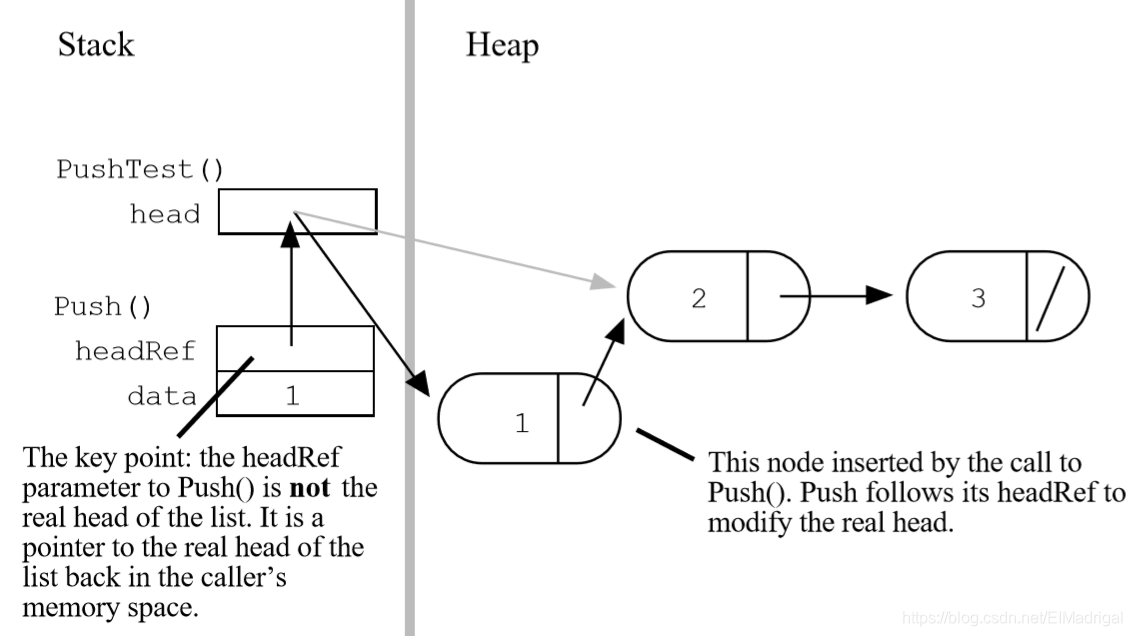
这个问题就在于C语言的值传递,在WrongPush()中对head指针的改变不会影响到WrongPushTest中的我们需要的head指针。
这个问题传统的解决方案是传递当前值的指针给函数而不是传递一份当前值的拷贝,即:
要改变调用者中int的值,就传一个int*给被调用者。在这个例子中,要改变struct node*,就要传递struct node**。也即:head的类型是pointer to a struct node,想要改变这个指针,就需要传一个指向该指针的指针pointer to a pointer to a struct node。
规则就是:to modify caller memory, pass a pointer to that memory.
所以正确的代码如下:
/*

Takes a list and a data value.

Creates a new link with the given data and pushes it

onto the front of the list.

The list is not passed in by its head pointer.

Instead the list is passed in as a "reference" pointer

to the head pointer -- this allows us to modify the caller's memory.

*/

void Push(struct node** headRef,int data)

{

	struct node* newNode = (struct node*)malloc(sizeof(struct node));

	newNode->data = data;

	newNode->next = *headRef;	//the * to dereferences back to the real head

	*headRef = newNode;    //ditto

}

void PushTest()

{

	struct node* head = buildTwoThree();	//suppose this returns the list {2,3}

	Push(&head, 1);    //note the &

	Push(&head, 13);

	//head is now the list {13,1,2,3}

}
内存示意图:
如果是C++,那么可以用引用完成上述工作。
/*

Push in C++ -- We just add a & to the right hand side of the head parameter type,

and the compiler makes that parameter work by reference. So this code changes the

caller's memory, but no extra uses of * are necessary -- we just access "head" directly,

and the compiler makes that change reference back to the caller.

*/

void Push(struct node*& head,int data)

{

	struct node* newNode = (struct node*)malloc(sizeof(struct node));

	newNode->data = data;

	newNode->next = head;	//No extra use of * necessary on head -- the compiler

	head = newNode;    //just takes care of it behind the scenes.

}

void PushTest()

{

	struct node* head = buildTwoThree();	//suppose this returns the list {2,3}

	Push(head, 1);    //No extra use & necessary -- the compiler

	Push(head, 13);   //takes care of it here too. Head is being changed by these calls.

	//head is now the list {13,1,2,3}

}
Linked List-1的更多相关文章
- [LeetCode] Linked List Random Node 链表随机节点
Given a singly linked list, return a random node's value from the linked list. Each node must have t ...
- [LeetCode] Plus One Linked List 链表加一运算
Given a non-negative number represented as a singly linked list of digits, plus one to the number. T ...
- [LeetCode] Odd Even Linked List 奇偶链表
Given a singly linked list, group all odd nodes together followed by the even nodes. Please note her ...
- [LeetCode] Delete Node in a Linked List 删除链表的节点
Write a function to delete a node (except the tail) in a singly linked list, given only access to th ...
- [LeetCode] Palindrome Linked List 回文链表
Given a singly linked list, determine if it is a palindrome. Follow up: Could you do it in O(n) time ...
- [LeetCode] Reverse Linked List 倒置链表
Reverse a singly linked list. click to show more hints. Hint: A linked list can be reversed either i ...
- [LeetCode] Remove Linked List Elements 移除链表元素
Remove all elements from a linked list of integers that have value val. Example Given: 1 --> 2 -- ...
- [LeetCode] Intersection of Two Linked Lists 求两个链表的交点
Write a program to find the node at which the intersection of two singly linked lists begins. For ex ...
- [LeetCode] Linked List Cycle II 单链表中的环之二
Given a linked list, return the node where the cycle begins. If there is no cycle, return null. Foll ...
- [LeetCode] Linked List Cycle 单链表中的环
Given a linked list, determine if it has a cycle in it. Follow up: Can you solve it without using ex ...
随机推荐
- Redis对象——集合(Set)
集合类型 (Set) 是一个无序并唯一的键值集合.它的存储顺序不会按照插入的先后顺序进行存储. 集合类型和列表类型的区别如下: 列表可以存储重复元素,集合只能存储非重复元素: 列表是按照元素的先后顺序 ...
- 虚拟机的vmnet8网卡找不到了
不知道我设置了什么,在我于Linux中配置网络时发现怎么都不行,检查了一下发现用于NAT的网卡没有了. 我重启了电脑之后发现还是没有. 于是按照网上的办法在虚拟网络编辑器将其重置,如下图. 问题解决. ...
- 搭建环境-Eclipse配置Tomcat创建Servlet总结
Descripton:Web开发:Eclipse的下载与安装,Tomcat下载和结合Eclipse的使用,Eclipse使用Servlet[记录下总结下] 一.Eclipse的下载与安装 下载地址 注 ...
- 小猪佩奇C代码实现
// ASCII Peppa Pig by Milo Yip #include <stdio.h> #include <math.h> #include <stdlib. ...
- jquery 延迟执行方法
setTimeout方法使用时需注意: //以下两种方式都行: setTimeout(function () { test(); }, ); //或者 setTimeout(); function t ...
- vue中 使用SVG实现鼠标点击绘图 提示鼠标移动位置 显示绘制坐标位置
<div class="div1"> <svg id="svg1" xmlns="http://www.w3.org/2000/sv ...
- Grafana-监控-报警-运维文档
Grafana运维文档 2019/09/23 Chenxin Wuweiwei 参考资料 https://grafana.com/grafana https://blog.52itstyle.vip/ ...
- Python 【面试强化宝典】
四大数据类型的常用方法 列表常用方法 #1. append 用于在列表末尾追加新的对象 a = [1,2,3] a.append(4) #the result : [1, 2, 3, 4] #2. c ...
- [PHP]$_SERVER参数详情
来源:PHP中$_SERVER的详细参数与说明 $_SERVER['PHP_SELF'] #当前正在执行脚本的文件名,与 document root相关.$_SERVER['argv'] #传递给该脚 ...
- 使用mysqlbinlog查看二进制日志
(一)mysqlbinlog工具介绍 binlog类型是二进制的,也就意味着我们没法直接打开看,MySQL提供了mysqlbinlog来查看二进制日志,该工具类似于Oracle的logminer.my ...