
Netty服务端与客户端(源码一)
首先,整理NIO进行服务端开发的步骤:
(1)创建ServerSocketChannel,配置它为非阻塞模式。
(2)绑定监听,配置TCP参数,backlog的大小。
(3)创建一个独立的I/O线程,用于轮询多路复用器Selector。
(4)创建Selector,将之前创建的ServerSocketChannel注册到Selector上,监听SelectionKeyACCEPT。
(5)启动I/O线程,在循环体中执行Selector.select()方法,轮训就绪的Channel。
(6)当轮询到了处于就绪状态的Channel时,需要对其进行判断,如果是OP_ACCEPT状态,说明是新的客户端接入,则调用ServerSocketChannel.accept()方法接受新的客户端。
(7)设置新接入的客户端链路SocketChannel为非阻塞模式,配置其他的一些TCP参数。
(8)将SocketChannel注册到Selector,监听OP_READ操作位。
(9)如果轮询的Channel为OP_READ,则说明SocketChannel中有新的就绪的数据包需要读取,则构造ByteBuffer对象,读取数据包。
(10)如果轮询的Channel为OP_WRITE,则说明还有数据没有发送完成,需要继续发送。
Netty时间服务器服务端 TimeServer:
 package netty;

 import io.netty.bootstrap.ServerBootstrap;

 import io.netty.channel.ChannelFuture;

 import io.netty.channel.ChannelInitializer;

 import io.netty.channel.ChannelOption;

 import io.netty.channel.EventLoopGroup;

 import io.netty.channel.nio.NioEventLoopGroup;

 import io.netty.channel.socket.SocketChannel;

 import io.netty.channel.socket.nio.NioServerSocketChannel;

 public class TimeServer {

     public void bind(int port) throws Exception{

         //配置服务端的NIO线程组 一个用于服务端接收客户端的连接,另一个用于进行SocketChannel的网络读写

         EventLoopGroup bossGroup = new NioEventLoopGroup();

         EventLoopGroup workerGroup = new NioEventLoopGroup();

         try{

             ServerBootstrap b = new ServerBootstrap();

             b.group(bossGroup,workerGroup)

             .channel(NioServerSocketChannel.class)

             .option(ChannelOption.SO_BACKLOG, 1024)

             .childHandler(new ChildChannelHandler());

             //绑定端口,同步等待成功

             ChannelFuture f = b.bind(port).sync();

             //等待服务器监听端口关闭

             f.channel().closeFuture().sync();

         }finally{

             //优雅退出,释放线程池资源

             bossGroup.shutdownGracefully();

             workerGroup.shutdownGracefully();

         }

     }

     private class ChildChannelHandler extends ChannelInitializer<SocketChannel>{

         protected void initChannel(SocketChannel arg0) throws Exception{

             arg0.pipeline().addLast(new TimeServerHandler());

         }

     }

 }
ServerBootstrap是Netty用于启动NIO服务端的辅助类,目的是降低服务端的开发难度。
绑定childChannelHandler,其作用类似于Reactor模式中的handler类,主要用于处理网络I/O事件,例如记录日志、对消息进行编解码等。
使用bind绑定监听端口,随后,调用它的同步阻塞方法sync等待绑定操作完成,完成后Netty会返回一个ChannelFuture,主要用于异步操作的通知回调。
Netty时间服务器服务端 TimeServerHandler:
 package netty;

 import java.io.IOException;

 import io.netty.buffer.ByteBuf;

 import io.netty.buffer.Unpooled;

 import io.netty.channel.ChannelHandlerAdapter;

 import io.netty.channel.ChannelHandlerContext;

 public class TimeServerHandler extends ChannelHandlerAdapter{

     public void channelRead(ChannelHandlerContext ctx,Object msg) throws IOException{

         //将msg转换成Netty的ByteBuf对象

         ByteBuf buf = (ByteBuf)msg;

         //将缓冲区中的字节数组复制到新建的byte数组中,

         byte[] req = new byte[buf.readableBytes()];

         buf.readBytes(req);

         //获取请求消息

         String body = new String(req,"UTF-8");

         System.out.println("The time server receive order:" + body);

         //如果是"QUERY TIME ORDER"则创建应答消息

         String currentTime = "QUERY TIME ORDER".equalsIgnoreCase(body) ? new java.util.Date(

                 System.currentTimeMillis()).toString() : "BAD ORDER";

                 ByteBuf resp = Unpooled.copiedBuffer(currentTime.getBytes());

         //异步发送应答消息给客户端

         ctx.write(resp);

     }

     public void channelReadComplete(ChannelHandlerContext ctx) throws Exception{

         ctx.flush();

     }

     public void exceptionCaught(ChannelHandlerContext ctx,Throwable cause){

         ctx.close();

     }

 }
相比昨天原生的NIO服务端,代码量大大减少。
Netty时间服务器客户端 TimeClient:
 package netty;

 import io.netty.bootstrap.Bootstrap;

 import io.netty.channel.ChannelFuture;

 import io.netty.channel.ChannelInitializer;

 import io.netty.channel.ChannelOption;

 import io.netty.channel.EventLoopGroup;

 import io.netty.channel.nio.NioEventLoopGroup;

 import io.netty.channel.socket.SocketChannel;

 import io.netty.channel.socket.nio.NioSocketChannel;

 public class TimeClient {

     public void connect(int port,String host) throws Exception{

         //创建客户端处理I/O读写的NioEventLoopGroup Group线程组

         EventLoopGroup group = new NioEventLoopGroup();

         try{

             //创建客户端辅助启动类Bootstrap

             Bootstrap b = new Bootstrap();

             b.group(group).channel(NioSocketChannel.class)

             .option(ChannelOption.TCP_NODELAY, true)

             .handler(new ChannelInitializer<SocketChannel>(){

                 //将ChannelHandler设置到ChannelPipleline中,用于处理网络I/O事件

                 @Override

                 protected void initChannel(SocketChannel ch) throws Exception {

                     ch.pipeline().addLast(new TimeClientHandler());

                 }

             });

             //发起异步连接操作,然后调用同步方法等待连接成功。

             ChannelFuture f = b.connect(host,port).sync();

             //等待客户端链路关闭

             f.channel().closeFuture().sync();

         }finally{

             //优雅退出,释放NIO线程组

             group.shutdownGracefully();

         }

     }

     public static void main(String[] args) throws Exception{

         int port = 8080;

         if(args != null && args.length > 0){

             try{

                 port = Integer.valueOf(args[0]);

             }catch(NumberFormatException e){

                 //采用默认值

             }

         }

         new TimeClient().connect(port, "127.0.0.1");

     }

 }
Netty时间服务器客户端 TimeClientHandler:
 package netty;

 import io.netty.buffer.ByteBuf;

 import io.netty.buffer.Unpooled;

 import io.netty.channel.ChannelHandlerAdapter;

 import io.netty.channel.ChannelHandlerContext;

 import java.util.logging.Logger;

 public class TimeClientHandler extends ChannelHandlerAdapter{

     private static final Logger logger = Logger.getLogger(TimeClientHandler.class.getName());

     private final ByteBuf firstMessage;

     public TimeClientHandler(){

         byte[] req = "QUERY TIME ORDER".getBytes();

         firstMessage = Unpooled.buffer(req.length);

         firstMessage.writeBytes(req);

     }

     //当客户端与服务端TCP链路简历成功后,Netty的NIO线程会调用该方法,发送查询时间的指令给服务器

     public void channelActive(ChannelHandlerContext ctx){

         //将请求消息发送给服务端

         ctx.writeAndFlush(firstMessage);

     }

     //当服务器返回应答消息时,该方法被调用

     public void channelRead(ChannelHandlerContext ctx,Object msg) throws Exception{

         ByteBuf buf = (ByteBuf) msg;

         byte[] req = new byte[buf.readableBytes()];

         buf.readBytes(req);

         String body = new String(req,"UTF-8");

         System.out.println("Now is :" + body);

     }

     public void exceptionCaught(ChannelHandlerContext ctx,Throwable cause){

         //释放资源

         logger.warning("Unexpected exception from downstream :" + cause.getMessage());

         ctx.close();

     }

 }
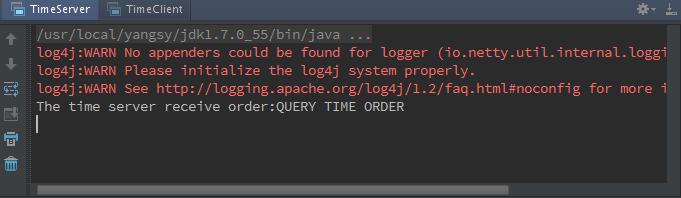
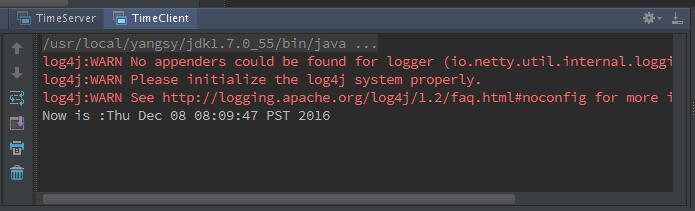
运行结果:
Server:
Client:
Netty服务端与客户端(源码一)的更多相关文章
- netty服务端启动--ServerBootstrap源码解析
netty服务端启动--ServerBootstrap源码解析 前面的第一篇文章中,我以spark中的netty客户端的创建为切入点,分析了netty的客户端引导类Bootstrap的参数设置以及启动 ...
- Netty服务端的启动源码分析
ServerBootstrap的构造: public class ServerBootstrap extends AbstractBootstrap<ServerBootstrap, Serve ...
- ZooKeeper单机服务端的启动源码阅读
程序的入口QuorumPeerMain public static void main(String[] args) { // QuorumPeerMain main = new QuorumPeer ...
- netty(二) 创建一个netty服务端和客户端
服务端 NettyServer package com.zw.netty.config; import com.zw.netty.channel.ServerInitializer;import io ...
- Netty之旅三:Netty服务端启动源码分析,一梭子带走!
Netty服务端启动流程源码分析 前记 哈喽,自从上篇<Netty之旅二:口口相传的高性能Netty到底是什么?>后,迟迟两周才开启今天的Netty源码系列.源码分析的第一篇文章,下一篇我 ...
- Netty(6)源码-服务端与客户端创建
原生的NIO类图使用有诸多不便,Netty向用户屏蔽了细节,在与用户交界处做了封装. 一.服务端创建时序图 步骤一:创建ServerBootstrap实例 ServerBootstrap是Netty服 ...
- 【转】TCP/UDP简易通信框架源码,支持轻松管理多个TCP服务端(客户端)、UDP客户端
[转]TCP/UDP简易通信框架源码,支持轻松管理多个TCP服务端(客户端).UDP客户端 目录 说明 TCP/UDP通信主要结构 管理多个Socket的解决方案 框架中TCP部分的使用 框架中UDP ...
- 【Netty源码分析】Netty服务端bind端口过程
这一篇博客我们介绍一下Netty服务端绑定端口的过程,我们通过跟踪代码一直到NIO原生绑定端口的操作. 绑定端口操作 ChannelFuture future = serverBootstrap.bi ...
- Netty 学习(一):服务端启动 & 客户端启动
Netty 学习(一):服务端启动 & 客户端启动 作者: Grey 原文地址: 博客园:Netty 学习(一):服务端启动 & 客户端启动 CSDN:Netty 学习(一):服务端启 ...
随机推荐
- css性能优化
1.前端 1.1.减少http请求次数: 1.1.1先了解下HTTP对性能的影响,HTTP是浏览器和服务器通过Interet进行相互通信的协议.HTTP是一种客服端/服务器协议,有请求和响应构成. 浏 ...
- 在VC下采用ADO实现BLOB(Binary)数据的存储,读取,修改,删除。
在VC下采用ADO实现BLOB(Binary)数据的存储,读取,修改,删除. 作者:邵盛松 2009-09-05 前言 1关于的BLOB(Binary)数据的存储和读取功能主要参考了MSDN上的一篇& ...
- CSS+DIV 设计一个简单的个人网页界面
*{ margin:0px; padding:0px; } body{ background:#e5e6d0; } #header,#menu,#banner,#main,#footer{ margi ...
- CKEditor使用配置方法
一.使用方法: 1.在页面<head>中引入ckeditor核心文件ckeditor.js <script type="text/javascript" src= ...
- dotproject 2.1.8 甘特图中文乱码解决
1.安装中文语言包 下载地址为http://www.dotproject.net/dpDownloads/Language_Packs/Chinese_Simplified_(GBK)/dotproj ...
- JSPatch心得
转载请注明来源 1 CGSize,CGPoint,CGRect的使用,直接调用x,y,width,height四个属性,而且不用加().例子defineClass('PZPhotoView', { z ...
- datatables增删改查的实现
学习可参考:http://www.guoxk.com/node/jquery-datatables http://yuemeiqing2008-163-com.iteye.com/blog/20069 ...
- dedecms 后台发布后的文章不能编辑出现一片空白的解决办法
dede后台无法写新文章也无法编辑以前的文档,文章编辑的地方无法写入,出现无法显示该页面的问题,这是怎么回事?我的dede在ftp中换过文件夹,是不是跟这个有关?该如何解决这个问题? 以下修改是针对d ...
- 关于C语言的问卷调查(补交)
你对自己的未来有什么规划?做了哪些准备?(还是处于比较迷茫的状态:我做的准备是吧自己对计算机的兴趣提起来!) 你认为什么是学习?学习有什么用?现在学习动力如何?为什么?(学习就是学自己不会的东西:增加 ...
- BFC与CFC
1.在创建了 Block Formatting Context 的元素中,其子元素按文档流一个接一个地放置.垂直方向上他们的起点是一个包含块的顶部,两个相邻的元素之间的垂直距离取决于 ‘margin’ ...