
[转]Intercepting the App Store's Traffic on iOS
Source:https://nabla-c0d3.github.io/blog/2013/08/20/intercepting-the-app-stores-traffic-on-ios/
TL;DR: By default, MobileSubstrate tweaks do not get injected into system daemons on iOS which explains why my SSL Kill Switch tool wasn’t able to disable SSL certificate validation in the iTunes App Store.
The problem
Last year I released the iOS SSL Kill Switch, a tool designed to help penetration testers decrypt and intercept an application’s network traffic, by disabling the system’s default SSL certificate validation as well as any kind of custom certificate validation (such as certificate pinning ).
While the tool worked well on most applications including SSL-pinning apps such as Twitter or Square,users reported that it didn’t work the iTunes App Store, which would still refuse to connect to an intercepting proxy impersonating the iTunes servers. Other similar tools such as Intrepidus Group’s trustmealso seemed to have the same limitation.
A quick look at the App Store on iOS
The first step was to get the right setup:
- An intercepting proxy (Burp Pro) running on my laptop.
- An iPad with the SSL Kill Switch installed, and configured to use my laptop as the device’s proxy.
After starting the App Store app, I noticed that I could already intercept and decrypt specific SSL connections initiated by the App Store: all the HTTP requests to query iTunes for available apps (as part of the App Store’s tabs such as Featured'',Top Charts’’, etc.) as well as app descriptions (Details'',Reviews’’).
However, more sensitive operations including user login or app installation and purchase would fail by rejecting my intercepting proxy’s invalid SSL certificate. From looking at logs on the device, it turns out that two distinct processes are behind the App Store’s functionality:
AppStore[339] <Warning>: JS: its.sf6.Bootstrap.init: Initialize

itunesstored[162] <Error>: Aug 22 11:29:10  SecTrustEvaluate  [root AnchorTrusted]
- AppStore is the actual App Store iOS application that you can launch from the Springboard. It is responsible for displaying the App Store UI to the user.
- itunesstored is a daemon launched at boot time by launchd, the process responsible for booting the system and managing services/daemons. tunesstored seems to be responsible for the more sensitive operations within the App Store (login, app purchase, etc.) and possibly some of the DRM/Fairplay functionality.
Why SSL Kill Switch didn’t work
I initially thought the issue to be that the strategy used by the SSL Kill Switch to disable certificate validation somehow wasn’t enough to bypass itunesstored’s certificate pinning. However, it turns out that the SSL Kill Switch was just not being injected into the itunesstored process at all, for a couple reasons:
- The itunesstored process is started as a daemon by launchd early during the device’s boot sequence, before MobileSubstrate and MobileLoader get started. Therefore, none of the MobileSubstrate tweaks installed on the device, including the SSL Kill Switch, get injected into this process.
- The SSL Kill Switch had a MobileLoader filter so that the code disabling certificate validation would only be loaded into apps linking the UIKit bundle (ie. applications with a user interface). This was initially done to restrict the effect of the SSL Kill Switch to App Store apps only. However, itunesstored is a daemon that doesn’t have a user interface, hence the filter prevented MobileLoader from injecting the SSL Kill Switch into the process.
Man-in-the-Middle on itunesstored
After figuring this out, getting itunesstored to stop validating SSL certificates was very straightforward. First of all, make sure you’re using the latest version of the SSL Kill Switch (at least v0.5). Then, all you need to do is kill the itunesstored process:
iPad-Mini:~ root# ps -ef | grep itunesstored

501   170     1   0   0:00.00 ??         0:01.95 /System/Library/PrivateFrameworks/iTunesStore.framework/Support/itunesstored

  0   432   404   0   0:00.00 ttys000    0:00.01 grep itunesstored

iPad-Mini:~ root# kill -s KILL 170
When doing so, launchd will automatically restart itunesstored. This time however, MobileLoader will inject the SSL Kill Switch’s code into the process. You can validate this by looking at the device’s logs, for example using the xCode console. You should see something like this:
itunesstored[1045] <Notice>: MS:Notice: Loading: /Library/MobileSubstrate/DynamicLibraries/SSLKillSwitch.dylib

itunesstored[1045] <Warning>: SSL Kill Switch - Hook Enabled.
If you restart the App Store app, you should then be able to proxy all the traffic and see app store transactions such as logins or app downloads.
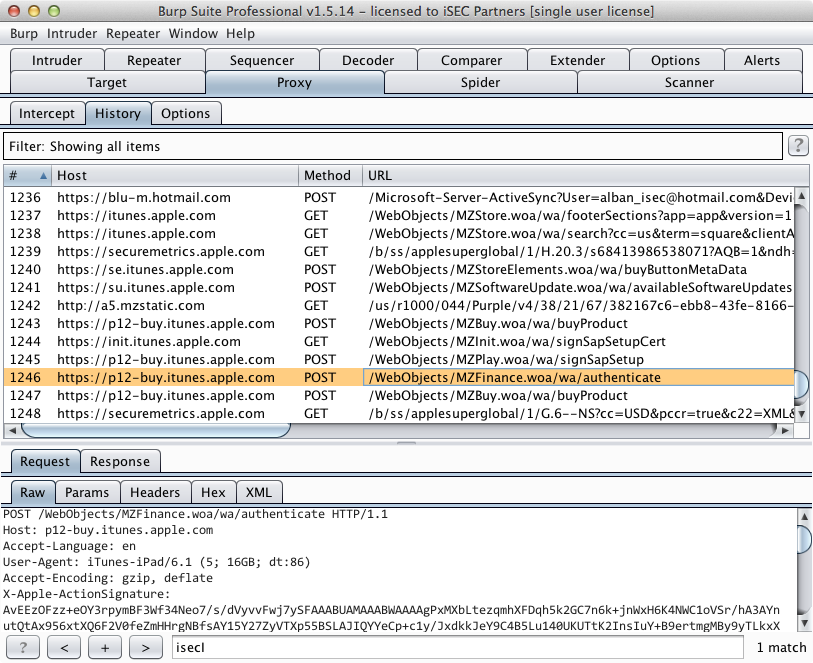
If you try to install an app while proxying, your proxy might crash or freeze when the App Store tries to download the app because IPA files can be fairly large (200+ MB).
Takeaway
A similar methodology could be used to proxy other system daemons including for example accountsd, which is responsible for the Twitter and Facebook integration that was added to iOS 5 and iOS 6.
While working on this, I also discovered a better way to disable SSL certificate validation and certificate pinning in iOS apps. Hence, SSL Kill Switch v0.5 is actually a complete rewrite. If you’re interested in knowing how it works, I wrote a blog post explaining what the tool does.
[转]Intercepting the App Store's Traffic on iOS的更多相关文章
- 向苹果App Store提交新应用的图文教程(转)
当你克服重重困难终于开发出了自己的App,下一步就是向App Store提交应用了,这时应该如何操作呢?我的App真的准备好提交了?我敢肯定这些问题将会浮现在你的脑海.基于这篇教程,我将告诉你一个完整 ...
- 【转】APP被苹果App Store拒绝的N个原因(持续补充)
作为iOS开发者,估计有很多都遇到过APP提交到App Store被拒,然后这些被拒的原因多种多样,今天dApps收集了常见的被拒的原因,以便更多开发者了解. 1.程序有重大bug,程序不能启动,或者 ...
- 不通过App Store,在iOS设备上直接安装应用程序(转)
今天在iOS设备上安装天翼云存储app,在safari上直接打开http://cloud.189.cn/wap/index.jsp,点击“点击免费安装”,如下图: 神奇的事情发生了,设备上直接下载ap ...
- APP store 上架过程中碰到的那些坑&被拒的各种奇葩原因整理&审核指南中文版
苹果官方发布的十大常见被拒原因 1.崩溃次数和Bug数量.苹果要求开发者在将应用提交给App Store之前彻查自己的应用,以尽量避免Bug的存在. 2.链或错误的链接.应用中所有的链接必须是真实且有 ...
- iPhone应用提交流程:如何将App程序发布到App Store?
对于刚加入iOS应用开发行列的开发者来说,终于经过艰苦的Coding后完成了第一个应用后最重要的历史时刻就是将应用程序提交到iTunes App Store.Xcode 4.2开发工具已经把App提交 ...
- APP被苹果App Store拒绝的79个原因【转】
作为iOS开发者,估计有很多都遇到过APP提交到App Store被拒,然后这些被拒的原因多种多样,今天dApps收集了常见的被拒的原因,以便更多开发者了解. APP被苹果APPStore拒绝的各种原 ...
- 20190415 - iOS11 无法连接到 App Store 的解决办法
问题:更新 iOS 11 后,打开 App Store 提示: 无法连接至 app store 解决: 进入 iOS 系统[设置][iTunes Store 与 App Store],退出当前登录用户 ...
- iPhone应用提交流程:如何将App程序发布到App Store
http://www.techolics.com/apple/20120401_197.html 对于刚加入iOS应用开发行列的开发者来说,终于经过艰苦的Coding后完成了第一个应用后最重要的历史时 ...
- 开发商应用被App Store拒绝的79个原因
转自:http://www.gamelook.com.cn/2014/10/186017 作为iOS开发者,估计有很多都遇到过APP提交到App Store被拒,然后这些被拒的原因多种多样,今天小编收 ...
随机推荐
- python test0729.py
#!/usr/env python #-*- coding: utf-8 -*- import urllib import urllib2 import random import requests ...
- 我的MYSQL学习心得(七)
原文:我的MYSQL学习心得(七) 我的MYSQL学习心得(七) 我的MYSQL学习心得(一) 我的MYSQL学习心得(二) 我的MYSQL学习心得(三) 我的MYSQL学习心得(四) 我的MYSQL ...
- 【高德地图API】从零开始学高德JS API(六)——坐标转换
原文:[高德地图API]从零开始学高德JS API(六)——坐标转换 摘要:如何从GPS转到谷歌?如何从百度转到高德?这些都是小case.我们还提供,如何将基站cell_id转换为GPS坐标? --- ...
- zsh的安装与配置
参考: http://cnbin.github.io/blog/2015/06/01/mac-zsh-an-zhuang-he-shi-yong/ http://www.cnblogs.com/ios ...
- 解决Uploadify上传控件加载导致的GET 404 Not Found问题
今天在项目发用到Uploadify上传, 发现在打开页面时会有一多余的请求,由于路由没有设置这个,导致404错误,能搜索查到以下解决的方法 <Uploadify v3 bug. Unecessa ...
- Node.js与MongoDB的基本连接示例
Node.js与MongoDB的基本连接示例 前提 已经安装了node.js和MongoDB,本文使用的node.js是v0.12.0,MongoDB是3.0.0. 初始化数据 启动MongoDB服务 ...
- Write the code.Change the world.---WWDC2014
- gpu显存(全局内存)在使用时数据对齐的问题
全局存储器,即普通的显存,整个网格中的随意线程都能读写全局存储器的任何位置. 存取延时为400-600 clock cycles 很easy成为性能瓶颈. 訪问显存时,读取和存储必须对齐,宽度为4B ...
- js模块开发
js模块开发(一) 现在嵌入页面里面的javascript代码越来越复杂,于是可能依赖也越来越严重,使用别人开发的js也越来越多,于是在理想情况下,我们只需要实现核心的业务逻辑,其他都可以加载别人已经 ...
- Mysql C语言API编程入门讲解
原文:Mysql C语言API编程入门讲解 软件开发中我们经常要访问数据库,存取数据,之前已经有网友提出让鸡啄米讲讲数据库编程的知识,本文就详细讲解如何使用Mysql的C语言API进行数据库编程. ...