
Classification week3: decision tree 笔记
华盛顿大学 machine learnign :classification week 3 笔记
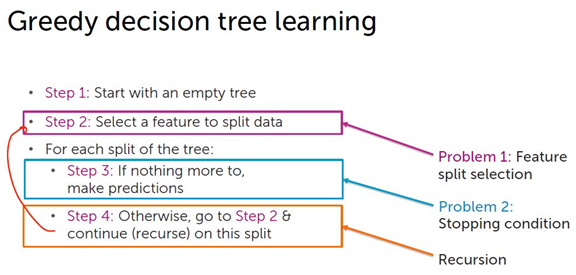
第二步:
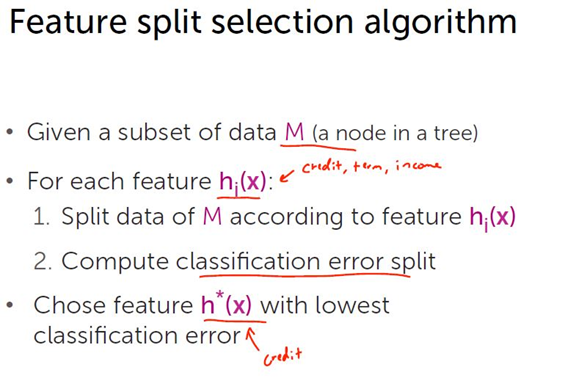
注:
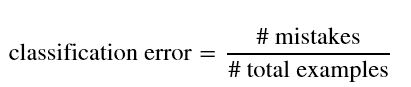
其中 ,mistake 的计算方法:
给定一个节点的数据集M,对每个特征hi(x),根据特征hi(x)将节点的数据集M分类。
统计哪个类别占多数,记为多数类。
所有不在多数类里的数据都作为误判mistakes
classification error = (left_mistakes + right_mistakes) / num_data_points
第三步:建树
考虑到防止过拟合:
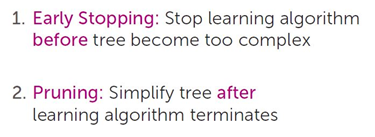
1. early stopping:
停止条件:

建树过程:
def decision_tree_create(data, features, target, current_depth = 0,

                         max_depth = 10, min_node_size=1,

                         min_error_reduction=0.0):

    remaining_features = features[:]

    target_values = data[target]

    # Stopping condition 1: All nodes are of the same type.

    if intermediate_node_num_mistakes(target_values) == 0:

        return create_leaf(target_values)

    # Stopping condition 2: No more features to split on.

    if remaining_features == []:

        return create_leaf(target_values)

    # Early stopping condition 1: Reached max depth limit.

    if current_depth >= max_depth:

        return create_leaf(target_values)

    # Early stopping condition 2: Reached the minimum node size.

    if   reached_minimum_node_size(data, min_node_size):

        return create_leaf(target_values)

    # Find the best splitting feature and split on the best feature.

    splitting_feature = best_splitting_feature(data, features, target)

    left_split = data[data[splitting_feature] == 0]

    right_split = data[data[splitting_feature] == 1]

    # calculate error

    error_before_split = intermediate_node_num_mistakes(target_values) / float(len(data))

    left_mistakes = intermediate_node_num_mistakes(left_split[target])

    right_mistakes = intermediate_node_num_mistakes(right_split[target])

    error_after_split = (left_mistakes + right_mistakes) / float(len(data))

    # Early stopping condition 3: Minimum error reduction

    if  error_before_split - error_after_split < min_error_reduction:

        return create_leaf(target_values)

    remaining_features.remove(splitting_feature)

    # Repeat (recurse) on left and right subtrees

    left_tree = decision_tree_create(left_split, remaining_features, target,

                                     current_depth + 1, max_depth, min_node_size, min_error_reduction)

    right_tree = decision_tree_create(right_split, remaining_features, target,

                                     current_depth + 1, max_depth, min_node_size, min_error_reduction)

    return create_node(splitting_feature, left_tree, right_tree)
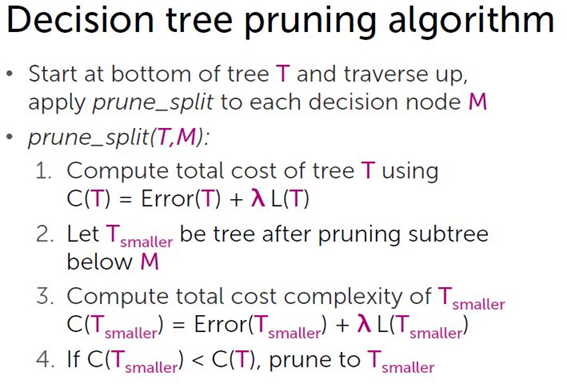
2. pruning
Total cost C(T) = Error(T) + λ L(T)
用建好的树预测数据:
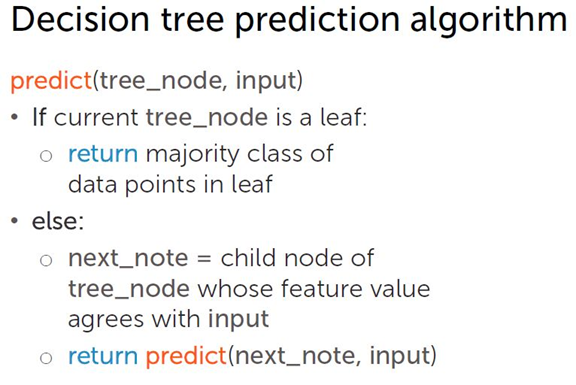
def classify(tree, input):

    # if the node is a leaf node.

    if tree['is_leaf']:

        return tree['prediction']

    else:

        # split on feature.

        split_feature_value = input[tree['splitting_feature']]

        if split_feature_value == 0:

            return classify(tree['left'], input)

        else:

            return classify(tree['right'], input)
Classification week3: decision tree 笔记的更多相关文章
- OpenCV码源笔记——Decision Tree决策树
来自OpenCV2.3.1 sample/c/mushroom.cpp 1.首先读入agaricus-lepiota.data的训练样本. 样本中第一项是e或p代表有毒或无毒的标志位:其他是特征,可以 ...
- [ML学习笔记] 决策树与随机森林(Decision Tree&Random Forest)
[ML学习笔记] 决策树与随机森林(Decision Tree&Random Forest) 决策树 决策树算法以树状结构表示数据分类的结果.每个决策点实现一个具有离散输出的测试函数,记为分支 ...
- 【机器学习】决策树(Decision Tree) 学习笔记
[机器学习]决策树(decision tree) 学习笔记 标签(空格分隔): 机器学习 决策树简介 决策树(decision tree)是一个树结构(可以是二叉树或非二叉树).其每个非叶节点表示一个 ...
- 决策树学习笔记(Decision Tree)
什么是决策树? 决策树是一种基本的分类与回归方法.其主要有点事模型具有可得性,分类速度快.学习时,利用训练数据,根据损失函数最小化原则建立决策树模型:预测时,对新数据,利用决策树模型进行分类. 决策树 ...
- 机器学习技法笔记:09 Decision Tree
Roadmap Decision Tree Hypothesis Decision Tree Algorithm Decision Tree Heuristics in C&RT Decisi ...
- 机器学习技法笔记:11 Gradient Boosted Decision Tree
Roadmap Adaptive Boosted Decision Tree Optimization View of AdaBoost Gradient Boosting Summary of Ag ...
- Coursera台大机器学习技法课程笔记11-Gradient Boosted Decision Tree
将Adaboost和decision tree相结合,需要注意的地主是,训练时adaboost需要改变资料的权重,如何将有权重的资 料和decision tree相结合呢?方法很类似于前面讲过的bag ...
- [学习笔记] Uplift Decision Tree With KL Divergence
Uplift Decision Tree With KL Divergence Intro Uplift model 我没找到一个合适的翻译,这方法主要应用是,探究用户在给予一定激励之后的表现,也就是 ...
- 【3】Decision tree(决策树)
前言 Decision tree is one of the most popular classification tools 它用一个训练数据集学到一个映射,该映射以未知类别的新实例作为输入,输出 ...
随机推荐
- 加入新的linux系统调用
上一篇详解了linux系统调用的原理,接下来依据上一篇的原理简介怎样创建新的linux系统调用 向内核中加入新的系统调用,须要运行3个步骤: 1. 加入新的内核函数 2. 更新头文件unistd.h ...
- java源码阅读HashSet
1类签名与注解 public class HashSet<E> extends AbstractSet<E> implements Set<E>, Cloneabl ...
- 多个客户端连接socket
import java.io.DataInputStream; import java.io.DataOutputStream; import java.io.IOException; import ...
- 【日志处理、监控ELK、Kafka、Flume等相关资料】
服务介绍 随着实时分析技术的发展及成本的降低,用户已经不仅仅满足于离线分析.目前我们服务的用户包括微博,微盘,云存储,弹性计算平台等十多个部门的多个产品的日志搜索分析业务,每天处理约32亿条(2TB) ...
- 【网络】再谈select, iocp, epoll,kqueue及各种I/O复用机制 && Reactor与Proactor的概念
首先,介绍几种常见的I/O模型及其区别,如下: blocking I/O nonblocking I/O I/O multiplexing (select and poll) signal drive ...
- Linq-语句之Select/Distinct和Count/Sum/Min/Max/Avg
上一篇讲述了LINQ,顺便说了一下Where操作,这篇开始我们继续说LINQ to SQL语句,目的让大家从语句的角度了解LINQ,LINQ包括LINQ to Objects.LINQ to Data ...
- (草稿)spring @value 原理源码解读
一切要从这说起:http://www.cnblogs.com/guazi/p/6698654.html 我们直接开始debug: 这里会遍历所有的需要注入的InjectedElement 这里我们需要 ...
- Qt学习 之 多线程程序设计
QT通过三种形式提供了对线程的支持.它们各自是, 一.平台无关的线程类 二.线程安全的事件投递 三.跨线程的信号-槽连接. 这使得开发轻巧的多线程Qt程序更为easy,并能充分利用多处理器机器的优势. ...
- 【Excle】动态更新数据下拉菜单
现在我们制作了一个简单的下拉菜单,如下: 但是随着公司的逐渐扩大,部门也变得多了,目前我是把数据范围写死的 ,所有每次添加一个部门,就得修改数据范围,那么现在我们不想修改这个范围了,想让他每次添加部门 ...
- (一)Oracle学习笔记—— 表和表空间
1. 表空间 一个数据库可以有多个表空间,一个表空间里可以有多个表.表空间就是存多个表的物理空间:可以指定表空间的大小位置等. 1.1 创建表空间语句 create tablespace ts3 d ...