
database---many to many relationships(多对多关系型数据库)
Many to many Relationships
A many-to-many relationship occurs when multiple records in a table are associated with multiple records in another table. For example, a many-to-many relationship exists between customers and products: customers can purchase various products, and products can be purchased by many customers.
Relational database systems usually don't allow you to implement a direct many-to-many relationship between two tables. Consider the example of keeping track of invoices. If there were many invoices with the same invoice number and one of your customers inquired about that invoice number, you wouldn’t know which number they were referring to. This is one reason for assigning a unique value to each invoice.
To avoid this problem, you can break the many-to-many relationship into two one-to-many relationships by using a third table, called a join table. Each record in a join table includes a match field that contains the value of the primary keys of the two tables it joins. (In the join table, these match fields are foreign keys.) These foreign key fields are populated with data as records in the join table are created from either table it joins.
A typical example of a many-to many relationship is one between students and classes. A student can register for many classes, and a class can include many students.
The following example includes a Students table, which contains a record for each student, and a Classes table, which contains a record for each class. A join table, Enrollments, creates two one-to-many relationships—one between each of the two tables.
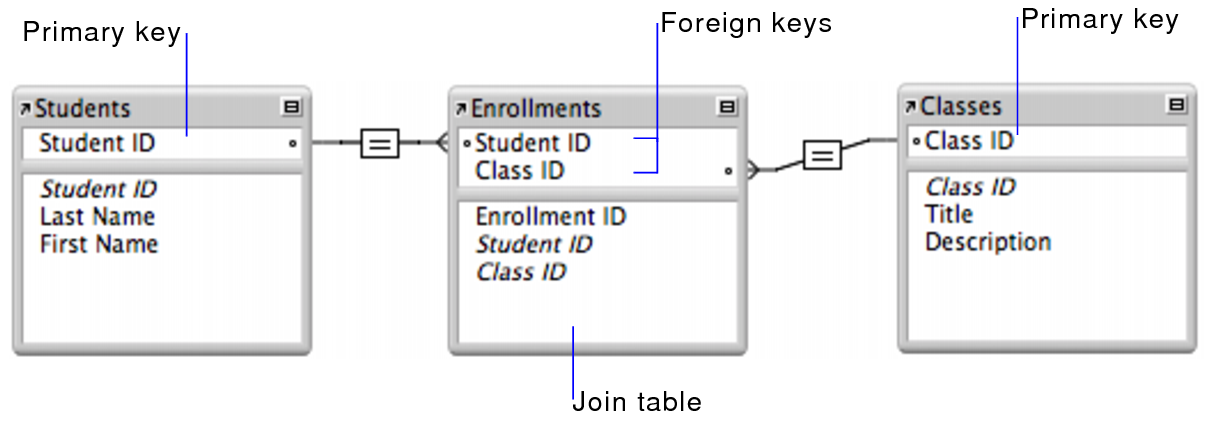
The primary key Student ID uniquely identifies each student in the Students table. The primary key Class ID uniquely identifies each class in the Classes table. The Enrollments table contains the foreign keys Student ID and Class ID.
To set up a join table for a many-to-many relationship:
Using the example above, create a table named Enrollments. This will be the join table.
In the Enrollments table, create a Student ID field and a Class ID field.
Join tables typically hold fields that might not make sense to have in any other table. You can add fields to the Enrollments table, such as a Date field to keep track of when someone started a class, and a Cost field to track how much a student paid to take a class.
- Create a relationship between the two Student ID fields in the tables. Then create a relationship between the two Class ID fields in the tables.
Using this design, if a student registers for three classes, that student will have one record in the Students table and three records in the Enrollments table—one record for each class the student enrolled in.
Notes
- Join tables can access fields and data across tables without having to create a separate relationship. For example, to display a list of all the classes a student enrolled in, create a portal on a layout based on the Students table. Design the portal to show related records from the Classes table. Then add the appropriate fields from Classes to the portal. As you browse through records in the Students layout, the portal displays all the classes a particular student is enrolled in.
database---many to many relationships(多对多关系型数据库)的更多相关文章
- Node的关系型数据库ORM库:bookshelf
NodeJs 关系数据库ORM库:Bookshelf.js bookshelf.js是基于knex的一个关系型数据库的ORM库.简单易用,内置了Promise的支持.这里主要罗列一些使用的例子,例子就 ...
- 关系型数据库之Mysql
简介 主要知识点包括:能够与mysql建立连接,创建数据库.表,分别从图形界面与脚本界面两个方面讲解 相关的知识点包括:E-R关系模型,数据库的3范式,mysql中数据字段的类型,字段约束 数据库的操 ...
- Oracle之关系型数据库
什么是关系型数据库? (1)关系型数据库是依据关系模型来创建的数据库. (2)所谓关系模型就是"一对一.一对多.多对多"等关系模型,关系模型就是指二维表格模型,因而一个关系型数据库 ...
- MongoDB学习笔记(二:入门环境配置及与关系型数据库区别总结)
一.下载及安装MongoDB MongoDB下载官网链接:http://www.mongodb.org/downloads 具体安装步骤教程:http://www.shouce.ren/api/vie ...
- Sqoop2入门之导入关系型数据库数据到HDFS上(sqoop2-1.99.4版本)
sqoop2-1.99.4和sqoop2-1.99.3版本操作略有不同:新版本中使用link代替了老版本的connection,其他使用类似. sqoop2-1.99.4环境搭建参见:Sqoop2环境 ...
- Google的分布式关系型数据库F1和Spanner
F1是Google开发的分布式关系型数据库,主要服务于Google的广告系统.Google的广告系统以前使用MySQL,广告系统的用户经常需要使用复杂的query和join操作,这就需要设计shard ...
- 大数据时代的数据存储,非关系型数据库MongoDB
在过去的很长一段时间中,关系型数据库(Relational Database Management System)一直是最主流的数据库解决方案,他运用真实世界中事物与关系来解释数据库中抽象的数据架构. ...
- 非关系型数据库SequoiaDB虚拟机下应用初探
SequoiaDB是广州巨杉软件有限公司开发的一款新型分布式非关系型数据库.可应用于linux操作系统下.在虚拟机下试用了一下(操作系统Ubuntu),感觉不错,操控简单易上手,在此分享一下心得. 下 ...
- ORMBase对象/关系型数据库映射在MVC中的应用
ORM这个字眼在我们操作数据库的时候,是我们使用频率最高的.它到底是个什么东西呢,我们先来看看一些对它的含义解释. 对象/关系数据库映射(object/relational mapping(ORM)) ...
随机推荐
- JQuery Easyui/TopJUI表格基本的删除功能(删除当前行和多选删除)
需求:数据表格datagrid实现删除当前行和多选删除的功能. html <a href="javascript:void(0)" data-toggle="top ...
- Image.resize()和Image.thumbnail()的区别
Image.resize()和Image.thumbnail()的区别 根据代码和代码注释, 这两个函数都是对图片进行缩放, 两者的主要区别如下: resize()函数会返回一个Image对象, th ...
- 关于ssh的介绍
最近看到一篇关于介绍ssh讲得很清晰的文章,这里来记录一下加深一下印象: 基本原理: SSH(Secure Shell)是一套协议标准,可以用来实现两台机器之间的安全登录以及安全的数据传送,其保证数据 ...
- python Windows和Linux路径表示问题
Windows下路径是用‘\\’表示也可以使用'/',但是Linux下路径都是‘/’表示. 因为python是跨平台的,有时候程序迁移会出现错误. 解决办法1 可全部使用‘/’表示 解决办法2 我们可 ...
- ZOJ Course Selection System DP
http://acm.zju.edu.cn/onlinejudge/showContestProblem.do?problemId=5565 Course Selection System Time ...
- 牛客网Java刷题知识点之方法覆盖(方法重写)和方法重载的区别
不多说,直接上干货! https://www.nowcoder.com/ta/review-java/review?query=&asc=true&order=&page=6 ...
- Ionic之button标签ng-click无反应解决
在使用Ionic中,使用按钮的ng-click事件,竟然点击没有反应,刚开始以为自己写得方法有问题才会不起作用,自己在点击之后就console.log()一个东西,但是console也是无法反应的.& ...
- 难道这就是gin中间件的原理,一个装饰者模式而已?
func wrapCtx(handler func(ctx *gin.Context)) gin.HandlerFunc { return func(c *gin.Context) { //获取请求的 ...
- 公司开发部门GIT与SVN 之争
公司最开始决定是使用GIT作为版本控制 , 也都使用了4,5个月了 , 开发人员也都是20多岁年轻力壮的年轻人 , 每个组的组长也一直在做git使用的培训 , 即使是这样 , 还是遇到了非常大的阻碍 ...
- ubuntu关闭cups服务(631端口)
本人使用的ubuntu10.10每次开机时使用nmap扫描127.0.0.1的时候总是能发现一个631端口开启,在/etc/services找到631端口是网络打印机服务,但对于我一个普通用户来说这根 ...