
一个简单文本分类任务-EM算法-R语言
一、问题介绍
概率分布模型中,有时只含有可观测变量,如单硬币投掷模型,对于每个测试样例,硬币最终是正面还是反面是可以观测的。而有时还含有不可观测变量,如三硬币投掷模型。问题这样描述,首先投掷硬币A,如果是正面,则投掷硬币B,如果是反面,则投掷硬币C,最终只记录硬币B,C投掷的结果是正面还是反面,因此模型中硬币B,C的正反是可观测变量,而硬币A的正反则是不可观测变量。这里,用Y表示可观测变量,Z表示(隐变量)不可观测变量,Y和Z统称为完全数据,Y成为不完全数据。对于文本分类问题,未标记数据的自变量为可观测变量Y,未标记数据为观测到的类别标签为隐变量Z。
一般的只含有可观测变量的概率分布模型由于先验概率分布是可以通过可观测的类别标签来求得(对应文本分类问题中每个类别的数据出现的概率),而条件概率分布是可以通过可观测的类别标签以和可观测的样本自变量中特征来求得(对应文本分类问题中已知类别的前提下某个单词是否出现的概率),因此通过朴素贝叶斯法就可以对概率模型求解。但是如果模型中存在隐变量,那么朴素贝叶斯法则不能使用,因为先验概率分布和条件概率分布无法直接求得,因此提出一种用迭代方式进行的对不完全数据进行极大似然估计的方法——期望最大化算法(EM算法),接下来将对算法进行详细的证明和解释。
二、算法详解
1. 极大化似然函数
由于能观测到的数据只有不完全数据Y,因此对参数进行极大似然估计。
对Z前提下Y的概率分布可以理解为每个类别确定后Y的概率模型。如果是高斯混合模型,那么类别确定之后,自变量应该符合高斯分布,如果是文本分类模型,那么类别确定之后,自变量应该符合条件概率分布(自变量是特征的集合,由于所有特征都是条件独立的,因此联合分布就是各个特征的分布连乘在一起,每个特征满足两点分布,那么自变量应该满足连乘的两点分布)。对Z的先验概率分布可以理解为每个类别出现的比例,即每个类别的先验概率。不完全数据的Z是无法观测的,因此难点就在于确定条件概率分布和先验概率分布。
这里B的两个参数表示不同含义,前一个参数表示Z的后验概率分布的参数空间,后一个参数表示完全数据的联合分布。
2. 收敛性分析
现在最大化似然函数L,可以先求似然函数L的下限函数B,然后找出下限函数B的极大值点,那么该点一定也使似然函数L更靠近其极大值点,通过迭代的步骤,就可以不断逼近L的极值点。如下图EM算法迭代
首先用先验启动知识对Z的后验概率进行初始化,即用已标记数据及计算出Y前提下Z的概率分布,因此可获得P(Z∣Y,θ(0))P(Z∣Y,θ(0)),这样在初始点(自变量是参数空间,应变量是似然函数值)的下限函数就可以求出,当迭代到第t步时求出下限函数为B(θ(t),θ)B(θ(t),θ)在t这一点,似然函数L和其下限函数相等L(θ(t))=B(θ(t),θ(t))L(θ(t))=B(θ(t),θ(t))。这时对B求极大值,可以获得迭代的下一步的参数
3. 算法流程
EM算法的流程分为两步,分别是E(期望)步和M(最大化)步。E步主要是求出当前的下限函数B,由于B是通过期望推导出的,所以称为期望步骤,M步主要是求出当前下限函数B的极大值,然后将这点的参数带入似然函数,所以称为最大化步,因此算法流程如下:
1. 利用预先知识,求出隐变量的后验概率分布,获得参数空间的初始值θ(0)来启动EM算法。
2. E步,求期望Ez[logP(Z,Y∣θ)∣Y,θ(t)]Ez[logP(Z,Y∣θ)∣Y,θ(t)]
3. M步,最大化期望,求出新的参数值θ(t+1)θ(t+1)
4. 迭代2、3步直至收敛或固定的迭代次数
下面是数学推导部分
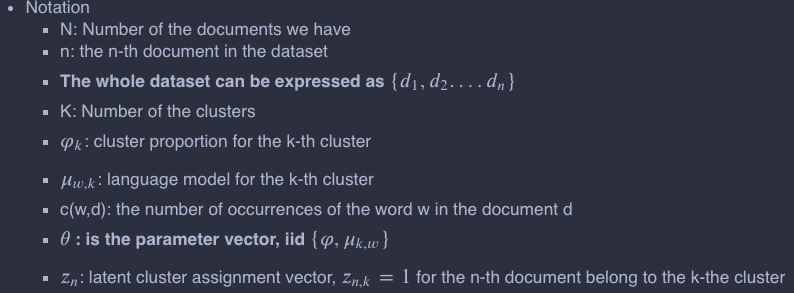
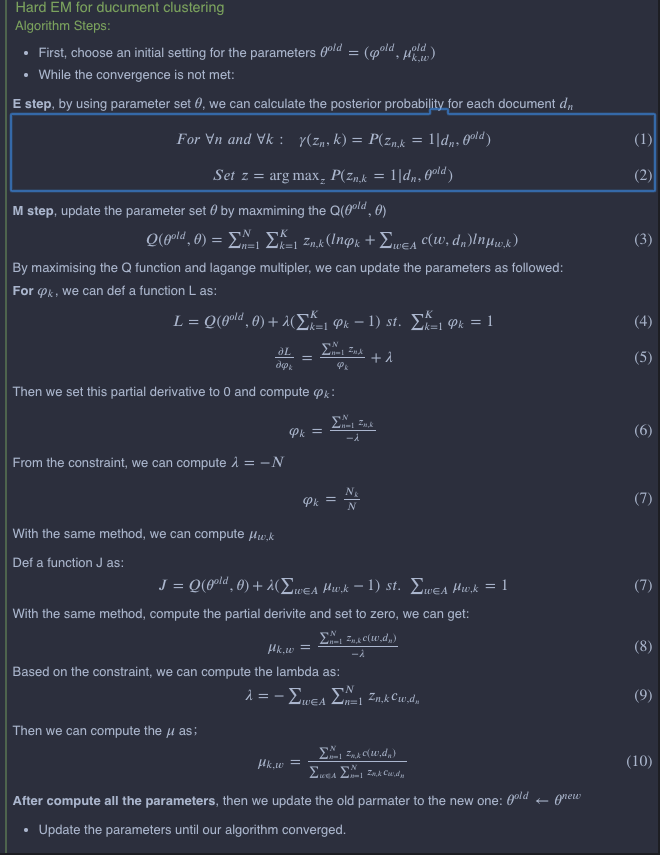
那根据上面的算法过程,我们可以讲其实现,代码如下
## Help Function

logSum <- function(v) {

   m = max(v)

   return ( m + log(sum(exp(v-m))))

}
# Hard E step

hard.E.step <- function(gamma, model, counts){

  # Model Parameter Setting

  N <- dim(counts)[2] # number of documents

  K <- dim(model$mu)[1]

  # E step:

  for (n in 1:N){

    for (k in 1:K){

      ## calculate the posterior based on the estimated mu and rho in the "log space"

      gamma[n,k] <- log(model$rho[k,1]) +  sum(counts[,n] * log(model$mu[k,]))

    }

    # normalisation to sum to 1 in the log space

    logZ = logSum(gamma[n,])

    gamma[n,] = gamma[n,] - logZ

    ## Compared with soft EM, here we need to do a hard assignment for the ducuments based on the post probability

    ## Find the max post probablity for znk

    max.index <- which.max(gamma[n,])

    ## Set all the post probability to 0 and biggest to 1 and finish the hard assignment

    gamma[n,] <- 0

    gamma[n,max.index] <- 1

  }

  return (gamma)

}
# M step

M.step <- function(gamma, model, counts,eps=1e-10){

  # Model Parameter Setting

    N <- dim(counts)[2]   # number of documents

    W <- dim(counts)[1]   # number of words i.e. vocabulary size

    K <- dim(model$mu)[1] # number of clusters

      ## Updating the parameters in the M step

    for (k in 1:K) {

        ## Update the mix cofficients

        model$rho[k,1] <- sum(gamma[,k])/N

        ## Update the language model mu

        total <- sum(gamma[,k] * t(counts)) + W * eps

        ## For each w, compute the language model

        for (w in 1:W){

            model$mu[k,w] <- (sum(gamma[,k] * counts[w,]) + eps)/total

        }

    }

      # Return the result

      return (model)

}
##--- Initialize model parameters randomly --------------------------------------------

##

initial.param <- function(vocab_size, K=4, seed=123456){

  rho <- matrix(1/K,nrow = K, ncol=1)                    # assume all clusters have the same size (we will update this later on)

  mu <- matrix(runif(K*vocab_size),nrow = K, ncol = vocab_size)    # initiate Mu

  mu <- prop.table(mu, margin = 1)               # normalization to ensure that sum of each row is 1

  return (list("rho" = rho, "mu"= mu))

}
接着我们把E-Mstep合并在一起
## Hard EM

##--- EM for Document Clustering --------------------------------------------

hard.EM <- function(counts, K=4, max.epoch=10, seed=123456){

  #INPUTS:

  ## counts: word count matrix

  ## K: the number of clusters

  #OUTPUTS:

  ## model: a list of model parameters

  # Model Parameter Setting

  N <- dim(counts)[2] # number of documents

  W <- dim(counts)[1] # number of unique words (in all documents)

  # Initialization

  model <- initial.param(W, K=K, seed=seed)

  gamma <- matrix(0, nrow = N, ncol = K)

  print(train_obj(model,counts))

  # Build the model

  for(epoch in 1:max.epoch){

    # E Step

    gamma <- hard.E.step(gamma, model, counts)

    # M Step

    model <- M.step(gamma, model, counts)

    print(train_obj(model,counts))

  }

  # Return Model

  return(list("model"=model,"gamma"=gamma))

}
接着,我们需要导入我们的文本,并做简单处理,接着我们去验证下我们上面实现的EM代码
## Load the library

library(tm)

library(SnowballC)

## Function for reading the data

eps=1e-10

# reading the data

read.data <- function(file.name='Task2A.txt', sample.size=1000, seed=100, pre.proc=TRUE, spr.ratio= 0.90) {

  # INPUTS:

  ## file.name: name of the input .txt file

  ## sample.size: if == 0  reads all docs, otherwise only reads a subset of the corpus

  ## seed: random seed for sampling (read above)

  ## pre.proc: if TRUE performs the preprocessing (recommended)

  ## spr.ratio: is used to reduce the sparcity of data by removing very infrequent words

  # OUTPUTS:

  ## docs: the unlabled corpus (each row is a document)

  ## word.doc.mat: the count matrix (each rows and columns corresponds to words and documents, respectively)

  ## label: the real cluster labels (will be used in visualization/validation and not for clustering)

  # Read the data

  text <- readLines(file.name)

  # select a subset of data if sample.size > 0

  if (sample.size>0){

    set.seed(seed)

    text <- text[sample(length(text), sample.size)]

  }

  ## the terms before the first '\t' are the lables (the newsgroup names) and all the remaining text after '\t' are the actual documents

  docs <- strsplit(text, '\t')

  # store the labels for evaluation

  labels <-  unlist(lapply(docs, function(x) x[1]))

  # store the unlabeled texts

  docs <- data.frame(unlist(lapply(docs, function(x) x[2])))

  library(tm)

  # create a corpus

  docs <- DataframeSource(docs)

  corp <- Corpus(docs)

  # Preprocessing:

  if (pre.proc){

    corp <- tm_map(corp, removeWords, stopwords("english")) # remove stop words (the most common word in a language that can be find in any document)

    corp <- tm_map(corp, removePunctuation) # remove pnctuation

    corp <- tm_map(corp, stemDocument) # perform stemming (reducing inflected and derived words to their root form)

    corp <- tm_map(corp, removeNumbers) # remove all numbers

    corp <- tm_map(corp, stripWhitespace) # remove redundant spaces

  }

  # Create a matrix which its rows are the documents and colomns are the words.

  dtm <- DocumentTermMatrix(corp)

  ## reduce the sparcity of out dtm

  dtm <- removeSparseTerms(dtm, spr.ratio)

  ## convert dtm to a matrix

  word.doc.mat <- t(as.matrix(dtm))

  # Return the result

  return (list("docs" = docs, "word.doc.mat"= word.doc.mat, "labels" = labels))

}
训练模型
# Reading documents

## Note: sample.size=0 means all read all documents!

##(for develiopment and debugging use a smaller subset e.g., sample.size = 40)

data <- read.data(file.name='Task2A.txt', sample.size=0, seed=100, pre.proc=TRUE, spr.ratio= .99)

# word-document frequency matrix

counts <- data$word.doc.mat

# calling the hard EM algorithm on the data with K = 4

hard.res <- hard.EM(counts, K = 4, max.epoch = 50)
得到以下输出
2171715

[1] 1952192

[1] 1942383

[1] 1938631

[1] 1937321

[1] 1936228

[1] 1935571

[1] 1935383

[1] 1935195

[1] 1935073

[1] 1935032

[1] 1934910

[1] 1934876

[1] 1934764

[1] 1934700

[1] 1934629

[1] 1934559

[1] 1934515

[1] 1934494

[1] 1934387

[1] 1934331

[1] 1934249

[1] 1934181

[1] 1934101

[1] 1933877

[1] 1933044

[1] 1929635

[1] 1927475

[1] 1926070

[1] 1925825

[1] 1925707

[1] 1925570

[1] 1925531

[1] 1925507

[1] 1925477

[1] 1925468

[1] 1925456

[1] 1925431

[1] 1925385

[1] 1925271

[1] 1925170

[1] 1925055

[1] 1924912

[1] 1924732

[1] 1924470

[1] 1924196

[1] 1923888

[1] 1923562

[1] 1923348

[1] 1923261

[1] 1923162
将我们的结果可视化出来
##--- Cluster Visualization -------------------------------------------------

cluster.viz <- function(doc.word.mat, color.vector, title=' '){

  p.comp <- prcomp(doc.word.mat, scale. = TRUE, center = TRUE)

  plot(p.comp$x, col=color.vector, pch=1,  main=title)

}

# hard EM clustering visualization

## find the culster with the maximum probability (since we have soft assignment here)

label.hat <- apply(hard.res$gamma, 1, which.max)

## normalize the count matrix for better visualization

counts<-scale(counts) # only use when the dimensionality of the data (number of words) is large enough

## visualize the estimated clusters

cluster.viz(t(counts), label.hat, 'Estimated Clusters (Hard EM)')
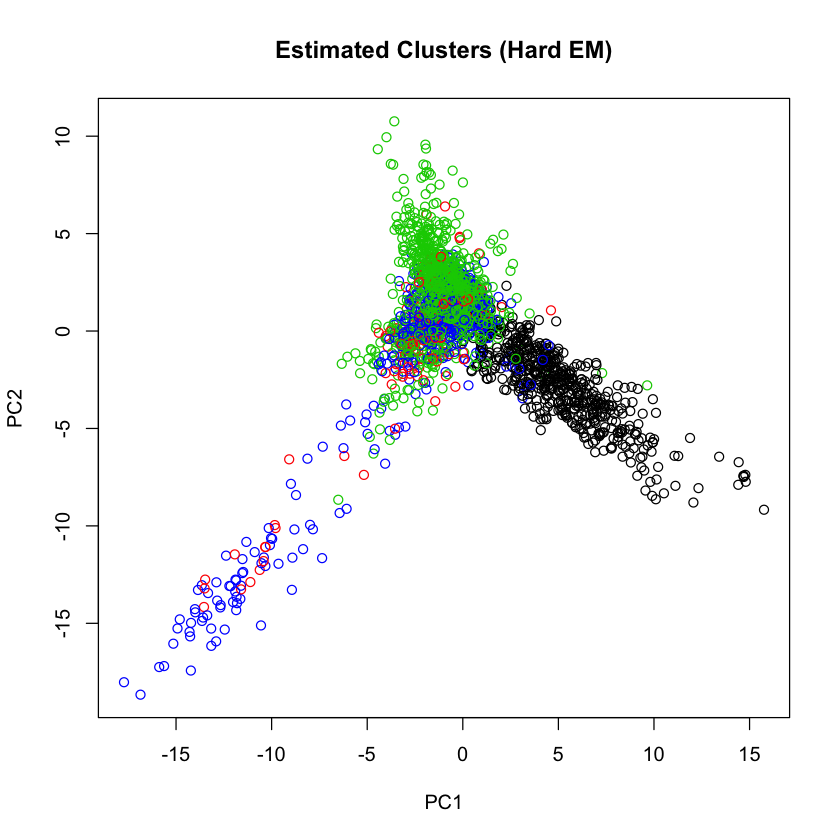
那这时候,我们把原文本直接分类可视化,和EM的分类做对比
## visualize the real clusters

cluster.viz(t(counts), factor(data$label), 'Real Clusters')
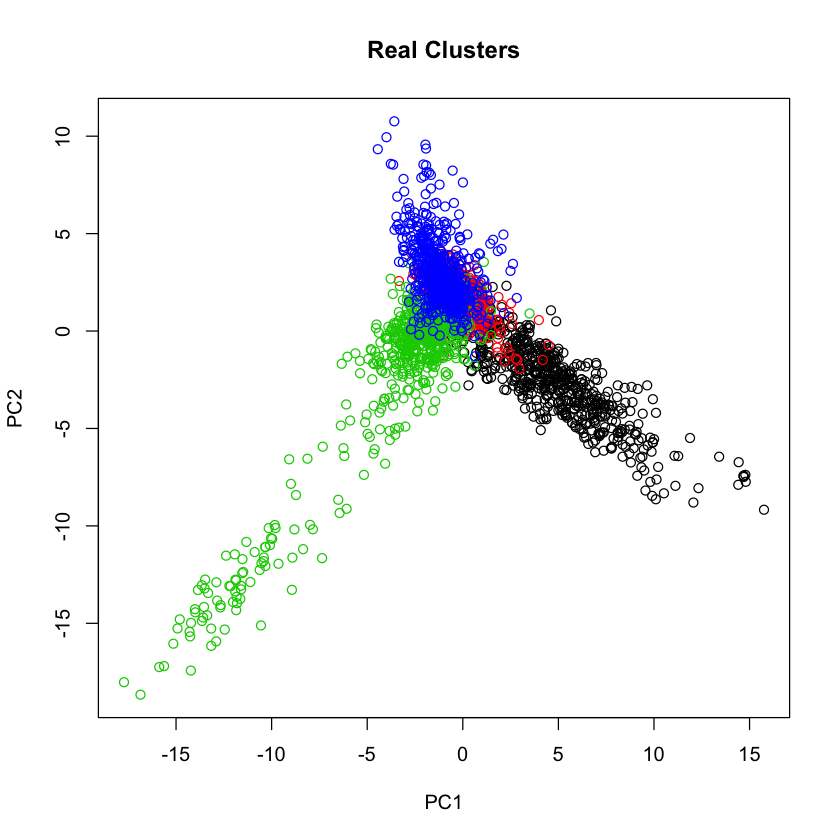
我们发现,EM基本上非常好的把文本的分类这个任务给完成了。
一个简单文本分类任务-EM算法-R语言的更多相关文章
- PageRank算法R语言实现
PageRank算法R语言实现 Google搜索,早已成为我每天必用的工具,无数次惊叹它搜索结果的准确性.同时,我也在做Google的SEO,推广自己的博客.经过几个月尝试,我的博客PR到2了,外链也 ...
- 数据挖掘算法R语言实现之决策树
数据挖掘算法R语言实现之决策树 最近,看到很多朋友问我如何用数据挖掘算法R语言实现之决策树,想要了解这方面的内容如下: > library("party")导入数据包 > ...
- Bert文本分类实践(一):实现一个简单的分类模型
写在前面 文本分类是nlp中一个非常重要的任务,也是非常适合入坑nlp的第一个完整项目.虽然文本分类看似简单,但里面的门道好多好多,作者水平有限,只能将平时用到的方法和trick在此做个记录和分享,希 ...
- 一个简单的多机器人编队算法实现--PID
用PID进行领航跟随法机器人编队控制 课题2:多机器人编队控制研究对象:两轮差动的移动机器人或车式移动机器人研究内容:平坦地形,编队的保持和避障,以及避障和队形切换算法等:起伏地形,还要考虑地形情况对 ...
- R语言︱情感分析—基于监督算法R语言实现(二)
每每以为攀得众山小,可.每每又切实来到起点,大牛们,缓缓脚步来俺笔记葩分享一下吧,please~ --------------------------- 笔者寄语:本文大多内容来自未出版的<数据 ...
- 【bzoj5016】[Snoi2017]一个简单的询问 莫队算法
题目描述 给你一个长度为N的序列ai,1≤i≤N和q组询问,每组询问读入l1,r1,l2,r2,需输出 get(l,r,x)表示计算区间[l,r]中,数字x出现了多少次. 输入 第一行,一个数字N,表 ...
- GA算法-R语言实现
旅行商问题 北工商-经研143班共有30位同学,来自22个地区,我们希望在假期来一次说走就走的旅行,将所有同学的家乡走一遍.算起来,路费是一笔很大的花销,所以希望设计一个旅行方案,确保这一趟走下来的总 ...
- C++写一个简单的解析器(分析C语言)
该方案实现了一个分析C语言的词法分析+解析. 注意: 1.简单语法,部分秕.它可以在本文法的基础上进行扩展,此过程使用自上而下LL(1)语法. 2.自己主动能达到求First 集和 Follow 集. ...
- 模拟退火算法 R语言
0 引言 模拟退火算法是用来解决TSP问题被提出的,用于组合优化. 1 原理 一种通用的概率算法,用来在一个打的搜索空间内寻找命题的最优解.它的原理就是通过迭代更新当前值来得到最优解.模拟退火通常使用 ...
随机推荐
- 2016年3月31日_应化所群体Review
Review目的: Phonegap的ble插件可以接收到设备发送的信息,但接收并在控制台显示的数据夏一鸣不知道是正确的数据,还是由于编码解码问题导致的乱码问题.此次Review要解决的问题即判断接收 ...
- 如何安全管理windows系统日志,windows系统日志的报表和告警
如何安全管理windows系统日志,windows系统日志的报表和告警 无论大小,每个拥有IT基础设施的组织都容易发生内部安全攻击.您的损失等同于黑客的收益:访问机密数据.滥用检索到的信息.系统崩溃, ...
- oracle count 大表
刚从生产环境导了一个大表到测试环境,迫不及待的要好好玩弄一下. 1.coun(1) ) from table_name; 条数: 567979280 时间:4:47 2.count 索引字段 sele ...
- org.jsoup.HttpStatusException: HTTP error fetching URL. Status=403
爬取网站的时候 conn = Jsoup.connect(url).timeout(5000).get();直接用get方法,有些网站可以正常爬取. 但是有些网站报403错误,403是一种在网站访问的 ...
- springboot同时使用thymeleaf和jsp模板
语言:javaEE 框架:springboot+thymeleaf.jsp模板引擎 背景:学习springboot过程中想同时使用thymeleaf和jsp访问(官方不建议) 步骤: 1) 在pom ...
- 在多台PC之间同步Resharper所有设置的方法
默认情况下Resharper只允许导出CodeStyle的设置,对于其它的设置不能导出,这样在不利用我们在多台PC之间同步Resharper的设置,经过多次尝试和Google找到了一种解决办法: Re ...
- Redis集群的主从切换研究
目录 目录 1 1. 前言 1 2. slave发起选举 2 3. master响应选举 5 4. 选举示例 5 5. 哈希槽传播方式 6 6. 一次主从切换记录1 6 6.1. 相关参数 6 6.2 ...
- ON_UPDATE_COMMAND_UI和ON_COMMAND有什么区别?
区别如下: UPDATE_COMMAND_UI表示处理菜单对应的用户界面显示状态. COMMAND表示处理该菜单对应的功能. 传统SDK程序要改变选单命令项状态,可以呼叫EnableMenuItem或 ...
- spring ioc beanfactory 关系图
spring security类关系图 mybatis-spring源码解析类关系图 Spring与Mybatis整合的MapperScannerConfigurer处理过程源码分析 转: sprin ...
- Android自定义视图二:如何绘制内容
这个系列是老外写的,干货!翻译出来一起学习.如有不妥,不吝赐教! Android自定义视图一:扩展现有的视图,添加新的XML属性 Android自定义视图二:如何绘制内容 Android自定义视图三: ...