
What is a heap?--reference
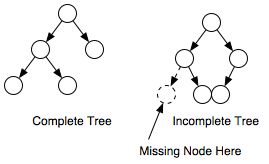
A heap is a partially sorted binary tree. Although a heap is not completely in order, it conforms to a sorting principle: every node has a value less (for the sake of simplicity, we will assume that all orderings are from least to greatest) than either of its children. Additionally, a heap is a "complete tree" -- a complete tree is one in which there are no gaps between leaves. For instance, a tree with a root node that has only one child must have its child as the left node. More precisely, a complete tree is one that has every level filled in before adding a node to the next level, and one that has the nodes in a given level filled in from left to right, with no breaks.
Why use a heap?
A heap can be thought of as a priority queue; the most important node will always be at the top, and when removed, its replacement will be the most important. This can be useful when coding algorithms that require certain things to processed in a complete order, but when you don't want to perform a full sort or need to know anything about the rest of the nodes. For instance, a well-known algorithm for finding the shortest distance between nodes in a graph, Dijkstra's Algorithm, can be optimized by using a priority queue.
Heaps can also be used to sort data. A heap sort is O(nlogn) efficiency, though it is not the fastest possible sorting algorithm. Check out thistutorial heap sort for more information related to heap sort.
How do you implement a heap?
Although the concept of a heap is simple, the actual implementation can appear tricky. How do you remove the root node and still ensure that it is eventually replaced by the correct node? How do you add a new node to a heap and ensure that it is moved into the proper spot?
The answers to these questions are more straight forward than meets the eye, but to understand the process, let's first take a look at two operations that are used for adding and removing nodes from a heap: upheaping and downheaping.
Upheap: The upheap process is used to add a node to a heap. When you upheap a node, you compare its value to its parent node; if its value is less than its parent node, then you switch the two nodes and continue the process. Otherwise the condition is met that the parent node is less than the child node, and so you can stop the process. Once you find a parent node that is less than the node being upheaped, you know that the heap is correct--the node being upheaped is greater than its parent, and its parent is greater than its own parent, all the way up to the root.
Downheap: The downheap process is similar to the upheaping process. When you downheap a node, you compare its value with its two children. If the node is less than both of its children, it remains in place; otherwise, if it is greater than one or both of its children, then you switch it with the child of lowest value, thereby ensuring that of the three nodes being compared, the new parent node is lowest. Of course, you cannot be assured that the node being downheaped is in its proper position -- it may be greater than one or both of its new children; the downheap process must be repeated until the node is less than both of its children.
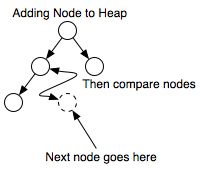 When you add a new node to a heap, you add it to the rightmost unoccupied leaf on the lowest level. Then you upheap that node until it has reached its proper position. In this way, the heap's order is maintained and the heap remains a complete tree.
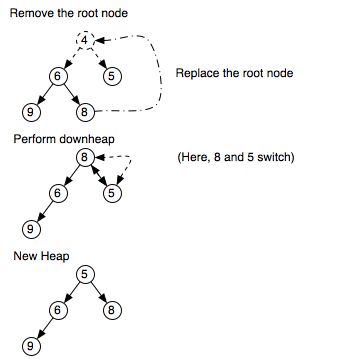 Removing the root node from a heap is almost as simple: when you take the node out of the tree, you replace it with "last" node in the tree: the node on the last level and rightmost on that level.
Once the top node has been replaced, you downheap the node that was moved until it reaches its proper position. As usual, the result will be a proper heap, as it will be complete, and even if the node in the last position happens to be the greatest node in the entire heap, it will do no worse than end up back where it started.
Efficiency of a heap
Whenever you work with a heap, most of the time taken by the algorithm will be in upheaping and downheaping. As it happens, the maximum number of levels of a complete tree is log(n)+1, where n is the number of nodes in the tree. Because upheap or downheap moves an element from one level to another, the order of adding to or removing from a heap is O(logn), as you can make switches only log(n) times, or one less time than the number of levels in the tree (consider that a two level tree can have only one switch).
reference from :http://www.cprogramming.com/tutorial/computersciencetheory/heap.html
What is a heap?--reference的更多相关文章
- (C#) Interview Questions.
(Note: Most are collected from Internet. 绝大部分内容来自互联网) 1. What's the difference between Hashtable and ...
- 11.Events
1.A type that defines an event member allows the type (or instances of the type) to notify other obj ...
- OpenJDK与HashMap
OpenJDK的非堆JDK增强提议(JDK Enhancement-Proposal,JEP)试图标准化一项基础设施,它从Java6开始,只能在HotSpot和OpenJDK内部使用.这种设施能够像管 ...
- MySQL :: MySQL 5.0 Reference Manual :: 14.4 The MEMORY (HEAP) Storage Engine
MySQL :: MySQL 5.0 Reference Manual :: 14.4 The MEMORY (HEAP) Storage Engine The MEMORY (HEAP) Stora ...
- Java 堆内存与栈内存异同(Java Heap Memory vs Stack Memory Difference)
--reference Java Heap Memory vs Stack Memory Difference 在数据结构中,堆和栈可以说是两种最基础的数据结构,而Java中的栈内存空间和堆内存空间有 ...
- Chrome-Console( Command Line API Reference)
来源于:https://developers.google.com/web/tools/chrome-devtools/console/command-line-reference The Comma ...
- CLR via C# 3rd - 05 - Primitive, Reference, and Value Types
1. Primitive Types Any data types the compiler directly supports are called primitive types. ...
- heap c++ 操作 大顶堆、小顶堆
在C++中,虽然堆不像 vector, set 之类的有已经实现的数据结构,但是在 algorithm.h 中实现了一些相关的模板函数.下面是一些示例应用 http://www.cplusplus.c ...
- strong reference cycle in block
However, because the reference is weak, the object that self points to could be deallocated while th ...
随机推荐
- VISUAL SVN安装 及客户端使用
1.为什么要用VisualSVN Server,而不用Subversion? 回答: 因为如果直接使用Subversion,那么在Windows 系统上,要想让它随系统启动,就要封装SVN Serve ...
- Can't find file: './mysql/plugin.frm' (errno: 13)[mysql数据目录迁移错位]错误解决
大概需要4个步骤,其中第1步通过service mysql stop停止数据库,第4步通过service mysql start启动数据库. 第2步移动数据文件,不知道是否为Ubuntu智能的原因,移 ...
- ubuntu下安装JDK详解
码农博客 即将到期,现将博客中部分文章转载到博客园.本文发表与2012年,转载时略有删减 安装JDK其实只要搞定两个问题,安装目录以及配置文件.如果你只想要快速安装JDK,请略过此部分直接看安装篇. ...
- LeetCode题解——Reverse Integer
题目: 数字翻转,即输入123,返回321:输入-123,返回-321. 代码: class Solution { public: int reverse(int x) { , sign = ; ) ...
- 自己手动写http服务器(2)
tringBuilder response =new StringBuilder(); //1) HTTP协议版本.状态代码.描述 response.append("HTTP/1.1&quo ...
- POJ 1738 石子合并2 GarsiaWachs算法
石子合并(GarsiaWachs算法) 只能用该算法过!!! 详解看代码 //#pragma comment(linker, "/STACK:167772160")//手动扩栈~~ ...
- work2
回答问题: 描述在这么多相似的需求面前, 你怎么维护你的设计 (父类/子类/基类, UML, 设计模式, 或者其它方法) 让整个程序的架构不至于崩溃的? 答:诚然,问题给出了很多选项如-a,-v,- ...
- 74LS164 for stm32 源码下载
在单片机系统中, 如果并行口的IO资源不够,而串行口又没有其他的作用, 那么我们可以用74LS164来扩展并行IO口,节约单片机资源. 74LS164是一个串行输入并行输出的移位寄存器 ...
- 高级C++开发工程师综合测试题(风林火山)
题目要求:代码要求能够直接编译运行 1. 请实现一个函数:凑14:输入很多个整数(1<=数值<=13),任意两个数相加等于14就可以从数组中删除这两个数,求剩余数(按由小到大排 ...
- Java经典面试题
1. Java中的异常处理机制的简单原理和应用. 当Java 程序违反了Java的语义规则时,Java虚拟机就会将发生的错误表示为一个异常.违反语义规则包括2种情况.一种是Java类库内置的语义检查. ...