
Part 3 talking about constraint in sql
What is Foreign key and how to create a Foreign key constraint?
Note:Foreign
Keys are used to enforce(强制) database integrity(完整) . In layman's
terms(一般来说), A foreign key in one table points to a primary key in
another table. The foreign key constraint prevents invalid data form
being inserted into the foreign key column. The values that you enter
into the foreign key column, has to be one of the values contained in
the table it points to.
for example:add a foreign key relation.
Table - Student: ID, GenderID;
Gender: ID, StudentID;
alter table Student add constraint FK_Student_GenderID

foreign key (GenderID) references Gender (ID)

Syntax:
ALTER TABLE 外键表名 ADD CONSTRAINT 外键约束名
FOREIGN KEY (外键名) REFERENCES 主表名 (主键名)
Adding a default constraint and dropping a constraint
Altering an existing column to add a default constraint:
alter table Gender
add constraint DF_Gender_ID
default 1 for ID

Syntax:
ALTER TABLE 表名

ADD CONSTRAINT 约束名

DEFAULT 默认值 FOR 列名
Adding a new column with default value, to an existing table:
alter table Student
add Name nvarchar(20) not null
constraint DF_Student_Name default 'gester'

Syntax:
ALTER TABLE 表名

ADD 列名 数据类型 是否允许null

CONSTRAINT 约束名 DEFAULT 默认值
Dropping a constraint:
alter table Student
drop constraint DF_Student_Name

Syntax:
ALTER TABLE 表名

DROP CONSTRAINT 约束名
Cascading referential integrity constraint
Cascading referential integrity constraint allows to define the actions Microsoft SQL Server should take when a user attempts to delete or update a key to which an existing foreign keys points.
For example, consider the 2 tables shown below. If you delete row with ID = 1 fromtblGender table, then row with ID = 3 from tblPerson table becomes an orphan record. You will not be able to tell the Gender for this row. So, Cascading referential integrity constraint can be used to define actions Microsoft SQL Server should take when this happens. By default, we get an error and the DELETE or UPDATE statement is rolled back.
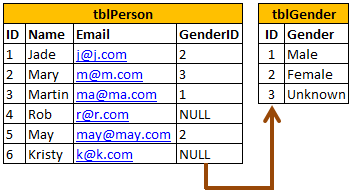
However, you have the following options when setting up Cascading referential integrity constraint
1. No Action: This is the default behaviour. No Action specifies that if an attempt is made to delete or update a row with a key referenced by foreign keys in existing rows in other tables, an error is raised and the DELETE or UPDATE is rolled back.
2. Cascade: Specifies that if an attempt is made to delete or update a row with a key referenced by foreign keys in existing rows in other tables, all rows containing those foreign keys are also deleted or updated.
3. Set NULL: Specifies that if an attempt is made to delete or update a row with a key referenced by foreign keys in existing rows in other tables, all rows containing those foreign keys are set to NULL.
4. Set Default: Specifies that if an attempt is made to delete or update a row with a key referenced by foreign keys in existing rows in other tables, all rows containing those foreign keys are set to default values.
Adding a check constraint
CHECK constraint is used to limit the range of the values, that can be entered for a column.
Let's say, we have an integer AGE column, in a table. The AGE in general cannot be less than ZERO and at the same time cannot be greater than 150. But, since AGE is an integer column it can accept negative values and values much greater than 150.
So, to limit the values, that can be added, we can use CHECK constraint. In SQL Server, CHECK constraint can be created graphically, or using a query.
The following check constraint, limits the age between ZERO and 150.
ALTER TABLE tblPerson
ADD CONSTRAINT CK_tblPerson_Age CHECK (Age > 0 AND Age < 150)
The general formula for adding check constraint in SQL Server:
ALTER TABLE { TABLE_NAME }
ADD CONSTRAINT { CONSTRAINT_NAME } CHECK ( BOOLEAN_EXPRESSION )
If the BOOLEAN_EXPRESSION returns true, then the CHECK constraint allows the value, otherwise it doesn't. Since, AGE is a nullable column, it's possible to pass null for this column, when inserting a row. When you pass NULL for the AGE column, the boolean expression evaluates to UNKNOWN, and allows the value.
To drop the CHECK constraint:
ALTER TABLE tblPerson
DROP CONSTRAINT CK_tblPerson_Age
Unique key constraint
We use UNIQUE constraint to enforce uniqueness of a column i.e the column shouldn't allow any duplicate values. We can add a Unique constraint thru the designer or using a query.
To add a unique constraint using SQL server management studio designer:
1. Right-click on the table and select Design
2. Right-click on the column, and select Indexes/Keys...
3. Click Add
4. For Columns, select the column name you want to be unique.
5. For Type, choose Unique Key.
6. Click Close, Save the table.
To create the unique key using a query:
Alter Table Table_Name

Add Constraint Constraint_Name Unique(Column_Name)
Both primary key and unique key are used to enforce, the uniqueness of a column. So, when do you choose one over the other?
A table can have, only one primary key. If you want to enforce(强制) uniqueness on 2 or more columns, then we use unique key constraint.
What is the difference between Primary key constraint and Unique key constraint? This question is asked very frequently in interviews.
1. A table can have only one primary key, but more than one unique key
2. Primary key does not allow nulls, where as unique key allows one null
To drop the constraint
1. Right click the constraint and delete.
Or
2. Using a query
Alter Table tblPerson

Drop COnstraint UQ_tblPerson_Email
Part 3 talking about constraint in sql的更多相关文章
- SQL基础--> 约束(CONSTRAINT)
--============================= --SQL基础--> 约束(CONSTRAINT) --============================= 一.几类数据完 ...
- SQL Server - 约束 CONSTRAINT
总结 约束放置在表中,以下五种约束: NOT NULL 非空约束C 指定的列不允许为空值 UNIQUE 唯一约束U 指定的列中没有重复值,或该表中每一个值或者每一组值都将是唯一的 PRIMARY KE ...
- Drop all the tables, stored procedures, triggers, constraints and all the dependencies in one SQL statement
Is there any way in which I can clean a database in SQl Server 2005 by dropping all the tables and d ...
- SQL PRIMARY KEY 约束\SQL FOREIGN KEY 约束\SQL CHECK 约束
SQL PRIMARY KEY 约束 PRIMARY KEY 约束唯一标识数据库表中的每条记录. 主键必须包含唯一的值. 主键列不能包含 NULL 值. 每个表都应该有一个主键,并且每个表只能有一个主 ...
- SQL语句删除所有表
) ) ) ) ) ) ) ) ) TABLE_NAME CONSTRAINT_NAME CONSTRAINT_NAME TABLE_NAME ) ) ) TABLE ...
- Oracle导出的sql执行出错
建的表如果有constraint的话sql语句中会有create unique index...而在前面的建表语句中,这个index实际上已经建好了. 所以导出的sql语句,应该将后面的create ...
- SQL SERVER 中的 object_id()函数
在SQLServer数据库中,如果查询数据库中是否存在指定名称的索引或者外键约束等,经常会用到object_id('name','type')方法,做笔记如下: ? 语法:object_id('obj ...
- SQL[连载3]sql的一些高级用法
SQL[连载3]sql的一些高级用法 SQL 高级教程 SQL SELECT TOP SQL SELECT TOP 子句 SELECT TOP 子句用于规定要返回的记录的数目. SELECT TOP ...
- [SQL Server系] -- 约束
什么是约束? 约束(Constraint)是SQL Server中提供的 自动保存数据库完整性 的一种方法,定义了可输入表或表的列中的数据限制条件. SQL Server中共有5中约束 PRIMARY ...
随机推荐
- MySQL中你肯定不知道的int隐情
MySQL中定义id字段为int类型,但是你知道它内部是什么玩意吗? 1.如果定义int类型,但是不声明长度,系统默认为11个长度(这个大家都知道): 2.如果指定长度小于11,实际上系统还是默认为1 ...
- Python 存储模型
1.Python彻底分离了对象和引用,可以认为内存中的对象都是不可修改的,每次修改引用,相当于在堆上重新创建一个对象,引用指向新对象. 2.对于数值和字符串,修改意味着引用指向一个新对象. 3.集合中 ...
- 基于W5500的嵌入式SNMP代理端实现
一 实验背景 近期一个做焊接设备的朋友想在焊机上加入监控的新功能,实时获取焊机的温度.功耗等參数,还可简单控制,实现对集群焊接设备的网络化管理.而这个朋友不想在开发管理系统上花太多精力,想找一个 ...
- c语言全局变量和局部变量问题汇总
.局部变量是否能和全局变量重名? 答:能,局部会屏蔽全局.要用全局变量,须要使用"::" 局部变量能够与全局变量同名,在函数内引用这个变量时,会用到同名的局部变量,而不会用到全局变 ...
- Soft Renderer的乐趣
最近这一个月的闲暇时间在边学习<3D编程大师技巧>边做自己的Soft Renderer,一个月下来总算有了个“基本原型”的样子.主要是在编写图形管线的过程式代码,简单明了为第一个阶段的目标 ...
- 高性能HTTP加速器Varnish安装与配置
导读 Varnish是一款高性能且开源的反向代理服务器和HTTP加速器,它采用了全新的软件体系结构,和现在的硬件体系配合紧密.下面就由我给大家简单说说他的安装与配置. 安装 安装pcre 如果没有安装 ...
- Linux下校验下载文件的完整性(MD5,SHA1,PGP)
查看: Linux下校验下载文件的完整性(MD5,SHA1,PGP) http://blog.useasp.net/archive/2014/03/29/use-md5-sha1-or-pgp-to- ...
- windows和linux中检查端口是否被占用
一.windows 1.查询端口占用情况 cmd > netstat -ano 2.查询8080端口是否被占用 cmd > netstat -ano|findstr 8080 3.查询哪个 ...
- 自动备份并保存最近几天的SQL数据库作业脚本
DECLARE @filename VARCHAR(255) DECLARE @date DATETIME SELECT @date=GETDATE() SELECT @filename = 'G:\ ...
- c++ 的几种强制转换的讨论
http://www.cnblogs.com/jerry19880126/archive/2012/08/14/2638192.html static_cast : 同 c 的强制转换类似: rei ...