
Linux内核中的常用宏container_of其实很简单【转】
转自:http://blog.csdn.net/npy_lp/article/details/7010752
开发平台:Ubuntu11.04
编 译器:gcc version 4.5.2 (Ubuntu/Linaro4.5.2-8ubuntu4)
Container_of在Linux内核中是一个常用的宏,用于从包含在某个结构中的指针获得结构本身的指针,通俗地讲就是通过结构体变量中某个成员的首地址进而获得整个结构体变量的首地址。
Container_of的定义如下:
- #define container_of(ptr, type, member) ({ \
- const typeof( ((type *)0)->member ) *__mptr = (ptr); \
- (type *)( (char *)__mptr - offsetof(type,member) );})
其实它的语法很简单,只是一些指针的灵活应用,它分两步:
第一步,首先定义一个临时的数据类型(通过typeof( ((type *)0)->member )获得)与ptr相同的指针变量__mptr,然后用它来保存ptr的值。
第二步,用(char *)__mptr减去member在结构体中的偏移量,得到的值就是整个结构体变量的首地址(整个宏的返回值就是这个首地址)。
其中的语法难点就是如何得出成员相对结构体的偏移量?
通过例子说明,如清单1:
- /* linux-2.6.38.8/include/linux/compiler-gcc4.h */
- #define __compiler_offsetof(a,b) __builtin_offsetof(a,b)
- /* linux-2.6.38.8/include/linux/stddef.h */
- #undef offsetof
- #ifdef __compiler_offsetof
- #define offsetof(TYPE,MEMBER) __compiler_offsetof(TYPE,MEMBER)
- #else
- #define offsetof(TYPE, MEMBER) ((size_t) &((TYPE *)0)->MEMBER)
- #endif
- #include <stdio.h>
- struct test_struct {
- int num;
- char ch;
- float fl;
- };
- int main(void)
- {
- printf("offsetof(struct test_struct, num) = %d\n",
- offsetof(struct test_struct, num));
- printf("offsetof(struct test_struct, ch) = %d\n",
- offsetof(struct test_struct, ch));
- printf("offsetof(struct test_struct, fl) = %d\n",
- offsetof(struct test_struct, fl));
- return 0;
- }
说明,__builtin_offsetof(a,b)是GCC的内置函数,可认为它的实现与((size_t) &((TYPE *)0)->MEMBER)这段代码是一致的。
例子输出结果:
- offsetof(struct test_struct, num) = 0
- offsetof(struct test_struct, ch) = 4
- offsetof(struct test_struct, fl) = 8
其中代码难以理解的地方就是它灵活地运用了0地址。如果觉得&( (struct test_struct *)0 )->ch这样的代码不好理解,那么我们可以假设在0地址分配了一个结构体变量struct test_struct a,然后定义结构体指针变量p并指向a(struct test_struct *p = &a),如此我们就可以通过&p->ch获得成员ch的地址。由于a的首地址为0x0,所以成员ch的首地址为0x4。
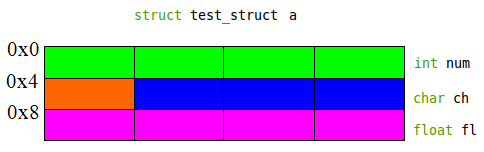
最后通过强制类型转换(size_t)把一个地址值转换为一个整数。
分析完container_of的定义,接下来举两个例子来体会一下它的使用方法。
正确的例子,如清单2:
- /* linux-2.6.38.8/include/linux/compiler-gcc4.h */
- #define __compiler_offsetof(a,b) __builtin_offsetof(a,b)
- /* linux-2.6.38.8/include/linux/stddef.h */
- #undef offsetof
- #ifdef __compiler_offsetof
- #define offsetof(TYPE,MEMBER) __compiler_offsetof(TYPE,MEMBER)
- #else
- #define offsetof(TYPE, MEMBER) ((size_t) &((TYPE *)0)->MEMBER)
- #endif
- /* linux-2.6.38.8/include/linux/kernel.h *
- * container_of - cast a member of a structure out to the containing structure
- * @ptr: the pointer to the member.
- * @type: the type of the container struct this is embedded in.
- * @member: the name of the member within the struct.
- *
- */
- #define container_of(ptr, type, member) ({ \
- const typeof( ((type *)0)->member ) *__mptr = (ptr); \
- (type *)( (char *)__mptr - offsetof(type,member) );})
- #include <stdio.h>
- struct test_struct {
- int num;
- char ch;
- float fl;
- };
- int main(void)
- {
- struct test_struct init_test_struct = { 99, 'C', 59.12 };
- char *char_ptr = &init_test_struct.ch;
- struct test_struct *test_struct = container_of(char_ptr, struct test_struct, ch);
- printf(" test_struct->num = %d\n test_struct->ch = %c\n test_struct->fl = %f\n",
- test_struct->num, test_struct->ch, test_struct->fl);
- return 0;
- }
例子输出结果:
- test_struct->num = 99
- test_struct->ch = C
- test_struct->fl = 59.119999
不适当的例子,如清单3:
- /* linux-2.6.38.8/include/linux/compiler-gcc4.h */
- #define __compiler_offsetof(a,b) __builtin_offsetof(a,b)
- /* linux-2.6.38.8/include/linux/stddef.h */
- #undef offsetof
- #ifdef __compiler_offsetof
- #define offsetof(TYPE,MEMBER) __compiler_offsetof(TYPE,MEMBER)
- #else
- #define offsetof(TYPE, MEMBER) ((size_t) &((TYPE *)0)->MEMBER)
- #endif
- /* linux-2.6.38.8/include/linux/kernel.h *
- * container_of - cast a member of a structure out to the containing structure
- * @ptr: the pointer to the member.
- * @type: the type of the container struct this is embedded in.
- * @member: the name of the member within the struct.
- *
- */
- #define container_of(ptr, type, member) ({ \
- const typeof( ((type *)0)->member ) *__mptr = (ptr); \
- (type *)( (char *)__mptr - offsetof(type,member) );})
- #include <stdio.h>
- struct test_struct {
- int num;
- char ch;
- float fl;
- };
- int main(void)
- {
- char real_ch = 'A';
- char *char_ptr = &real_ch;
- struct test_struct *test_struct = container_of(char_ptr, struct test_struct, ch);
- printf(" char_ptr = %p test_struct = %p\n\n", char_ptr, test_struct);
- printf(" test_struct->num = %d\n test_struct->ch = %c\n test_struct->fl = %f\n",
- test_struct->num, test_struct->ch, test_struct->fl);
- return 0;
- }
例子输出结果:
- char_ptr = 0xbfb72d7f test_struct = 0xbfb72d7b
- test_struct->num = -1511000897
- test_struct->ch = A
- test_struct->fl = 0.000000
注意,由于这里并没有一个具体的结构体变量,所以成员num和fl的值是不确定的。
Linux内核中的常用宏container_of其实很简单【转】的更多相关文章
- Linux内核中的常用宏container_of其实很简单
http://blog.csdn.net/npy_lp/article/details/7010752 通过一个结构体变量的地址,求该结构体的首地址. #ifndef CONTAINER_OF #de ...
- (十)Linux内核中的常用宏container_of
Container_of在Linux内核中是一个常用的宏,用于从包含在某个结构中的指针获得结构本身的指针,通俗地讲就是通过结构体变量中某个成员的首地址进而获得整个结构体变量的首地址. Containe ...
- Linux内核中的常用宏container_of
Container_of在Linux内核中是一个常用的宏,用于从包含在某个结构中的指针获得结构本身的指针,通俗地讲就是通过结构体变量中某个成员的首地址进而获得整个结构体变量的首地址. Containe ...
- 《C预处理》Linux内核中可变参数宏的用法
http://blog.csdn.net/tankai19880619/article/details/12015305
- linux内核中的宏ffs(x)
linux内核中ffs(x)宏是平台相关的宏,在arm平台,该宏定义在 arch/arm/include/asm/bitops.h #define ffs(x) ({ unsigned long __ ...
- Linux内核中双向链表的经典实现
概要 前面一章"介绍双向链表并给出了C/C++/Java三种实现",本章继续对双向链表进行探讨,介绍的内容是Linux内核中双向链表的经典实现和用法.其中,也会涉及到Linux内核 ...
- Linux 内核中的 GCC 特性
https://www.ibm.com/developerworks/cn/linux/l-gcc-hacks/ GCC 和 Linux 是出色的组合.尽管它们是独立的软件,但是 Linux 完全依靠 ...
- 剖析linux内核中的宏---------container_of
#define container_of(ptr, type, member) ({ \ const typeof(((type *)0)->member) * __mptr = (ptr); ...
- Linux内核中常用的数据结构和算法(转)
知乎链接:https://zhuanlan.zhihu.com/p/58087261 Linux内核代码中广泛使用了数据结构和算法,其中最常用的两个是链表和红黑树. 链表 Linux内核代码大量使用了 ...
随机推荐
- WebClient的使用
1.下载网页源码: private void button1_Click(object sender, EventArgs e) { string url = textBox1.Text; strin ...
- bootstrap练习制作网页
导航条 <nav class="navbar navbar-default"> <div class="container-fluid"> ...
- uoj54-bzoj3434-时空穿梭
题意 在一个 \(n\) 维空间中,求一个点可以用一个 \(n\) 维向量 \((x_1,x_2,\dots x_n)\) 表示.现在要选出 \(c\) 个点,有三个限制: 设 \(x_i\) 表示任 ...
- BZOJ 1566 管道取珠(DP)
求方案数的平方之和.这个看起来很难解决.如果转化为求方案数的有序对的个数.那么就相当于求A和B同时取,最后序列一样的种数. 令dp[i][j][k]表示A在上管道取了i个,下管道取了j个,B在上管道取 ...
- P1065 作业调度方案
题目描述 我们现在要利用m台机器加工n个工件,每个工件都有m道工序,每道工序都在不同的指定的机器上完成.每个工件的每道工序都有指定的加工时间. 每个工件的每个工序称为一个操作,我们用记号j−k表示一个 ...
- Best Reward HDU - 3613(马拉车+枚举+前缀和)
题意: 给你一串字符串,每个字符都有一个权值,要求把这个字符串在某点分开,使之成为两个单独的字符串 如果这两个子串某一个是回文串,则权值为那一个串所有的字符权值和 若不是回文串,则权值为0 解析: 先 ...
- Qt浅谈之总结(整理)
Qt浅谈之总结(整理) 来源 http://blog.csdn.net/taiyang1987912/article/details/32713781 一.简介 QT的一些知识点总结,方便以后查阅. ...
- 【BZOJ1065】【NOI2008】奥运物流(动态规划)
[BZOJ1065][NOI2008]奥运物流(动态规划) 题面 BZOJ 洛谷 题解 先不考虑环的情况,于是变成了一棵树. 这样子我们答案的贡献是\(\sum_{i=1}^nC_i\times k^ ...
- POJ.3468 A Simple Problem with Integers(线段树 区间更新 区间查询)
POJ.3468 A Simple Problem with Integers(线段树 区间更新 区间查询) 题意分析 注意一下懒惰标记,数据部分和更新时的数字都要是long long ,别的没什么大 ...
- (转)IOS 的一些资源汇总
UI界面类项目: Panoramagl —— 720全景展示 Panorama viewer library for iPhone, iPad and iPod touch MBProgressH ...