
tesnorflow conv deconv,padding
1.padding test
input = tf.placeholder(tf.float32, shape=(1,2, 2,1))

simpleconv=slim.conv2d(input,1,[3,3],stride = 1,activation_fn = None,scope = 'simpleconv3')

sess.run(tf.global_variables_initializer())

weights=graph.get_tensor_by_name("simpleconv3/weights:0")

sess.run(tf.assign(weights,tf.constant(1.0,shape=weights.shape)))

a=np.ndarray(shape=(1,2,2,1),dtype='float',buffer=np.array([1.0,2,3,4]))

simpleconvout=sess.run(simpleconv,feed_dict={input:a.astype('float32')})

print simpleconvout

[[[[ 10.000000]

[ 10.000000]]

[[ 10.000000]

[ 10.000000]]]]

input1 = tf.placeholder(tf.float32, shape=(1,4, 4,1))

simpleconv=slim.conv2d(input1,1,[3,3],stride = 2,activation_fn = None,scope = 'simpleconv3')

sess.run(tf.global_variables_initializer())

weights=graph.get_tensor_by_name("simpleconv3/weights:0")

sess.run(tf.assign(weights,tf.constant(1.0,shape=weights.shape)))

a=np.ndarray(shape=(1,4,4,1),dtype='float',buffer=np.array([1.0,2,3,4,2,3,4,5,3,4,5,6,4,5,6,7]))

simpleconvout=sess.run(simpleconv,feed_dict={input1:a.astype('float32')})

print simpleconvout

[[[[ 27.]

[ 27.]]

[[ 27.]

[ 24.]]]]

simpledeconv=slim.conv2d_transpose(input,1,[3,3],stride = 2,activation_fn = None,scope = 'simpledeconv')

sess.run(tf.global_variables_initializer())

weights=graph.get_tensor_by_name("simpledeconv/weights:0")

sess.run(tf.assign(weights,tf.constant(1.0,shape=weights.shape)))

a=np.ndarray(shape=(1,2,2,1),dtype='float',buffer=np.array([1.0,2,3,4]))

simpleconvout=sess.run(simpledeconv,feed_dict={input:a.astype('float32')})

print simpleconvout

[[[[ 1.000000]

[ 1.000000]

[ 3.000000]

[ 2.000000]]

[[ 1.000000]

[ 1.000000]

[ 3.000000]

[ 2.000000]]

[[ 4.000000]

[ 4.000000]

[ 10.000000]

[ 6.000000]]

[[ 3.000000]

[ 3.000000]

[ 7.000000]

[ 4.000000]]]]

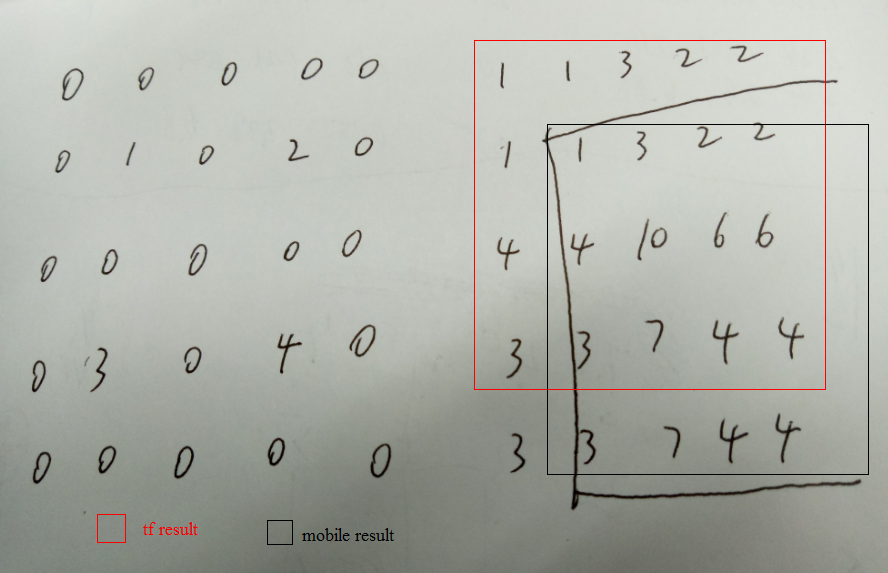
conv stride=1是四周padding 0,stride=2是down right padding 0

deconv是top left各插了两行0

而torch中的deconv是四周padding一圈0
参考http://blog.csdn.net/lujiandong1/article/details/53728053
'SAME' padding方式时,如果padding的数目是奇数,则多的padding在右边(下边)
2.实现custom-padding
https://stackoverflow.com/questions/37659538/custom-padding-for-convolutions-in-tensorflow
实现custom conv decon

def conv(input,num_outputs,kernel_size,stride=1,padW=0,padH=0,activation_fn=None,scope=None):

    padded_input = tf.pad(input, [[0, 0], [padH, padH], [padW, padW], [0, 0]], "CONSTANT")

    return slim.conv2d(padded_input,num_outputs,kernel_size,stride = stride,padding="VALID",activation_fn = activation_fn ,scope = scope)

input1 = tf.placeholder(tf.float32, shape=(1,4, 4,1))

a=np.ndarray(shape=(1,4,4,1),dtype='float',buffer=np.array([1.0,2,3,4,2,3,4,5,3,4,5,6,4,5,6,7]))

simpleconv=conv(input1,1,[3,3],stride = 2,padW=1,padH=1,activation_fn = None,scope = 'conv')

sess.run(tf.global_variables_initializer())

weights=graph.get_tensor_by_name("conv/weights:0")

sess.run(tf.assign(weights,tf.constant(1.0,shape=weights.shape)))

simpleconvout=sess.run(simpleconv,feed_dict={input1:a.astype('float32')})

print simpleconvout

[[[[ 8.]

[ 21.]]

[[ 21.]

[ 45.]]]]

def deconv(input,num_outputs,kernel_size,stride=2,activation_fn=None,scope=None):

    N,H,W,C = [i.value for i in input.get_shape()]

    out = slim.conv2d_transpose(input,num_outputs,kernel_size,stride = stride,padding="VALID",activation_fn = activation_fn ,scope = scope)

    return tf.slice(out, [0, kernel_size[0]/2,kernel_size[1]/2, 0], [N, H*stride, W*stride,num_outputs])

input = tf.placeholder(tf.float32, shape=(1,2, 2,1))

a=np.ndarray(shape=(1,2,2,1),dtype='float',buffer=np.array([1.0,2,3,4]))

simpledeconv=deconv(input,1,[3,3],stride = 2,activation_fn = None,scope = 'simpledeconv1')

sess.run(tf.global_variables_initializer())

weights=graph.get_tensor_by_name("simpledeconv1/weights:0")

sess.run(tf.assign(weights,tf.constant(1.0,shape=weights.shape)))

out=sess.run(simpledeconv,feed_dict={input:a.astype('float32')})

print out

[[[[ 1.]

[ 3.]

[ 2.]

[ 2.]]

[[ 4.]

[ 10.]

[ 6.]

[ 6.]]

[[ 3.]

[ 7.]

[ 4.]

[ 4.]]

[[ 3.]

[ 7.]

[ 4.]

[ 4.]]]]

tesnorflow conv deconv,padding的更多相关文章
- 深度学习卷积网络中反卷积/转置卷积的理解 transposed conv/deconv
搞明白了卷积网络中所谓deconv到底是个什么东西后,不写下来怕又忘记,根据参考资料,加上我自己的理解,记录在这篇博客里. 先来规范表达 为了方便理解,本文出现的举例情况都是2D矩阵卷积,卷积输入和核 ...
- 论文阅读(Xiang Bai——【arXiv2016】Scene Text Detection via Holistic, Multi-Channel Prediction)
Xiang Bai--[arXiv2016]Scene Text Detection via Holistic, Multi-Channel Prediction 目录 作者和相关链接 方法概括 创新 ...
- 论文笔记:Mask R-CNN
之前在一次组会上,师弟诉苦说他用 UNet 处理一个病灶分割的任务,但效果极差,我看了他的数据后发现,那些病灶区域比起整张图而言非常的小,而 UNet 采用的损失函数通常是逐像素的分类损失,如此一来, ...
- 本人AI知识体系导航 - AI menu
Relevant Readable Links Name Interesting topic Comment Edwin Chen 非参贝叶斯 徐亦达老板 Dirichlet Process 学习 ...
- 【文献阅读】Densely Connected Convolutional Networks-best paper-CVPR-2017
Densely Connected Convolutional Networks,CVPR-2017-best paper之一(共两篇,另外一篇是apple关于GAN的paper),早在去年八月 De ...
- 如何快速使用YOLO3进行目标检测
本文目的:介绍一篇YOLO3的Keras实现项目,便于快速了解如何使用预训练的YOLOv3,来对新图像进行目标检测. 本文使用的是Github上一位大神训练的YOLO3开源的项目.这个项目提供了很多使 ...
- YOLO v3算法介绍
图片来自https://towardsdatascience.com/yolo-v3-object-detection-with-keras-461d2cfccef6 数据前处理 输入的图片维数:(4 ...
- LCD: 2D-3D匹配算法
LCD: 2D-3D匹配算法 标题:LCD:Learned Cross-Domain Descriptors for 2D-3D Matching 作者:Quang-Hieu Pham, Mikael ...
- dilated conv、deconv、fractional-strided conv
deconv的其中一个用途是做upsampling,即增大图像尺寸. dilated convolution: dilated conv,中文可以叫做空洞卷积或者扩张卷积. 首先是诞生背景,在图像分割 ...
随机推荐
- Day 14A 网络编程入门
---恢复内容开始--- 计算机网络基础 计算机网络是独立自主的计算机互联而成的系统的总称,组建计算机网络最主要的目的是实现多台计算机之间的通信和资源共享.今天计算机网络中的设备和计算机网络的用户已经 ...
- Delphi新注释
标准请看帮助文件里的:XML Documentation Comments 个人常用 <summary></summary>:摘要 /// <summary> // ...
- JAVA基础——内存流
掌握内存操作流 输入和输出都是从文件中来的,当然,也可将输出的位置设置在内存上,这就需要ByteArrayInputStream和ByteArrayOutputStream ByteArrayInpu ...
- IDEA修改背景图片和主题代码风格
使用IDEA有一段时间了,之前为了写代码没时间折腾这玩意,以前使用Eclipse的时候一次性折腾好了,现在把之前Eclipse的配置再配到IDEA里面来,下面是效果图.Eclipse的设置见:点击这里 ...
- HTTP实验:分别使用httpd-2.2和httpd-2.4实现
1. 需求描述 1.建立httpd服务,要求: (1) 提供两个基于名称的虚拟主机: www1.stuX.com,页面文件目录为/web/vhosts/www1:错误日志为/var/log/httpd ...
- Python之机器学习-朴素贝叶斯(垃圾邮件分类)
目录 朴素贝叶斯(垃圾邮件分类) 邮箱训练集下载地址 模块导入 文本预处理 遍历邮件 训练模型 测试模型 朴素贝叶斯(垃圾邮件分类) 邮箱训练集下载地址 邮箱训练集可以加我微信:nickchen121 ...
- UvaLive 4917 Abstract Extract (模拟)
题意: 给定一篇文章, 文章中有段落, 段落中有句子. 句子只会以'!' , '.' , '?' 结尾, 求出每段中含有与他下面同样是该段落中相同单词数最多的句子, 注意, 单词忽略大小写, 重复的单 ...
- [bzoj3668][Noi2014][起床困难综合症] (按位贪心)
Description 21 世纪,许多人得了一种奇怪的病:起床困难综合症,其临床表现为:起床难,起床后精神不佳.作为一名青春阳光好少年,atm 一直坚持与起床困难综合症作斗争.通过研究相关文献,他找 ...
- 节点回来shard仍然delayed原因
1:es2 fetch shard data时,存在节点刚加入集群,还没有收到cluster metadata的情况.此时,节点因为没有该索引,返回的sharddata为empty,主节点缓存了该sh ...
- 微信开放平台PC端扫码登录功能个人总结
最近公司给我安排一个微信登录的功能,需求是这样的: 1.登录授权 点击二维码图标后,登录界面切换为如下样式(二维码),微信扫描二维码并授权,即可成功登录: 若当前账号未绑定微信账号,扫描后提示“ ...