
如何快速使用YOLO3进行目标检测
本文目的:介绍一篇YOLO3的Keras实现项目,便于快速了解如何使用预训练的YOLOv3,来对新图像进行目标检测。
本文使用的是Github上一位大神训练的YOLO3开源的项目。这个项目提供了很多使用 YOLOv3 的模型,包括对象检测、迁移学习、从头开始训练模型等。其中提供了一个脚本文件yolo3_one_file_to_detect_them_all.py,作者表示单独运行即可进行目标检测。
但是经过测试,还是有几个坑。所以我把代码分解成几个功能模块,在jupyter notebook上单独运行,查出bug后,即可正常运行。
本文操作十分方便,直接下载权重文件,将后面三部分代码拷贝至jupyter notebook运行即可(前提是需要安装库numpy、Keras、cv2),不需要其他的脚本文件。
第一步:下载权重文件 https://pjreddie.com/media/files/yolov3.weights
这个权重是在MS COCO上训练的结果,因此可以检测80种目标。
第二步:导入需要的库函数,以及后续待用的函数
import argparse

import os

import numpy as np

from keras.layers import Conv2D, Input, BatchNormalization, LeakyReLU, ZeroPadding2D, UpSampling2D

from keras.layers.merge import add, concatenate

from keras.models import Model

import struct

import cv2

#改动1:这里报错,和我机器不一致,所以注释掉

#np.set_printoptions(threshold=np.nan)

#os.environ["CUDA_DEVICE_ORDER"]="PCI_BUS_ID"

#os.environ["CUDA_VISIBLE_DEVICES"]="0"

argparser = argparse.ArgumentParser(

    description='test yolov3 network with coco weights')

argparser.add_argument(

    '-w',

    '--weights',

    help='path to weights file')

argparser.add_argument(

    '-i',

    '--image',

    help='path to image file')

class WeightReader:

    def __init__(self, weight_file):

        with open(weight_file, 'rb') as w_f:

            major,    = struct.unpack('i', w_f.read(4))

            minor,    = struct.unpack('i', w_f.read(4))

            revision, = struct.unpack('i', w_f.read(4))

            if (major*10 + minor) >= 2 and major < 1000 and minor < 1000:

                w_f.read(8)

            else:

                w_f.read(4)

            transpose = (major > 1000) or (minor > 1000)

            binary = w_f.read()

        self.offset = 0

        self.all_weights = np.frombuffer(binary, dtype='float32')

    def read_bytes(self, size):

        self.offset = self.offset + size

        return self.all_weights[self.offset-size:self.offset]

    def load_weights(self, model):

        for i in range(106):

            try:

                conv_layer = model.get_layer('conv_' + str(i))

                print("loading weights of convolution #" + str(i))

                if i not in [81, 93, 105]:

                    norm_layer = model.get_layer('bnorm_' + str(i))

                    size = np.prod(norm_layer.get_weights()[0].shape)

                    beta  = self.read_bytes(size) # bias

                    gamma = self.read_bytes(size) # scale

                    mean  = self.read_bytes(size) # mean

                    var   = self.read_bytes(size) # variance

                    weights = norm_layer.set_weights([gamma, beta, mean, var])

                if len(conv_layer.get_weights()) > 1:

                    bias   = self.read_bytes(np.prod(conv_layer.get_weights()[1].shape))

                    kernel = self.read_bytes(np.prod(conv_layer.get_weights()[0].shape))

                    kernel = kernel.reshape(list(reversed(conv_layer.get_weights()[0].shape)))

                    kernel = kernel.transpose([2,3,1,0])

                    conv_layer.set_weights([kernel, bias])

                else:

                    kernel = self.read_bytes(np.prod(conv_layer.get_weights()[0].shape))

                    kernel = kernel.reshape(list(reversed(conv_layer.get_weights()[0].shape)))

                    kernel = kernel.transpose([2,3,1,0])

                    conv_layer.set_weights([kernel])

            except ValueError:

                print("no convolution #" + str(i))

    def reset(self):

        self.offset = 0

class BoundBox:

    def __init__(self, xmin, ymin, xmax, ymax, objness = None, classes = None):

        self.xmin = xmin

        self.ymin = ymin

        self.xmax = xmax

        self.ymax = ymax

        self.objness = objness

        self.classes = classes

        self.label = -1

        self.score = -1

    def get_label(self):

        if self.label == -1:

            self.label = np.argmax(self.classes)

        return self.label

    def get_score(self):

        if self.score == -1:

            self.score = self.classes[self.get_label()]

        return self.score

def _conv_block(inp, convs, skip=True):

    x = inp

    count = 0

    for conv in convs:

        if count == (len(convs) - 2) and skip:

            skip_connection = x

        count += 1

        if conv['stride'] > 1: x = ZeroPadding2D(((1,0),(1,0)))(x) # peculiar padding as darknet prefer left and top

        x = Conv2D(conv['filter'],

                   conv['kernel'],

                   strides=conv['stride'],

                   padding='valid' if conv['stride'] > 1 else 'same', # peculiar padding as darknet prefer left and top

                   name='conv_' + str(conv['layer_idx']),

                   use_bias=False if conv['bnorm'] else True)(x)

        if conv['bnorm']: x = BatchNormalization(epsilon=0.001, name='bnorm_' + str(conv['layer_idx']))(x)

        if conv['leaky']: x = LeakyReLU(alpha=0.1, name='leaky_' + str(conv['layer_idx']))(x)

    return add([skip_connection, x]) if skip else x

def _interval_overlap(interval_a, interval_b):

    x1, x2 = interval_a

    x3, x4 = interval_b

    if x3 < x1:

        if x4 < x1:

            return 0

        else:

            return min(x2,x4) - x1

    else:

        if x2 < x3:

             return 0

        else:

            return min(x2,x4) - x3

def _sigmoid(x):

    return 1. / (1. + np.exp(-x))

def bbox_iou(box1, box2):

    intersect_w = _interval_overlap([box1.xmin, box1.xmax], [box2.xmin, box2.xmax])

    intersect_h = _interval_overlap([box1.ymin, box1.ymax], [box2.ymin, box2.ymax])

    intersect = intersect_w * intersect_h

    w1, h1 = box1.xmax-box1.xmin, box1.ymax-box1.ymin

    w2, h2 = box2.xmax-box2.xmin, box2.ymax-box2.ymin

    union = w1*h1 + w2*h2 - intersect

    return float(intersect) / union

def make_yolov3_model():

    input_image = Input(shape=(None, None, 3))

    # Layer  0 => 4

    x = _conv_block(input_image, [{'filter': 32, 'kernel': 3, 'stride': 1, 'bnorm': True, 'leaky': True, 'layer_idx': 0},

                                  {'filter': 64, 'kernel': 3, 'stride': 2, 'bnorm': True, 'leaky': True, 'layer_idx': 1},

                                  {'filter': 32, 'kernel': 1, 'stride': 1, 'bnorm': True, 'leaky': True, 'layer_idx': 2},

                                  {'filter': 64, 'kernel': 3, 'stride': 1, 'bnorm': True, 'leaky': True, 'layer_idx': 3}])

    # Layer  5 => 8

    x = _conv_block(x, [{'filter': 128, 'kernel': 3, 'stride': 2, 'bnorm': True, 'leaky': True, 'layer_idx': 5},

                        {'filter':  64, 'kernel': 1, 'stride': 1, 'bnorm': True, 'leaky': True, 'layer_idx': 6},

                        {'filter': 128, 'kernel': 3, 'stride': 1, 'bnorm': True, 'leaky': True, 'layer_idx': 7}])

    # Layer  9 => 11

    x = _conv_block(x, [{'filter':  64, 'kernel': 1, 'stride': 1, 'bnorm': True, 'leaky': True, 'layer_idx': 9},

                        {'filter': 128, 'kernel': 3, 'stride': 1, 'bnorm': True, 'leaky': True, 'layer_idx': 10}])

    # Layer 12 => 15

    x = _conv_block(x, [{'filter': 256, 'kernel': 3, 'stride': 2, 'bnorm': True, 'leaky': True, 'layer_idx': 12},

                        {'filter': 128, 'kernel': 1, 'stride': 1, 'bnorm': True, 'leaky': True, 'layer_idx': 13},

                        {'filter': 256, 'kernel': 3, 'stride': 1, 'bnorm': True, 'leaky': True, 'layer_idx': 14}])

    # Layer 16 => 36

    for i in range(7):

        x = _conv_block(x, [{'filter': 128, 'kernel': 1, 'stride': 1, 'bnorm': True, 'leaky': True, 'layer_idx': 16+i*3},

                            {'filter': 256, 'kernel': 3, 'stride': 1, 'bnorm': True, 'leaky': True, 'layer_idx': 17+i*3}])

    skip_36 = x

    # Layer 37 => 40

    x = _conv_block(x, [{'filter': 512, 'kernel': 3, 'stride': 2, 'bnorm': True, 'leaky': True, 'layer_idx': 37},

                        {'filter': 256, 'kernel': 1, 'stride': 1, 'bnorm': True, 'leaky': True, 'layer_idx': 38},

                        {'filter': 512, 'kernel': 3, 'stride': 1, 'bnorm': True, 'leaky': True, 'layer_idx': 39}])

    # Layer 41 => 61

    for i in range(7):

        x = _conv_block(x, [{'filter': 256, 'kernel': 1, 'stride': 1, 'bnorm': True, 'leaky': True, 'layer_idx': 41+i*3},

                            {'filter': 512, 'kernel': 3, 'stride': 1, 'bnorm': True, 'leaky': True, 'layer_idx': 42+i*3}])

    skip_61 = x

    # Layer 62 => 65

    x = _conv_block(x, [{'filter': 1024, 'kernel': 3, 'stride': 2, 'bnorm': True, 'leaky': True, 'layer_idx': 62},

                        {'filter':  512, 'kernel': 1, 'stride': 1, 'bnorm': True, 'leaky': True, 'layer_idx': 63},

                        {'filter': 1024, 'kernel': 3, 'stride': 1, 'bnorm': True, 'leaky': True, 'layer_idx': 64}])

    # Layer 66 => 74

    for i in range(3):

        x = _conv_block(x, [{'filter':  512, 'kernel': 1, 'stride': 1, 'bnorm': True, 'leaky': True, 'layer_idx': 66+i*3},

                            {'filter': 1024, 'kernel': 3, 'stride': 1, 'bnorm': True, 'leaky': True, 'layer_idx': 67+i*3}])

    # Layer 75 => 79

    x = _conv_block(x, [{'filter':  512, 'kernel': 1, 'stride': 1, 'bnorm': True, 'leaky': True, 'layer_idx': 75},

                        {'filter': 1024, 'kernel': 3, 'stride': 1, 'bnorm': True, 'leaky': True, 'layer_idx': 76},

                        {'filter':  512, 'kernel': 1, 'stride': 1, 'bnorm': True, 'leaky': True, 'layer_idx': 77},

                        {'filter': 1024, 'kernel': 3, 'stride': 1, 'bnorm': True, 'leaky': True, 'layer_idx': 78},

                        {'filter':  512, 'kernel': 1, 'stride': 1, 'bnorm': True, 'leaky': True, 'layer_idx': 79}], skip=False)

    # Layer 80 => 82

    yolo_82 = _conv_block(x, [{'filter': 1024, 'kernel': 3, 'stride': 1, 'bnorm': True,  'leaky': True,  'layer_idx': 80},

                              {'filter':  255, 'kernel': 1, 'stride': 1, 'bnorm': False, 'leaky': False, 'layer_idx': 81}], skip=False)

    # Layer 83 => 86

    x = _conv_block(x, [{'filter': 256, 'kernel': 1, 'stride': 1, 'bnorm': True, 'leaky': True, 'layer_idx': 84}], skip=False)

    x = UpSampling2D(2)(x)

    x = concatenate([x, skip_61])

    # Layer 87 => 91

    x = _conv_block(x, [{'filter': 256, 'kernel': 1, 'stride': 1, 'bnorm': True, 'leaky': True, 'layer_idx': 87},

                        {'filter': 512, 'kernel': 3, 'stride': 1, 'bnorm': True, 'leaky': True, 'layer_idx': 88},

                        {'filter': 256, 'kernel': 1, 'stride': 1, 'bnorm': True, 'leaky': True, 'layer_idx': 89},

                        {'filter': 512, 'kernel': 3, 'stride': 1, 'bnorm': True, 'leaky': True, 'layer_idx': 90},

                        {'filter': 256, 'kernel': 1, 'stride': 1, 'bnorm': True, 'leaky': True, 'layer_idx': 91}], skip=False)

    # Layer 92 => 94

    yolo_94 = _conv_block(x, [{'filter': 512, 'kernel': 3, 'stride': 1, 'bnorm': True,  'leaky': True,  'layer_idx': 92},

                              {'filter': 255, 'kernel': 1, 'stride': 1, 'bnorm': False, 'leaky': False, 'layer_idx': 93}], skip=False)

    # Layer 95 => 98

    x = _conv_block(x, [{'filter': 128, 'kernel': 1, 'stride': 1, 'bnorm': True, 'leaky': True,   'layer_idx': 96}], skip=False)

    x = UpSampling2D(2)(x)

    x = concatenate([x, skip_36])

    # Layer 99 => 106

    yolo_106 = _conv_block(x, [{'filter': 128, 'kernel': 1, 'stride': 1, 'bnorm': True,  'leaky': True,  'layer_idx': 99},

                               {'filter': 256, 'kernel': 3, 'stride': 1, 'bnorm': True,  'leaky': True,  'layer_idx': 100},

                               {'filter': 128, 'kernel': 1, 'stride': 1, 'bnorm': True,  'leaky': True,  'layer_idx': 101},

                               {'filter': 256, 'kernel': 3, 'stride': 1, 'bnorm': True,  'leaky': True,  'layer_idx': 102},

                               {'filter': 128, 'kernel': 1, 'stride': 1, 'bnorm': True,  'leaky': True,  'layer_idx': 103},

                               {'filter': 256, 'kernel': 3, 'stride': 1, 'bnorm': True,  'leaky': True,  'layer_idx': 104},

                               {'filter': 255, 'kernel': 1, 'stride': 1, 'bnorm': False, 'leaky': False, 'layer_idx': 105}], skip=False)

    model = Model(input_image, [yolo_82, yolo_94, yolo_106])

    return model

def preprocess_input(image, net_h, net_w):

    new_h, new_w, _ = image.shape

    # determine the new size of the image

    if (float(net_w)/new_w) < (float(net_h)/new_h):

        new_h = (new_h * net_w)/new_w

        new_w = net_w

    else:

        new_w = (new_w * net_h)/new_h

        new_h = net_h

    # resize the image to the new size

    resized = cv2.resize(image[:,:,::-1]/255., (int(new_w), int(new_h)))

    # embed the image into the standard letter box

    new_image = np.ones((net_h, net_w, 3)) * 0.5

    #改动2:下面有个坑,源代码中new_h可能会出现小数截断之后不匹配问题,所以提前截断

    #new_image[int((net_h-new_h)//2):int((net_h+new_h)//2), int((net_w-new_w)//2):int((net_w+new_w)//2), :] = resized

    new_image[int((net_h-int(new_h))//2):int((net_h+int(new_h))//2), int((net_w-int(new_w))//2):int((net_w+int(new_w))//2), :] = resized

    new_image = np.expand_dims(new_image, 0)

    return new_image

def decode_netout(netout, anchors, obj_thresh, nms_thresh, net_h, net_w):

    grid_h, grid_w = netout.shape[:2]

    nb_box = 3

    netout = netout.reshape((grid_h, grid_w, nb_box, -1))

    nb_class = netout.shape[-1] - 5

    boxes = []

    netout[..., :2]  = _sigmoid(netout[..., :2])

    netout[..., 4:]  = _sigmoid(netout[..., 4:])

    netout[..., 5:]  = netout[..., 4][..., np.newaxis] * netout[..., 5:]

    netout[..., 5:] *= netout[..., 5:] > obj_thresh

    for i in range(grid_h*grid_w):

        row = i / grid_w

        col = i % grid_w

        for b in range(nb_box):

            # 4th element is objectness score

            objectness = netout[int(row)][int(col)][b][4]

            #objectness = netout[..., :4]

            if(objectness.all() <= obj_thresh): continue

            # first 4 elements are x, y, w, and h

            x, y, w, h = netout[int(row)][int(col)][b][:4]

            x = (col + x) / grid_w # center position, unit: image width

            y = (row + y) / grid_h # center position, unit: image height

            w = anchors[2 * b + 0] * np.exp(w) / net_w # unit: image width

            h = anchors[2 * b + 1] * np.exp(h) / net_h # unit: image height

            # last elements are class probabilities

            classes = netout[int(row)][col][b][5:]

            box = BoundBox(x-w/2, y-h/2, x+w/2, y+h/2, objectness, classes)

            #box = BoundBox(x-w/2, y-h/2, x+w/2, y+h/2, None, classes)

            boxes.append(box)

    return boxes

def correct_yolo_boxes(boxes, image_h, image_w, net_h, net_w):

    if (float(net_w)/image_w) < (float(net_h)/image_h):

        new_w = net_w

        new_h = (image_h*net_w)/image_w

    else:

        new_h = net_w

        new_w = (image_w*net_h)/image_h

    for i in range(len(boxes)):

        x_offset, x_scale = (net_w - new_w)/2./net_w, float(new_w)/net_w

        y_offset, y_scale = (net_h - new_h)/2./net_h, float(new_h)/net_h

        boxes[i].xmin = int((boxes[i].xmin - x_offset) / x_scale * image_w)

        boxes[i].xmax = int((boxes[i].xmax - x_offset) / x_scale * image_w)

        boxes[i].ymin = int((boxes[i].ymin - y_offset) / y_scale * image_h)

        boxes[i].ymax = int((boxes[i].ymax - y_offset) / y_scale * image_h)

def do_nms(boxes, nms_thresh):

    if len(boxes) > 0:

        nb_class = len(boxes[0].classes)

    else:

        return

    for c in range(nb_class):

        sorted_indices = np.argsort([-box.classes[c] for box in boxes])

        for i in range(len(sorted_indices)):

            index_i = sorted_indices[i]

            if boxes[index_i].classes[c] == 0: continue

            for j in range(i+1, len(sorted_indices)):

                index_j = sorted_indices[j]

                if bbox_iou(boxes[index_i], boxes[index_j]) >= nms_thresh:

                    boxes[index_j].classes[c] = 0

def draw_boxes(image, boxes, labels, obj_thresh):

    for box in boxes:

        label_str = ''

        label = -1

        for i in range(len(labels)):

            if box.classes[i] > obj_thresh:

                label_str += labels[i]

                label = i

                print(labels[i] + ': ' + str(box.classes[i]*100) + '%')

        if label >= 0:

            cv2.rectangle(image, (box.xmin,box.ymin), (box.xmax,box.ymax), (0,255,0), 3)

            #改动3:原预测框标签不清晰,所以重新画

            #cv2.putText(image,

            #            label_str + ' ' + str(box.get_score()),

            #            (box.xmin, box.ymin - 13),

            #            cv2.FONT_HERSHEY_SIMPLEX,

            #            1e-3 * image.shape[0],

            #            (0,255,0), 2)

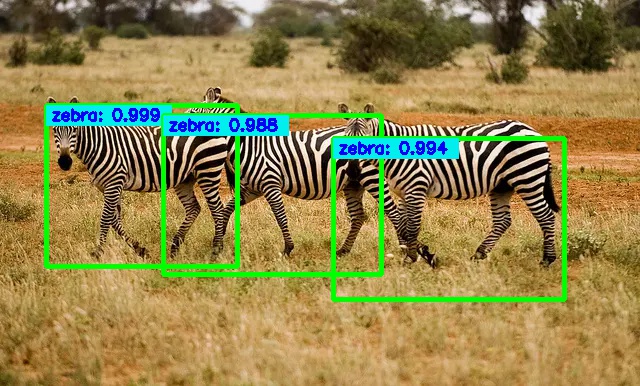
            cv2.rectangle(image, (box.xmin,box.ymin), (box.xmin+125,box.ymin+20), (238,238,0), -1)

            tag = '{}: {:.3f}'.format(label_str, box.get_score())

            cv2.putText(image,

                        tag,

                        (box.xmin+5, box.ymin+15),

                        cv2.FONT_HERSHEY_SIMPLEX,

                        1.4e-3 * image.shape[0],

                        (255,0,0), 2)

    return image
第三步:创建模型,加载权重
#建模并加载权重

weights_path = 'MyFiles/yolov3.weights'  #这里是权重文件路径

# make the yolov3 model to predict 80 classes on COCO

yolov3 = make_yolov3_model()

# load the weights trained on COCO into the model

weight_reader = WeightReader(weights_path)

weight_reader.load_weights(yolov3)
第四步:对新图像做目标检测
需要预测的图像示例:

##########################设置参数###################################

net_h, net_w = 416, 416

obj_thresh, nms_thresh = 0.5, 0.45

anchors = [[116,90,  156,198,  373,326],  [30,61, 62,45,  59,119], [10,13,  16,30,  33,23]]

labels = ["person", "bicycle", "car", "motorbike", "aeroplane", "bus", "train", "truck", \

          "boat", "traffic light", "fire hydrant", "stop sign", "parking meter", "bench", \

          "bird", "cat", "dog", "horse", "sheep", "cow", "elephant", "bear", "zebra", "giraffe", \

          "backpack", "umbrella", "handbag", "tie", "suitcase", "frisbee", "skis", "snowboard", \

          "sports ball", "kite", "baseball bat", "baseball glove", "skateboard", "surfboard", \

          "tennis racket", "bottle", "wine glass", "cup", "fork", "knife", "spoon", "bowl", "banana", \

          "apple", "sandwich", "orange", "broccoli", "carrot", "hot dog", "pizza", "donut", "cake", \

          "chair", "sofa", "pottedplant", "bed", "diningtable", "toilet", "tvmonitor", "laptop", "mouse", \

          "remote", "keyboard", "cell phone", "microwave", "oven", "toaster", "sink", "refrigerator", \

          "book", "clock", "vase", "scissors", "teddy bear", "hair drier", "toothbrush"]

###########################预测图像################################

image_path   = 'MyFiles/zebra.jpg' #要预测的图像路径

# preprocess the image

image = cv2.imread(image_path)

image_h, image_w, _ = image.shape

new_image = preprocess_input(image, net_h, net_w)

# run the prediction

yolos = yolov3.predict(new_image)

boxes = []

for i in range(len(yolos)):

    # decode the output of the network

    boxes += decode_netout(yolos[i][0], anchors[i], obj_thresh, nms_thresh, net_h, net_w)

# correct the sizes of the bounding boxes

correct_yolo_boxes(boxes, image_h, image_w, net_h, net_w)

# suppress non-maximal boxes

do_nms(boxes, nms_thresh)

# draw bounding boxes on the image using labels

draw_boxes(image, boxes, labels, obj_thresh)

# write the image with bounding boxes to file

cv2.imwrite(image_path[:-4] + '_detected' + image_path[-4:], (image).astype('uint8'))
注意:原yolo3_one_file_to_detect_them_all.py文件中对应代码运行后程序有两次报错:
- 第一次是最开始的环境设置代码,直接注释掉即可;
- 第二次错误指向第二步的preprocess_input()函数 ValueError: could not broadcast input array from shape (250,416,3) into shape (251,416,3)。模型输入指定尺寸是(416,416),示例图像的像素是(386,640),将其带入preprocess_input函数后,发现 new_image[...] = resized 这一步出现了浮点数截断带来的问题,因此注释掉,换成本文中代码。
将两处代码修改后,检测结果如图所示:
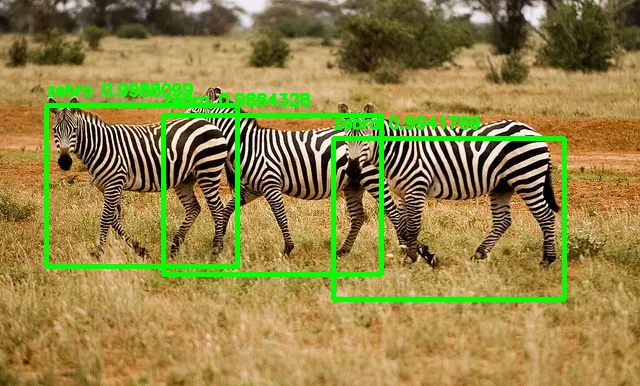
这个检测结果标签不清楚,于是将边框绘制函数 draw_boxes() 改成本文中代码,结果如下,虽然美观不足,但足够清楚。
其他注意点:
Reference:
https://juejin.im/post/5d12eef5e51d455a68490ba8
https://github.com/experiencor/keras-yolo3
https://blog.csdn.net/loovelj/article/details/81097614
如何快速使用YOLO3进行目标检测的更多相关文章
- 第三十五节,目标检测之YOLO算法详解
Redmon, J., Divvala, S., Girshick, R., Farhadi, A.: You only look once: Unified, real-time object de ...
- yolo3(目标检测)实测
yolo是继faster-r-cnn后,原作者在目标检测领域进行的新研究.到了v3版本以后,虽然已经换人支持,但是更注重工程实践,在实际使用过程中突出感受就是 “非常快”,GPU加速以后能够达到实时多 ...
- 快速理解YOLO目标检测
YOLO(You Only Look Once)论文 近些年,R-CNN等基于深度学习目标检测方法,大大提高了检测精度和检测速度. 例如在Pascal VOC数据集上Faster R-CNN的mAP达 ...
- 【目标检测】YOLO:
PPT 可以说是讲得相当之清楚了... deepsystems.io 中文翻译: https://zhuanlan.zhihu.com/p/24916786 图解YOLO YOLO核心思想:从R-CN ...
- [目标检测]YOLO原理
1 YOLO 创新点: 端到端训练及推断 + 改革区域建议框式目标检测框架 + 实时目标检测 1.1 创新点 (1) 改革了区域建议框式检测框架: RCNN系列均需要生成建议框,在建议框上进行分类与回 ...
- 目标检测网络之 YOLOv2
YOLOv1基本思想 YOLO将输入图像分成SxS个格子,若某个物体 Ground truth 的中心位置的坐标落入到某个格子,那么这个格子就负责检测出这个物体. 每个格子预测B个bounding b ...
- 【深度学习】目标检测算法总结(R-CNN、Fast R-CNN、Faster R-CNN、FPN、YOLO、SSD、RetinaNet)
目标检测是很多计算机视觉任务的基础,不论我们需要实现图像与文字的交互还是需要识别精细类别,它都提供了可靠的信息.本文对目标检测进行了整体回顾,第一部分从RCNN开始介绍基于候选区域的目标检测器,包括F ...
- 利用更快的r-cnn深度学习进行目标检测
此示例演示如何使用名为“更快r-cnn(具有卷积神经网络的区域)”的深度学习技术来训练对象探测器. 概述 此示例演示如何训练用于检测车辆的更快r-cnn对象探测器.更快的r-nnn [1]是r-cnn ...
- 目标检测网络之 YOLOv3
本文逐步介绍YOLO v1~v3的设计历程. YOLOv1基本思想 YOLO将输入图像分成SxS个格子,若某个物体 Ground truth 的中心位置的坐标落入到某个格子,那么这个格子就负责检测出这 ...
随机推荐
- poj 2505 乘法博弈论
转自:http://hzwer.com/1921.html 题目大意: 题意:Stan从1开始,可以乘上2~9中任何一个数,Ollie也如此操作,只到某个人本回合的操作超过N为之..1<N< ...
- python 文件单行循环读取的坑(一个程序中,文件默认只能按行循环读取一次,即使写到另一个循环里,它也只读取一次)
本来写了一个程序,想获取a文件中有,但是b文件中没有的行: 想到的方法是:1.一行一行提取a文件中数据,然后用a文件中的每一行与b文件中的每一行比较, 2.如果找到相同行就继续查找a中的下一行,如果找 ...
- buuctf | [强网杯 2019]随便注
1' and '0,1' and '1 : 单引号闭合 1' order by 3--+ : 猜字段 1' union select 1,database()# :开始注入,发现正则过滤 1' an ...
- 分布式架构下的会话追踪实践【基于Cookie和Redis实现】
分布式架构下的会话追踪实践[基于Cookie和Redis实现] 博客分类: NoSQL/Redis/MongoDB session共享rediscookie分布式架构session 在单台Tomcat ...
- nginx配置-location
以 =开头表示精确匹配如 A 中只匹配根目录结尾的请求,后面不能带任何字符串. ^~ 开头表示uri以某个常规字符串开头,不是正则匹配 ~ 开头表示区分大小写的正则匹配; ~* 开头表示不区分大小写的 ...
- Weblgic安装应用报错:Caused by: com.bea.xml.XmlException: failed to load java type corresponding to e=web-a
文章目录 报错如下 解决: 报错如下 Exception in AppMerge flows' progression 后台日志报错: Caused by: com.bea.xml.XmlExcept ...
- MultipartFile 图片上传到Linux服务器Tomcat下的webapps目录
第一次接触 linux 服务器,做图片上传的时候遇到了些坑,搞了些天总算成功了,记录一下 /** * 上传图片 * * @param request * @param file * @return * ...
- VUE不能对新增属性监测更新
data () { return { data:{}, } }, method:{ if(data.code==0){ this.loading = false; this.data = data.d ...
- git笔记十:本地仓库同步到gitlab
本地仓库同步到gitlab 帮助文档 git remote --help 操作场景: 本地创建git仓库(含有readme.md文件), commit了三次 gitlab网站创建了一个项目 添加了re ...
- Oracle基础数据类型与运算符
Oracle基础数据类型: 1. 字符型:字符串 char(最大2000), nchar(最大1000, 支持 Unicode)--->固定长 ...