
Chapter 8 The Simplest Plug-in Solution
This chapter introduces the simplest plug-in solution that are applicable to the four major components. This solution involves the following aspects:
1) Combine the dex of all plugins to solve the problem of loading plug-in's class.
2) Declare the four major components of the plugin in the host app’s AndroidManifest file. It’s a nuisance for hundreds of activities in the plug-in.
3) Merge all the resources in the plug-in into the host's resources in one time. Of course, this may result in conflict of resource ids.
8.1 Declaring Components in a Plug-in in Android Manifest
As we mentioned earlier, the four major components in the plug-in are just ordinary classes that the system does not recognize at all.
To make the host app to recognize them, you must declare the four major components in the host app's AndroidManifest.xml.
Then there is the simplest plug-in solution in history. The four components in the plug-in are declared in the host app.
Look at the example ZeusStudy1.0, as shown in the figure below. Plugin1 has a TestService1 component
.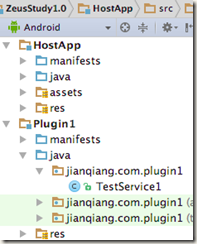
Figure 8-1 Project structure of Plugin1
Correspondingly, in the Host app’s AndroidManifest file, the statement is as follows:
<service android:name="jianqiang.com.plugin1.TestService1" />
8.2 Combine the dex
Host app loads classes in plug-ins, there are two methods to make it. [1]
1.Use the class of plug-in’s ClassLoader;
2.Combine the dexs of host app and plug-in.
The second one is simpler.
Once the plug-in dex is merged into the host's dex, then the ClassLoader corresponding to the host App loads all the classes in the plug-in as follows:
public final class BaseDexClassLoaderHookHelper {
public static void patchClassLoader(ClassLoader cl, File apkFile, File optDexFile)
throws IllegalAccessException, NoSuchMethodException, IOException, InvocationTargetException, InstantiationException, NoSuchFieldException {
// Obtain BaseDexClassLoader : pathList
Object pathListObj = RefInvoke.getFieldObject(DexClassLoader.class.getSuperclass(), cl, "pathList");
// Obtain PathList: Element[] dexElements
Object[] dexElements = (Object[]) RefInvoke.getFieldObject(pathListObj, "dexElements");
// Element type
Class<?> elementClass = dexElements.getClass().getComponentType();
// Create an array to replace the original array
Object[] newElements = (Object[]) Array.newInstance(elementClass, dexElements.length + 1);
// Construct a plugin Element(File file, boolean isDirectory, File zip, DexFile dexFile) This constructor
Class[] p1 = {File.class, boolean.class, File.class, DexFile.class};
Object[] v1 = {apkFile, false, apkFile, DexFile.loadDex(apkFile.getCanonicalPath(), optDexFile.getAbsolutePath(), 0)};
Object o = RefInvoke.createObject(elementClass, p1, v1);
Object[] toAddElementArray = new Object[] { o };
// Copy the original elements
System.arraycopy(dexElements, 0, newElements, 0, dexElements.length);
// The element of the plugin is copied in
System.arraycopy(toAddElementArray, 0, newElements, dexElements.length, toAddElementArray.length);
// replace
RefInvoke.setFieldObject(pathListObj, "dexElements", newElements);
}
}
8.3 Start the Service of plug-in
Combined with the previous two parts, the host App can start a service that in plug-in.
Intent intent = new Intent();
String serviceName = "jianqiang.com.plugin1.TestService1";
intent.setClassName(this, serviceName);
startService(intent);
8.4Activity resources [2]
Not just Service, four major components can be implemented as plug-in program. Both ContentProvider and Receiver are relatively simple, you can try to implement it by yourself.
Service, ContentProvider, and Receiver just need to merge dex, because they have no resources.
The solution for Activity here is a bit complicated.
Activity is heavily dependent on resources. Therefore, if you want to implement the plug-in of the Activity, you must solve the problem of loading the resources in the plug-in.
Chapter 7 introduced the relationship between AssetManager and Resources. AssetManager has an addAssetPath method that can populate the plugin's path all at once, and then generates a "super" Resource based on this "super" AssetManager.
Save this Super Resources in the global variable PluginManager. After you find the plugin or the host resource, you can find it too.
The above logic is implemented as follows (located in MyApplication):
private static void reloadInstalledPluginResources() {
try {
AssetManager assetManager = AssetManager.class.newInstance();
Method addAssetPath = AssetManager.class.getMethod("addAssetPath", String.class);
addAssetPath.invoke(assetManager, mBaseContext.getPackageResourcePath());
addAssetPath.invoke(assetManager, pluginItem1.pluginPath);
Resources newResources = new Resources(assetManager,
mBaseContext.getResources().getDisplayMetrics(),
mBaseContext.getResources().getConfiguration());
RefInvoke.setFieldObject (mBaseContext, "mResources", newResources);
// This is the main need to replace, if you do not support the plug-in runtime update, just leave this one
RefInvoke.setFieldObject (mPackageInfo, "mResources", newResources);
mNowResources = newResources;
// Need to clean up the mTheme object, otherwise it will report an error when loading resources through inflate mode
// If the activity dynamically loads the plugin, you need to set the activity's mTheme object to null RefInvoke.setFieldObject (mBaseContext, "mTheme", null);
} catch (Throwable e) {
e.printStackTrace();
}
The plug-in Activity must implement the base class ZeusBaseActivity. In this base class, the getResource method is overridden, thereby ensuring that the plug-in Activity is fetched from the "super" Resources each time it fetches resources.
public class ZeusBaseActivity extends Activity {
@Override
public Resources getResources() {
return PluginManager.mNowResources;
}
}
Here is the code for TestActivity1 in plug-in which called Plugin1. It uses the layout xml resource called activity_test1 in the plug-in:
public class TestActivity1 extends ZeusBaseActivity {
private final static String TAG = "TestActivity1";
@Override
protected void onCreate(Bundle savedInstanceState) {
super.onCreate(savedInstanceState);
setContentView(R.layout.activity_test1);
findViewById(R.id.button1).setOnClickListener(new View.OnClickListener() {
@Override
public void onClick(View v) {
try {
Intent intent = new Intent();
String activityName = "jianqiang.com.hostapp.ActivityA";
intent.setComponent(new ComponentName("jianqiang.com.hostapp", activityName));
startActivity(intent);
} catch (Exception e) {
e.printStackTrace();
}
}
});
}
}
At this point, the simplest plug-in solution of activity is complete, and we can even jump from the plug-in activity to the activity in the host.
However, there has a fatal problem: The four major components in the plugin must be declared in the host's AndroidManifest file beforehand and cannot be added.
In fact, for most of the App, rarely use Service, Receiver and ContentProvider, so the plug-in has these three components, is also typically updated logic, and will not add new.
However, there are many activities in the plug-in, and also add new, at this moment, we cannot pre-empt in the host AndroidManifest file.
This issue will be completely resolved in Chapter 9.
8.5Summary
This chapter introduces the simplest plug-in solution. Although the plug-in can be successfully loaded, there are many problems:
1) Because the plugin and host resources are merged together, the resource ids will conflict.
2) Activity in the plug-in cannot be expected in advance, especially add new Activity1 in the plug-in.
These problems will be solved in the subsequent chapters.
[1] This section example code, please refer to https://github.com/Baobaojianqiang/ZeusStudy1.0
[2] This section example code, please refer to https://github.com/Baobaojianqiang/ZeusStudy1.1
Chapter 8 The Simplest Plug-in Solution的更多相关文章
- C++ 之 策略模式
1 会飞的鸭子 Duck 基类,包含两个成员函数 swim() 和 display():派生类 MallardDuck,RedheadDuck 和 RubberDuck,各自重写 display() ...
- (转)几种范数的解释 l0-Norm, l1-Norm, l2-Norm, … , l-infinity Norm
几种范数的解释 l0-Norm, l1-Norm, l2-Norm, - , l-infinity Norm from Rorasa's blog l0-Norm, l1-Norm, l2-Norm, ...
- 如何创建Asp.net MVC ViewModel
ASP.NET MVC View Model Patterns Since MVC has been released I have observed much confusion about how ...
- C#主要字典集合性能对比[转]
A post I made a couple days ago about the side-effect of concurrency (the concurrent collections in ...
- 2D Rotated Rectangle Collision
Introduction While working on a project for school, I found it necessary to perform a collision chec ...
- TIJ——Chapter One:Introduction to Objects
///:~容我对这个系列美其名曰"读书笔记",其实shi在练习英文哈:-) Introduction to Objects Object-oriented programming( ...
- Think Python - Chapter 18 - Inheritance
In this chapter I present classes to represent playing cards, decks of cards, and poker hands.If you ...
- Think Python - Chapter 11 - Dictionaries
Dictionaries A dictionary is like a list, but more general. In a list, the indices have to be intege ...
- Chapter 4: Spring and AOP:Spring's AOP Framework -- draft
Spring's AOP Framework Let's begin by looking at Spring's own AOP framework - a proxy-based framewor ...
随机推荐
- docker image 详解
docker iamge docker 镜像: [root@localhost ~]# docker image --help Usage: docker image COMMAND 管理镜像 Com ...
- 纯css3单选框/复选框美化样式代码
纯CSS 单/复选框 美化请选择iPhone 型号 iPhone 6s iPhone 6s Plus iPhone 7 iPhone 7 Plus 选择兴趣爱好 女 绘画 摄影 骑行 原理在这 ...
- 为什么text的值改变后onchange没有反应?
onchange发生在元素失去焦点后,而不是想象中的元素的值发生改变的时候.其实它的作用就跟onblur(失去焦点事件)差不多,只不过onchange是失去焦点且值发生了改变.要想实现目的,可以改用o ...
- MySQL锁问题,事务隔离级别
未完待续... 概述 这里专门指的是InnoDB存储引擎的锁问题和事务隔离级别. ========================================================= 锁 ...
- Winform 利用 Oracle.ManagedDataAccess访问Oracle数据库
Winform 利用 Oracle.ManagedDataAccess访问Oracle数据库时出现以下错误: Message = "每个配置文件中只允许存在一个 <configSect ...
- pl/sql调试存储过程
1.找到对应的存储过程 2.在存储过程名称上右键,选择Test 3.点击1标识的按钮(begin debugger),选择2开始调试 4.存储过程如需参数,需要在右侧下方的表格区域(3)填入对应的值即 ...
- 阿里oss图片上传
<script type="text/javascript" src="../../static/js/manage/oss_uploader.js"&g ...
- "hello,world"———C++入门有感
刚进入这所学校时,编程对于我来说应该算得上一个既熟悉又陌生的词语.虽然曾经耳边不断有人不断提到编程语言,C语言,程序猿等词语,但是作为一个外行人在来到这所学校之前,对于其中的奥秘还是没什么特别了解,仅 ...
- duilib窗口从任务栏恢复问题
关闭.最大最小化和恢复等消息由WM_SYSCOMMAND和OnSysCommand()进行处理,需要在HandleMessage()中添加处理.
- 利用clonezilla克隆、还原CentOS整个系统
实现目的:全盘备份CentOS 6.0系统到U盘或者到移动硬盘 操作步骤: 1.制作再生龙镜像启动光盘或U盘,插入到要备份的CentOS 6.0 Linux上面,设置好开机启动(我这里用的是U盘,所以 ...