
POJ 3608 Bridge Across Islands(计算几何の旋转卡壳)
Description
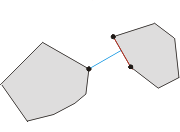
Thousands of thousands years ago there was a small kingdom located in the middle of the Pacific Ocean. The territory of the kingdom consists two separated islands. Due to the impact of the ocean current, the shapes of both the islands became convex polygons. The king of the kingdom wanted to establish a bridge to connect the two islands. To minimize the cost, the king asked you, the bishop, to find the minimal distance between the boundaries of the two islands.
Input
The input consists of several test cases.
Each test case begins with two integers N, M. (3 ≤ N, M ≤ 10000)
Each of the next N lines contains a pair of coordinates, which describes the position of a vertex in one convex polygon.
Each of the next M lines contains a pair of coordinates, which describes the position of a vertex in the other convex polygon.
A line with N = M = 0 indicates the end of input.
The coordinates are within the range [-10000, 10000].
Output
For each test case output the minimal distance. An error within 0.001 is acceptable.
题目大意:给两个凸多边形,求两个凸多边形的最近距离
思路:用旋转卡壳,最短距离一定在两条支撑线之间(相当于切线吧大概……),详见代码,表达能力渣渣
PS:此题虽然没说点的顺序,DISCUSS里面有人说是乱序的,但实际上好像是逆序的(反正我不考虑点的顺序也能过就是了……)
代码(125MS):
 #include <cstdio>

 #include <cstring>

 #include <cmath>

 #include <algorithm>

 using namespace std;

 #define EPS 1e-8

 #define MAXN 10010

 inline int sgn(double x) {

     if(fabs(x) < EPS) return ;

     return x >  ?  : -;

 }

 struct Point {

     double x, y;

     Point(double xx = , double yy = ): x(xx), y(yy) {}

 };

 //cross

 inline double operator ^ (const Point &a, const Point &b) {

     return a.x * b.y - a.y * b.x;

 }

 inline double operator * (const Point &a, const Point &b) {

     return a.x * b.x + a.y * b.y;

 }

 inline Point operator - (const Point &a, const Point &b) {

     return Point(a.x - b.x, a.y - b.y);

 }

 inline double dist(const Point &a, const Point &b) {

     return sqrt((a.x - b.x) * (a.x - b.x) + (a.y - b.y) * (a.y - b.y));

 }

 inline double Cross(Point o, Point s, Point e) {

     return (s - o) ^ (e - o);

 }

 struct Line {

     Point s, e;

     Line() {}

     Line(Point ss, Point ee): s(ss), e(ee) {}

 };

 inline double Point_to_Line(const Point &p, const Line &L) {

     return fabs(Cross(p, L.s, L.e)/dist(L.s, L.e));

 }

 inline double Point_to_Seg(const Point &p, const Line &L) {

     if(sgn((L.e - L.s) * (p - L.s)) < ) return dist(p, L.s);

     if(sgn((L.s - L.e) * (p - L.e)) < ) return dist(p, L.e);

     return Point_to_Line(p, L);

 }

 inline double Seg_to_Seg(const Line &a, const Line &b) {

     double ans1 = min(Point_to_Seg(a.s, b), Point_to_Seg(a.e, b));

     double ans2 = min(Point_to_Seg(b.s, a), Point_to_Seg(b.e, a));

     return min(ans1, ans2);

 }

 inline double solve(Point *p, Point *q, int np, int nq) {

     p[np] = p[];

     q[nq] = q[];

     int sp = , sq = ;

     for(int i = ; i < np; ++i) if(sgn(p[i].y - p[sp].y) < ) sp = i;

     for(int i = ; i < nq; ++i) if(sgn(q[i].y - q[sq].y) < ) sq = i;

     double tmp, ans = dist(p[], q[]);

     for(int i = ; i < np; ++i) {

         while(sgn(tmp = (Cross(q[sq], p[sp], p[sp+]) - Cross(q[sq+],p[sp],p[sp+]))) < )

             sq = (sq + ) % nq;

         if(sgn(tmp) > )

             ans = min(ans, Point_to_Seg(q[sq], Line(p[sp], p[sp+])));

         else

             ans = min(ans, Seg_to_Seg(Line(p[sp], p[sp+]), Line(q[sq], q[sq+])));

         sp = (sp + ) % np;

     }

     return ans;

 }

 Point p[MAXN], q[MAXN];

 int np, nq;

 int main() {

     while(scanf("%d%d", &np, &nq) != EOF) {

         if(np ==  && nq == ) break;

         for(int i = ; i < np; ++i)

             scanf("%lf%lf", &p[i].x, &p[i].y);

         for(int i = ; i < nq; ++i)

             scanf("%lf%lf", &q[i].x, &q[i].y);

         printf("%f\n", min(solve(p, q, np, nq), solve(q, p, nq, np)));

     }

     return ;

 }
代码(141MS)(高度模板化):
 #include <cstdio>

 #include <cstring>

 #include <iostream>

 #include <algorithm>

 #include <cmath>

 using namespace std;

 const int MAXN = ;

 const double EPS = 1e-;

 const double PI = acos(-1.0);//3.14159265358979323846

 const double INF = ;

 inline int sgn(double x) {

     return (x > EPS) - (x < -EPS);

 }

 struct Point {

     double x, y, ag;

     Point() {}

     Point(double x, double y): x(x), y(y) {}

     void read() {

         scanf("%lf%lf", &x, &y);

     }

     bool operator == (const Point &rhs) const {

         return sgn(x - rhs.x) ==  && sgn(y - rhs.y) == ;

     }

     bool operator < (const Point &rhs) const {

         if(y != rhs.y) return y < rhs.y;

         return x < rhs.x;

     }

     Point operator + (const Point &rhs) const {

         return Point(x + rhs.x, y + rhs.y);

     }

     Point operator - (const Point &rhs) const {

         return Point(x - rhs.x, y - rhs.y);

     }

     Point operator * (const double &b) const {

         return Point(x * b, y * b);

     }

     Point operator / (const double &b) const {

         return Point(x / b, y / b);

     }

     double operator * (const Point &rhs) const {

         return x * rhs.x + y * rhs.y;

     }

     double length() {

         return sqrt(x * x + y * y);

     }

     Point unit() {

         return *this / length();

     }

     void makeAg() {

         ag = atan2(y, x);

     }

     void print() {

         printf("%.10f %.10f\n", x, y);

     }

 };

 typedef Point Vector;

 double dist(const Point &a, const Point &b) {

     return (a - b).length();

 }

 double cross(const Point &a, const Point &b) {

     return a.x * b.y - a.y * b.x;

 }

 //ret >= 0 means turn right

 double cross(const Point &sp, const Point &ed, const Point &op) {

     return cross(sp - op, ed - op);

 }

 double area(const Point& a, const Point &b, const Point &c) {

     return fabs(cross(a - c, b - c)) / ;

 }

 //counter-clockwise

 Point rotate(const Point &p, double angle, const Point &o = Point(, )) {

     Point t = p - o;

     double x = t.x * cos(angle) - t.y * sin(angle);

     double y = t.y * cos(angle) + t.x * sin(angle);

     return Point(x, y) + o;

 }

 struct Seg {

     Point st, ed;

     double ag;

     Seg() {}

     Seg(Point st, Point ed): st(st), ed(ed) {}

     void read() {

         st.read(); ed.read();

     }

     void makeAg() {

         ag = atan2(ed.y - st.y, ed.x - st.x);

     }

 };

 typedef Seg Line;

 //ax + by + c > 0

 Line buildLine(double a, double b, double c) {

     if(sgn(a) ==  && sgn(b) == ) return Line(Point(sgn(c) >  ? - : , INF), Point(, INF));

     if(sgn(a) == ) return Line(Point(sgn(b), -c/b), Point(, -c/b));

     if(sgn(b) == ) return Line(Point(-c/a, ), Point(-c/a, sgn(a)));

     if(b < ) return Line(Point(, -c/b), Point(, -(a + c) / b));

     else return Line(Point(, -(a + c) / b), Point(, -c/b));

 }

 void moveRight(Line &v, double r) {

     double dx = v.ed.x - v.st.x, dy = v.ed.y - v.st.y;

     dx = dx / dist(v.st, v.ed) * r;

     dy = dy / dist(v.st, v.ed) * r;

     v.st.x += dy; v.ed.x += dy;

     v.st.y -= dx; v.ed.y -= dx;

 }

 bool isOnSeg(const Seg &s, const Point &p) {

     return (p == s.st || p == s.ed) ||

         (((p.x - s.st.x) * (p.x - s.ed.x) <  ||

           (p.y - s.st.y) * (p.y - s.ed.y) < ) &&

          sgn(cross(s.ed, p, s.st) == ));

 }

 bool isIntersected(const Point &s1, const Point &e1, const Point &s2, const Point &e2) {

     return (max(s1.x, e1.x) >= min(s2.x, e2.x)) &&

         (max(s2.x, e2.x) >= min(s1.x, e1.x)) &&

         (max(s1.y, e1.y) >= min(s2.y, e2.y)) &&

         (max(s2.y, e2.y) >= min(s1.y, e1.y)) &&

         (cross(s2, e1, s1) * cross(e1, e2, s1) >= ) &&

         (cross(s1, e2, s2) * cross(e2, e1, s2) >= );

 }

 bool isIntersected(const Seg &a, const Seg &b) {

     return isIntersected(a.st, a.ed, b.st, b.ed);

 }

 bool isParallel(const Seg &a, const Seg &b) {

     return sgn(cross(a.ed - a.st, b.ed - b.st)) == ;

 }

 //return Ax + By + C =0 's A, B, C

 void Coefficient(const Line &L, double &A, double &B, double &C) {

     A = L.ed.y - L.st.y;

     B = L.st.x - L.ed.x;

     C = L.ed.x * L.st.y - L.st.x * L.ed.y;

 }

 //point of intersection

 Point operator * (const Line &a, const Line &b) {

     double A1, B1, C1;

     double A2, B2, C2;

     Coefficient(a, A1, B1, C1);

     Coefficient(b, A2, B2, C2);

     Point I;

     I.x = - (B2 * C1 - B1 * C2) / (A1 * B2 - A2 * B1);

     I.y =   (A2 * C1 - A1 * C2) / (A1 * B2 - A2 * B1);

     return I;

 }

 bool isEqual(const Line &a, const Line &b) {

     double A1, B1, C1;

     double A2, B2, C2;

     Coefficient(a, A1, B1, C1);

     Coefficient(b, A2, B2, C2);

     return sgn(A1 * B2 - A2 * B1) ==  && sgn(A1 * C2 - A2 * C1) ==  && sgn(B1 * C2 - B2 * C1) == ;

 }

 double Point_to_Line(const Point &p, const Line &L) {

     return fabs(cross(p, L.st, L.ed)/dist(L.st, L.ed));

 }

 double Point_to_Seg(const Point &p, const Seg &L) {

     if(sgn((L.ed - L.st) * (p - L.st)) < ) return dist(p, L.st);

     if(sgn((L.st - L.ed) * (p - L.ed)) < ) return dist(p, L.ed);

     return Point_to_Line(p, L);

 }

 double Seg_to_Seg(const Seg &a, const Seg &b) {

     double ans1 = min(Point_to_Seg(a.st, b), Point_to_Seg(a.ed, b));

     double ans2 = min(Point_to_Seg(b.st, a), Point_to_Seg(b.ed, a));

     return min(ans1, ans2);

 }

 struct Poly {

     int n;

     Point p[MAXN];//p[n] = p[0]

     void init(Point *pp, int nn) {

         n = nn;

         for(int i = ; i < n; ++i) p[i] = pp[i];

         p[n] = p[];

     }

     double area() {

         if(n < ) return ;

         double s = p[].y * (p[n - ].x - p[].x);

         for(int i = ; i < n; ++i)

             s += p[i].y * (p[i - ].x - p[i + ].x);

         return s / ;

     }

 };

 //the convex hull is clockwise

 void Graham_scan(Point *p, int n, int *stk, int &top) {//stk[0] = stk[top]

     sort(p, p + n);

     top = ;

     stk[] = ; stk[] = ;

     for(int i = ; i < n; ++i) {

         while(top && cross(p[i], p[stk[top]], p[stk[top - ]]) <= ) --top;

         stk[++top] = i;

     }

     int len = top;

     stk[++top] = n - ;

     for(int i = n - ; i >= ; --i) {

         while(top != len && cross(p[i], p[stk[top]], p[stk[top - ]]) <= ) --top;

         stk[++top] = i;

     }

 }

 //use for half_planes_cross

 bool cmpAg(const Line &a, const Line &b) {

     if(sgn(a.ag - b.ag) == )

         return sgn(cross(b.ed, a.st, b.st)) < ;

     return a.ag < b.ag;

 }

 //clockwise, plane is on the right

 bool half_planes_cross(Line *v, int vn, Poly &res, Line *deq) {

     int i, n;

     sort(v, v + vn, cmpAg);

     for(i = n = ; i < vn; ++i) {

         if(sgn(v[i].ag - v[i-].ag) == ) continue;

         v[n++] = v[i];

     }

     int head = , tail = ;

     deq[] = v[], deq[] = v[];

     for(i = ; i < n; ++i) {

         if(isParallel(deq[tail - ], deq[tail]) || isParallel(deq[head], deq[head + ]))

             return false;

         while(head < tail && sgn(cross(v[i].ed, deq[tail - ] * deq[tail], v[i].st)) > )

             --tail;

         while(head < tail && sgn(cross(v[i].ed, deq[head] * deq[head + ], v[i].st)) > )

             ++head;

         deq[++tail] = v[i];

     }

     while(head < tail && sgn(cross(deq[head].ed, deq[tail - ] * deq[tail], deq[head].st)) > )

         --tail;

     while(head < tail && sgn(cross(deq[tail].ed, deq[head] * deq[head + ], deq[tail].st)) > )

         ++head;

     if(tail <= head + ) return false;

     res.n = ;

     for(i = head; i < tail; ++i)

         res.p[res.n++] = deq[i] * deq[i + ];

     res.p[res.n++] = deq[head] * deq[tail];

     res.n = unique(res.p, res.p + res.n) - res.p;

     res.p[res.n] = res.p[];

     return true;

 }

 //ix and jx is the points whose distance is return, res.p[n - 1] = res.p[0], res must be clockwise

 double dia_rotating_calipers(Poly &res, int &ix, int &jx) {

     double dia = ;

     int q = ;

     for(int i = ; i < res.n - ; ++i) {

         while(sgn(cross(res.p[i], res.p[q + ], res.p[i + ]) - cross(res.p[i], res.p[q], res.p[i + ])) > )

             q = (q + ) % (res.n - );

         if(sgn(dist(res.p[i], res.p[q]) - dia) > ) {

             dia = dist(res.p[i], res.p[q]);

             ix = i; jx = q;

         }

         if(sgn(dist(res.p[i + ], res.p[q]) - dia) > ) {

             dia = dist(res.p[i + ], res.p[q]);

             ix = i + ; jx = q;

         }

     }

     return dia;

 }

 //a and b must be clockwise, find the minimum distance between two convex hull

 double half_rotating_calipers(Poly &a, Poly &b) {

     int sa = , sb = ;

     for(int i = ; i < a.n; ++i) if(sgn(a.p[i].y - a.p[sa].y) < ) sa = i;

     for(int i = ; i < b.n; ++i) if(sgn(b.p[i].y - b.p[sb].y) < ) sb = i;

     double tmp, ans = dist(a.p[], b.p[]);

     for(int i = ; i < a.n; ++i) {

         while(sgn(tmp = cross(a.p[sa], a.p[sa + ], b.p[sb + ]) - cross(a.p[sa], a.p[sa + ], b.p[sb])) > )

             sb = (sb + ) % (b.n - );

         if(sgn(tmp) < ) ans = min(ans, Point_to_Seg(b.p[sb], Seg(a.p[sa], a.p[sa + ])));

         else ans = min(ans, Seg_to_Seg(Seg(a.p[sa], a.p[sa + ]), Seg(b.p[sb], b.p[sb + ])));

         sa = (sa + ) % (a.n - );

     }

     return ans;

 }

 double rotating_calipers(Poly &a, Poly &b) {

     return min(half_rotating_calipers(a, b), half_rotating_calipers(b, a));

 }

 /*******************************************************************************************/

 Poly a, b;

 double solve() {

     double ans = 1e100;

     for(int i = ; i < a.n; ++i)

         for(int j = ; j < b.n; ++j) ans = min(ans, dist(a.p[i], b.p[j]));

     return ans;

 }

 int main() {

     while(scanf("%d%d", &a.n, &b.n) != EOF) {

         if(a.n ==  && b.n == ) break;

         for(int i = ; i < a.n; ++i) a.p[i].read();

         a.p[a.n++] = a.p[];

         for(int i = ; i < b.n; ++i) b.p[i].read();

         b.p[b.n++] = b.p[];

         printf("%f\n", rotating_calipers(a, b));

         //printf("%f\n", solve());

     }

     return ;

 }
POJ 3608 Bridge Across Islands(计算几何の旋转卡壳)的更多相关文章
- POJ 3608 Bridge Across Islands(旋转卡壳,两凸包最短距离)
Bridge Across Islands Time Limit: 1000MS Memory Limit: 65536K Total Submissions: 7202 Accepted: ...
- POJ 3608 Bridge Across Islands (旋转卡壳)
[题目链接] http://poj.org/problem?id=3608 [题目大意] 求出两个凸包之间的最短距离 [题解] 我们先找到一个凸包的上顶点和一个凸包的下定点,以这两个点为起点向下一个点 ...
- POJ - 3608 Bridge Across Islands【旋转卡壳】及一些有趣现象
给两个凸包,求这两个凸包间最短距离 旋转卡壳的基础题 因为是初学旋转卡壳,所以找了别人的代码进行观摩..然而发现很有意思的现象 比如说这个代码(只截取了关键部分) double solve(Point ...
- POJ 3608 Bridge Across Islands --凸包间距离,旋转卡壳
题意: 给你两个凸包,求其最短距离. 解法: POJ 我真的是弄不懂了,也不说一声点就是按顺时针给出的,不用调整点顺序. 还是说数据水了,没出乱给点或给逆时针点的数据呢..我直接默认顺时针给的点居然A ...
- POJ 3608 Bridge Across Islands [旋转卡壳]
Bridge Across Islands Time Limit: 1000MS Memory Limit: 65536K Total Submissions: 10455 Accepted: ...
- ●POJ 3608 Bridge Across Islands
题链: http://poj.org/problem?id=3608 题解: 计算几何,求两个凸包间的最小距离,旋转卡壳 两个凸包间的距离,无非下面三种情况: 所以可以基于旋转卡壳的思想,去求最小距离 ...
- POJ 3608 凸包间最短距离(旋转卡壳)
Bridge Across Islands Time Limit: 1000MS Memory Limit: 65536K Total Submissions: 11539 Accepted: ...
- 「POJ-3608」Bridge Across Islands (旋转卡壳--求两凸包距离)
题目链接 POJ-3608 Bridge Across Islands 题意 依次按逆时针方向给出凸包,在两个凸包小岛之间造桥,求最小距离. 题解 旋转卡壳的应用之一:求两凸包的最近距离. 找到凸包 ...
- poj 3608 Bridge Across Islands
题目:计算两个不相交凸多边形间的最小距离. 分析:计算几何.凸包.旋转卡壳.分别求出凸包,利用旋转卡壳求出对踵点对,枚举距离即可. 注意:1.利用向量法判断旋转,而不是计算角度:避免精度问题和TLE. ...
随机推荐
- MySQL数据库安装配置步骤详解
MYSQL的安装 1.打开下载的mysql安装文件mysql-5.5.27-win32.zip,双击解压缩,运行“setup.exe”. 2.选择安装类型,有“Typical(默认)”.“Comple ...
- Linux sed命令用法
概述 sed命令是一个面向字符流的非交互式编辑器,不允许用户与它进行交互操作.sed是以行为单位处理文本内容的.在shell中,可以批量修改文本内容. 用法 sed [选项] [动作] 选项与参数:- ...
- 笔记: js构造函数与原型
目录 构造函数与原型介绍 涉及三种引用的操作 有关原型及原型链的一些相关方法总结 @ 构造函数与原型介绍 1.函数与函数的原型对象(prototype object): 在JavaScript中,创建 ...
- javascript 时间倒计时效果
<div id="divdown1"></div> <script language="javascript" type=&quo ...
- .Net Core如何在程序的任意位置使用和注入服务
最近有人问我:我该如何在Startup类之外的地方注入我的服务呢,都写在startup里看着好乱:我该如何在程序的其他地方获取我注入的服务呢: 故我写了这篇博客,文中有不对的地方欢迎指正. 一.如何在 ...
- Flask之app实例的参数配置
说是app实例的配置, 实际也就是flask程序的配置 Flask 是一个非常灵活且短小精干的web框架 , 那么灵活性从什么地方体现呢? 有一个神奇的东西叫 Flask配置 , 这个东西怎么用呢? ...
- sql server 获取当前日期前三十天的日期
select convert(varchar(10),dateadd(dd,number,dateadd(month,-1,getdate())),120) as dtfrom master..spt ...
- shazam音乐检索算法 附完整c代码
在讲算法之前,上一些前人的资料. http://coding-geek.com/how-shazam-works/ https://laplacian.wordpress.com/2009/01/10 ...
- Java设计模式(12)——结构型模式之门面模式(Facade)
一.概述 概念 简要示意图(没有一个统一的UML图) 角色 门面角色:门面模式核心,它被客户端调用,并且熟悉子系统 子系统角色:子系统,子系统并不知道门面的存在,门面对它来说只不过是另外一个客户端 ...
- 利用Python Counter快速计算出现次数topN的元素
需要用Python写一段代码,给定一堆关键词,返回出现次数最多的n个关键字. 第一反应是采用一个dict,key存储关键词,value存储出现次数,如此一次遍历即可得出所有不同关键词的出现次数,而后排 ...