
堆排序(python实现)
堆排序是利用最大最或最小堆,废话不多说:
先给出几个概念:
二叉树:二叉树是每个节点最多有两个子树的树结构。通常子树被称作“左子树”(left subtree)和“右子树”
完全二叉树:除最后一层外,每一层上的节点数均达到最大值;在最后一层上只缺少右边的若干结点。
满二叉树: 除最后一层无任何子节点外,每一层上的所有结点都有两个子结点。
堆:堆是一种数据结构,类似树根结构,如图,但是不一定是二叉树。
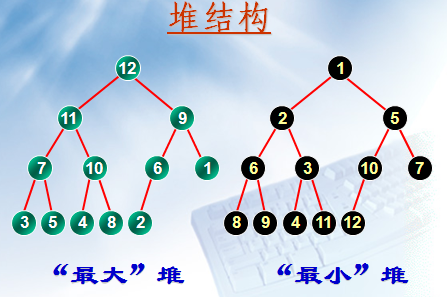
二叉堆:二叉堆是一种特殊的堆,二叉堆是完全二元树(二叉树)或者是近似完全二元树(二叉树),包括最大堆和最小堆。
最大堆:父结点的键值总是大于或等于任何一个子节点的键值,即根节点为最大数字
最小堆:父结点的键值总是大于或等于任何一个子节点的键值,即根节点为最小数字
堆排序步骤:
1.将数据构建成堆,这里的堆指完全二叉树(不一定是满二叉树)
2.将堆调整为最小堆或最大堆
3.此时堆顶已经为最大数或最小数,可以对下面的分支堆再进行调堆即可,此处采用的是将堆顶数取出,再调堆
本人愚钝,网上代码不慎明了,根据自己的思路写了一下,不足之处,请多多指教
1.首先实现将数组按照堆打印
 def PrintArrayTree(arr):

     frontRowSum=1 #Number of digits in front of n-1 rows

     row=1      #row n(start from 1)

     for i in range(0,len(arr)):

         if i==frontRowSum:

             frontRowSum=frontRowSum+2**row #Number of digits in front of n rows

             print("\n")#the next row

             row=row+1

         print (arr[i],end="  ") #print digits

     print("Over")

 arr=[10,9,8,7,6,5,4,3,2,1,234,562,452,23623,565,5,26]

 PrintArrayTree(arr)
运行结果如下:
10
9 8
7 6 5 4
3 2 1 234 562 452 23623 565
5 26
print Over
2.构建完了堆,我想实现在堆内任意查找,找到他的子节点和父节点,代码如下:
 def FindNode(arr,row,cloumn):

     if row<1 or cloumn<1:

         print("the number of row and column must be greater than 1")

         return

     if cloumn>2**(row-1):

         print("this row just ",2**(row-1),"numbers")

         return

     frontRowSum=0

     CurrentRowSum=0

     for index in range(0,row-1):

         CurrentRowSum=2**index  #the number of  digits in current row

         frontRowSum=frontRowSum+CurrentRowSum #the number of  digits of all rows

     NodeIndex=frontRowSum+cloumn-1   #find the location of the node in the array by row and cloumn

     if NodeIndex>len(arr)-1:

         print("out of this array")

         return

     currentNode=arr[NodeIndex]

     childIndex=NodeIndex*2+1

     print("Current Node:",currentNode)

     if row==1:              #row 1 have no parent node

         print("no parent node!")

     else:                   #the parent node ofcurrent node

         parentIndex=int((NodeIndex-1)/2)

         parentNode=arr[parentIndex]

         print("Parent Node:",parentNode)

     if childIndex+1>len(arr):   #print leftChild node

         print("no left child node!")

     else:

         leftChild=arr[childIndex]

         print("Left Child Node:",leftChild)

     if childIndex+1+1>len(arr):     #print rightChild node

         print("no left right node!")

     else:

         rightChild=arr[childIndex+1]

         print("Right Child Node:",rightChild)

     print("\n")

 arr=[10,9,8,7,6,5,4,3,2,1,234,562,452,23623,565,5,26]

 FindNode(arr,1,1)

 FindNode(arr,2,2)

 FindNode(arr,4,1)
代码运行结果如下:
Current Node: 10
no parent node!
Left Child Node: 9
Right Child Node: 8
Current Node: 8
Parent Node: 10
Left Child Node: 5
Right Child Node: 4
Current Node: 3
Parent Node: 7
Left Child Node: 5
Right Child Node: 26
此代码在堆排序中没有直接用到,但是提供了一些思路
3.按照堆排序步骤,建堆之后需要进行堆调整,接下来进行堆调整,先实现单个叉(某个节点及其子孩子)的进行排序,直接借鉴FindNode里面的代码,将当前节点分别与其左右孩子比较就行了,本文意在实现最小堆,即将小的节点作为父节点
def MinSort(arr,row,cloumn):

    if row<1 or cloumn<1:

        print("the number of row and column must be greater than 1")

        return

    if cloumn>2**(row-1):

        print("this row just ",2**(row-1),"numbers")

        return

    frontRowSum=0

    CurrentRowSum=0

    for index in range(0,row-1):

        CurrentRowSum=2**index  #the number of  digits in current row

        frontRowSum=frontRowSum+CurrentRowSum  #the number of  digits of all rows

    NodeIndex=frontRowSum+cloumn-1 #find the location of the node in the array by row and cloumn

    if NodeIndex>len(arr)-1:

        print("out of this array")

        return

    currentNode=arr[NodeIndex]

    childIndex=NodeIndex*2+1

    print("Current Node:",currentNode)

    if row==1:

        print("no parent node!")

    else:

        parentIndex=int((NodeIndex-1)/2)

        parentNode=arr[parentIndex]

        print("Parent Node:",parentNode)

    if childIndex+1>len(arr):

        print("no left child node!")

    else:

        leftChild=arr[childIndex]

        print("Left Child Node:",leftChild)

        if currentNode>leftChild:

            print("swap currentNode and leftChild")

            temp=currentNode

            currentNode=leftChild

            leftChild=temp

            arr[childIndex]=leftChild

    if childIndex+1>=len(arr):

        print("no right child node!")

    else:

        rightChild=arr[childIndex+1]

        print("Right Chile Node:",rightChild)

        if currentNode>rightChild:

            print("swap rightCild and leftChild")

            temp=rightChild

            rightChild=currentNode

            currentNode=temp

            arr[childIndex+1]=rightChild

    arr[NodeIndex]=currentNode

arr=[10,9,8,7,6,5,4,3,2,1,234,562,452,23623,565,5,26]

print("initial array:",arr)

MinSort(arr,1,1)

print("result array:",arr)
运行结果如下,可以看出对于第一个节点,其自孩子为9,8,已经实现将节点与最小的自孩子进行交换,保证父节点小于任何一个子孩子
initial array: [10, 9, 8, 7, 6, 5, 4, 3, 2, 1, 234, 562, 452, 23623, 565, 5, 26]
Current Node: 10
no parent node!
Left Child Node: 9
swap currentNode and leftChild
Right Chile Node: 8
swap rightCild and leftChild
result array: [8, 10, 9, 7, 6, 5, 4, 3, 2, 1, 234, 562, 452, 23623, 565, 5, 26]
4.已经实现对单个节点和子孩子进行比较,保证父节点小于孩子,将堆内所有拥有孩子的节点进行排序,即可调整为最小堆,代码如下:
def MinHeap(arr):

    frontRowSum=1

    row=1

    for i in range(0,len(arr)):

        if i==frontRowSum:

            frontRowSum=frontRowSum+2**row #the number of  digits of all rows

            print("\n") # next row

            row=row+1

        print (arr[i],end="  ")

    print("row",row)

    rowIndex=row-1    #the last row have no child node

    print("rowIndex",rowIndex)

    column=2**(rowIndex-1)  #the number of digits of current row

    print("column",column)

    number=len(arr)

    while rowIndex>0:   #sort the nodes that have child nodes from the last number to the first number

        if number<=2**(rowIndex-1):

            rowIndex=rowIndex-1

            column=2**(rowIndex-1)

        print("sort",rowIndex,column)

        MinSort(arr,rowIndex,column)

        number=number-1

        column=column-1

arr=[10,9,8,7,6,5,4,3,2,1,234,562,452,23623,565,5,26]

print("initial array:",arr)
PrintArrayTree(arr)

MinHeap(arr)

print("result array:",arr)
PrintArrayTree(arr)
运行结果如下,可以看到最小数字已经位于顶端,实现最小堆
initial array: [10, 9, 8, 7, 6, 5, 4, 3, 2, 1, 234, 562, 452, 23623, 565, 5, 26]
10
9 8
7 6 5 4
3 2 1 234 562 452 23623 565
5 26
print Over
.......
result array: [1, 10, 4, 9, 2, 8, 5, 7, 3, 6, 234, 562, 452, 23623, 565, 5, 26]
1
10 4
9 2 8 5
7 3 6 234 562 452 23623 565
5 26
print Over
4.最小值已经到顶端,将最小值依次取出,然后再调整堆,再取出,就完成堆排序。代码如下:
 def HeapSort(arr):

     arr2=[]

     for i in range(0,len(arr)):

         MinHeap(arr)

         arr2.append(arr[0])

         del arr[0]

     return arr2

 arr=[10,9,8,7,6,5,4,3,2,1,234,562,452,23623,565,5,26]

 print("initial array:",arr)

 PrintArrayTree(arr)

 resultArr=HeapSort(arr)

 print("result array:",resultArr)

 PrintArrayTree(resultArr)
运行结果如下:
initial array: [10, 9, 8, 7, 6, 5, 4, 3, 2, 1, 234, 562, 452, 23623, 565, 5, 26]
10
9 8
7 6 5 4
3 2 1 234 562 452 23623 565
5 26
print Over
10
9 8
7 6 5 4
3 2 1 234 562 452 23623 565
5 26
.........
result array: [1, 2, 3, 4, 5, 5, 6, 7, 8, 9, 10, 26, 234, 452, 562, 565, 23623]
1
2 3
4 5 5 6
7 8 9 10 26 234 452 562
565 23623
print Over
5.后续工作:
1)代码需要优化
2)感觉堆排序有点类似冒泡排序
3)需要检查代码的健壮性
4)后续需要计算分析代码的复杂度
1)优化之后的程序如下:写法还能再优化,但继续优化会影响可读性
 def MinSort(arr,start,end):

     import math

     arrHeight=0

     for index in range(0,end-start):

         if index==2**(arrHeight+1)-1:

             arrHeight=arrHeight+1

     for NodeIndex in range(2**(arrHeight)-2,-1,-1):

         currentNode=arr[NodeIndex+start]

         childIndex=NodeIndex*2+1+start

         if childIndex+1>len(arr):

             continue

         else:

             leftChild=arr[childIndex]

             if currentNode>leftChild:

                 temp=currentNode

                 currentNode=leftChild

                 leftChild=temp

                 arr[childIndex]=leftChild

                 arr[NodeIndex+start]=currentNode

         if childIndex+1>=len(arr):

             continue

         else:

             rightChild=arr[childIndex+1]

             if currentNode>rightChild:

                 temp=rightChild

                 rightChild=currentNode

                 currentNode=temp

                 arr[childIndex+1]=rightChild

                 arr[NodeIndex+start]=currentNode

 def HeapSort(arr):

     for i in range(0,len(arr)-1):

         MinSort(arr,i,len(arr))

 arr=[10,9,8,7,6,5,4,3,2,1,234,562,452,23623,565,5,26]

 print("Initial array:\n",arr)

 HeapSort(arr)

 print("Result array:\n",arr)
运行结果:
Initial array:
[10, 9, 8, 7, 6, 5, 4, 3, 2, 1, 234, 562, 452, 23623, 565, 5, 26]
Result array:
[1, 2, 3, 4, 5, 5, 6, 7, 8, 9, 10, 26, 234, 452, 562, 565, 23623]
堆排序(python实现)的更多相关文章
- 高速排序,归并排序,堆排序python实现
高速排序的时间复杂度最好情况下为O(n*logn),最坏情况下为O(n^2),平均情况下为O(n*logn),是不稳定的排序 归并排序的时间复杂度最好情况下为O(n*logn),最坏情况下为O(n*l ...
- 堆排序python实现
def MAX_Heapify(heap,HeapSize,root):#在堆中做结构调整使得父节点的值大于子节点 left = 2*root+1 right = left + 1 larger = ...
- 简单的堆排序-python
AA = raw_input().strip().split(' ') A = [] ###############初始化大堆############### def fixUp(A): k = len ...
- 排序NB三人组
排序NB三人组 快速排序,堆排序,归并排序 1.快速排序 方法其实很简单:分别从初始序列“6 1 2 7 9 3 4 5 10 8”两端开始“探测”.先从右往左找一个小于6的数,再从左往 ...
- 3、计数排序,电影top100
1.计数排序 # -*- coding: utf-8 -*- # @Time : 2018/07/31 0031 11:32 # @Author : Venicid def count_sort(li ...
- 数据结构:堆排序 (python版) 小顶堆实现从大到小排序 | 大顶堆实现从小到大排序
#!/usr/bin/env python # -*- coding:utf-8 -*- ''' Author: Minion-Xu 小堆序实现从大到小排序,大堆序实现从小到大排序 重点的地方:小堆序 ...
- 你需要知道的九大排序算法【Python实现】之堆排序
六.堆排序 堆排序是一种树形选择排序,是对直接选择排序的有效改进. 堆的定义下:具有n个元素的序列 (h1,h2,...,hn),当且仅当满足(hi>=h2i,hi>=2i+1)或(h ...
- python下实现二叉堆以及堆排序
python下实现二叉堆以及堆排序 堆是一种特殊的树形结构, 堆中的数据存储满足一定的堆序.堆排序是一种选择排序, 其算法复杂度, 时间复杂度相对于其他的排序算法都有很大的优势. 堆分为大头堆和小头堆 ...
- 算法导论 第六章 堆排序(python)
6.1堆 卫星数据:一个带排序的的数通常是有一个称为记录的数据集组成的,每一个记录有一个关键字key,记录的其他数据称为卫星数据. 原地排序:在排序输入数组时,只有常数个元素被存放到数组以外的空间中去 ...
- Python八大算法的实现,插入排序、希尔排序、冒泡排序、快速排序、直接选择排序、堆排序、归并排序、基数排序。
Python八大算法的实现,插入排序.希尔排序.冒泡排序.快速排序.直接选择排序.堆排序.归并排序.基数排序. 1.插入排序 描述 插入排序的基本操作就是将一个数据插入到已经排好序的有序数据中,从而得 ...
随机推荐
- Step01-题目申报
毕业设计题目申报表 姓名: 王刚 学号: 201303041029 题目名称: 通用型云端物联网网关系统的设计与实现 毕业设计(论文)简介: 2017是物联网进入加速发展或成为最贴近普通民众的实用 ...
- CSS3与页面布局学习总结(三)——BFC、定位、浮动、7种垂直居中方法
一.BFC与IFC 1.1.BFC与IFC概要 BFC(Block Formatting Context)即“块级格式化上下文”, IFC(Inline Formatting Context)即行内格 ...
- CSS3与页面布局学习总结(一)——概要、选择器、特殊性与刻度单位
web前端开发者最最注的内容是三个:HTML.CSS与JavaScript,他们分别在不同方面发挥自己的作用,HTML实现页面结构,CSS完成页面的表现与风格,JavaScript实现一些客户端的功能 ...
- Java 哈希表运用-LeetCode 1 Two Sum
Given an array of integers, find two numbers such that they add up to a specific target number. The ...
- C#:解决WCF中服务引用 自动生成代码不全的问题。
问题描述: 如下图:打叉的部分是引用不成功的部分 ,在web.config文件中没有自动添加其引用代码. 英文解释 在服务引用选择自己的项目的程序集就行了,如下图: 特别注意:这些程序集一定要在自己的 ...
- 【读fastclick源码有感】彻底解决tap“点透”,提升移动端点击响应速度
申明!!!最后发现判断有误,各位读读就好,正在研究中.....尼玛水太深了 前言 近期使用tap事件为老夫带来了这样那样的问题,其中一个问题是解决了点透还需要将原来一个个click变为tap,这样的话 ...
- 微信JS-SDK坐标位置转换为百度地图坐标
微信JS-SDK开发过程中,使用getLocation获取坐标位置,如何将微信获取的坐标直接应用到百度地图中,显示以下效果: 说明:红色图标是从微信转换过来的位置,蓝色图标是周边位置.首先从微信开发流 ...
- ASP.NET 中 OutputCache 指令参数详解
使用@ OutputCache指令使用@ OutputCache指令,能够实现对页面输出缓存的一般性需要.@ OutputCache指令在ASP.NET页或者页中包含的用户控件的头部声明.这种方式非常 ...
- 用VS Code写Python程序
安装python 常见的Linux发行版本中已经安装了python,而且可能不止一个版本,以Ubuntu14.04为例,预装的python有2个版本,分别是2.7.6和3.4.3,python2和py ...
- [精品书单] C#/.NET 学习之路——从入门到放弃
C#/.NET 学习之路--从入门到放弃 此系列只包含 C#/CLR 学习,不包含应用框架(ASP.NET , WPF , WCF 等)及架构设计学习书籍和资料. C# 入门 <C# 本质论&g ...