
caffe中softmax源码阅读
(1) softmax函数
 (1)
(1)
其中,zj 是softmax层的bottom输入, f(zj)是softmax层的top输出,C为该层的channel数。
(2) softmax_layer.cpp中的Reshape函数:
 template <typename Dtype>

 void SoftmaxLayer<Dtype>::Reshape(const vector<Blob<Dtype>*>& bottom,                //bottom blob为softmax层的输入,top blob为该层输出。

       const vector<Blob<Dtype>*>& top) {

   softmax_axis_ =                                                                    //softmax_axis_为1

       bottom[]->CanonicalAxisIndex(this->layer_param_.softmax_param().axis());

   top[]->ReshapeLike(*bottom[]);                                                   //使用bttom[0]的shape和值去初始化top[0],后面所有的操作基于top[0]
   //bottom[0]的shape为[N, C, H, W], bottom[0]->shape(softmax_axis_)的值为C

   vector<int> mult_dims(, bottom[]->shape(softmax_axis_));
     //Blob<Dtype> sum_multipiler、Blob<Dtype> scale_、int outer_num_、int inner_num_变量定义在softmax_layer.hpp中
     //初始化sum_multiplier, mult_dims的值为C

   sum_multiplier_.Reshape(mult_dims);

   Dtype* multiplier_data = sum_multiplier_.mutable_cpu_data();
     //设置sum_multiplier的所有元素值为1

   caffe_set(sum_multiplier_.count(), Dtype(), multiplier_data);
   //blob的shape为[N, C, H, W], 形象点说就是blob->shape[0] = N, blob->shape[1] = C
   //blob的count为N*C*H*W,形象点说就是blob->count() = N*C*H*W
     //blob->count(0, 2)中的(0, 2)是左闭右开区间,返回的是N*C
     //所以就有outer_num_ = bottom[0]->count(0, softmax_axis_) = N
     //       inner_num_ = bottom[0]->count(softmax_axis_) = H*W

   outer_num_ = bottom[]->count(, softmax_axis_);

   inner_num_ = bottom[]->count(softmax_axis_ + );
     //下面两行scale_dims的shape为[N, 1, H, W]

   vector<int> scale_dims = bottom[]->shape();

   scale_dims[softmax_axis_] = ;
   //scale_ blob的shape为[N, 1, H, W]

   scale_.Reshape(scale_dims);

 }
(3) softmax_layer.cpp中的Forward_cpu函数:
 template <typename Dtype>

 void SoftmaxLayer<Dtype>::Forward_cpu(const vector<Blob<Dtype>*>& bottom,

     const vector<Blob<Dtype>*>& top) {

   const Dtype* bottom_data = bottom[]->cpu_data();

   Dtype* top_data = top[]->mutable_cpu_data();

   Dtype* scale_data = scale_.mutable_cpu_data();

   int channels = bottom[]->shape(softmax_axis_);                             //channels = C

   int dim = bottom[]->count() / outer_num_;                                  //dim = N*C*H*W / N = C*H*W

   caffe_copy(bottom[]->count(), bottom_data, top_data);                      //将bottom_data的blob数据复制给top_data的blob.

   // We need to subtract the max to avoid numerical issues, compute the exp,

   // and then normalize.
     //求channel最大值,存放在scale_ blob中。

   for (int i = ; i < outer_num_; ++i) {

     // initialize scale_data to the first plane

     caffe_copy(inner_num_, bottom_data + i * dim, scale_data);

     for (int j = ; j < channels; j++) {

       for (int k = ; k < inner_num_; k++) {

         scale_data[k] = std::max(scale_data[k],

             bottom_data[i * dim + j * inner_num_ + k]);

       }

     }

     // subtraction
       //bottom blob数据减去对应channel的最大值

     caffe_cpu_gemm<Dtype>(CblasNoTrans, CblasNoTrans, channels, inner_num_,

         , -., sum_multiplier_.cpu_data(), scale_data, ., top_data);

     // exponentiation
       //对每个样本的每个channel数据取e.

     caffe_exp<Dtype>(dim, top_data, top_data);

     // sum after exp
       // 下面的代码实现的是公式(1)

     caffe_cpu_gemv<Dtype>(CblasTrans, channels, inner_num_, .,

         top_data, sum_multiplier_.cpu_data(), ., scale_data);

     // division

     for (int j = ; j < channels; j++) {

       caffe_div(inner_num_, top_data, scale_data, top_data);
         //指针指向下一个数据

       top_data += inner_num_;

     }

   }

 }
该函数分为下面几个步骤:
<1> 求每个样本channel的最大值;
<2> softmax的每个输入减去其所在channel的最大值,即caffe_cpu_gemm函数的功能,该函数的原型为:
 void caffe_cpu_gemm<float>(const CBLAS_TRANSPOSE TransA, const CBLAS_TRANSPOSE TransB, const int M, const int N, const int K, const float alpha, const float *A, const float *B, const float beta, float *C){

       int lda = (TransA == CblasNoTrans) ? K : M;

       int ldb = (TransB == CblasNoTrans) ? N : K;

       cblas_sgemm(CblasRowMajor, TransA, TransB, M, N, K, alpha, A, lda, B, ldb, beta, C, N);

 }
cblas_sgemm函数作用为实现矩阵间的乘法,原型为:
//该函数实现的运算为:C = alpha*A*B + beta*C
//cblasTrans/cblasNoTrans表示对输入矩阵是否转置
//M为矩阵A,C的行数,若转置,则表示转置后的行数
//N为矩阵B、C的列数,若转置,则表示转置后的列数
//K为矩阵A的列数,或B的行数,若转置,则为转置后的列数和行数
//alpha, beta为系数
//A'cols为矩阵A的列数,与是否转置无关
//B'cols为矩阵B的列数,与是否转置无关
1 cblas_sgemm(cblasRowMajor, cblasNoTrans cblasNoTrans, M, N, K, alpha, A, A'cols, B, B'cols, beta, C, C'cols)
形象点说,caffe_cpu_gemm实现的功能为:
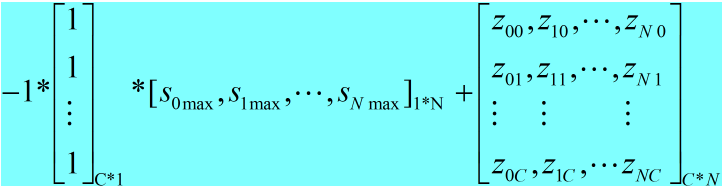
<3> 对top blob中的每个数据取e.
<4> 对每个样本的channel求和,与caffe_cpu_gemm不同的是,caffe_cpu_gemv实现的是矩阵与向量的乘法,具体的相乘过程和上面<2>中一样;
<5> 对每个样本而言,其channel的每个值除以该channel的和,也就是caffe_div完成的功能。
(4) softmax_layer.cpp中的Backward_cpu函数:
因为该函数在实际中没有用到,所以没有作过多阅读。
 template <typename Dtype>

 void SoftmaxLayer<Dtype>::Backward_cpu(const vector<Blob<Dtype>*>& top,

     const vector<bool>& propagate_down,

     const vector<Blob<Dtype>*>& bottom) {

   const Dtype* top_diff = top[]->cpu_diff();

   const Dtype* top_data = top[]->cpu_data();

   Dtype* bottom_diff = bottom[]->mutable_cpu_diff();

   Dtype* scale_data = scale_.mutable_cpu_data();

   int channels = top[]->shape(softmax_axis_);

   int dim = top[]->count() / outer_num_;

   caffe_copy(top[]->count(), top_diff, bottom_diff);

   for (int i = ; i < outer_num_; ++i) {

     // compute dot(top_diff, top_data) and subtract them from the bottom diff

     for (int k = ; k < inner_num_; ++k) {

       scale_data[k] = caffe_cpu_strided_dot<Dtype>(channels,

           bottom_diff + i * dim + k, inner_num_,

           top_data + i * dim + k, inner_num_);

     }

     // subtraction

     caffe_cpu_gemm<Dtype>(CblasNoTrans, CblasNoTrans, channels, inner_num_, ,

         -., sum_multiplier_.cpu_data(), scale_data, ., bottom_diff + i * dim);

   }

   // elementwise multiplication

   caffe_mul(top[]->count(), bottom_diff, top_data, bottom_diff);

 }
caffe中softmax源码阅读的更多相关文章
- go 中 select 源码阅读
深入了解下 go 中的 select 前言 1.栗子一 2.栗子二 3.栗子三 看下源码实现 1.不存在 case 2.select 中仅存在一个 case 3.select 中存在两个 case,其 ...
- vue中$watch源码阅读笔记
项目中使用了vue,一直在比较computed和$watch的使用场景,今天周末抽时间看了下vue中$watch的源码部分,也查阅了一些别人的文章,暂时把自己的笔记记录于此,供以后查阅: 实现一个简单 ...
- 【tensorflow使用笔记三】:tensorflow tutorial中的源码阅读
https://blog.csdn.net/victoriaw/article/details/61195620#t0 input_data 没用的另一种解决方法:tensorflow1.8版本及以上 ...
- caffe中batch norm源码阅读
1. batch norm 输入batch norm层的数据为[N, C, H, W], 该层计算得到均值为C个,方差为C个,输出数据为[N, C, H, W]. <1> 形象点说,均值的 ...
- Caffe源码阅读(1) 全连接层
Caffe源码阅读(1) 全连接层 发表于 2014-09-15 | 今天看全连接层的实现.主要看的是https://github.com/BVLC/caffe/blob/master/src ...
- caffe-windows中classification.cpp的源码阅读
caffe-windows中classification.cpp的源码阅读 命令格式: usage: classification string(模型描述文件net.prototxt) string( ...
- 源码阅读笔记 - 1 MSVC2015中的std::sort
大约寒假开始的时候我就已经把std::sort的源码阅读完毕并理解其中的做法了,到了寒假结尾,姑且把它写出来 这是我的第一篇源码阅读笔记,以后会发更多的,包括算法和库实现,源码会按照我自己的代码风格格 ...
- 源码阅读经验谈-slim,darknet,labelimg,caffe(1)
本文首先谈自己的源码阅读体验,然后给几个案例解读,选的例子都是比较简单.重在说明我琢磨的点线面源码阅读方法.我不是专业架构师,是从一个深度学习算法工程师的角度来谈的,不专业的地方请大家轻拍. 经常看别 ...
- SpringMVC源码阅读:Controller中参数解析
1.前言 SpringMVC是目前J2EE平台的主流Web框架,不熟悉的园友可以看SpringMVC源码阅读入门,它交代了SpringMVC的基础知识和源码阅读的技巧 本文将通过源码(基于Spring ...
随机推荐
- 【学习笔记】第一章 python安全开发简介
1.1为什么黑客喜欢用python? python为我们提供了非常完善的基础代码库,覆盖了网络.文件.GUI.数据库.文本等大量内容,被形象的称为“”内置电池“”,用python开发,许多功能不必从零 ...
- OPC-System.Runtime.InteropServices.COMException:“Error HRESULT E_FAIL has been returned from a call to a COM component.”
Error HRESULT E_FAIL has been returned from a call to a COM component的错误提示,还是因为OPC配置,这次是红框中标签定义错误,应该 ...
- STL中nth_element的用法
nth_element函数原型有四个,详细我就不一一累赘了,我们就用最普通的用法寻找第k位置的元素. 函数用法为:nth_element(first,kth,end). first,last 第一个和 ...
- CSS——设置背景
<!DOCTYPE html> <html> <head> <meta charset="UTF-8"> <title> ...
- DirectX12 3D 游戏开发与实战第二章内容
矩阵代数 学习目标 理解矩阵及其相关运算的定义 探究为何能把向量和矩阵的乘法视为一种线性组合 学习单位矩阵.转置矩阵.行列式以及矩阵的逆等概念 逐步熟悉DirectXMath库中提供的关于矩阵计算的类 ...
- java线上cpu、内存问题排查方法
一.线程 查进程中占用cpu高的线程 ps -mp xxxxx -o THREAD,tid,time | sort -rn 将线程的id从10位转到16位,可以在下面jstack中找到对应线程 输出线 ...
- OAuth2.0 RFC 6749 中文
英文原版:https://tools.ietf.org/html/rfc6749 转自:https://github.com/jeansfish/RFC6749.zh-cn 一.简介 在传统的客户端- ...
- hadoop之hdfs命令详解
本篇主要对hadoop命令和hdfs命令进行阐述,yarn命令会在之后的文章中体现 hadoop fs命令可以用于其他文件系统,不止是hdfs文件系统内,也就是说该命令的使用范围更广可以用于HDFS. ...
- DOM之事件(一)
DOM事件,就是浏览器或用户针对页面可以做出的某种动作,我们称这些动作为DOM事件.它是用户和页面交互的核心.当动作发生(事件触发)时,我们可以为其绑定一个或多个事件处理程序(函数),来完成我们想要实 ...
- spring框架对于实体类复杂属性注入xml文件的配置
spring框架是javaWeb项目中至关重要的一个框架,大多web 项目在工作层次上分为持久层.服务层.控制层.持久层(dao.mapper)用于连接数据库,完成项目与数据库中数据的传递:服务层(s ...