
POJ2553( 有向图缩点)
| Time Limit: 3000MS | Memory Limit: 65536K | |
| Total Submissions: 9779 | Accepted: 4063 |
Description
Let n be a positive integer, and let p=(e1,...,en) be a sequence of length n of edges ei∈E such that ei=(vi,vi+1) for a sequence of vertices (v1,...,vn+1). Then p is called a path from vertex v1 to vertex vn+1 in Gand we say that vn+1 is reachable from v1, writing (v1→vn+1).
Here are some new definitions. A node v in a graph G=(V,E) is called a sink, if for every node w in G that is reachable from v, v is also reachable from w. The bottom of a graph is the subset of all nodes that are sinks, i.e., bottom(G)={v∈V|∀w∈V:(v→w)⇒(w→v)}. You have to calculate the bottom of certain graphs.
Input
Output
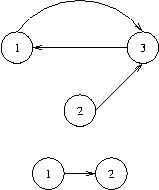
Sample Input
3 3

1 3 2 3 3 1

2 1

1 2

0
Sample Output
1 3

2
题意:给定一幅有向图,若某点所能到达的点也能到达其本身,那么这个点为sink。由小到大输出sink.
思路:有向图缩点得到一棵树,答案为构成叶子(出度为0)结点的连通分量。
#include<cstdio>

#include<cstring>

#include<algorithm>

#include<vector>

using namespace std;

const int MAXN=;

vector<int> mp[MAXN];

int n,m;

int dfn[MAXN],low[MAXN],time;

int stack[MAXN],top;

bool ins[MAXN];

int belong[MAXN],cnt;

void dfs(int u)

{

    dfn[u]=low[u]=++time;

    stack[top++]=u;

    ins[u]=true;

    for(int i=;i<mp[u].size();i++)

    {

        int v=mp[u][i];

        if(!dfn[v])

        {

            dfs(v);

            low[u]=min(low[u],low[v]);

        }

        else if(ins[v])    low[u]=min(low[u],dfn[v]);

    }

    if(dfn[u]==low[u])

    {

        int v;

        cnt++;

        do{

            v=stack[--top];

            belong[v]=cnt;

            ins[v]=false;

        }while(u!=v);

    }

}

int deg[MAXN];

bool flag[MAXN];

void solve()

{

    /*

    for(int i=1;i<=n;i++)

        printf("%d\n",belong[i]);*/

    for(int i=;i<=n;i++)

        for(int j=;j<mp[i].size();j++)

        {

            int v=mp[i][j];

            if(belong[i]!=belong[v])

            {

                deg[belong[i]]++;

            }

        }

    for(int i=;i<=cnt;i++)

        if(deg[i]==)

            flag[i]=true;

    for(int i=;i<=n;i++)

        if(flag[belong[i]])

            printf("%d ",i);

    printf("\n");

}

int main()

{

    while(scanf("%d",&n)!=EOF&&n)

    {

        scanf("%d",&m);

        memset(dfn,,sizeof(dfn));

        memset(low,,sizeof(low));

        memset(ins,false,sizeof(ins));

        memset(deg,,sizeof(deg));

        memset(flag,false,sizeof(flag));

        top=;

        time=;

        cnt=;

        for(int i=;i<=n;i++)

            mp[i].clear();

        for(int i=;i<m;i++)

        {

            int u,v;

            scanf("%d%d",&u,&v);

            mp[u].push_back(v);

        }

        for(int i=;i<=n;i++)

            if(!dfn[i])

                dfs(i);

        solve();

    }

}
下面是kosaraju算法
#include"cstdio"

#include"cstring"

#include"vector"

using namespace std;

const int MAXN=;

vector<int> G[MAXN];

vector<int> rG[MAXN];

vector<int> vs;

int V,E;

int cpnt[MAXN];

int vis[MAXN];

void dfs(int u)

{

    vis[u]=;

    for(int i=;i<G[u].size();i++)

        if(!vis[G[u][i]])    dfs(G[u][i]);

    vs.push_back(u);

}

void rdfs(int u,int k)

{

    cpnt[u]=k;

    vis[u]=;

    for(int i=;i<rG[u].size();i++)

        if(!vis[rG[u][i]])    rdfs(rG[u][i],k);

}

void scc()

{

    memset(vis,,sizeof(vis));

    for(int i=;i<=V;i++)

        if(!vis[i])    dfs(i);

    memset(vis,,sizeof(vis));

    int k=;

    for(int i=vs.size()-;i>=;i--)

        if(!vis[vs[i]])    rdfs(vs[i],k++);

}

int deg[MAXN];

void solve()

{

    scc();

    for(int i=;i<=V;i++)

    {

        for(int j=;j<G[i].size();j++)

        {

            int to=G[i][j];

            if(cpnt[i]!=cpnt[to])

            {

                deg[cpnt[i]]++;

            }

        }

    }

    int flag=;

    for(int i=;i<=V;i++)

    {

        if(deg[cpnt[i]]==)

        {

            if(flag==)

            {

                printf("%d",i);

                flag=;

            }

            else

            {

                printf(" %d",i);

            }

        }

    }

    printf("\n");

}

int main()

{

    while(scanf("%d",&V)!=EOF&&V)

    {

        scanf("%d",&E);

        vs.clear();

        memset(cpnt,,sizeof(cpnt));

        memset(deg,,sizeof(deg));

        for(int i=;i<=V;i++)

        {

            G[i].clear();

            rG[i].clear();

        }

        for(int i=;i<E;i++)

        {

            int u,v;

            scanf("%d%d",&u,&v);

            G[u].push_back(v);

            rG[v].push_back(u);

        }

        solve();

    }

    return ;

}
POJ2553( 有向图缩点)的更多相关文章
- poj2553 有向图缩点,强连通分量。
//求这样的sink点:它能达到的点,那个点必能达到他,即(G)={v∈V|任意w∈V:(v→w)推出(w→v)} //我法:tarjan缩点后,遍历点,如果该点到达的点不在同一个强连通中,该点排除, ...
- hdu 3072 有向图缩点成最小树形图计算最小权
题意,从0点出发,遍历所有点,遍历边时候要付出代价,在一个SCC中的边不要付费.求最小费用. 有向图缩点(无需建立新图,,n<=50000,建则超时),遍历边,若不在一个SCC中,用一个数组更新 ...
- HDU1269(有向图缩点模板题)
迷宫城堡 Time Limit: 2000/1000 MS (Java/Others) Memory Limit: 65536/32768 K (Java/Others)Total Submis ...
- POJ2186(有向图缩点)
Popular Cows Time Limit: 2000MS Memory Limit: 65536K Total Submissions: 28379 Accepted: 11488 De ...
- POJ1904(有向图缩点+输入输出挂参考)
King's Quest Time Limit: 15000MS Memory Limit: 65536K Total Submissions: 8311 Accepted: 3017 Cas ...
- hdu 1827 有向图缩点看度数
题意:给一个有向图,选最少的点(同时最小价值),从这些点出发可以遍历所有. 思路:先有向图缩点,成有向树,找入度为0的点即可. 下面给出有向图缩点方法: 用一个数组SCC记录即可,重新编号,1.... ...
- HDU 4635 (完全图 和 有向图缩点)
题目链接:HDU 4635 题目大意: 给你一个有向图,加有向边,使得这个图是简单有向图.问你最多加多少条有向边. 简单有向图: 1.不存在有向重边. 2.不存在图循环.(注意是不存在 “图” 循环 ...
- 对Tarjan——有向图缩点算法的理解
开始学tarjan的时候,有关无向图的割点.桥.点双边双缩点都比较容易地理解了,唯独对有向图的缩点操作不甚明了.通过对luoguP2656_采蘑菇一题的解决,大致搞清了tarjan算法的正确性. 首先 ...
- hdu 3639 有向图缩点+建反向图+搜索
题意:给个有向图,每个人可以投票(可以投很多人,一次一票),但是一个人只能支持一人一次,支持可以传递,自己支持自己不算,被投支持最多的人. 开始想到缩点,然后搜索,问题是有一点想错了!以为支持按票数计 ...
随机推荐
- 【Python】Selenium元素定位错误之解决办法
当使用class定位元素时发现报错: 错误信息:selenium.common.exceptions.InvalidSelectorException: Message: Compound class ...
- JavaWeb学习总结第三篇--走进JSP页面元素
JavaWeb学习(三)—走进JSP页面元素 JSP:Java Server Pages,译为Java服务器页面.其脚本采用Java语言,继承了Java所有优点.JSP元素可以分为指令元素.脚本元素和 ...
- MySQL mysqlbinlog
MySQL binlog日志记录了MySQL数据库从启用日志以来所有对当前数据库的变更.binlog日志属于二进制文件,我们可以从binlog提取出来生成可读的文本或者SQL语句来重建当前数据库以及根 ...
- EasyNVR实现海康、大华NVR硬盘录像机Web无插件播放方案(支持取特定时间段视频流)
本文转自:https://blog.csdn.net/black_3717/article/details/79872725 背景说明: 由于视频自身的直观性和便利性,对于传统安防行业,摄像机的直播和 ...
- 深入了解Cookie(1)------selenium2进行Cookie操作的前奏
世界上最宽阔的是海洋,比海洋还宽阔的是天空,比天空还宽阔的是人的心量.做人的心量有多大.人生的成就就有多大. 不为一己之利去争.去斗.去夺,扫除报复之心和妒忌之念.自然"心底无私天地宽&qu ...
- 【windows】如何让一个程序开机自启动
windows的开机自启动也是将一个程序放在文件夹下即可,将应用程序或者快捷方式放在如下文件夹下,即可实现开机自启动 C:\ProgramData\Microsoft\Windows\Start Me ...
- 简单Android代码混淆(转)
代码混淆步骤: 1,project.properties中打开代码混淆功能,加入proguard.config=proguard.cfg 2,编辑proguard.cfg文件,项目没有自动生成时可手工 ...
- PAT 甲级 1104. Sum of Number Segments (20) 【数学】
题目链接 https://www.patest.cn/contests/pat-a-practise/1104 思路 最容易想到的一个思路就是 遍历一下所有组合 加一遍 但 时间复杂度 太大 会超时 ...
- mvn 创建的项目 导入到eclipse
首先,我的工具版本如下: jdk: java version "1.6.0_10-rc2"; maven: apache-maven-3.1.0; eclipse: MyEclip ...
- CSS3 3D下拉折叠菜单
在线演示 本地下载