
[LeetCode] Smallest Subtree with all the Deepest Nodes 包含最深结点的最小子树
Given a binary tree rooted at `root`, the *depth* of each node is the shortest distance to the root.
A node is deepest if it has the largest depth possible among any node in the entire tree.
The subtree of a node is that node, plus the set of all descendants of that node.
Return the node with the largest depth such that it contains all the deepest nodes in its subtree.
Example 1:
Input: [3,5,1,6,2,0,8,null,null,7,4]

Output: [2,7,4]

Explanation:
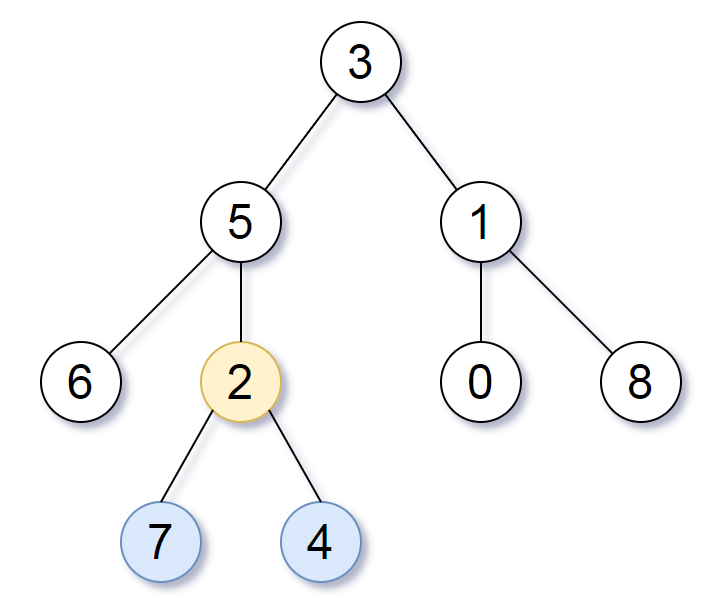
We return the node with value 2, colored in yellow in the diagram.

The nodes colored in blue are the deepest nodes of the tree.

The input "[3, 5, 1, 6, 2, 0, 8, null, null, 7, 4]" is a serialization of the given tree.

The output "[2, 7, 4]" is a serialization of the subtree rooted at the node with value 2.

Both the input and output have TreeNode type.
Note:
- The number of nodes in the tree will be between 1 and 500.
- The values of each node are unique.
这道题给了我们一棵二叉树,让我们找包含所有最深结点的最小子树,就是返回这棵最小子树的根结点。题目中给了一个例子,因为有图,所以可以很直接的看出来最深的结点是7和4,那么包含这两个结点的最小子树的根结点是2,返回即可。其实最深的结点不一定只有两个,可能有很多个,比如对于一棵完全二叉树,即把例子图中的结点7和4去掉后,此时最深的结点就有四个,分别是6,2,0,8,都包含这些结点的子树就是原树本身了,要返回根结点。
通过上述分析,可以发现,子树的最大深度很重要,对于一棵完全二叉树来说,根结点的左右子树的最大深度一定是相同的,此时直接返回根结点即可。若左右子树的最大深度不同,则最深结点一定位于深度大的子树中,可以对其调用递归函数。所以只需要写一个计算最大深度的递归函数,来计算左右子树的最大深度差,再根据这个差值来决定对谁调用当前的递归函数,两个递归函数相互缠绕,画面美极了,参见代码如下:
解法一:
class Solution {

public:

    TreeNode* subtreeWithAllDeepest(TreeNode* root) {

        int diff = depth(root->left) - depth(root->right);

        return (diff == 0) ? root : subtreeWithAllDeepest(diff > 0 ? root->left : root->right);

    }

    int depth(TreeNode* node) {

        return !node ? 0 : max(depth(node->left), depth(node->right)) + 1;

    }

};
上面的解法其实并不高效,因为对于每个结点,都要统计其左右子树的最大深度,有大量的重复计算存在,我们来尝试提高时间复杂度,就不可避免的要牺牲一些空间。递归函数需要返回一个 pair,由每个结点的最大深度,以及包含最深结点的最小子树组成。所以在原函数中,对根结点调用递归函数,并取返回的 pair 中的第二项。
在递归函数中,首先判断结点是否存在,为空的话直接返回一个 {0, NULL} 对儿。否则分别对左右子结点调用递归函数,将各自的返回的 pair 存入 left 和 right 中,然后先分别在 left 和 right 中取出左右子树的最大深度 d1 和 d2,之后就要建立返回值的 pair,第一项为当前结点的最大深度,由左右子树中的最大深度加1组成,而包含最深结点的最小子树由 d1 和 d2 值的大小决定,若 d1>d2,则为 left.second,否则为 right.second,这样我们就把原本的两个递归,揉合到了一个递归函数中,大大提高了运行效率,参见代码如下:
解法二:
class Solution {

public:

    TreeNode* subtreeWithAllDeepest(TreeNode* root) {

        return helper(root).second;

    }

    pair<int, TreeNode*> helper(TreeNode* node) {

        if (!node) return {0, NULL};

        auto left = helper(node->left), right = helper(node->right);

        int d1 = left.first, d2 = right.first;

        return {max(d1, d2) + 1, (d1 == d2) ? node : (d1 > d2 ? left.second : right.second)};

    }

};
Github 同步地址:
https://github.com/grandyang/leetcode/issues/865
参考资料:
https://leetcode.com/problems/smallest-subtree-with-all-the-deepest-nodes/
https://leetcode.com/problems/smallest-subtree-with-all-the-deepest-nodes/discuss/146808/One-pass
[LeetCode All in One 题目讲解汇总(持续更新中...)](https://www.cnblogs.com/grandyang/p/4606334.html)
[LeetCode] Smallest Subtree with all the Deepest Nodes 包含最深结点的最小子树的更多相关文章
- 865. Smallest Subtree with all the Deepest Nodes 有最深节点的最小子树
[抄题]: Given a binary tree rooted at root, the depth of each node is the shortest distance to the roo ...
- leetcode_865. Smallest Subtree with all the Deepest Nodes
https://leetcode.com/problems/smallest-subtree-with-all-the-deepest-nodes/ 给定一颗二叉树,输出包含所有最深叶子结点的最小子树 ...
- LeetCode 865. Smallest Subtree with all the Deepest Nodes
原题链接在这里:https://leetcode.com/problems/smallest-subtree-with-all-the-deepest-nodes/ 题目: Given a binar ...
- 【LeetCode】865. Smallest Subtree with all the Deepest Nodes 解题报告(Python & C++)
作者: 负雪明烛 id: fuxuemingzhu 个人博客: http://fuxuemingzhu.cn/ 目录 题目描述 题目大意 解题方法 日期 题目地址:https://leetcode.c ...
- [Swift]LeetCode865. 具有所有最深结点的最小子树 | Smallest Subtree with all the Deepest Nodes
Given a binary tree rooted at root, the depth of each node is the shortest distance to the root. A n ...
- [LeetCode] 1123. Lowest Common Ancestor of Deepest Leaves 最深叶结点的最小公共父节点
Given a rooted binary tree, return the lowest common ancestor of its deepest leaves. Recall that: Th ...
- FB面经 Prepare: LCA of Deepest Nodes in Binary Tree
给一个 二叉树 , 求最深节点的最小公共父节点 . retrun . 先用 recursive , 很快写出来了, 要求用 iterative . 时间不够了... Recursion: 返回的时候返 ...
- Leetcode之深度优先搜索(DFS)专题-1123. 最深叶节点的最近公共祖先(Lowest Common Ancestor of Deepest Leaves)
Leetcode之深度优先搜索(DFS)专题-1123. 最深叶节点的最近公共祖先(Lowest Common Ancestor of Deepest Leaves) 深度优先搜索的解题详细介绍,点击 ...
- LeetCode 1123. Lowest Common Ancestor of Deepest Leaves
原题链接在这里:https://leetcode.com/problems/lowest-common-ancestor-of-deepest-leaves/ 题目: Given a rooted b ...
随机推荐
- Non-decreasing Array
Given an array with n integers, your task is to check if it could become non-decreasing by modifying ...
- 【easy】Number of Segments in a String 字符串中的分段数量
以空格为分隔符,判断一个string可以被分成几部分. 注意几种情况:(1)全都是空格 (2)空字符串(3)结尾有空格 思路: 只要统计出单词的数量即可.那么我们的做法是遍历字符串,遇到空格直接跳过, ...
- 【easy】235. Lowest Common Ancestor of a Binary Search Tree
题意大概是,找两个节点的最低公共祖先 /** * Definition for a binary tree node. * struct TreeNode { * int val; * TreeNod ...
- django学习笔记-模板层
模板层 将Python嵌入到HTML中. 模板简介 将HTML硬解码到视图并不是那么完美原因如下: 对页面设计时也需要对python代码进行相应的修改,模板可以不就行python代码修改的情况下变更设 ...
- 高可用Redis(十):Redis原生命令搭建集群
1.搭建Redis Cluster主要步骤 1.配置开启节点 2.meet 3.指派槽 4.主从关系分配 2.环境说明 两台虚拟机,IP地址分别为:192.168.81.100和192.168.81. ...
- PHP斐波那契数列有点不明白有哪位大佬能给讲讲思想以及实现过程
function Fibonacci($n){ if($n <= 0) { return 0; }elseif($n == 1) { ...
- 在django中uwsgi的使用,以及安装
首先了解wsgi是一个python web服务器,uwsgi实现了wsgi所有的功能,性能稳定,效率高的服务器: 1.安装uwsgi pip install uwsgi 2.配置uwsgi [uwsg ...
- PHP消息队列实现及应用
目前对消息队列并不了解其原理,本篇文章主要是通过慕课网学习归纳的一些笔记,为后续学习打下基础. 众所周知在对网站设计的时候,会遇到给用户“群发短信”,“订单系统有大量的日志”,“秒杀设计”等,服务器没 ...
- mysql 和 sqlserver sql差异比较
mysql:select * from table_name limit 100,200;--取出从100到200的数据 获取时间:mysql:now() mysql tinyint(0,1) → b ...
- C# Aspose.Cells 如何设置单元格样式
//Instantiating a Workbook object Workbook workbook = new Workbook(); //Adding a new worksheet to th ...