
步进电机的Arduino库函数
This library allows you to control unipolar or bipolar stepper motors. To use it you will need a stepper motor, and the appropriate hardware to control it. For more on that, see Tom Igoe's notes on steppers.
函数
Stepper(steps, pin1, pin2) 步进电机定义
Stepper(steps, pin1, pin2, pin3, pin4) 步进电机定义
Description 解释
This function creates a new instance of the Stepper class that represents a particular stepper motor attached to your Arduino board. Use it at the top of your sketch, above setup() and loop(). The number of parameters depends on how you've wired your motor - either using two or four pins of the Arduino board.
Parameters 参数
steps: the number of steps in one revolution of your motor. If your motor gives the number of degrees per step, divide that number into 360 to get the number of steps (e.g. 360 / 3.6 gives 100 steps). (int) 一圈对应的步数
pin1, pin2: two pins that are attached to the motor (int)
pin3, pin4: optional the last two pins attached to the motor, if it's connected to four pins (int)
Returns A new instance of the Stepper motor class.
setSpeed(rpm) 速度设定
Description 解释
Sets the motor speed in rotations per minute (RPMs). This function doesn't make the motor turn, just sets the speed at which it will when you call step().
Parameters 参数
rpms: the speed at which the motor should turn in rotations per minute - a positive number (long)
Returns None 无返回值
step(steps) 步数执行
Description
Turns the motor a specific number of steps, at a speed determined by the most recent call to setSpeed(). This function is blocking; that is, it will wait until the motor has finished moving to pass control to the next line in your sketch. For example, if you set the speed to, say, 1 RPM and called step(100) on a 100-step motor, this function would take a full minute to run. For better control, keep the speed high and only go a few steps with each call to step().
Parameters
steps: the number of steps to turn the motor - positive to turn one direction, negative to turn the other (int)
Returns None
举例
例1 Stepper Motor Knob 用电位器控制步进电机步数
Control a highly accurate stepper motor using a potentiometer
Stepper motors, due to their unique design, can be controlled to a high degree of accuracy without any feedback mechanisms. The shaft of a stepper, mounted with a series of magnets, is controlled by a series of electromagnetic coils that are charged positively and negatively in a specific sequence, precisely moving it forward or backward in small "steps".
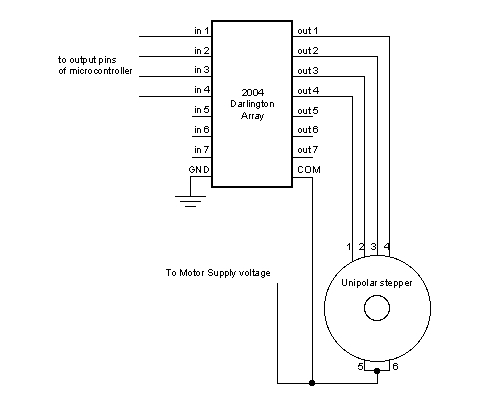
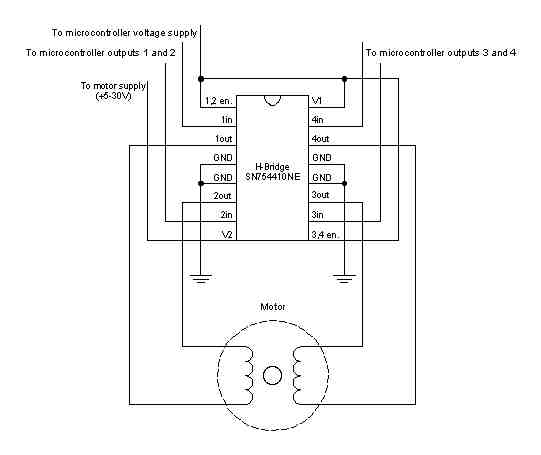
There are two types of steppers, Unipolars and Bipolars, and it is very important to know which type you are working with. For each of the motors, there is a different circuit. The example code will control both kinds of motors. See the unipolar and bipolar motor schematics for information on how to wire up your motor.
In this example, a potentiometer (or other sensor) on analog input 0 is used to control the movement of a stepper motor using the Arduino Stepper Library. The stepper is controlled by with digital pins 8, 9, 10, and 11 for either unipolar or bipolar motors.
The Arduino or Genuino board will connect to a U2004 Darlington Array if you're using a unipolar stepper or a SN754410NE H-Bridge if you have a bipolar motor.
For more information about the differences of the two types, please take a look at Tom Igoe's page on stepper motors.
Hardware Required 硬件
Arduino or Genuino Board
10k ohm potentiometer
stepper motor
U2004 Darlington Array (if using a unipolar stepper)
SN754410ne H-Bridge (if using a bipolar stepper)
power supply appropriate for your particular stepper
hook-up wires
breadboard
Circuits 电路
Below you'll find circuits for both unipolar and bipolar steppers. In either case, it is best to power your stepper motors from an external supply, as they draw too much to be powered directly from your Arduino board.
In both circuits, connect a 10k pot to power and ground, with it's wiper outputting to analog pin 0.
Note: Both circuits below are four wire configurations. Two wire configurations will not work with the code provided.
Unipolar Stepper Circuit and schematic:
Bipolar Stepper Circuit and schematic:
Code 程序
For both unipolar and bipolar steppers
 1 /*

 2 * MotorKnob

 3 ** A stepper motor follows the turns of a potentiometer (or other sensor) on analog input 0.

 4 ** http://www.arduino.cc/en/Reference/Stepper

 5 * This example code is in the public domain.

 6 */

 7

 8 #include <Stepper.h>

 9 #define STEPS 100     // change this to the number of steps on your motor

10   // create an instance of the stepper class, specifying

11   // the number of steps of the motor and the pins it's attached to

12 Stepper stepper(STEPS, 8, 9, 10, 11);

13 int previous = 0;    // the previous reading from the analog input

14

15 void setup()

16 {

17     stepper.setSpeed(30);   // set the speed of the motor to 30 RPMs

18 }

19

20 void loop()

21 {

22     int val = analogRead(0);   // get the sensor value

23   // move a number of steps equal to the change in the sensor reading

24     stepper.step(val - previous);   // remember the previous value of the sensor

25     previous = val;

26 }
例2 Stepper Speed Control 用电位器控制步进电机速度
Control the stepping speed with a potentiometer
硬件与电路部分,与上例同
Code 程序
For both unipolar and bipolar steppers
 1 /*

 2 Stepper Motor Control - speed control

 3 This program drives a unipolar or bipolar stepper motor.

 4 The motor is attached to digital pins 8 - 11 of the Arduino.

 5 A potentiometer is connected to analog input 0.

 6     The motor will rotate in a clockwise direction. The higher the potentiometer value,the faster the motor speed. Because setSpeed() sets the delay between steps,you may notice the motor is less responsive to changes in the sensor value at low speeds.

 7

 8 Created 30 Nov. 2009,Modified 28 Oct 2010,by Tom Igoe

 9 */

10

11 #include <Stepper.h>

12 const int stepsPerRevolution = 200;

13 // change this to fit the number of steps per revolution

14   // for your motor initialize the stepper library on pins 8 through 11:

15 Stepper myStepper(stepsPerRevolution, 8, 9, 10, 11);

16 int stepCount = 0;   // number of steps the motor has taken

17

18 void setup()

19 {

20     // nothing to do inside the setup

21 }

22

23 void loop()

24  {

25     int sensorReading = analogRead(A0); // read the sensor value:

26     int motorSpeed = map(sensorReading, 0, 1023, 0, 100);

27     // map it to a range from 0 to 100

28     if (motorSpeed > 0) // set the motor speed:

29     {

30         myStepper.setSpeed(motorSpeed);

31         myStepper.step(stepsPerRevolution / 100); // step 1/100 of a revolution:

32     }

33 }
例3 Stepper One Revolution 正转一圈反转一圈
Turn the shaft one revolution clockwise and one counterclockwise.
硬件与电路部分,与上例同
Code 程序
For both unipolar and bipolar steppers
 1 /*

 2 Stepper Motor Control - one revolution

 3 This program drives a unipolar or bipolar stepper motor.

 4 The motor is attached to digital pins 8 - 11 of the Arduino.

 5     The motor should revolve one revolution in one direction, then one revolution in the other direction.

 6

 7 Created 11 Mar. 2007,Modified 30 Nov. 2009,by Tom Igoe

 8 */

 9 #include <Stepper.h>

10 const int stepsPerRevolution = 200;

11 // change this to fit the number of steps per revolution

12  // for your motor initialize the stepper library on pins 8 through 11:

13 Stepper myStepper(stepsPerRevolution, 8, 9, 10, 11);

14

15 void setup()

16 {

17     myStepper.setSpeed(60);   // set the speed at 60 rpm:

18     Serial.begin(9600);   // initialize the serial port:

19 }

20

21 void loop()

22 {

23     Serial.println("clockwise");   // step one revolution in one direction:

24     myStepper.step(stepsPerRevolution);

25     delay(500);

26     Serial.println("counterclockwise");   // step one revolution in the other         direction:

27     myStepper.step(-stepsPerRevolution);

28     delay(500);

29 }
例4 One step at a time 一次只走一步
Turn the shaft step by step to check the proper wiring of the motor.
硬件与电路部分,与上例同
Code 程序
For both unipolar and bipolar steppers
 1 /*

 2 Stepper Motor Control - one step at a time

 3 This program drives a unipolar or bipolar stepper motor.

 4 The motor is attached to digital pins 8 - 11 of the Arduino.

 5     The motor will step one step at a time, very slowly. You can use this to test that you've got the four wires of your stepper wired to the correct pins. If wired correctly, all steps should be in the same direction.

 6     Use this also to count the number of steps per revolution of your motor,if you don't know it. Then plug that number into the one Revolution example to see if you got it right.

 7

 8 Created 30 Nov. 2009,by Tom Igoe

 9 */

10

11 #include <Stepper.h>

12 const int stepsPerRevolution = 200; // change this to fit the number of steps per revolution

13     // for your motor initialize the stepper library on pins 8 through 11:

14 Stepper myStepper(stepsPerRevolution, 8, 9, 10, 11);

15 int stepCount = 0; // number of steps the motor has taken

16

17 void setup()

18 {

19     Serial.begin(9600);   // initialize the serial port:

20 }

21

22 void loop()

23 {

24     myStepper.step(1);   // step one step:

25     Serial.print("steps:");

26     Serial.println(stepCount);

27     stepCount++;

28     delay(500);

29 }
步进电机的Arduino库函数的更多相关文章
- 总线SPI的Arduino库函数
来源参考:https://www.cnblogs.com/MyAutomation/p/9348480.html 总线SPI的Arduino库函数 SPI基本知识 SPI:高速同步串行口.是一种标准的 ...
- OneWire总线的Arduino库函数
OneWire总线基本点 One-wire总线是DALLAS公司研制开发的一种协议,采用单根信号线,既传输时钟,又传输数据而且数据传输是双向的.它具有节省I/O 口线资源.结构简单.成本低廉.便于总线 ...
- I2C总线的Arduino库函数
I2C总线的Arduino库函数 I2C即Inter-Integrated Circuit串行总线的缩写,是PHILIPS公司推出的芯片间串行传输总线.它以1根串行数据线(SDA)和1根串行时钟线(S ...
- Arduino库函数中文说明
#define 常量名 常量值 % 取模运算符 String abc / char abc[n] 定义字符串 pinMode(pin,mode); 用于引脚的初始化 mode包括 INPUT ...
- arduino库函数1
https://wenku.baidu.com/view/e657b1f0bcd126fff6050baf.html 的阅读笔记.现在到了 第四十页. setup应该是 在开始 执行一次. 然后 lo ...
- 伺服电机的Arduino库函数
servo.attach(pin) //连接伺服电机的信号线于控制板的引脚,9或10号引脚servo.attach(pin, min, max) servo: a variable of type ...
- Arduino小车学习与研究
信安系统设计基础实践模块 Arduino小车学习与研究 ================== 陈都(20135328) 余佳源(20135321) 莫凡(20135225) ---------- 索引 ...
- Arduino小车学习与研究博客
Arduino小车学习与研究博客 信安系统设计基础实践模块 Arduino小车学习与研究 ================== 陈都(20135328) 余佳源(20135321) 莫凡(201352 ...
- AVR开发 Arduino方法(一) 端口子系统
Arduino UNO R3使用的主处理器ATMega328P上有3个8位的输入/输出端口,它们分别是PB,PC和PD.Arduino IDE提供的Blink示例可以帮助我们了解端口的数字输出功能: ...
随机推荐
- 【Android】SwipeRefreshLayout的简单使用教程。下拉刷新控件炫酷效果。
作者:程序员小冰,GitHub主页:https://github.com/QQ986945193 新浪微博:http://weibo.com/mcxiaobing 首先给大家看一下我们今天这个最终实现 ...
- Macbook Pro HDMI 无信号解决办法
因为CS:GO无法启动的问题,使用过了下面的命令 sudo pmset -a GPUSwitch 0 导致HDMI显示器无信号 输入下面的代码 sudo pmset -a GPUSwitch 1 可以 ...
- 利用阿里云服务器免费体验word press博客、个人网站
本文首发于我的个人博客:https://chens.life/create-wordpress-blog.html 前言 目前市面上有许许多多的虚拟云服务器ECS,例如阿里云.华为云.又拍云等等,他们 ...
- WinForm使用Setuo Project打包安装包 (附带vs2019 InstallerProjects安装程序)
vs2019 InstallerProjects安装程序地址: 链接:https://pan.baidu.com/s/1K5iDuQT4CBBw2dJjRLqhjg提取码:dfhy 转载至https: ...
- [java]将多个文件压缩成一个zip文件
此文进阶请见:https://www.cnblogs.com/xiandedanteng/p/12155957.html 方法: package zip; import java.io.Buffere ...
- AES字节数组加密解密流程
AES类时微软MSDN中最常用的加密类,微软官网也有例子,参考链接:https://docs.microsoft.com/zh-cn/dotnet/api/system.security.crypto ...
- Java类加载机制()
Java类加载机制(转载) 概述 在开始正文之前,我们先看两张图 .Java平台的理解?Java最显著的特性?Java是解释执行? 先看一下java程序的执行流程图 再看一下jvm的大致物理结构图 本 ...
- JS中条件判断语句
用pycharm敲代码时,在.js文件中敲,敲完之后复制代码到浏览器的console中去回车执行 1.if( ){} 2.switch(a){} 3.for循环 循环列表 循环字典 循环字符串 另外 ...
- django之安装和项目创建
dos界面下安装django 自动下载和安装:cmd:pip3 install django 手动安装: 1.登录django官网下载django 2.下载地址:https://www.django ...
- [leetCode]5. 最长回文子串(DP)
题目 给定一个字符串 s,找到 s 中最长的回文子串.你可以假设 s 的最大长度为 1000. 题解 dp.先初始化长度为1和长度为2的串.再依次算长度为3,4,5.... 当找到回文串时,若长度比当 ...