
狂神说SpringBoot11:Thymeleaf模板引擎
狂神说SpringBoot系列连载课程,通俗易懂,基于SpringBoot2.2.5版本,欢迎各位狂粉转发关注学习。
微信公众号:狂神说(首发) Bilibili:狂神说Java(视频)
未经作者授权,禁止转载
Thymeleaf
模板引擎
前端交给我们的页面,是html页面。如果是我们以前开发,我们需要把他们转成jsp页面,jsp好处就是当我们查出一些数据转发到JSP页面以后,我们可以用jsp轻松实现数据的显示,及交互等。
jsp支持非常强大的功能,包括能写Java代码,但是呢,我们现在的这种情况,SpringBoot这个项目首先是以jar的方式,不是war,像第二,我们用的还是嵌入式的Tomcat,所以呢,他现在默认是不支持jsp的。
那不支持jsp,如果我们直接用纯静态页面的方式,那给我们开发会带来非常大的麻烦,那怎么办呢?
SpringBoot推荐你可以来使用模板引擎:
模板引擎,我们其实大家听到很多,其实jsp就是一个模板引擎,还有用的比较多的freemarker,包括SpringBoot给我们推荐的Thymeleaf,模板引擎有非常多,但再多的模板引擎,他们的思想都是一样的,什么样一个思想呢我们来看一下这张图:
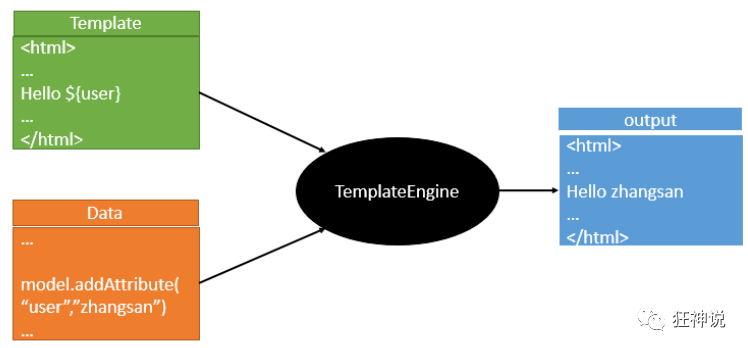
模板引擎的作用就是我们来写一个页面模板,比如有些值呢,是动态的,我们写一些表达式。而这些值,从哪来呢,就是我们在后台封装一些数据。然后把这个模板和这个数据交给我们模板引擎,模板引擎按照我们这个数据帮你把这表达式解析、填充到我们指定的位置,然后把这个数据最终生成一个我们想要的内容给我们写出去,这就是我们这个模板引擎,不管是jsp还是其他模板引擎,都是这个思想。只不过呢,就是说不同模板引擎之间,他们可能这个语法有点不一样。其他的我就不介绍了,我主要来介绍一下SpringBoot给我们推荐的Thymeleaf模板引擎,这模板引擎呢,是一个高级语言的模板引擎,他的这个语法更简单。而且呢,功能更强大。
我们呢,就来看一下这个模板引擎,那既然要看这个模板引擎。首先,我们来看SpringBoot里边怎么用。
引入Thymeleaf
怎么引入呢,对于springboot来说,什么事情不都是一个start的事情嘛,我们去在项目中引入一下。给大家三个网址:
Thymeleaf 官网:https://www.thymeleaf.org/
Thymeleaf 在Github 的主页:https://github.com/thymeleaf/thymeleaf
Spring官方文档:找到我们对应的版本
https://docs.spring.io/spring-boot/docs/2.2.5.RELEASE/reference/htmlsingle/#using-boot-starter
找到对应的pom依赖:可以适当点进源码看下本来的包!
<!--thymeleaf-->

<dependency>

    <groupId>org.springframework.boot</groupId>

    <artifactId>spring-boot-starter-thymeleaf</artifactId>

</dependency>
Maven会自动下载jar包,我们可以去看下下载的东西;

Thymeleaf分析
前面呢,我们已经引入了Thymeleaf,那这个要怎么使用呢?
我们首先得按照SpringBoot的自动配置原理看一下我们这个Thymeleaf的自动配置规则,在按照那个规则,我们进行使用。
我们去找一下Thymeleaf的自动配置类:ThymeleafProperties
@ConfigurationProperties(

    prefix = "spring.thymeleaf"

)

public class ThymeleafProperties {

    private static final Charset DEFAULT_ENCODING;

    public static final String DEFAULT_PREFIX = "classpath:/templates/";

    public static final String DEFAULT_SUFFIX = ".html";

    private boolean checkTemplate = true;

    private boolean checkTemplateLocation = true;

    private String prefix = "classpath:/templates/";

    private String suffix = ".html";

    private String mode = "HTML";

    private Charset encoding;

}
我们可以在其中看到默认的前缀和后缀!
我们只需要把我们的html页面放在类路径下的templates下,thymeleaf就可以帮我们自动渲染了。
使用thymeleaf什么都不需要配置,只需要将他放在指定的文件夹下即可!
测试
1、编写一个TestController
@Controller

public class TestController {

    @RequestMapping("/t1")

    public String test1(){

        //classpath:/templates/test.html

        return "test";

    }

}
2、编写一个测试页面 test.html 放在 templates 目录下
<!DOCTYPE html>

<html lang="en">

<head>

    <meta charset="UTF-8">

    <title>Title</title>

</head>

<body>

<h1>测试页面</h1>

</body>

</html>
3、启动项目请求测试
Thymeleaf 语法学习
要学习语法,还是参考官网文档最为准确,我们找到对应的版本看一下;
Thymeleaf 官网:https://www.thymeleaf.org/ , 简单看一下官网!我们去下载Thymeleaf的官方文档!
我们做个最简单的练习 :我们需要查出一些数据,在页面中展示
1、修改测试请求,增加数据传输;
@RequestMapping("/t1")

public String test1(Model model){

    //存入数据

    model.addAttribute("msg","Hello,Thymeleaf");

    //classpath:/templates/test.html

    return "test";

}
2、我们要使用thymeleaf,需要在html文件中导入命名空间的约束,方便提示。
我们可以去官方文档的#3中看一下命名空间拿来过来:
xmlns:th="http://www.thymeleaf.org"
3、我们去编写下前端页面
<!DOCTYPE html>

<html lang="en" xmlns:th="http://www.thymeleaf.org">

<head>

    <meta charset="UTF-8">

    <title>狂神说</title>

</head>

<body>

<h1>测试页面</h1>

<!--th:text就是将div中的内容设置为它指定的值,和之前学习的Vue一样-->

<div th:text="${msg}"></div>

</body>

</html>
4、启动测试!
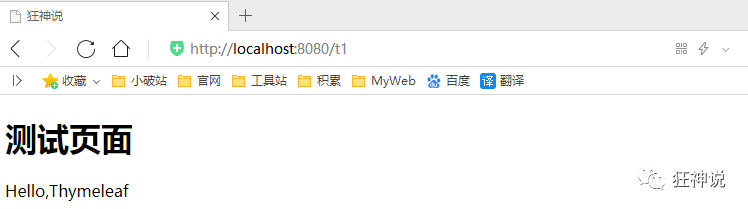
OK,入门搞定,我们来认真研习一下Thymeleaf的使用语法!
1、我们可以使用任意的 th:attr 来替换Html中原生属性的值!

2、我们能写哪些表达式呢?
Simple expressions:(表达式语法)

Variable Expressions: ${...}:获取变量值;OGNL;

    1)、获取对象的属性、调用方法

    2)、使用内置的基本对象:#18

         #ctx : the context object.

         #vars: the context variables.

         #locale : the context locale.

         #request : (only in Web Contexts) the HttpServletRequest object.

         #response : (only in Web Contexts) the HttpServletResponse object.

         #session : (only in Web Contexts) the HttpSession object.

         #servletContext : (only in Web Contexts) the ServletContext object.

    3)、内置的一些工具对象:

      #execInfo : information about the template being processed.

      #uris : methods for escaping parts of URLs/URIs

      #conversions : methods for executing the configured conversion service (if any).

      #dates : methods for java.util.Date objects: formatting, component extraction, etc.

      #calendars : analogous to #dates , but for java.util.Calendar objects.

      #numbers : methods for formatting numeric objects.

      #strings : methods for String objects: contains, startsWith, prepending/appending, etc.

      #objects : methods for objects in general.

      #bools : methods for boolean evaluation.

      #arrays : methods for arrays.

      #lists : methods for lists.

      #sets : methods for sets.

      #maps : methods for maps.

      #aggregates : methods for creating aggregates on arrays or collections.

==================================================================================

  Selection Variable Expressions: *{...}:选择表达式:和${}在功能上是一样;

  Message Expressions: #{...}:获取国际化内容

  Link URL Expressions: @{...}:定义URL;

  Fragment Expressions: ~{...}:片段引用表达式

Literals(字面量)

      Text literals: 'one text' , 'Another one!' ,…

      Number literals: 0 , 34 , 3.0 , 12.3 ,…

      Boolean literals: true , false

      Null literal: null

      Literal tokens: one , sometext , main ,…

Text operations:(文本操作)

    String concatenation: +

    Literal substitutions: |The name is ${name}|

Arithmetic operations:(数学运算)

    Binary operators: + , - , * , / , %

    Minus sign (unary operator): -

Boolean operations:(布尔运算)

    Binary operators: and , or

    Boolean negation (unary operator): ! , not

Comparisons and equality:(比较运算)

    Comparators: > , < , >= , <= ( gt , lt , ge , le )

    Equality operators: == , != ( eq , ne )

Conditional operators:条件运算(三元运算符)

    If-then: (if) ? (then)

    If-then-else: (if) ? (then) : (else)

    Default: (value) ?: (defaultvalue)

Special tokens:

    No-Operation: _
练习测试
1、 我们编写一个Controller,放一些数据
@RequestMapping("/t2")

public String test2(Map<String,Object> map){

    //存入数据

    map.put("msg","<h1>Hello</h1>");

    map.put("users", Arrays.asList("qinjiang","kuangshen"));

    //classpath:/templates/test.html

    return "test";

}
2、测试页面取出数据
<!DOCTYPE html>

<html lang="en" xmlns:th="http://www.thymeleaf.org">

<head>

    <meta charset="UTF-8">

    <title>狂神说</title>

</head>

<body>

<h1>测试页面</h1>

<div th:text="${msg}"></div>

<!--不转义-->

<div th:utext="${msg}"></div>

<!--遍历数据-->

<!--th:each每次遍历都会生成当前这个标签:官网#9-->

<h4 th:each="user :${users}" th:text="${user}"></h4>

<h4>

    <!--行内写法:官网#12-->

    <span th:each="user:${users}">[[${user}]]</span>

</h4>

</body>

</html>
3、启动项目测试!
我们看完语法,很多样式,我们即使现在学习了,也会忘记,所以我们在学习过程中,需要使用什么,根据官方文档来查询,才是最重要的,要熟练使用官方文档!
一定要关注分享支持一下哦~

狂神说SpringBoot11:Thymeleaf模板引擎的更多相关文章
- (二)SpringBoot基础篇- 静态资源的访问及Thymeleaf模板引擎的使用
一.描述 在应用系统开发的过程中,不可避免的需要使用静态资源(浏览器看的懂,他可以有变量,例:HTML页面,css样式文件,文本,属性文件,图片等): 并且SpringBoot内置了Thymeleaf ...
- 【Springboot】Springboot整合Thymeleaf模板引擎
Thymeleaf Thymeleaf是跟Velocity.FreeMarker类似的模板引擎,它可以完全替代JSP,相较与其他的模板引擎,它主要有以下几个特点: 1. Thymeleaf在有网络和无 ...
- 三、thymeleaf模板引擎构建前台html, 后台使用 ModelAndView 和 Model 模型
项目源码:https://github.com/y369q369/springBoot.git -> thymeleaf 私聊QQ: 1486866853 1.pom.xml中 ...
- SpringBoot使用thymeleaf模板引擎
(1).添加pom依赖 <dependency> <groupId>org.springframework.boot</groupId> <artifactI ...
- Spring Boot 2.0 整合Thymeleaf 模板引擎
本节将和大家一起实战Spring Boot 2.0 和thymeleaf 模板引擎 1. 创建项目 2. 使用Spring Initlizr 快速创建Spring Boot 应用程序 3. 填写项目配 ...
- Thymeleaf模板引擎的初步使用
在springboot中,推荐使用的模板引擎是Thymeleaf模板引擎,它提供了完美的Spring MVC的支持.下面就简单的介绍一下Thymeleaf模板引擎的使用. 在controller层中, ...
- spring boot: thymeleaf模板引擎使用
spring boot: thymeleaf模板引擎使用 在pom.xml加入thymeleaf模板依赖 <!-- 添加thymeleaf的依赖 --> <dependency> ...
- SpringBoot入门篇--使用Thymeleaf模板引擎进行页面的渲染
在做WEB开发的时候,我们不可避免的就是在前端页面之间进行跳转,中间进行数据的查询等等操作.我们在使用SpringBoot之前包括我在内其实大部分都是用的是JSP页面,可以说使用的已经很熟悉.但是我们 ...
- (二)SpringBoot2.0基础篇- 静态资源的访问及Thymeleaf模板引擎的使用
一.描述 在应用系统开发的过程中,不可避免的需要使用静态资源(浏览器看的懂,他可以有变量,例:HTML页面,css样式文件,文本,属性文件,图片等): 并且SpringBoot内置了Thymeleaf ...
随机推荐
- 树莓派(4B)新手入门教程
前期准备 必要物料 树莓派4B 主机 Type-C 电源 内存卡(8G+) 一般建议一步到位64G 系统镜像 镜像写入工具 下载地址 镜像下载 官方下载地址: https://www.raspberr ...
- exchangeNetwork
泛洪(Flooding) 转发(Forwarding) 丢弃(Discarding) 交换机中有一个MAC地址表,里面存放了MAC地址与交换机的映射关系.MAC地址表也称为CAM(Content Ad ...
- 使用CSS的clip-path实现图片剪切效果
最近有个业务需求:校对图片文本信息,如下图所示,当鼠标点击文本中某一行的时候,文本上会显示对应行图片同时左侧会显示对应位置的画框. clip-path 今天要说的主题是:如何剪切原图中的部分图片?(前 ...
- git的基础知识
git 分布式版本控制工具 具备的功能 协同开发 多人并行不悖修改服务器端的同一个文件 数据备份 不仅保持目录和文件当前状态,还能保存每一个提交的历史版本 版本管理 保存每一个版本的文件信息的时候做到 ...
- Debian安装HomeBrew
前言 HomeBrew 的用处我想使用 Mac 的开发人员都知道, 本篇讲解如何在 Debian 上安装 BrewLinux 更新: 后来发现并不是很好用, 不建议使用 官方推荐的脚本安装 注意这里只 ...
- Eclipse-Che 安装(Centos)
安装docker,然后执行:docker run -it --rm -v /var/run/docker.sock:/var/run/docker.sock -v /home/cheData:/dat ...
- 浅谈sql索引
索引是什么 假如你手上有一个你公司的客户表,老板说找什么客户你就得帮他找出来. 客户不多的时候,你拿着手指一行一行滑,费不了多少时间就能找到. 后来公司做大了,客户越来越多,好几页的客户,你发现,一行 ...
- python学习笔记 | PyCharm出现卡顿解决方法
问题:使用pycharm时常出现 the IDE is running low on memory 的问题 表示pycharm这款IDE使用内存不足 需要在系统内存充足的情况下扩充IDE memory ...
- 通用寄存器_MOV_ADD_SUB_AND_OR_NOT
通用寄存器 MOV指令 注意:目标操作数与操作数宽度必须一样 MOV 目标操作数,源操作数 作用:拷贝源操作数到目标操作数 1.源操作数可以是立即数.通用寄存器.段寄存器.或者内存单元. 2.目标操作 ...
- 【EXPDP/IMPDP】数据泵导入导出遇到目录没有权限问题
当执行数据泵导出的时候,报了如下错误: ORA-39002: invalid operation ORA-39070: Unable to open the log file. ORA-39087: ...