
[转帖]TaiShan v110 - Microarchitectures - HiSilicon
https://en.wikichip.org/wiki/hisilicon/microarchitectures/taishan_v110
| Edit Values | |
| TaiShan v110 µarch | |
| General Info | |
| Arch Type | CPU |
| Designer | HiSilicon |
| Manufacturer | TSMC |
| Introduction | 2019 |
| Process | 7 nm |
| Core Configs | 32, 48, 64 |
| Pipeline | |
| Type | Superscalar, Superpipeline |
| OoOE | Yes |
| Speculative | Yes |
| Reg Renaming | Yes |
| Decode | 4-way |
| Instructions | |
| ISA | ARMv8.2-A |
| Extensions | NEON |
| Cache | |
| L1I Cache | 64 KiB/core |
| L1D Cache | 64 KiB/core |
| L2 Cache | 512 KiB/core |
| L3 Cache | 1 MiB/core |
| Succession | |
|
|
|
TaiShan v110 is the successor to the TaiShan v100, a high-performance ARM server microarchitecture designed by HiSilicon for Huawei's own TaiShan servers.
contents
[hide]
Brands[edit]
TaiShan-based CPUs are branded as the Kunpeng 920 series.
Release Dates[edit]
Kunpeng 920 CPUs were officially launched in early 2019.
Architecture[edit]
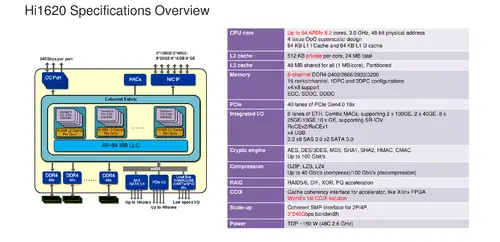
Overview
Key changes from TaiShan v100[edit]
- TSMC 7 nm HPC process (from 16 nm)
- 2x core count (64, up from 32)
- Custom cores (from Cortex-A72)
- ASIMD
- double SP Vector throughput (2 inst/cycle, up from 1)
- ASIMD
- Custom cores (from Cortex-A72)
- Memory
- 2x memory channels (8, up from 4)
- I/O
- PCIe Gen 4 (from Gen 3)
This list is incomplete; you can help by expanding it.
Block Diagram[edit]
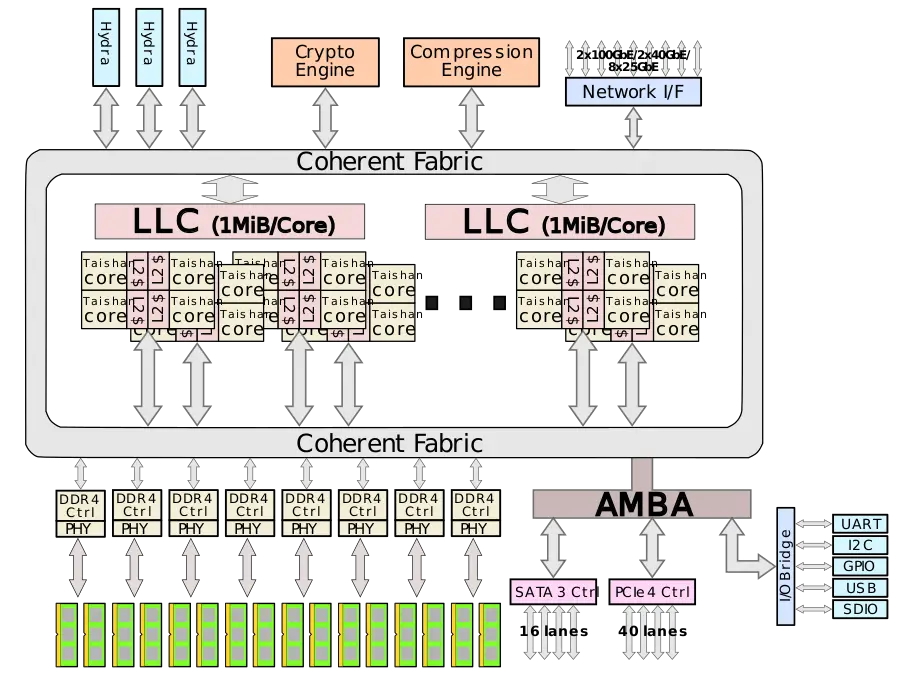
Entire Chip[edit]
Memory Hierarchy[edit]
- Cache
- L1I Cache
- 64 KiB/core, private
- 64-byte cache lines
- L1D Cache
- 64 KiB/core, private
- 64-byte cache lines
- L2 Cache
- 512 KiB/core, private
- L3 Cache
- 1 MiB/core
- Shared by all cores
- System DRAM
- 1 TiB Max Memory / socket
- 8 Channels
- DDR4, up to 2933 MT/s
- 1 DPC and 2 DPC support
- 8 B/cycle/channel (@ memory clock)
- ECC, SDDC, DDDC
- L1I Cache
Overview[edit]
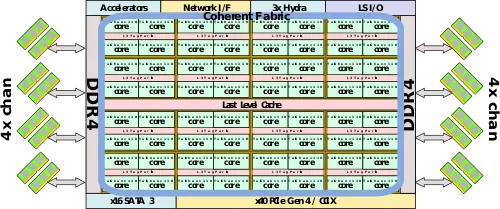
Overview
Though HiSilicon has a history of designing Arm processors. The TaiShan v110 core is HiSilicons' first custom homegrown high-performance ARM core and SoC design. The chip, which incorporates multiple compute dies and an I/O is a multi-chip package, is fabricated on TSMC's 7-nanometers HPC process and integrates up to 64 cores and up to 64 MiB of last level cache.
The SoC also incorporates a number of hardware accelerators. There is a crypto engine that supports AES, DES/3DES, MD5, SHA1, SHA2, HMAC, CMAC with throughputs of up to 100 Gbit/s. Additionally, there is also a compression engine supporting GZIP, LZS, LZ4 with compression throughputs of up to 40 Gbit/s and decompression of up to 100 Gbit/s.
Marketed as the Kunpeng 920, this SoC supports up to 4-way multiprocessing support through HiSilicon's Hydra interface. In order to keep the cores fed, eight DDR4 memory channels are incorporated per socket. Additionally, designed to facilitate an easy accelerator platform, there are 40 PCIe Gen 4 lanes provided per socket with CCIX support, enabling cache coherency.
Core[edit]
Each core is a 4-way out-of-order superscalar that implements the ARMv8.2-A ISA. Huawei stated that the core supports almost all the ARMv8.4 features with a few exceptions, including dot product and the FP16 FML extension. It features private 64 KiB L1 instruction and data caches as well as 512 KiB of private L2. Though light on details, Huawei says that compared to Arm's Cortex cores, their core features an improved memory subsystem, a larger number of execution units, and a better branch predictor.
ASIMD[edit]
Each core features a single 128-bit NEON unit. It is capable of executing single double-precision FMA vector instruction per cycle or two single-precision vector instructions per cycle. Operating at 2 GHz, a 64-core chip will have a peak compute of 512 GigaFLOPS of double-precision floating point. It's worth noting that compared to the TaiShan v100, the throughput for single-precision vector has been doubled from 1 to 2 instructions per cycle.
MCP physical design[edit]
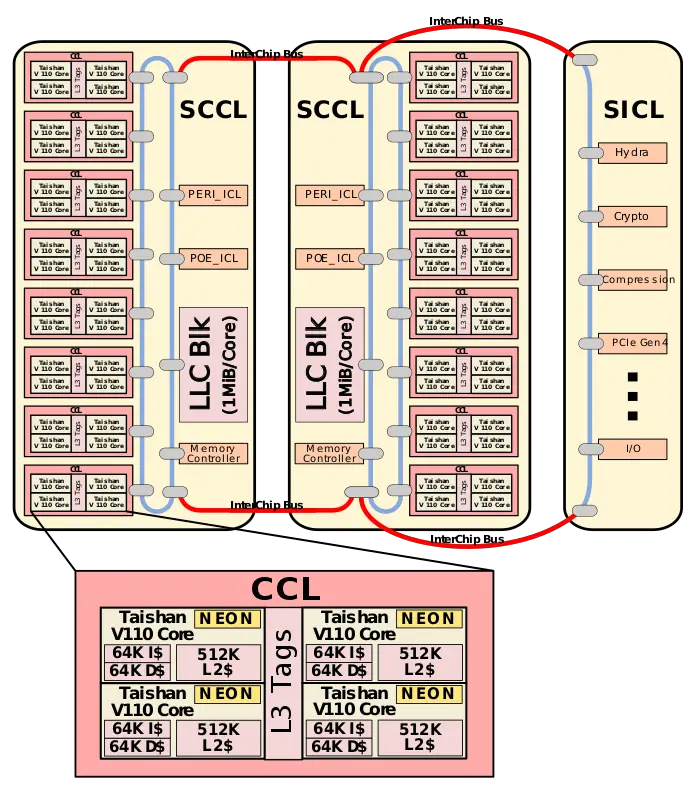
The SoC itself comprises 3 dies - two Super CPU Cluster (SCCL) compute dies and a Super IO Cluster (SICL). The SCCL compute dies contains 8 CPU Clusters (CCLs), memory controllers, and the L3 cache block. There are eight CCLs on each of the SICL dies for a total of 64 cores. The CCLs are TaiShan V110 quadplex along with the L3 cache tags partition. The Super IO Clusters include the various I/O peripherals including PCIe Gen 4, SAS, the network interface controllers, and the Hydra links.
Scalability[edit]
- See also: Hydra Interface
Each chip incorporates three Hydra interface ports. The Hydra interface facilitates the cache coherency between the dies on the chip. Every link supports 240 Gb/s (30 GB/s) of peak bandwidth for a total aggregated bandwidth of 720 Gb/s (90 GB/s) in a 2-way symmetric multiprocessing configuration.
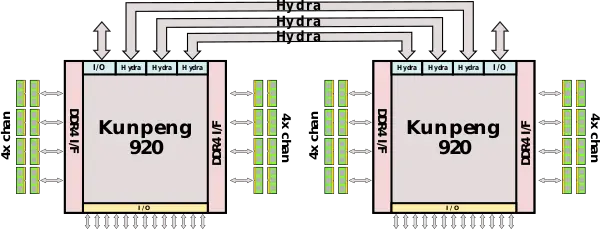
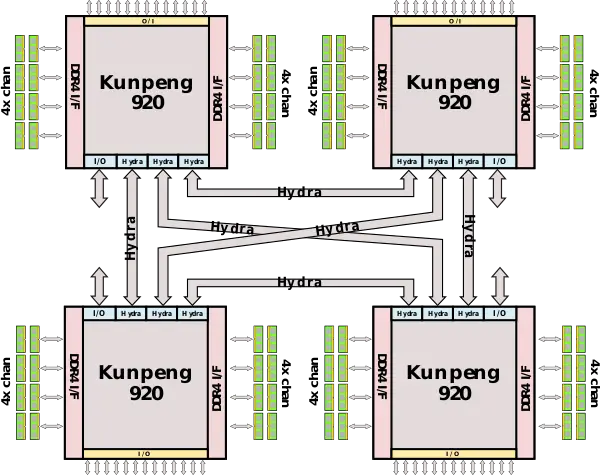
With all three links, there is also support for 4-way SMP. In this configuration, one link from each socket is connected to another socket for an all-for-all connection.
Chipset[edit]
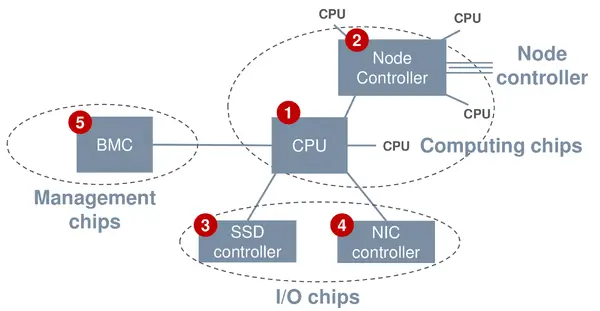
Along with the Hi1620 SoC, HiSilicon developed a number of integrated circuits as part of the chipset platform.
| Chip | Description |
|---|---|
| Hi1620 | CPU, Kunpeng 920 series Chip |
| Hi1503 | CPU interconnect chip, supports scaling-up to 32 sockets |
| Hi1812 | SSD storage controller, for read/write I/O acceleration |
| Hi1822 | Network controller chip, DC high-speed flexible interconnect |
| Hi1710 | BMC management chip + enhanced RAS features chip |
Die[edit]
- TSMC 7 nm HPC
- 20,000,000,000 transistors
- 3-4 dies
All TaiShan v110 Chips[edit]
Bibliography[edit]
- Huawei. Personal Communication. 2019
- Huawei Connect 2018. October 2018
- HiSilicon Event. January 7, 2019
- Huawei, Supercomputing 2018
| codename | TaiShan v110 + |
| core count | 32 +, 48 + and 64 + |
| designer | HiSilicon + |
| first launched | 2019 + |
| full page name | hisilicon/microarchitectures/taishan v110 + |
| instance of | microarchitecture + |
| instruction set architecture | ARMv8.2-A + |
| manufacturer | TSMC + |
| microarchitecture type | CPU + |
| name | TaiShan v110 + |
| process | 7 nm (0.007 μm, 7.0e-6 mm) + |
[转帖]TaiShan v110 - Microarchitectures - HiSilicon的更多相关文章
- 华为TaiShan 2280 ARM 服务器
华为TaiShan 2280 ARM 服务器 华为TaiShan 2280 ARM 服务器 https://e.huawei.com/cn/products/cloud-computing-dc/s ...
- nginx负载均衡基于ip_hash的session粘帖
nginx负载均衡基于ip_hash的session粘帖 nginx可以根据客户端IP进行负载均衡,在upstream里设置ip_hash,就可以针对同一个C类地址段中的客户端选择同一个后端服务器,除 ...
- [转帖]网络协议封封封之Panabit配置文档
原帖地址:http://myhat.blog.51cto.com/391263/322378
- [转帖]零投入用panabit享受万元流控设备——搭建篇
原帖地址:http://net.it168.com/a2009/0505/274/000000274918.shtml 你想合理高效的管理内网流量吗?你想针对各个非法网络应用与服务进行合理限制吗?你是 ...
- 3d数学总结帖
3d数学总结帖,以下是对3d学习过程中数学知识的简单总结 角度值和弧度制的互转 Deg2Rad 角度A1转弧度A2 => A2=A1*PI/180 Rad2Deg 弧度A2转换角度A1 => ...
- [转帖]The Lambda Calculus for Absolute Dummies (like myself)
Monday, May 7, 2012 The Lambda Calculus for Absolute Dummies (like myself) If there is one highly ...
- [转帖]FPGA开发工具汇总
原帖:http://blog.chinaaet.com/yocan/p/5100017074 ----------------------------------------------------- ...
- [Android分享] 【转帖】Android ListView的A-Z字母排序和过滤搜索功能
感谢eoe社区的分享 最近看关于Android实现ListView的功能问题,一直都是小伙伴们关心探讨的Android开发问题之一,今天看到有关ListView实现A-Z字母排序和过滤搜索功能 ...
- AxureRP7.0各类交互效果汇总帖(转)
了便于大家参考,我把这段时间发布分享的所有关于AxureRP7.0的原型做了整理. 以下资源均有对应的RP源文件可以下载. 当然 ,其中有部分是需要通过完成解密游戏[攻略]才能得到下载地址或者下载密码 ...
- 未能加载文件或程序集“Newtonsoft.Json, Version=4.0.0.0, Culture=neutral, PublicKeyToken=30a [问题点数:40分,结帖人u010259408]
未能加载文件或程序集“Newtonsoft.Json, Version=4.0.0.0, Culture=neutral, PublicKeyToken=30a [问题点数:40分,结帖人u01025 ...
随机推荐
- CUDA C编程权威指南:1.1-CUDA基础知识点梳理
主要整理了N多年前(2013年)学习CUDA的时候开始总结的知识点,好长时间不写CUDA代码了,现在LLM推理需要重新学习CUDA编程,看来出来混迟早要还的. 1.CUDA 解析:2007年,NV ...
- CartoonGAN论文复现:如何将图像动漫化
摘要:本案例是 CartoonGAN: Generative Adversarial Networks for Photo Cartoonization的论文复现案例. 本文分享自华为云社区<c ...
- MySQL 数据库救火:磁盘爆满了,怎么办?
摘要:当磁盘空间爆满后,MySQL会发生什么事呢?又应该怎么应对? 本文分享自华为云社区<[MySQL 数据库救火]- 磁盘突然爆满的处理方式>,原文作者:技术火炬手 . 大多数用户在对于 ...
- Python图像处理丨图像缩放、旋转、翻转与图像平移
摘要:本篇文章主要讲解Python调用OpenCV实现图像位移操作.旋转和翻转效果,包括四部分知识:图像缩放.图像旋转.图像翻转.图像平移. 本文分享自华为云社区<[Python图像处理] 六. ...
- Go语言逆向技术:恢复函数名称算法
摘要:在对程序做安全审计.漏洞检测时,通常都需要对程序做逆向分析,本文在没有符号表的情况下,提出了一种恢复函数名称的算法,方便对go语言二进制文件进行逆向分析,提升分析效率. 本文分享自华为云社区&l ...
- 年搜索量超 7 亿次背后:这款 APP 用火山引擎 DataTester 完成“数据驱动”
更多技术交流.求职机会,欢迎关注字节跳动数据平台微信公众号,回复[1]进入官方交流群 双十一刚过,双十二在即,随着线上营销玩法的层出不穷,各平台之间的价格逐渐"内卷".消费者对跨平 ...
- Solon Aop 特色开发(4)Bean 扫描的三种方式
Solon,更小.更快.更自由!本系列专门介绍Solon Aop方面的特色: <Solon Aop 特色开发(1)注入或手动获取配置> <Solon Aop 特色开发(2)注入或手动 ...
- Web 3.0 会是互联网的下一个时代吗?
2000 年初,只读互联网 Web 1.0 被 Web 2.0 所取代.在 Web 2.0 时代,用户摆脱了只读的困扰,可以在平台上进行互动并创作内容.而 Web 3.0 的到来,除了加密货币和区块链 ...
- WEB端播放华为海康大华视频方案
WEB端播放华为海康大华视频方案 类似标题:谷歌浏览器播放华为海康大华视频方案 方案 以下方案相当于给需要播放视频的WEB系统做了一个专用的浏览器,通过专用浏览器的CS客户端组件播放视频,当然,这个专 ...
- 为什么 Go 和 Rust 语言都舍弃了继承?
为什么go和rust语言都舍弃了继承? 舍弃了 Class 舍弃或弱化子类型 类的继承是一段儿弯路 OO 发明了继承,然后发现真正有意义的是 interface 的组合(更准确的说,是 Product ...